
In today’s fast-paced financial sector, streamlining compliance is more than a buzzword it’s a necessity for compliance officers and financial institutions seeking to maintain operational efficiency, reduce risk, and achieve regulatory excellence. This guide is designed specifically for compliance professionals and organizations in the financial industry who are responsible for managing client record creation, employee authorization, and AML (Anti-Money Laundering) reporting.
Streamlining compliance refers to the process of simplifying and optimizing compliance workflows by automating repetitive tasks, centralizing data, and enabling real-time monitoring. Streamlining compliance processes is essential for reducing risks, saving time, and achieving operational excellence. By leveraging modern compliance technology solutions such as InvestGlass that focus on automation, centralized data, and real-time compliance monitoring, organizations can significantly improve the accuracy, responsiveness, and transparency of their compliance management.
This guide will walk you through the three core pillars of compliance management:
- Client record creation: Automating and centralizing onboarding to ensure accuracy and efficiency.
- Employee authorization: Implementing robust access controls to protect sensitive data.
- AML reporting: Leveraging technology for real-time transaction monitoring and seamless suspicious activity reporting.
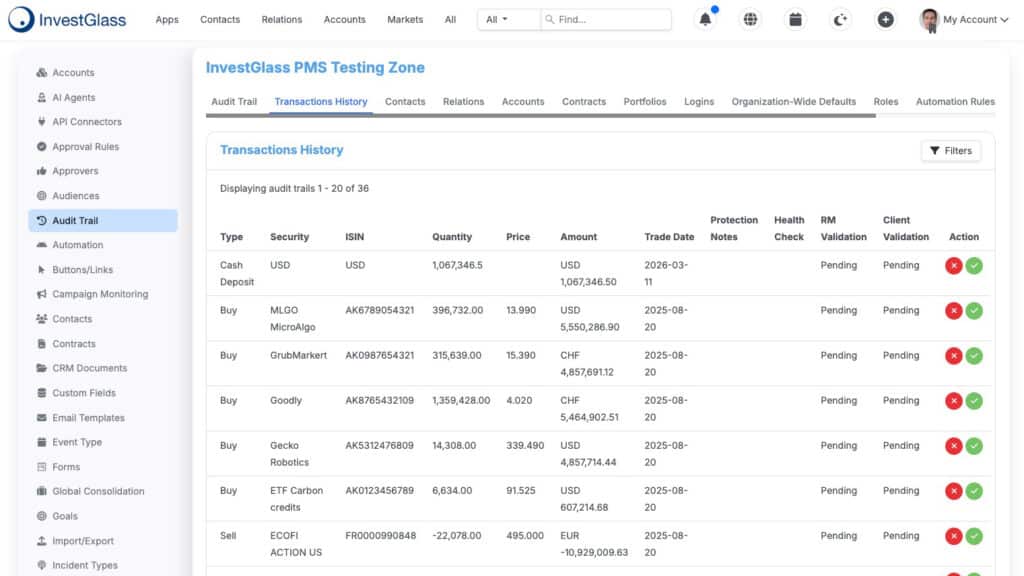
By the end, you’ll understand how streamlining compliance with InvestGlass not only reduces risks and saves time but also positions your organization for operational excellence in an evolving regulatory landscape.
Quick Answer: How does InvestGlass automate compliance?
InvestGlass provides a sovereign Swiss platform that centralizes CRM, KYC automation, and AML monitoring in a single platform for compliance management. It automates client record creation by generating unique IDs and checking for duplicates, enforces security through Role-Based Access Control (RBAC) and MFA, and utilizes AI-driven rules and systems that enable efficient compliance management to detect structuring patterns in transactions, facilitating seamless SAR filing to MROS.
Compliance automation and compliance management are both integral to streamlining compliance. Automation and centralization are key to efficiency, as they reduce manual effort, prevent human error, and ensure all compliance information is accessible in one place for better transparency and collaboration.
These features enable efficient compliance management for organizations, supporting the broader goal of streamlining compliance processes to reduce risks, save time, and achieve operational excellence.
Why Compliance Automation Matters in 2026
Why should you care about automating your compliance workflows?
In the rapidly evolving regulatory landscape of 2026, manual compliance processes are no longer just inefficient they represent a significant challenge and a major source of compliance challenges for organizations. Manual processes make it difficult to keep up with complex regulatory requirements, increasing the risk of errors and non-compliance. Financial institutions in Switzerland and globally face increasing pressure from regulators like FINMA to maintain rigorous standards for KYC (Know Your Customer) and AML (Anti-Money Laundering).
Key reasons why streamlining compliance matters:
- Operational efficiency: Automation reduces manual work, accelerates onboarding, and improves data accuracy.
- Risk reduction: Centralized data and real-time monitoring help identify and mitigate risks before they escalate.
- Regulatory alignment: Automated workflows ensure consistent adherence to evolving regulatory requirements.
From our experience at InvestGlass, we’ve seen firsthand how automation transforms these hurdles into competitive advantages by dramatically improving efficiency. By integrating digital onboarding with automated risk assessment, firms can reduce human error, speed up client acquisition, and ensure a bulletproof audit trail. This guide explores the three pillars of a secure financial operation: client creation, internal authorization, and transaction monitoring.
With the importance of compliance automation established, let’s explore how InvestGlass streamlines each pillar of compliance management, starting with client record creation.
Pillar 1: The Client Record Creation Process
How do you ensure a compliant and efficient client onboarding journey?
The journey begins the moment an application is received. Whether it’s via a web form, mobile app, or a referral, the transition from a lead to a verified client must be seamless and documented. In the modern financial landscape, the “first impression” is often digital. A clunky, manual onboarding process can lead to high abandonment rates, whereas a streamlined, automated one builds immediate trust.
Digital onboarding and smart forms not only accelerate the process but also ensure data accuracy and accuracy in client information, reducing the risk of errors and supporting compliance requirements. The system provides easy access to client records and compliance documentation for authorized users, enabling quick retrieval of essential information whenever needed.
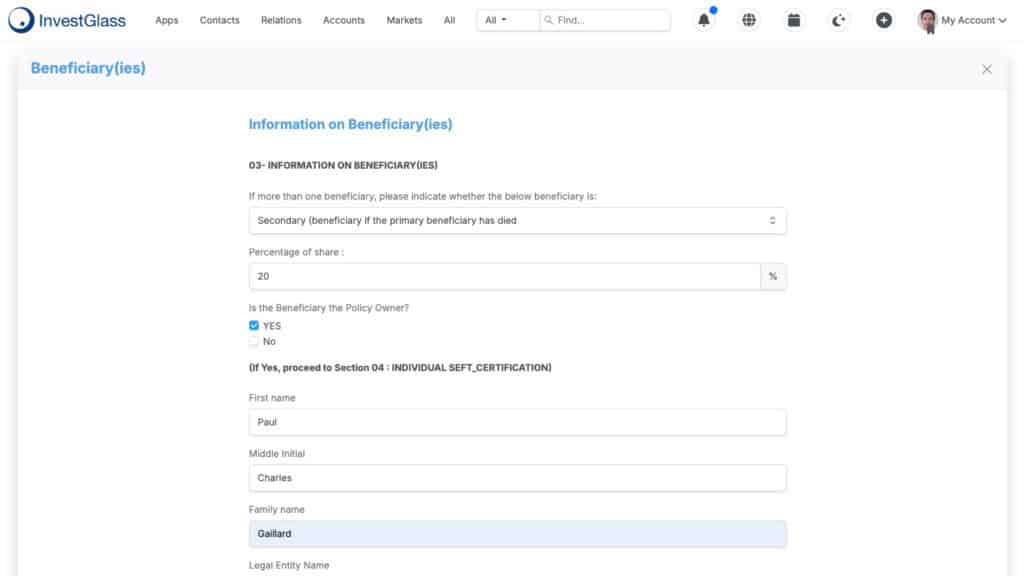
Triggering the Digital Onboarding
What happens when a new application arrives?
- When a prospect submits their details, the InvestGlass “New Request” module automatically captures the pre-filled data. This includes essential information such as name, email, and client type (individual or legal entity).
- By using digital onboarding forms, firms eliminate manual data entry and ensure that all required fields are collected from the start.
- This initial stage is critical for establishing the “Customer Identification Program” (CIP), which is the first step in any robust KYC framework.
From our experience, the use of smart forms that adapt based on user input significantly improves data quality. For example, if a user selects “Legal Entity,” the form can dynamically request additional fields like “Country of Incorporation” or “Tax Identification Number,” ensuring that the compliance team has all the necessary information before they even open the file.
Automated CRM Actions
How does the CRM handle initial data processing?
Once the request is in the system, InvestGlass performs several automated actions that would otherwise take hours of manual work:
- Unique ID Generation: A unique Client ID (e.g., CH-2024-XXXXX) is assigned immediately. This ID serves as the primary key for all future transactions, communications, and compliance checks, ensuring a “single source of truth.”
- Duplicate Checks: The system scans for existing records by email, phone, or company name to prevent data fragmentation. This is vital for maintaining a clean database and preventing “siloed” information that could hide potential risks.
- Draft Creation: A “Draft” entry is created with a “Pending Documentation” status. This ensures that every lead is tracked and that the compliance team has a clear view of the onboarding pipeline.
These automated procedures consolidate compliance steps into a centralized process, ensuring consistency and transparency throughout onboarding and supporting regulatory compliance.
Categorization and KYC Checklists
How are different risk levels managed?
The operator selects the client category Retail, SME, or Corporate. InvestGlass then automatically applies the appropriate KYC checklist. These checklists can also be tailored to specific industry requirements, ensuring that unique regulatory needs for each sector are addressed:
- Retail: Simplified verification for low-risk individuals. This typically involves basic ID verification and a check against PEP (Politically Exposed Persons) and sanctions lists.
- SME: Standard checks including beneficial ownership. For small businesses, it’s crucial to identify the “Ultimate Beneficial Owner” (UBO) to comply with AML regulations.
- Corporate: Enhanced Due Diligence (EDD) for complex legal entities. This involves a deep dive into the company’s structure, source of wealth, and business activities, often requiring more extensive documentation and senior management sign-off.
Resource Allocation and Task Management
How is the workload distributed?
The system automatically assigns a Relationship Manager (RM) based on territory or language (e.g., a Zurich-based client is assigned to a German-speaking RM). This ensures that the client receives personalized service from someone who understands their local context and language. Simultaneously, it creates a series of time-bound tasks to keep the process moving:
- Document Collection: 5-day deadline. This includes requesting passports, utility bills, and corporate certificates.
- Identity Verification: 10-day deadline. This often involves integrating with third-party providers for biometric checks or video identification.
- Risk Assessment: 15-day deadline. The final step where the compliance officer reviews all gathered information and assigns a final risk score to the client.

By automating these tasks, InvestGlass optimizes the use of operational resources and enables seamless collaboration across departments, ensuring compliance workflows are streamlined and efficient. The system sends automated reminders to both the RM and the client if deadlines are approaching, significantly reducing the “time-to-onboard.”
| Process Step | Action | InvestGlass Tool |
| Trigger | Web Form Submission | Digital Forms & Portals |
| Identification | Unique ID & Duplicate Check | InvestGlass CRM |
| Compliance | KYC Checklist Application | Automation Rules Engine |
| Assignment | RM Allocation | Workflow Automation |
With client onboarding streamlined and compliance steps automated, the next critical area is ensuring that only authorized employees have access to sensitive data. Let’s move to employee authorization and access control.
Pillar 2: Employee Authorization and Access Control
Security isn’t just about keeping hackers out; it’s about ensuring that employees only have access to the data they need to perform their roles. In the financial sector, internal data breaches can be just as damaging as external ones. InvestGlass provides a comprehensive suite of tools to manage internal authorization and ensure that sensitive client information is always protected. Robust access control not only strengthens risk management by reducing internal threats, but also ensures adherence to internal compliance policies and regulatory requirements.
Role-Based Access Control (RBAC)
What is RBAC and why is it essential?
InvestGlass utilizes a robust Role-Based Access Control system. When a new employee, such as a Junior KYC Analyst, starts, their account is configured with specific rights. For example, they may have “Read” access to all client KYC fields but “No Access” to transaction details or pricing. This “Principle of Least Privilege” is a cornerstone of modern cybersecurity, ensuring that even if an account is compromised, the potential damage is limited.
Implementing RBAC is one of the key practices for effective compliance management, as it embeds regulatory adherence into daily operations and supports a culture of excellence.
From our experience, RBAC is not just about security; it’s also about productivity. By only showing employees the data and tools they need for their specific job, you reduce clutter and help them focus on their core tasks. A KYC analyst doesn’t need to see marketing data, and a relationship manager doesn’t need to see deep compliance logs.
Advanced Security Restrictions
What additional layers of protection are available?
Beyond roles, InvestGlass enforces environmental restrictions that are critical for maintaining a secure perimeter:
- IP Whitelisting: Access is restricted to the office network or a corporate VPN. This prevents employees from logging in from unsecured public Wi-Fi or other unauthorized locations.
- Time Restrictions: Access can be limited to business hours (e.g., 07:00 20:00 CET). This is a powerful deterrent against unauthorized access during off-hours, which is often when suspicious activity occurs.
- Multi-Factor Authentication (MFA): TOTP authenticators are required for every login, providing a critical second layer of security. We recommend using Swiss-made apps for an extra layer of sovereignty and trust.
These security measures enable continuous monitoring of access and activity, supporting proactive oversight and helping organizations stay ahead of regulatory changes to maintain compliance.
The Approval Workflow
How are access requests managed?
Access isn’t granted automatically. A request is sent to a Team Lead or Compliance Officer for approval. Only after this digital sign-off is the account activated. This ensures that every user on the platform has been vetted and authorized by management. This workflow is fully documented, providing a clear record of who authorized whom and when.
Session Management and Audit Trails
How do you monitor user activity?
To comply with FINMA requirements, InvestGlass maintains a detailed and immutable audit trail. Every action from viewing a record to editing a document is logged. This level of transparency is essential for demonstrating compliance during regulatory audits. Furthermore, the system features automatic logout after 15 minutes of inactivity and can block suspicious activity, alerting the security team instantly. This proactive approach to security ensures that your firm is always one step ahead of potential threats. These robust audit trails and security measures directly support operational excellence in compliance management by streamlining processes and reducing risk.
With employee access tightly controlled and monitored, the next step is to ensure that all financial transactions are continuously monitored for suspicious activity. Let’s examine how InvestGlass streamlines AML transaction monitoring and SAR reporting.
Pillar 3: AML Transaction Monitoring and SAR Reporting
How do you detect and report financial crime effectively?
Anti-Money Laundering (AML) is a continuous process of monitoring and investigation. In the age of digital finance, the volume of transactions is too high for manual monitoring. Technology now plays a crucial role in streamlining compliance, enabling continuous compliance through real-time monitoring and automated reporting. InvestGlass provides an AI-powered transaction monitoring platform that helps financial institutions stay ahead of money launderers and other financial criminals.
Detecting Structuring Patterns
What triggers an AML alert?
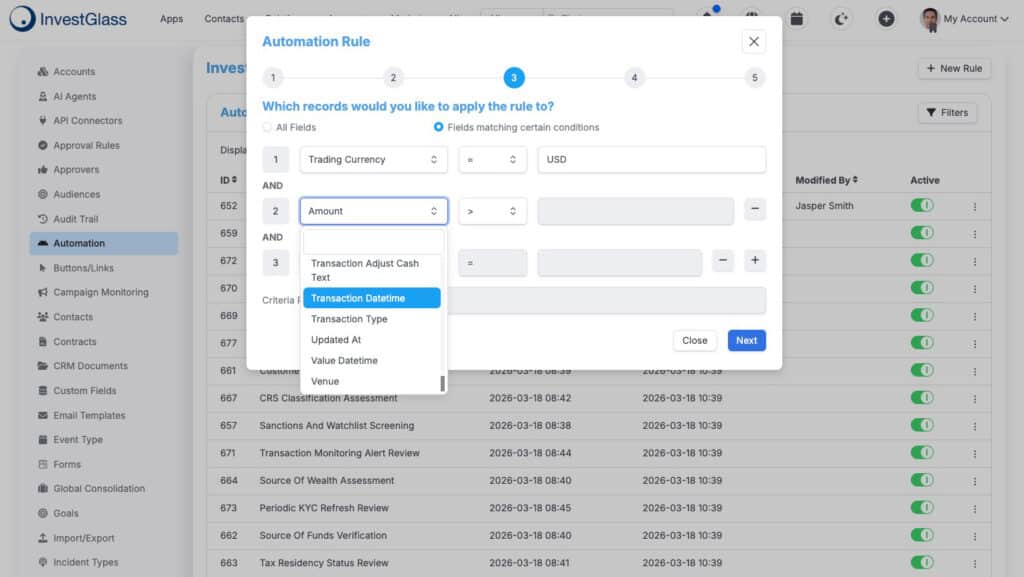
The InvestGlass monitoring system uses AI-driven rules to detect suspicious patterns, such as “Structuring.” For instance, if a retail client makes four cash deposits of CHF 9,800 within two weeks, the system flags this as an attempt to avoid the CHF 10,000 reporting threshold (Art. 9 AMLA). These rules are highly configurable, allowing firms to tailor their monitoring to their specific risk profile and regulatory requirements. AI-driven rules also significantly improve the accuracy of identifying suspicious patterns, reducing false positives and ensuring compliance teams focus on genuine risks.
From our experience, the ability to detect these patterns in real-time is a game-changer. It allows compliance teams to act quickly, potentially preventing further illicit activity before it can do more damage.
The Investigation Workflow
What happens after an alert is generated?
- The operator opens the alert in the CRM to view a comprehensive dashboard of information:
- Transaction Graphs: A timeline visualization of the activity, making it easy to spot patterns and anomalies.
- Client History: A sudden change from low to high activity is highlighted, providing critical context for the investigation.
- Evidence: Photos from surveillance cameras (for cash deposits) or linked documents are readily available.
- If the initial assessment confirms the suspicion, a linked AML Case is created for a detailed investigation. This case management system ensures that all findings, communications, and decisions are documented in one place.
Client Communication and Document Evaluation
How is the investigation conducted?
- The operator requests information from the client regarding the source of funds. This is a delicate process that must be handled professionally.
- If the client’s explanation (e.g., “sold a car”) is inconsistent with the deposited amounts or dates (e.g., the sale price was CHF 45,000 but CHF 49,500 was deposited), the operator concludes the explanation is not credible.
- InvestGlass facilitates this communication through secure portals, ensuring that all interactions are logged and stored securely.
Filing a Suspicious Activity Report (SAR)
How is the report submitted to MROS?
When suspicious activity is confirmed, a Suspicious Activity Report (SAR) must be filed with MROS (Swiss FIU). InvestGlass automates this process by:
- Generating the SAR form in the required FINMA format, ensuring that all necessary fields are correctly filled.
- Allowing the operator to complete the narrative description of the suspicious behavior.
- Facilitating electronic submission via a secure channel, such as the goAML system.
Post-Filing Actions
What happens after the SAR is filed?
- The client is not notified of the SAR, as “tipping off” is prohibited by law.
- The account remains active but with restrictions, such as a block on cash deposits or enhanced monitoring.
- A quarterly review is assigned to ensure that the risk is ongoingly managed.
- If MROS requests more information, the CRM provides quick access to the entire case file, allowing for a rapid and accurate response.
These ongoing reviews and management actions are essential for maintaining compliance with AML regulations, helping organizations stay aligned with evolving legal requirements and industry standards. This end-to-end automation ensures that your firm remains compliant with the highest standards of AML regulation.
With AML monitoring and reporting streamlined, let’s explore the strategic advantages of using a sovereign Swiss compliance platform like InvestGlass.
The Strategic Advantage of Sovereign Swiss Compliance
Why is “Sovereign Swiss” more than just a marketing term?
In an era of global data surveillance and increasing geopolitical uncertainty, where your data is stored and who has access to it matters more than ever. InvestGlass is a uniquely “Sovereign Swiss” platform, meaning it is built, hosted, and managed entirely within Switzerland. This provides a level of data protection and regulatory alignment that non-Swiss platforms simply cannot match.
InvestGlass enables organizations to meet regulatory demands and effectively navigate complex regulatory landscapes by offering advanced compliance management tools.
Data Privacy and the Swiss Advantage
How does Swiss hosting protect your firm?
Switzerland has some of the world’s strongest data privacy laws, including the Federal Act on Data Protection (FADP). By hosting your compliance data on a sovereign Swiss platform, you ensure that it is protected from foreign subpoenas and data requests that might affect cloud providers based in other jurisdictions. For financial institutions, this is not just a matter of privacy; it’s a matter of legal necessity. Strong data privacy laws also help build customer trust, reassuring clients that their sensitive information is handled securely and in compliance with the highest standards.
Alignment with FINMA and MROS
Because InvestGlass is based in Switzerland, our tools are designed from the ground up to align with the specific requirements of Swiss regulators like FINMA and MROS. From the format of our SAR reports to the logic of our KYC checklists, everything is tailored to the Swiss regulatory environment. This reduces the need for complex customizations and ensures that you are always in sync with local laws. This close alignment with regulatory standards fosters compliance excellence, enabling financial institutions to maintain high standards and continuously improve their compliance management practices.
Building Trust with Clients
How does sovereignty impact the client experience?
Clients today are more aware of data privacy than ever before. When you can tell your clients that their sensitive financial and personal data is stored on a sovereign Swiss platform, it builds immediate trust. It demonstrates that you take their privacy seriously and that you have chosen the most secure and compliant tools available to manage their wealth.
Now that you understand the strategic benefits of a sovereign Swiss platform, let’s address some frequently asked questions about InvestGlass and compliance automation.
Frequently Asked Questions (FAQs)
- How does InvestGlass handle duplicate client records?
- InvestGlass automatically scans for duplicates using email, phone numbers, and company names. When a new request is created, the system cross-references this data against the existing database. If a match is found, the operator is alerted, preventing the creation of redundant records and ensuring data integrity across the platform.
- InvestGlass automatically scans for duplicates using email, phone numbers, and company names. When a new request is created, the system cross-references this data against the existing database. If a match is found, the operator is alerted, preventing the creation of redundant records and ensuring data integrity across the platform.
- What is the difference between simplified and enhanced KYC?
- Simplified KYC is used for low-risk clients, while enhanced KYC (EDD) is for high-risk or complex entities. InvestGlass automates this by applying different checklists based on the client category (Retail vs. Corporate). Enhanced Due Diligence involves deeper investigation into the source of wealth and beneficial ownership structures.
- Simplified KYC is used for low-risk clients, while enhanced KYC (EDD) is for high-risk or complex entities. InvestGlass automates this by applying different checklists based on the client category (Retail vs. Corporate). Enhanced Due Diligence involves deeper investigation into the source of wealth and beneficial ownership structures.
- Can I restrict employee access to specific times of the day?
- Yes, InvestGlass allows administrators to set time-based access restrictions. For example, you can limit system access to standard business hours, such as 07:00 to 20:00 CET. This reduces the risk of unauthorized access during off-hours and is a key feature of the platform’s security suite.
- Yes, InvestGlass allows administrators to set time-based access restrictions. For example, you can limit system access to standard business hours, such as 07:00 to 20:00 CET. This reduces the risk of unauthorized access during off-hours and is a key feature of the platform’s security suite.
- What is “Structuring” in AML monitoring?
- Structuring is the practice of breaking down large transactions into smaller ones to avoid reporting thresholds. In Switzerland, transactions over CHF 10,000 often require identification. InvestGlass uses automated rules to detect patterns where multiple smaller deposits are made in a short period to circumvent these rules.
- Structuring is the practice of breaking down large transactions into smaller ones to avoid reporting thresholds. In Switzerland, transactions over CHF 10,000 often require identification. InvestGlass uses automated rules to detect patterns where multiple smaller deposits are made in a short period to circumvent these rules.
- How does InvestGlass support SAR filing to MROS?
- InvestGlass automates the generation of SAR forms in the required FINMA format. The platform captures all relevant transaction data and investigation notes, allowing compliance officers to submit reports electronically to the Money Laundering Reporting Office Switzerland (MROS) through secure channels.
- InvestGlass automates the generation of SAR forms in the required FINMA format. The platform captures all relevant transaction data and investigation notes, allowing compliance officers to submit reports electronically to the Money Laundering Reporting Office Switzerland (MROS) through secure channels.
- Is Multi-Factor Authentication (MFA) mandatory in InvestGlass?
- While configurable, InvestGlass strongly recommends and supports mandatory MFA for all users. By requiring a TOTP (Time-based One-Time Password) from a Swiss-made app or other authenticators, the platform ensures that a compromised password alone is not enough to gain access to sensitive data.
- While configurable, InvestGlass strongly recommends and supports mandatory MFA for all users. By requiring a TOTP (Time-based One-Time Password) from a Swiss-made app or other authenticators, the platform ensures that a compromised password alone is not enough to gain access to sensitive data.
- How are Relationship Managers assigned to new clients?
- InvestGlass uses automation rules to assign Relationship Managers based on criteria like territory and language. This ensures that a client in Zurich is automatically paired with a German-speaking RM, while a client in Geneva is assigned to a French-speaking one, optimizing the client experience from day one.
- InvestGlass uses automation rules to assign Relationship Managers based on criteria like territory and language. This ensures that a client in Zurich is automatically paired with a German-speaking RM, while a client in Geneva is assigned to a French-speaking one, optimizing the client experience from day one.
- What happens if an employee’s IP address is not whitelisted?
- If an employee attempts to log in from an unauthorized IP address, the system will block the access attempt. InvestGlass allows firms to whitelist specific office IPs or corporate VPNs, ensuring that sensitive financial data can only be accessed from secure, approved locations.
- If an employee attempts to log in from an unauthorized IP address, the system will block the access attempt. InvestGlass allows firms to whitelist specific office IPs or corporate VPNs, ensuring that sensitive financial data can only be accessed from secure, approved locations.
- Does InvestGlass provide an audit trail for FINMA audits?
- Yes, InvestGlass maintains a comprehensive and immutable audit trail of all user actions. This includes every record viewed, edited, or deleted. This level of transparency is essential for demonstrating compliance during regulatory audits by FINMA or other governing bodies.
- Yes, InvestGlass maintains a comprehensive and immutable audit trail of all user actions. This includes every record viewed, edited, or deleted. This level of transparency is essential for demonstrating compliance during regulatory audits by FINMA or other governing bodies.
- Can InvestGlass detect suspicious activity in real-time?
- Yes, the InvestGlass rules engine monitors transactions as they occur to flag suspicious patterns. By setting specific thresholds and behavioral triggers, the system can generate instant alerts for compliance teams, allowing for rapid response and investigation of potential financial crimes.
With these FAQs addressed, let’s summarize how streamlining compliance with InvestGlass delivers tangible benefits for your organization.
Conclusion: The Future of Sovereign Swiss Compliance
The integration of InvestGlass into your compliance workflow does more than just satisfy regulators; it builds trust with your clients and protects your firm’s reputation. By automating the client record creation process, enforcing strict employee authorization, and maintaining vigilant AML monitoring, you create a resilient operation capable of thriving in the complex financial world of 2026.
Key benefits of streamlining compliance with InvestGlass:
- Reduces risks by automating detection and reporting of suspicious activity.
- Saves time by eliminating manual data entry and repetitive tasks.
- Achieves operational excellence through centralized data, real-time monitoring, and robust audit trails.
As we’ve explored in this guide, the key to successful compliance is not just having the right rules, but having the right tools to enforce them. Automation reduces the burden on your compliance team, allowing them to focus on high-value investigations rather than manual data entry. Meanwhile, robust security controls and a sovereign Swiss foundation ensure that your data is always protected and your firm is always in alignment with the law.
The future of finance is digital, and the future of compliance is automated. By choosing InvestGlass, you are not just choosing a software provider; you are choosing a partner dedicated to your firm’s success and security in the Swiss financial landscape.
Ready to transform your compliance process and experience the power of sovereign Swiss automation? Contact InvestGlass today to see our tools in action and discover how we can help you build a more secure and efficient operation.
Final Thoughts
Embracing technology and implementing innovative strategies are essential for organizations aiming to stay ahead of new regulations and avoid the risks of non-compliance. Moving away from traditional methods and automating repetitive tasks enables leading firms to streamline compliance management.
In summary:
- Streamlining compliance processes is essential for reducing risks, saving time, and achieving operational excellence.
- Modern compliance technology solutions like InvestGlass focus on automation, centralized data, and real-time compliance monitoring, which are key improvements in compliance management efficiency.
- These ongoing efforts not only enhance operational efficiency but also ensure that compliance processes are resilient, proactive, and aligned with industry best practices.
By adopting these approaches, organizations can transform compliance into a strategic advantage and maintain operational efficiency in an evolving regulatory environment.


