In today’s competitive landscape, a well-executed marketing campaign is no longer a luxury it’s a necessity. For businesses aiming to achieve sustainable growth, a strategic marketing campaign is the engine that drives lead generation, customer acquisition, and brand loyalty. However, with the ever-increasing number of marketing channels and technologies, creating a campaign that truly resonates with your target audience and delivers measurable results can be a daunting task. This is where a powerful marketing automation platform like InvestGlass can make all the difference.
This comprehensive guide will walk you through the essential steps of creating a high-impact marketing campaign, from initial planning to post-campaign analysis. We will explore how you can leverage the advanced features of InvestGlass to streamline your workflow, personalise your messaging, and maximise your return on investment (ROI). Whether you are a seasoned marketing professional or just starting, this article will provide you with the knowledge and tools you need to create marketing campaigns that produce tangible results.
What You’ll Learn:
•The fundamentals of modern marketing and the importance of a customer-centric approach.
•The key features of InvestGlass and how they can be used to create successful marketing campaigns.
•A step-by-step guide to creating a high-impact marketing campaign, from planning to execution and analysis.
•Best practices for creating personalised, mobile-friendly campaigns that drive results.
•The answers to frequently asked questions about marketing campaigns.
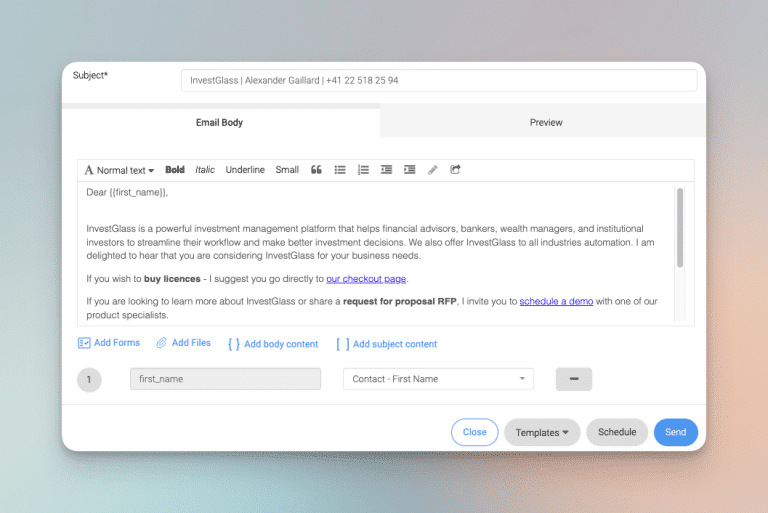
InvestGlass AI Email Writer
Understanding the Modern Marketing Landscape
The marketing landscape has undergone a seismic shift in recent years. The rise of digital technologies has empowered consumers, giving them more control over the content they consume and the brands they interact with. To succeed in this new era of marketing, businesses must adopt a customer-centric approach, focusing on building meaningful relationships with their audience. This means delivering personalised experiences, providing valuable content, and engaging with customers on their preferred channels.
At the same time, the proliferation of marketing technologies has created a wealth of opportunities for businesses to automate their marketing efforts, gain deeper insights into their customers, and optimise their campaigns for better performance. However, with so many tools available, it can be challenging to choose the right ones and integrate them into a cohesive marketing strategy. This is where an all-in-one platform like InvestGlass comes in, providing a unified solution for managing all aspects of your marketing campaigns.
The Rise of Marketing Automation
Marketing automation has become an indispensable tool for modern businesses. According to recent research, companies that use marketing automation see a 451% increase in qualified leads compared to those that do not. This is because automation allows businesses to nurture leads at scale, delivering the right message to the right person at the right time, without the need for manual intervention.
The benefits of marketing automation extend beyond lead generation. By automating repetitive tasks such as email sending, social media posting, and lead scoring, marketing teams can free up valuable time to focus on more strategic activities, such as content creation and campaign optimisation. This not only improves efficiency but also leads to better results.
The Importance of Data-Driven Marketing
In the age of big data, marketing decisions should be based on data, not intuition. Data-driven marketing allows businesses to gain a deeper understanding of their customers, identify trends and patterns, and make informed decisions that lead to better outcomes. By leveraging data, marketers can create more targeted campaigns, personalise their messaging, and optimise their strategies for maximum impact. Companies using data-driven marketing often see a 5–8 times increase in ROI.
InvestGlass provides powerful analytics tools and reporting capabilities that make it easy to collect, analyse, and act on data. With InvestGlass, you can track key metrics such as open rates, click-through rates, and conversion rates, and use this data to continuously improve your campaigns.
The Power of InvestGlass for Marketing Campaigns
InvestGlass is more than just a CRM; it’s a complete sales and marketing automation platform designed to help businesses of all sizes grow and succeed. With its comprehensive suite of tools, InvestGlass CRM for financial services empowers marketers to create, manage, and optimise their campaigns from a single, centralised platform. Here are some of the key features that make InvestGlass the ideal solution for your marketing campaigns:
Why Choose InvestGlass Over Other Platforms?
There are many marketing automation platforms on the market, so why should you choose InvestGlass? Here are a few reasons:
Swiss Data Sovereignty: InvestGlass is a Swiss-based company, which means your data is stored in Switzerland and is subject to Swiss data protection laws. This provides an extra layer of security and privacy for your business and your customers.
All-in-One Solution: Unlike many other platforms that require you to use multiple tools to manage your marketing campaigns, InvestGlass provides everything you need in one place. From CRM and email marketing to automation and analytics, InvestGlass has you covered.
Ease of Use: InvestGlass is designed to be user-friendly, even for those who are not tech-savvy. With its intuitive interface and drag-and-drop functionality, you can create and launch campaigns in minutes, without the need for any coding or technical expertise.
Scalability: Whether you are a small business or a large enterprise, InvestGlass can scale to meet your needs. With flexible pricing plans and a modular architecture, you can start small and grow as your business grows, from startups to private banks and wealth managers.
A Step-by-Step Guide to Creating a High-Impact Marketing Campaign with InvestGlass
Now that you have a better understanding of the power of InvestGlass, let’s dive into the step-by-step process of creating a high-impact marketing campaign that drives results.
Step 1: Define Your Campaign Goals and KPIs
Before you launch any marketing campaign, it’s crucial to define your goals, clear marketing objectives, and key performance indicators (KPIs). What do you want to achieve with your campaign, and how will your marketing objectives support broader business objectives? Are you looking to increase brand awareness, generate leads, drive sales, or something else? Increasing website traffic by 20% is one example of a marketing objective. Once you have a clear understanding of your goals, you can identify the KPIs that you will use to measure your success.
Some common marketing KPIs include:
By setting clear goals and KPIs from the outset, you will be able to track your progress, measure your success, and make data-driven decisions to optimise your campaign for better results.
Step 2: Identify and Segment Your Target Audience
Once you have defined your goals, the next step is to identify and segment your target audience. Who are you trying to reach with your campaign within your target market, and which potential customers matter most? What are their needs, pain points, and motivations? Market research helps gather data on customer preferences and customer behavior before segmentation, and in regulated industries this often includes streamlined KYC verification automation as part of the onboarding process. The more you know about your target audience, the better you will be able to create a campaign that resonates with them.
InvestGlass makes it easy to segment your audience based on a variety of criteria, including, for example, specialised segments such as patients in Swiss dental practices:
Demographics: Age, gender, location, income, education level, and occupation are all examples of demographic criteria that can be used to segment your audience. For example, if you are selling luxury products, you may want to target high-net-worth individuals (HNWIs). Learn more about what HNWIs means.
Psychographics: Interests, values, lifestyle, and personality traits are examples of psychographic criteria. Understanding the psychographics of your audience can help you create messaging that resonates on a deeper level.
Behaviour: Past purchases, website activity, email engagement, and social media interactions are examples of behavioural criteria. By analysing behaviour using customer data, you can identify patterns and predict future actions, whether you are targeting retail customers or patients in Swiss therapy practices.
By segmenting your audience, you can create highly targeted campaigns that deliver personalised messages to each segment, and segmentation informed by emerging trends can improve campaign relevance. This can lead to a significant increase in engagement and conversions. In fact, marketers who use segmented campaigns report as much as a 760% increase in revenue.
Step 3: Craft a Compelling Message and Offer
Once you have identified your target audience, the next step is to craft a compelling message and offer. For effective marketing campaigns, both need to align closely with what your audience actually wants and needs. What do you want to say to your audience? What is your unique value proposition? Your message should be clear, concise, and persuasive. It should also be tailored to the specific needs and interests of your target audience.
Your offer is what you are giving your audience in exchange for their time and attention. It could be a free trial, a discount, a white paper, or something else. Whatever it is, make sure it is valuable and relevant to your target audience.
Tips for Crafting a Compelling Message:
1.Focus on benefits, not features. Instead of listing the features of your product or service, focus on the benefits that your audience will receive and how consistent value-led messaging can support customer loyalty over time. How will your product or service improve their lives?
2.Use clear and simple language. Avoid jargon and technical terms that your audience may not understand. Use clear and simple language that is easy to read and understand.
3.Create a sense of urgency. Encourage your audience to take action now by creating a sense of urgency. This could be a limited-time offer, a countdown timer, or a scarcity message.
4.Include a clear call to action (CTA). Tell your audience exactly what you want them to do next. Whether it’s signing up for a free trial, downloading a white paper, or making a purchase, make sure your CTA is clear and prominent.
Step 4: Choose Your Marketing Channels
Once you have crafted your message and offer, the next step is to choose your marketing channels. Where will you reach your target audience? There are a variety of channels within digital marketing to choose from, each with its own strengths and weaknesses.
Email Marketing: Email marketing is one of the most effective marketing channels, with an average ROI of EUR36 for every EUR1 spent. It is a great way to nurture leads, build relationships with customers, and drive conversions. Our automatic email sender software can help you get started.
Social Media: Social media platforms like Facebook, Twitter, LinkedIn, and Instagram are great for reaching a large audience and engaging with your customers. They are also effective for building brand awareness and driving traffic to your website. social media ads are especially useful when you need precise audience targeting based on demographics, interests, or behavior.
Content Marketing: Content marketing involves creating and sharing valuable content, such as blog posts, white papers, and videos, to attract and retain a clearly defined audience. It is a long-term strategy that can help establish your brand as a thought leader in your industry, as high-quality content also builds authority and fosters trust.
Paid Advertising: Paid advertising platforms like Google Ads and Facebook Ads allow you to reach a large audience quickly and easily. They are effective for driving traffic, generating leads, and increasing sales. search engine optimization can complement paid campaigns by improving long-term visibility.
SMS Marketing: SMS marketing is a highly effective channel for reaching customers on their mobile devices. With open rates as high as 98%, SMS is a great way to deliver time-sensitive messages and promotions.
InvestGlass supports a wide range of marketing channels, allowing you to create integrated campaigns that reach your customers on their preferred channels. search engine optimization seo, influencer marketing, and other tactics should be chosen based on your target audience and campaign goals.
Step 5: Create and Launch Your Campaign
Once you have chosen your marketing channels, the next step is to create and launch your campaign. This is where you will bring your marketing plan and preparation to life. With InvestGlass, you can easily create and launch your campaigns from a single, centralised platform.
Here are some of the things you will need to do when creating your campaign:
Create your content: This includes your email copy, social media posts, blog posts, and any other content you will be using in your campaign. Make sure your content is engaging, informative, and aligned with your brand voice. An effective marketing strategy turns those assets into coordinated execution.
Design your creative: This includes your images, videos, and any other visual elements you will be using in your campaign. Visual content is more engaging than text alone, so make sure to invest in high-quality visuals.
Set up your automation: This includes your email autoresponders, social media scheduling, and any other automation you will be using in your campaign. Automation allows you to deliver the right message to the right person at the right time, without the need for manual intervention. Integrating multi-channel lead capture can funnel new leads into CRM automatically.
Test your campaign: Before you launch your campaign, make sure to test it thoroughly. Send test emails, check your links, and preview your content on different devices to ensure everything looks and works as expected.
Once you have created and tested your campaign, it’s time to launch it, with organised execution supporting business growth. With InvestGlass, you can easily launch your campaigns with the click of a button.
Step 6: Track and Analyse Your Results
Once your campaign is live, it’s important to track and analyse your results. This will help you to see what’s working and what’s not, so you can make data-driven decisions and turn analytics into actionable insights to optimise your campaign for better results. InvestGlass provides detailed analytics and reporting on all aspects of your marketing campaigns, making it easy to track your performance, measure your success, and support customer satisfaction tracking where relevant.
Here are some of the things you should be tracking:
Your KPIs: Are you on track to meet your goals? If not, what adjustments can you make to improve your performance?
Your engagement metrics: How are people interacting with your content? Are they opening your emails, clicking on your links, and sharing your posts?
Your conversion metrics: Are people taking the desired action? If not, what barriers are preventing them from converting?
Campaign analysis should also review customer acquisition costs to evaluate channel efficiency and support revenue growth.
By tracking and analysing your results, you can make informed decisions to improve your campaign and achieve your goals as part of a successful marketing strategy, in the same way that AI-driven portfolio management strategies use continuous data analysis to optimise performance.
Email Marketing Best Practices
Email marketing remains one of the most effective marketing channels, with an average ROI of EUR36 for every EUR1 spent. However, to get the most out of your email marketing campaigns, you need to follow best practices. Here are some tips to help you create successful email marketing campaigns:
1. Build a Quality Email List
The foundation of any successful email marketing campaign is a quality email list. Focus on building a list of subscribers who have opted in to receive your emails and are genuinely interested in your products or services. Avoid purchasing email lists, as this can lead to low engagement rates and damage your sender reputation.
2. Segment Your Audience
As mentioned earlier, segmentation is key to creating targeted and relevant email campaigns. By segmenting your audience based on demographics, behaviour, and engagement history, you can deliver personalised messages that resonate with each segment.
3. Write Compelling Subject Lines
Your subject line is the first thing your recipients will see, so make it count. A compelling subject line should be clear, concise, and intriguing. It should also be relevant to the content of your email and create a sense of urgency or curiosity.
4. Personalise Your Emails
Personalisation goes beyond just using the recipient’s name. Use dynamic content to personalise your emails based on the recipient’s preferences, behaviour, and past interactions with your brand, including data from customer relationship management systems. Personalised emails have been shown to generate 6x higher transaction rates than non-personalised emails.
5. Optimise for Mobile
With 41% of all email views coming from mobile devices, it’s essential to optimise your emails for mobile. Use a responsive design that adapts to different screen sizes, and keep your content concise and easy to read on a small screen.
6. Test and Optimise
A/B testing is a powerful way to optimise your email campaigns. Test different subject lines, content, CTAs, and send times to see what works best for your audience. Use the results to continuously improve your campaigns.
Marketing Automation Workflows
Marketing automation workflows are a series of automated actions that are triggered by specific events or behaviours. They allow you to nurture leads, engage customers, and drive conversions without the need for manual intervention. Here are some examples of marketing automation workflows that you can create with InvestGlass:
Welcome Series
A welcome series is a sequence of emails that are sent to new subscribers to introduce them to your brand and set expectations for future communications. A typical welcome series might include:
1.A welcome email thanking the subscriber for signing up and providing an overview of what they can expect.
2.An email introducing your products or services and highlighting key benefits.
3.An email with a special offer or discount to encourage the subscriber to make their first purchase.
Lead Nurturing
Lead nurturing workflows are designed to move leads through the sales funnel by providing them with relevant content and offers at each stage of their journey. For example:
1.A lead downloads a white paper from your website.
2.They receive a follow-up email with additional resources related to the topic of the white paper.
3.A few days later, they receive an email inviting them to a webinar or demo.
AI-powered lead scoring tools can identify high-intent prospects and prioritise follow-up.
4.If they attend the webinar, they receive a follow-up email with a special offer.
Re-Engagement
Re-engagement workflows are designed to win back inactive subscribers or customers. For example:
1.A subscriber hasn’t opened an email in 90 days.
2.They receive an email asking if they’re still interested in receiving communications.
3.If they don’t respond, they receive a final email with a special offer to encourage them to re-engage.
4.If they still don’t respond, they are removed from the active list.
These workflows also support customer retention by bringing inactive contacts back into the funnel.
Compliance and Data Protection
When running marketing campaigns, it’s essential to comply with data protection regulations such as the General Data Protection Regulation (GDPR) in Europe and the CAN-SPAM Act in the United States. Failure to comply with these regulations can result in significant fines and damage to your reputation.
GDPR Compliance
The GDPR is a comprehensive data protection law that applies to any company that processes the personal data of EU citizens, regardless of where the company is based. Key requirements of the GDPR include:
Consent: You must obtain explicit consent from individuals before collecting and processing their personal data. This means using clear and unambiguous opt-in mechanisms, rather than pre-ticked boxes.
Right to Access: Individuals have the right to request access to their personal data and to know how it is being used.
Right to Erasure: Individuals have the right to request that their personal data be deleted.
Data Portability: Individuals have the right to receive their personal data in a structured, commonly used, and machine-readable format.
InvestGlass is designed with GDPR compliance in mind, providing tools and features that make it easy to manage consent, respond to data subject requests, and ensure the security of personal data.
CAN-SPAM Compliance
The CAN-SPAM Act is a US law that sets rules for commercial email. Key requirements include:
Don’t use false or misleading header information. Your “From,” “To,” and “Reply-To” information must be accurate.
Don’t use deceptive subject lines. Your subject line must accurately reflect the content of your email.
Identify the message as an advertisement. You must clearly disclose that your message is an advertisement.
Include your physical address. Your email must include your valid physical postal address.
Provide an opt-out mechanism. You must provide a clear and conspicuous way for recipients to opt out of receiving future emails.
Honour opt-out requests promptly. You must process opt-out requests within 10 business days.
Measuring Campaign Success
Measuring the success of your marketing campaigns is essential for understanding what’s working and what’s not. By tracking key metrics and analysing your results, you can make data-driven decisions to optimise your campaigns and improve your ROI.
Key Metrics to Track
Using Analytics to Improve Your Campaigns
InvestGlass provides comprehensive analytics and reporting tools that make it easy to track your campaign performance. Use these tools to:
Identify trends and patterns. Look for trends in your data that can help you understand what’s working and what’s not.
Test and optimise. Use A/B testing to experiment with different elements of your campaigns and see what performs best.
Segment your audience. Use your data to create more targeted segments and deliver more personalised messages.
Adjust your strategy. Based on your analysis, make adjustments to your strategy to improve your results.
Best Practices for High-Impact Marketing Campaigns
In addition to the steps outlined above, there are a number of best practices that you should follow to create high-impact marketing campaigns with an effective marketing strategy tied to your long-term business strategy:
Personalise your campaigns: Personalisation is key to success in modern marketing. Use dynamic content to personalise your messages and create a unique experience for each customer. According to research, 71% of consumers expect companies to deliver personalised interactions.
A/B test your campaigns: A/B testing involves creating two versions of your campaign and testing them to see which one performs better. This is a great way to optimise your campaigns for better results.
Use a clear and concise call to action (CTA): Your CTA is what you want people to do next. Make sure it is clear, concise, and easy to find.
Make sure your campaigns are mobile-friendly: More and more people are accessing the internet from their mobile devices. Make sure your campaigns are optimised for mobile to provide a good user experience. In fact, 41% of all email views come from mobile devices.
Focus on quality over quantity: It’s better to send fewer, more targeted emails than to bombard your audience with irrelevant messages. Focus on delivering value with every communication, and use disciplined marketing investments plus a realistic marketing budget to prioritise the highest-performing activities.
Maintain a consistent brand voice: Your brand voice should be consistent across all channels and touchpoints. This helps build trust and recognition with your audience, and aligning the marketing team around shared standards improves execution quality.
By following these best practices, you can create high-impact marketing campaigns that drive results. Stronger execution can also help increase market share over time.
Conclusion
Creating a high-impact marketing campaign is essential for any business that wants to succeed in today’s competitive landscape. By following the steps and best practices outlined in this guide, you can create campaigns that resonate with your target audience, drive results, and help you achieve your business goals. And with a powerful marketing automation platform like InvestGlass, you can streamline your workflow, personalise your messaging, and maximise your ROI.
Ready to take your marketing campaigns to the next level? Get started with InvestGlass today!
Frequently Asked Questions (FAQs)
1. What is a marketing campaign?
A marketing campaign is a coordinated series of steps intended to achieve a specific goal, such as raising awareness of a new product or generating leads for the sales team. Campaigns typically use a variety of marketing channels, including email, social media, and content marketing, to reach their target audience.
2. Why are marketing campaigns important?
Marketing campaigns are important because they help businesses to achieve their goals, such as increasing brand awareness, generating leads, and driving sales. A well-executed marketing campaign can also help businesses to build relationships with their customers and create a loyal following.
3. What are the key elements of a successful marketing campaign?
The foundation of a successful marketing strategy is a clear goal, a well-defined target audience, a compelling message and offer, a mix of marketing channels, and a system for tracking and analysing results.
4. How can InvestGlass help me with my marketing campaigns?
InvestGlass is a powerful marketing automation platform that can help you to create, manage, and optimise your marketing campaigns. With its comprehensive suite of tools, InvestGlass can help you to automate your marketing tasks, segment your audience, personalise your messaging, and track your results.
5. What are some common marketing campaign mistakes to avoid?
Some common marketing campaign mistakes to avoid include not having a clear goal, not knowing your target audience, not having a compelling message or offer, not using a mix of marketing channels, and not tracking your results.
6. How do I measure the success of my marketing campaigns?
You can measure the success of your marketing campaigns by tracking your KPIs. Some common marketing KPIs include website traffic, conversion rate, cost per acquisition (CPA), and return on investment (ROI).
7. What is the difference between a marketing campaign and a marketing strategy?
A marketing strategy is a high-level plan within your broader business strategy that outlines your overall marketing goals and how you will achieve them. A marketing campaign is a specific set of actions that serves as the execution layer of an effective marketing strategy to achieve a specific goal within your overall marketing strategy.
8. How long should a marketing campaign last?
The length of a marketing campaign will vary depending on your goals and your industry. Some campaigns may last for a few weeks, while others may last for several months, depending on your resources, channel complexity, and available business acumen.
9. How much should I spend on a marketing campaign?
The amount you should spend on a marketing campaign will vary depending on your goals, expected ROI, and customer acquisition costs. Set a clear marketing budget that aligns with your business objectives and available marketing investments. However, it is important to remember that marketing is an investment, not an expense. A well-executed marketing campaign can generate a significant return on investment.
10. What are some examples of successful marketing campaigns?
There are many examples of successful marketing campaigns. Some well-known examples include Nike’s “Just Do It” campaign, Apple’s “Get a Mac” campaign, and Dove’s “Real Beauty” campaign.
References
[1] Email marketing ROI: Average return on email marketing
[2] Campaign Monitor: The New Rules of Email Marketing
[3] HubSpot: 2025 Marketing Statistics, Trends & Data
[4] Annuitas Group: Marketing Automation Study
[5] Experian: Email Marketing Study
[6] McKinsey: Unlocking the next frontier of personalized marketing
Conclusion
Creating a high-impact marketing campaign that drives results requires a clear marketing strategy grounded in thorough market research and a deep understanding of your target audience. By leveraging InvestGlass’s all-in-one platform, you can streamline your marketing initiatives, personalise customer interactions, and gain valuable insights to optimise your campaigns continuously. Implementing a data-driven approach and focusing on customer lifetime value will help you build lasting relationships and drive repeat business. With InvestGlass, you gain a competitive advantage through seamless social media management, automation workflows, and robust analytics, all while ensuring compliance and data security. Start harnessing the power of InvestGlass today to transform your marketing campaigns into measurable business growth.