
What happens when one of the world’s most trusted financial systems faces a shock? How should banks prepare when liquidity can vanish overnight? And are Swiss financial institutions truly ready for the next regulatory era?
The Swiss financial sector, renowned globally for its stability and precision, is undergoing a profound regulatory transformation. In the wake of recent market turbulences, including the unprecedented events surrounding Credit Suisse in 2023, the Swiss Financial Market Supervisory Authority (FINMA) has significantly tightened its grip on liquidity risk management. At the heart of this regulatory evolution is the Ordinance on the Liquidity of Banks and Securities Firms, commonly referred to as the Liquidity Ordinance (LiqO) or OLICO (Ordonnance sur les liquidités).
For banks and securities firms operating within Switzerland, achieving and maintaining OLICO compliance is no longer merely a regulatory checkbox; it is a fundamental pillar of operational resilience and strategic viability. The introduction of the new LiqO-FINMA, expected to enter into force on 1 January 2027, elevates previous guidelines into legally enforceable mandates, demanding a more structured, integrated, and forward-looking approach to liquidity and funding planning.
This comprehensive guide explores the intricacies of OLICO compliance, the evolving regulatory landscape in Switzerland, and how modern technological solutions, such as a Swiss sovereign CRM, can empower financial institutions to navigate these complex requirements with confidence and efficiency.
What You Will Learn
In this article, you will gain a thorough understanding of the Swiss Liquidity Ordinance (OLICO/LiqO), including its fundamental principles, quantitative and qualitative requirements, the impact of the new LiqO-FINMA, how these regulations dictate specific software and IT infrastructure requirements, the strategic challenges banks face, and how InvestGlass provides a comprehensive automated solution for achieving seamless regulatory compliance.
Understanding OLICO: The Swiss Liquidity Ordinance
The Ordinance on the Liquidity of Banks and Securities Firms (SR 952.06), enacted by the Swiss Federal Council on 30 November 2012 and in force since 1 January 2013, establishes the legal foundation for liquidity risk management in the Swiss financial sector. Its primary objective is to ensure that banks and account-holding securities firms maintain sufficient liquidity to meet their payment obligations at all times, even under severe stress conditions.
Switzerland’s financial sector accounts for 9.1% of GDP (CHF 72 billion), employs approximately 200,000 people, and is a global leader in cross-border wealth management. In 2023, there were 230 banks with around 110,000 full-time equivalents operating in the country. Given the sector’s systemic importance, the regulatory framework governing liquidity must be both comprehensive and adaptable to evolving market conditions.
The Core Principles of Liquidity Management
According to Article 2 of the Ordinance, every bank must maintain a sufficient and sustainable liquidity reserve to protect against short-term deteriorations in liquidity while ensuring appropriate medium- to long-term funding. This principle is operationalised through a combination of qualitative management requirements and strict quantitative metrics.
The regulatory framework is built upon the principle of proportionality, as outlined in Article 5. Depending on their size, complexity, and risk profile, institutions are required to appropriately manage their liquidity risk at both the individual entity and financial group levels. This means that while systemically important banks face rigorous, extensive planning discussions with FINMA, smaller institutions in categories 4 and 5 under the Banking Ordinance may adopt simplified approaches, provided they maintain regulatory compliance.
The proportionality principle is a defining characteristic of the Swiss approach. It recognises that a one-size-fits-all framework would be both impractical and counterproductive, potentially stifling innovation and competition among smaller institutions while failing to adequately address the systemic risks posed by larger, more complex organisations. FINMA has consistently emphasised that proportionality does not mean reduced vigilance; rather, it means that the tools and methodologies employed should be commensurate with the institution’s risk profile.
Qualitative Requirements: Governance, Risk Mitigation, and Internal Controls
OLICO mandates robust governance structures for liquidity risk management. Banks must explicitly define their liquidity risk tolerance and establish strategies consistent with this threshold. Crucially, institutions must account for liquidity costs and risks across all material on- and off-balance sheet business activities, particularly when pricing products, introducing new offerings, or measuring revenue.
Risk Measurement and Management Systems form the backbone of qualitative compliance. Article 7 of the Ordinance requires banks to establish appropriate processes for identifying, assessing, managing, and monitoring liquidity risk. This includes the creation of detailed liquidity statements for various time horizons, as well as the identification and management of liquidity risk across the financial group, legal entities, business areas, and currencies that are of significance. Banks must also take into account any legal, regulatory, and operational limitations to the transferability of liquidity between entities.
Intraday Liquidity Monitoring is another critical requirement. Article 7(3) mandates that banks identify, manage, and monitor intraday liquidity risk to ensure that payment and settlement obligations are never compromised. The ability to demonstrate real-time visibility into intraday cash flows is essential for meeting this obligation.
Asset Encumbrance monitoring, as specified in Article 7(4), requires banks to monitor the assets used to generate liquidity, distinguishing clearly between encumbered and unencumbered assets. Institutions must be able to show at all times where assets are held and how they can be liquidated in a timely manner. This transparency is vital for both internal risk management and regulatory reporting.
Stress Testing requirements, detailed in Article 9, demand that banks develop diverse stress scenarios and perform regular stress tests of their liquidity situation. These scenarios must encompass institution-specific, market-wide, and combined causes and factors, covering different time horizons and varying degrees of severity. Notably, the scenarios must include the possibility of a loss of unsecured funding combined with restrictions on secured funding, a scenario that proved devastatingly real during the Credit Suisse crisis.
For banks in categories 4 and 5, the Ordinance provides a simplified approach, requiring them to use exclusively the stress scenario stipulated in Article 12(1) for stress testing purposes. This proportional treatment reduces the compliance burden on smaller institutions while maintaining a minimum standard of resilience.
Contingency Funding Plans, as mandated by Article 10, require each bank to develop comprehensive strategies for addressing liquidity shortfalls. These plans must define responsibilities, communication channels, and necessary measures in appropriate form within internal regulations and directives. The contingency funding plan must pay particular attention to the stress scenarios and the results of the stress tests, ensuring that the institution is prepared to respond effectively to a liquidity crisis.
Quantitative Requirements: LCR and NSFR
The quantitative backbone of OLICO compliance rests on two internationally recognised metrics introduced under the Basel III framework: the Liquidity Coverage Ratio (LCR) and the Net Stable Funding Ratio (NSFR).
| Metric | Primary Objective | Time Horizon | Minimum Requirement |
| Liquidity Coverage Ratio (LCR) | Ensures banks hold sufficient High-Quality Liquid Assets (HQLA) to survive a significant stress scenario. | 30 days | 100% (HQLA must equal or exceed total net cash outflows) |
| Net Stable Funding Ratio (NSFR) | Promotes resilience by requiring banks to fund activities with sufficiently stable sources. | 1 year | 100% (Available Stable Funding must equal or exceed Required Stable Funding) |
The LCR, defined in Article 12 of the Ordinance, is designed to ensure that banks maintain an adequate stock of unencumbered HQLA that can be converted into cash at little or no loss of value in private markets. The ratio is calculated by dividing the total stock of HQLA by the total net cash outflows over a 30-calendar-day stress period. Banks must maintain this ratio at or above 100% at all times.
The NSFR complements the LCR by addressing medium- to long-term funding stability. It requires banks to maintain a stable funding profile in relation to their on- and off-balance sheet activities. The ratio is calculated by dividing the Available Stable Funding (ASF) by the Required Stable Funding (RSF). A minimum ratio of 100% ensures that institutions do not overly rely on short-term wholesale funding to finance long-term, illiquid assets.
These metrics are designed to prevent the maturity mismatches that historically led to bank runs. The Credit Suisse crisis of 2023 demonstrated the devastating consequences of a loss of confidence, where what began as a reputational crisis rapidly escalated into a full-scale liquidity emergency, ultimately necessitating government intervention and the bank’s acquisition by UBS.
Reporting Obligations and Supervisory Expectations
OLICO imposes stringent reporting obligations on financial institutions. Systemically important banks are required to submit their liquidity reports to the Swiss National Bank (SNB) on a monthly basis within 15 calendar days of the last calendar day of the month. These reports must provide a comprehensive view of the institution’s liquidity position, including detailed breakdowns of HQLA, cash inflows, cash outflows, and the resulting LCR.
FINMA retains broad supervisory powers under the Ordinance. It may require banks to provide additional information, conduct supplementary stress tests, or implement specific measures to address identified vulnerabilities. The regulator’s approach is risk-based, meaning that institutions with higher risk profiles or identified weaknesses will be subject to more intensive supervision.
The Evolving Regulatory Landscape: The New LiqO-FINMA
The Swiss regulatory environment is not static. Following the implementation of the final Basel III standards, which entered into force on 1 January 2025 with the first reporting date on 31 March 2025, FINMA has continued to refine its supervisory approach. A significant development is the introduction of the new Ordinance on the Liquidity of Banks and Securities Firms (LiqO-FINMA).
On 3 July 2025, FINMA initiated a consultation on this new ordinance, which will replace the previous FINMA-Circular 15/02 “Liquidity: Banks”. The consultation period ran until 29 September 2025, and the new regulation is expected to enter into force on 1 January 2027. This transition is not merely administrative; it elevates existing supervisory guidance into legally enforceable provisions, reflecting a broader regulatory shift aimed at enhancing the resilience of Swiss banks in the face of liquidity stress.
Key Enhancements in the New Framework
The new LiqO-FINMA introduces stringent requirements in two critical areas that address gaps identified in the current regulatory framework.
Liquidity and Funding Planning is the first major area of enhancement. The ordinance formalises expectations for forward-looking liquidity and funding resilience through specific technical implementation provisions. Each institution must maintain a written liquidity and funding plan tailored to its specific business model, size, complexity, and risk profile. This plan must demonstrate the bank’s ability to meet both regulatory and internal liquidity and funding requirements over a three-year horizon. Crucially, the plan must be closely aligned with strategic planning, earnings targets, and the budgeting process, and must be explicitly integrated with capital planning.
Information Provision During Stress is the second critical enhancement. To strengthen FINMA’s ability to intervene rapidly during crises, the ordinance specifies the form, frequency, and quality requirements for information and scenario analyses that banks must provide in the event of actual or expected stress situations. This includes the capability to generate daily liquidity reports and detailed stress scenario data on demand. The Credit Suisse crisis underscored the importance of timely and accurate information flow between supervised institutions and the regulator.
Furthermore, banks with material foreign currency liabilities are now explicitly required to address potential currency mismatches and the associated liquidity risks within their planning frameworks. This requirement reflects the reality that many Swiss banks operate internationally and are exposed to significant foreign exchange risks that can amplify liquidity pressures during periods of market stress.
FINMA’s Organisational Response: Integrated Risk Expertise
In parallel with the regulatory reforms, FINMA has reorganised its internal structure to enhance supervisory effectiveness. Since April 2025, the regulator has centralised risk functions and cross-cutting issues, including liquidity, capital, stress tests, credit risks, anti-money laundering, and sustainable finance, into a new business area called “Integrated Risk Expertise” (GB-I). This pooling of expertise strengthens integrated supervision and enables FINMA to take a more holistic view of the risks facing individual institutions and the financial system as a whole.
The Federal Council’s Package for Banking Stability
The regulatory evolution extends beyond FINMA’s ordinances. In June 2025, the Federal Council proposed a comprehensive package to prevent liquidity crises and increase the stability of systemically important banks. The package includes measures to increase capital requirements, strengthen liquidity through the assistance of the Swiss National Bank, create a public liquidity backstop (PLB) functioning as a state guarantee on liquidity assistance during a crisis, expand the range of available crisis management tools, and introduce changes to the variable remuneration and responsibility regime of senior managers. These legislative projects are expected to enter into force in January 2027 at the earliest.

How OLICO Compliance Applies to Software and Technology
The transition from manual compliance processes to automated, technology-driven frameworks is no longer optional under the new LiqO-FINMA regime. For financial institutions, the software and IT infrastructure they deploy must meet stringent regulatory requirements to ensure real-time liquidity monitoring, data integrity, and rapid reporting capabilities.
When evaluating how OLICO compliance applies to software, institutions must consider several critical technological dimensions:
1. Real-Time Data Architecture and Integration
The most significant technological shift driven by OLICO is the move from end-of-day batch processing to real-time data architecture. Software systems must be capable of monitoring intraday positions across multiple payment systems, currencies, and legal entities simultaneously.
This requires an API-first architecture that can seamlessly integrate with legacy core banking systems, treasury management platforms, and external market data feeds. The software must aggregate this disparate data into a single source of truth, enabling sub-second processing capabilities to track cash positions, collateral, and daily payment flows accurately. Without this integrated data architecture, banks cannot meet the intraday liquidity monitoring requirements stipulated in Article 7(3) of the Ordinance.
2. Automated Stress Testing and Scenario Analysis
Under the new LiqO-FINMA, banks must project their liquidity and funding resilience over a three-year horizon under various stress scenarios. Software solutions must therefore incorporate advanced computational engines capable of running complex, multi-variable stress tests.
These systems must automate the calculation of the Liquidity Coverage Ratio (LCR) and Net Stable Funding Ratio (NSFR) under both baseline and stressed conditions. Furthermore, the software should leverage predictive analytics and machine learning algorithms to identify emerging liquidity risks, such as potential currency mismatches or the sudden devaluation of specific asset classes, allowing risk managers to take proactive corrective actions.
3. Rapid Regulatory Reporting and Auditability
The requirement to provide daily liquidity reports during stress events places immense pressure on a bank’s reporting infrastructure. Compliance software must feature automated reporting pipelines that can generate FINMA-compliant reports on demand, without manual intervention.
Crucially, the software must maintain an immutable, timestamped audit trail of all data inputs, calculations, and reporting outputs. This ensures that the institution can demonstrate to regulators exactly how a specific liquidity metric was derived at any given moment, providing the transparency required during supervisory reviews.
4. 24/7 Operational Monitoring and Exception Handling
As financial markets operate globally and continuously, liquidity management software must support 24/7 operational models. This involves providing real-time dashboards that offer risk managers immediate visibility into the bank’s liquidity posture.
The software must include sophisticated exception handling and alert mechanisms. If a specific liquidity threshold is breached or an intraday payment flow deviates from expected patterns, the system must automatically trigger alerts to the relevant personnel, ensuring that issues are addressed immediately rather than at the end of the business day.
5. Data Sovereignty and Security Compliance
For Swiss financial institutions, liquidity management software must not only meet OLICO requirements but also adhere to the strict data protection standards of the revised Federal Act on Data Protection (FADP) and Swiss banking secrecy laws.
Software solutions must offer robust cybersecurity protections against unauthorized access and data breaches. More importantly, the deployment model, whether on-premise or via a Swiss sovereign cloud, must guarantee that sensitive financial and client data remains within the Swiss jurisdiction, preventing exposure to foreign regulatory frameworks or hyperscalers.
Strategic Challenges in Achieving OLICO Compliance
Transitioning to the enhanced requirements of the new LiqO-FINMA presents several strategic and operational challenges for financial institutions of all sizes.
Integrating Strategic Planning Processes
Historically, many banks managed liquidity planning, capital planning, and budgeting in isolated silos. The new regulations demand a coherent, integrated framework where liquidity and funding planning is embedded within the broader strategic planning process. Evaluating the impact of business strategy changes on a bank’s liquidity and funding profile requires cross-functional collaboration between treasury, risk management, finance, and business units. This integration often necessitates significant governance and operational process changes, as well as the establishment of cross-functional working groups responsible for strategic planning.
Enhancing Stress Testing Methodologies
The requirement to assess the robustness of the funding mix under relevant stress scenarios over a three-year horizon demands a thorough review and enhancement of existing stress testing methodologies. Banks must ensure that their strategic planning processes consider all relevant risks, including macroeconomic shifts, geopolitical tensions, interest rate movements, and institution-specific vulnerabilities. The linkage between a bank’s risk tolerance and its liquidity and funding plan, while already established under FINMA-Circular 17/01 “Corporate Governance: Banks”, becomes more concrete and important under the new framework.
Data Management and Reporting Capabilities
Perhaps the most significant operational hurdle is the requirement for rapid, high-quality information provision. The ability to produce daily liquidity reports and detailed scenario analyses during a crisis demands exceptional data quality, automated reporting pipelines, and robust IT infrastructure. Manual processes and fragmented legacy systems are no longer sufficient to meet these rigorous supervisory expectations. Banks must invest in technology that can aggregate data from multiple sources, perform complex calculations in real time, and generate reports that meet FINMA’s exacting standards.
Defining the Role of the Risk Control Function
With the new and explicit requirements under LiqO-FINMA, the role of the risk control function in the liquidity and funding planning exercise becomes more concrete and important. Banks must determine how the risk control function can be involved effectively in the planning process, ensuring adequate challenge and independent oversight without creating bottlenecks that impede operational efficiency.
Managing Currency Mismatches
For banks with significant international operations, the explicit requirement to address currency mismatches adds another layer of complexity. Institutions must develop sophisticated models to assess the impact of foreign exchange movements on their liquidity positions and ensure that adequate buffers are maintained in each material currency. This requires access to real-time market data and the ability to run scenario analyses across multiple currencies simultaneously.
How InvestGlass Empowers OLICO Compliance
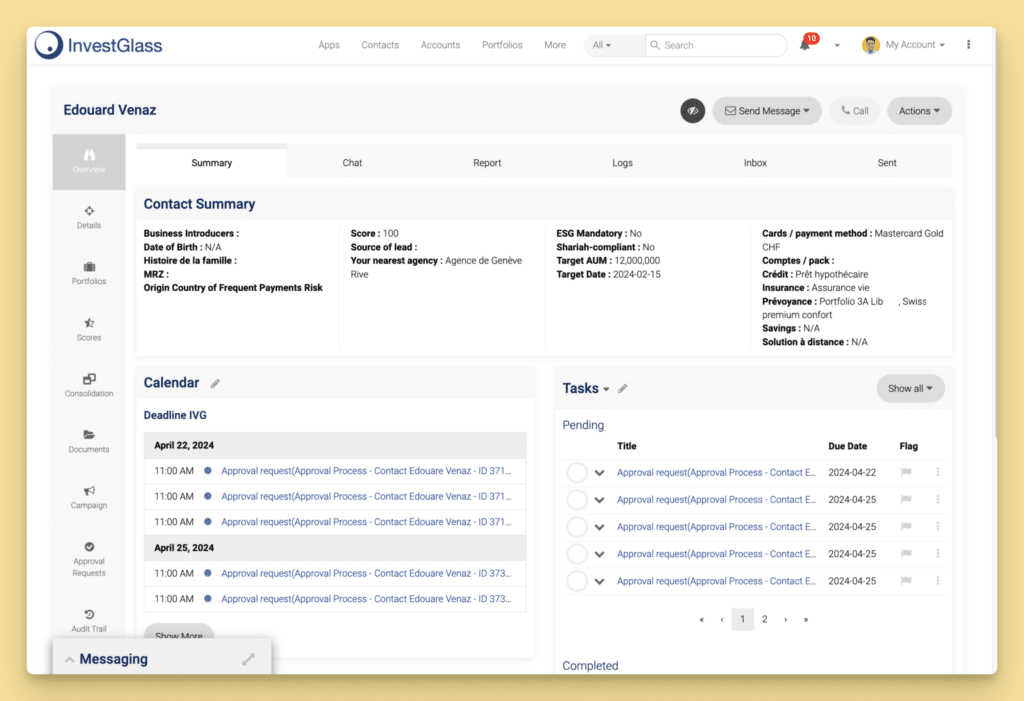
Navigating the complexities of OLICO compliance requires more than just policy updates; it requires a technological foundation capable of delivering real-time insights, automated workflows, and unassailable data integrity. InvestGlass, a 100% Swiss sovereign CRM and automation platform, is uniquely positioned to help financial institutions meet these stringent regulatory demands.
A Swiss Sovereign Solution for Data Privacy and Sovereignty
In an era where data sovereignty is paramount, InvestGlass offers a distinct advantage. Hosted entirely in Switzerland or available on-premise, the platform ensures that sensitive client and liquidity data remains under strict Swiss data protection laws, including the revised Federal Act on Data Protection (FADP) that came into force on 1 September 2023. This sovereign infrastructure addresses the cross-border data transfer constraints and banking secrecy requirements that private banks face, providing a secure environment for managing compliance documentation.
The importance of data sovereignty cannot be overstated. High-net-worth individuals and institutional investors demand the highest levels of confidentiality and security. By demonstrating a steadfast commitment to protecting their data within Swiss jurisdiction, banks can differentiate themselves in a highly competitive market. InvestGlass enables institutions to leverage AI-assisted compliance and portfolio supervision without sending sensitive data to foreign hyperscalers, a critical consideration for institutions subject to Swiss banking secrecy laws.
Centralised Data and Integrated Risk Management
InvestGlass serves as the central repository for all client data, KYC documentation, risk assessments, and advisory interactions. By eliminating fragmented systems, the platform provides compliance officers, relationship managers, and risk teams with a single, consistent view of the institution’s risk profile. This centralised approach directly supports the integrated planning framework demanded by the new LiqO-FINMA.
The platform’s Portfolio Management capabilities offer real-time data tracking and compliance checks. It provides a comprehensive view of positions and risks, enabling institutions to zero in on exposures across every portfolio. This holistic visibility is crucial for monitoring asset encumbrance and managing intraday liquidity risks as mandated by OLICO. The ability to distinguish between encumbered and unencumbered assets in real time, and to demonstrate how assets can be liquidated, is a core compliance requirement that InvestGlass addresses through its integrated data architecture.
Automating Compliance Workflows and Regulatory Reporting
To meet the demanding reporting requirements of the new LiqO-FINMA, automation is essential. InvestGlass features robust Automation and Approval processes that streamline compliance tasks and reduce the operational burden on compliance teams.
Automated Audit Trails are a cornerstone of the platform’s compliance capabilities. Every interaction, decision, and document exchange is meticulously logged with timestamps, creating an immutable audit trail that simplifies FINMA or SRO inspections. This comprehensive documentation ensures that institutions can demonstrate compliance on demand, a critical capability during periods of heightened regulatory scrutiny.
Customisable Reporting enables the automated generation of complex regulatory reports. The platform’s data aggregation capabilities allow banks to produce the daily liquidity reports and scenario data required during stress events, transforming what was previously a labour-intensive manual process into an automated, reliable workflow. Reports can be tailored to meet the specific requirements of different regulatory bodies, including FINMA and the SNB.
AI-Assisted Compliance represents the cutting edge of regulatory technology. InvestGlass leverages AI in Regulatory Compliance to automate processes, reduce human error, and provide real-time monitoring. The platform’s AI capabilities can identify potential compliance issues before they escalate, enabling proactive risk management rather than reactive remediation. Crucially, because InvestGlass is a sovereign solution, all AI processing occurs within the Swiss data perimeter, ensuring that sensitive financial data is never exposed to foreign jurisdictions.
Streamlined Digital Onboarding and KYC
Effective liquidity risk management begins at the client level. Accurate client data is the foundation upon which all risk models and compliance processes are built. InvestGlass excels in Digital Onboarding, offering guided KYC/AML forms, suitability questionnaires, and a white-label client portal with e-signature capabilities.
By automating risk assessments during onboarding, institutions can accurately classify client risk profiles from day one, ensuring that the foundational data feeding into liquidity models is accurate and compliant. This automated approach eliminates the manual errors and data inconsistencies that plague institutions relying on spreadsheets and disconnected systems.
Supporting FINMA’s Behavioural Duties and Broader Compliance
OLICO compliance does not exist in isolation. Financial institutions must simultaneously meet a wide range of regulatory obligations, including FINMA’s behavioural duties, the Swiss Financial Services Act (FinSA), anti-money laundering requirements, and data protection regulations. InvestGlass is designed to support this comprehensive compliance landscape through a single, integrated platform.
The platform’s FINSA implementation capabilities ensure that suitability assessments, product governance, and client documentation requirements are seamlessly integrated with broader compliance workflows. This holistic approach reduces the risk of compliance gaps and ensures that institutions can demonstrate adherence to multiple regulatory frameworks simultaneously.
Aligning with FINMA’s Integrated Risk Expertise
FINMA’s recent centralisation of risk functions into the “Integrated Risk Expertise” (GB-I) division underscores the regulator’s holistic approach to supervision. InvestGlass mirrors this integrated philosophy. By combining CRM, portfolio management, and compliance monitoring into a single platform, InvestGlass enables banks to align their internal processes with FINMA’s supervisory expectations, facilitating smoother regulatory interactions and demonstrating a proactive commitment to risk management.
Building a Future-Proof Compliance Framework
The regulatory landscape governing liquidity risk in Switzerland will continue to evolve. Trade conflicts, geopolitical tensions, rising government debt in key markets, and the increasing complexity of IT systems all contribute to an environment of heightened risk. Financial institutions that invest in scalable, adaptable compliance infrastructure today will be better positioned to navigate the challenges of tomorrow.
The Role of Technology in Regulatory Evolution
The transition from FINMA-Circular 15/02 to the legally enforceable LiqO-FINMA represents a broader trend towards the codification of supervisory expectations. As regulations become more prescriptive, the demand for technology solutions that can automate compliance processes, aggregate data in real time, and generate reports on demand will only intensify.
InvestGlass is committed to continuously innovating and expanding its platform’s capabilities to stay ahead of regulatory developments. Whether it is adapting to new reporting requirements, integrating emerging technologies, or expanding support for new regulatory frameworks, InvestGlass provides a solid foundation for sustainable compliance.
Practical Steps for Institutions
Financial institutions seeking to strengthen their OLICO compliance posture should consider the following practical steps:
| Step | Description | InvestGlass Capability |
| Gap Assessment | Evaluate current liquidity and funding planning frameworks against new LiqO-FINMA requirements. | Comprehensive compliance monitoring and reporting tools to identify gaps. |
| Integrated Planning | Develop an integrated strategic planning framework linking liquidity, capital, and budget planning. | Centralised data repository with cross-functional visibility. |
| Stress Testing Enhancement | Review and enhance stress scenarios to cover a three-year horizon with multiple risk factors. | AI-assisted scenario analysis and real-time data aggregation. |
| Reporting Automation | Implement automated reporting pipelines for daily liquidity reports and regulatory submissions. | Customisable reporting engine with automated audit trails. |
| Data Sovereignty | Ensure all compliance data is hosted within Swiss jurisdiction or on-premise. | 100% Swiss sovereign hosting with on-premise deployment option. |
| Cross-Functional Governance | Establish clear roles and responsibilities for the risk control function in planning processes. | Role-based access controls and approval workflows. |
Conclusion
The regulatory landscape governing liquidity risk in Switzerland is becoming increasingly rigorous. The transition from guidance to the legally enforceable LiqO-FINMA ordinance underscores the critical importance of robust, forward-looking liquidity and funding planning. For Swiss banks and securities firms, OLICO compliance is a strategic imperative that demands integrated processes, enhanced stress testing, and superior data management capabilities.
InvestGlass provides the comprehensive, automated, and sovereign technological infrastructure required to meet these challenges head-on. By centralising data, automating compliance workflows, and providing real-time risk visibility, InvestGlass empowers financial institutions to not only achieve regulatory compliance but to transform it into a competitive advantage. In a market where trust, transparency, and resilience are the ultimate differentiators, the right technology partner can make all the difference.
To discover how InvestGlass can streamline your compliance processes and fortify your institution’s operational resilience, explore our CRM for Financial Services or learn more about meeting international compliance standards today.
Frequently Asked Questions (FAQs)
1. What does OLICO stand for in Swiss banking regulation?
OLICO refers to the Ordonnance sur les liquidités, which is the French term for the Ordinance on the Liquidity of Banks and Securities Firms (Liquidity Ordinance, LiqO). It is the primary legal framework governing liquidity requirements for financial institutions in Switzerland, codified under SR 952.06.
2. What are the main objectives of the Liquidity Ordinance (LiqO)?
The primary objective of LiqO is to ensure that banks and account-holding securities firms maintain sufficient liquidity to meet their payment obligations at all times, including during severe stress situations. It establishes both qualitative governance requirements and quantitative metrics (LCR and NSFR) to prevent liquidity crises and bank runs.
3. What is the Liquidity Coverage Ratio (LCR) and why does it matter?
The LCR is a quantitative requirement mandating that banks hold a sufficient stock of unencumbered High-Quality Liquid Assets (HQLA) to cover their total net cash outflows over a 30-day stress scenario. The minimum requirement is 100%. It matters because it ensures that banks can withstand short-term liquidity shocks without requiring external assistance.
4. How does the Net Stable Funding Ratio (NSFR) differ from the LCR?
While the LCR focuses on short-term (30-day) liquidity resilience, the NSFR addresses medium- to long-term funding stability. It requires banks to maintain a stable funding profile in relation to their on- and off-balance sheet activities over a one-year horizon, ensuring they do not overly rely on short-term wholesale funding.
5. What is the new LiqO-FINMA and how does it change the regulatory landscape?
The new LiqO-FINMA is an updated ordinance that replaces the previous FINMA-Circular 15/02 “Liquidity: Banks”. It elevates existing supervisory guidance into legally enforceable provisions, introducing stricter requirements for liquidity and funding planning over a three-year horizon and enhanced information provision during stress events, including daily liquidity reporting capabilities.
6. When is the new LiqO-FINMA expected to enter into force?
Following the consultation period initiated on 3 July 2025 and running until 29 September 2025, the new LiqO-FINMA regulation is expected to enter into force on 1 January 2027.
7. How does the principle of proportionality apply to OLICO compliance?
Proportionality means that regulatory requirements are scaled based on an institution’s size, complexity, and risk profile. While systemically important banks face extensive planning and reporting requirements, including monthly submissions to the SNB, smaller banks in categories 4 and 5 may adopt simplified approaches to liquidity planning and stress testing.
8. Why is a Swiss sovereign CRM important for OLICO compliance?
A Swiss sovereign CRM, like InvestGlass, ensures that all sensitive client and compliance data is hosted within Switzerland under strict data protection laws (FADP) and banking secrecy regulations. This prevents unauthorised cross-border data transfers and provides a secure environment for managing the sensitive financial data required for OLICO compliance.
9. How can InvestGlass assist with FINMA reporting requirements under the new LiqO-FINMA?
InvestGlass automates the generation of complex regulatory reports and maintains immutable audit trails. Its robust data aggregation capabilities enable banks to quickly produce the daily liquidity reports and scenario analyses required by FINMA during stress events, while its AI-assisted compliance tools provide real-time monitoring and proactive risk identification.
10. Can InvestGlass support compliance with multiple Swiss regulatory frameworks simultaneously?
Yes, InvestGlass is designed as a comprehensive compliance platform that supports multiple regulatory frameworks, including OLICO/LiqO, FinSA/FinIA, FINMA behavioural duties, anti-money laundering regulations, GDPR, and the Swiss FADP. By centralising all compliance processes in a single platform, InvestGlass eliminates the silos and inconsistencies that arise from using multiple disconnected systems.


