
Introduction: Why Customer Onboarding Software Matters in 2026
If you manage client relationships at a bank, wealth management firm, or insurance company, you already know that the moment after a client signs is fragile. Get onboarding right, and you unlock lifetime value increases of up to 300%, revenue growth of 2.5x, and retention rates that outpace competitors by a wide margin. Get it wrong, and you risk losing mandates before they even begin,research shows that 52% of fintech users abandon at the KYC stage, and clients who only partially complete onboarding retain at just 19% compared to 82% for those who finish.
In regulated sectors, the stakes are even higher. Customer onboarding is not simply a UX step or a nice-to-have efficiency gain. For every new customer, onboarding defines the overall customer experience, setting the tone for the relationship from day one. Standardized, templated workflows and custom onboarding portals are essential for ensuring consistency, efficiency, and regulatory compliance for new customers. It is a regulatory obligation under KYC/AML frameworks, MiFID II suitability requirements, Swiss FinIA/FinSA rules, GDPR, and the Swiss Federal Act on Data Protection (FADP). Between 2022 and 2025, European banks faced millions in fines for AML lapses, while FINMA circulars increasingly emphasize the need for traceable, risk-based digital processes. For institutions serving high-net-worth individuals, family offices, or corporate clients across borders, onboarding defines both the client experience and the audit trail that regulators will scrutinize.
InvestGlass is a Swiss sovereign CRM and onboarding platform purpose-built for banks, wealth managers, insurers, and other regulated actors. Hosted in Swiss data centers,or on-premise where required,InvestGlass unifies digital onboarding, KYC workflows, portfolio management, and marketing automation into a single, compliance-ready stack. Unlike generic user onboarding tools designed for SaaS or e-commerce, InvestGlass handles multi-entity structures, jurisdiction-specific documentation, and the complex approval workflows that regulated industries demand.
This article will show you how customer onboarding software works in the context of financial services, what key features to prioritize when evaluating solutions, and how InvestGlass structures compliant, automated onboarding journeys that turn new clients into engaged, long-term relationships. We’ll cover practical scenarios, measurable outcomes, and a checklist to guide your selection in 2026 and beyond.

Up next: a financial-grade definition of customer onboarding software and what sets it apart from the tools you might find in a typical SaaS product tour.
What Is Customer Onboarding Software? (Financial‑Grade Definition)
Customer onboarding software in the context of B2B financial institutions is a specialized category of digital platform. It orchestrates the entire customer onboarding process from initial client engagement through regulatory compliance verification to seamless activation of services. The software collects and integrates customer data from various sources, enabling personalized onboarding capabilities that guide new users through tailored workflows and communications. In practical terms, this means coordinating KYC and KYB data capture, automated risk scoring based on predefined compliance rules, secure document collection via digital forms, multi-stage approval workflows involving compliance officers and relationship managers, and the delivery of initial value,such as account activation or portfolio setup,immediately after the contract is signed.
How It Differs from Generic User Onboarding Tools
Generic user onboarding software,the kind you encounter in SaaS applications or e-commerce,focuses on simple tooltips, progressive profiling for email signups, or gamified tutorials that average 1.2 to 7.2 minutes to complete. The user onboarding process in SaaS is typically designed for rapid customer activation, clear communication of product value, and building loyalty through streamlined UI elements. In contrast, financial-grade onboarding tools are fundamentally different:
- Multi-entity accounts: Handle family offices, corporate groups, or nested beneficial ownership structures with up to five or more layers.
- Regulated documentation: Generate jurisdiction-specific paperwork compliant with MiFID II suitability assessments, GDPR data processing consents, or Swiss FINIA/FinSA client advisor rules.
- Complex approval workflows: Route tasks through compliance officers, relationship managers, and operations teams with role-based access.
- Immutable audit trails: Log every user action with timestamps and IDs, supporting regulatory inspections by FINMA, ESMA, or internal audit.

Concrete Examples for 2024–2026
Consider onboarding an ultra-high-net-worth (UHNW) client in Zurich. The onboarding flow might involve conditional forms that reveal CRS/FATCA tax residency declarations only after the initial ID upload, followed by source-of-funds verification and PEP/sanctions screening. This contrasts sharply with a three-step e-commerce flow where 45% of users abandon if it exceeds three steps. Specialized customer onboarding software provides tools and strategies to help users onboard more efficiently, reducing abandonment rates and improving overall conversion.
Similarly, for an EU SME seeking a lending product, the software automates suitability tests under ESMA guidelines, pulls credit data via open banking APIs, and ensures FATF-aligned transaction monitoring is in place from day one.
Typical Stakeholders Involved
- Relationship managers (RMs): Initiate onboarding journeys and maintain client communication.
- Compliance teams: Run risk engines, approve or reject clients, and manage regulatory checks.
- Operations: Handle document approvals, data entry validation, and system updates.
- IT: Manage integrations with core banking, portfolio management, and external verification providers.
- External introducers or partners: Share preliminary client data securely before formal onboarding begins.
How Customer Onboarding Software Drives Revenue and Compliance
Better onboarding connects directly to hard metrics. Firms with optimized onboarding flows see 2.5x revenue growth, 28% ARR uplift, and activation rates that jump by 40% when completion times drop from ten minutes to under five. In fintech, full completion yields 82% retention versus 19% for partial, and NPS scores can leap from 42 to 65 with a streamlined customer journey. For B2B financial institutions, these outcomes translate into faster time-to-value, reduced abandonment after “agreement signed,” and improved cross-sell,22% upsell rates post-onboarding are common among top performers.
Automation is the engine behind these results. Cutting manual KYC data entry from days to hours is not just a convenience; it is a compliance cost reduction. The customer onboarding process typically consumes 2–4 hours of RM time per client and 3–5 hours of back-office effort when handled manually. Digital onboarding platforms compress this dramatically while centralizing data and logging every change for regulators.
In 2025–2026, regulators increasingly expect traceable, digital processes. FINMA circulars since 2016 have emphasized risk-based approaches and video identification. ESMA’s MiFID II suitability expectations,enhanced after the 2022 ESG amendments,require institutions to capture investor preferences and demonstrate that products fit client profiles. FATF recommendations underpin KYC/AML obligations globally. Institutions relying on email chains and Word templates risk not only inefficiency but regulatory findings.
Real-time visibility over onboarding stages enables proactive communication. Engagement analytics and tracking customer progress provide actionable insights, allowing teams to monitor each client’s journey, intervene early, and optimize onboarding workflows. When an RM sees that a beneficial owner’s passport is missing, they can intervene the same day rather than discovering the gap weeks later during a compliance review. Dashboards tracking onboarding progress by stage, jurisdiction, or product type allow management to spot bottlenecks and reallocate resources before delays compound.
Summary of outcomes from modern onboarding software:
- Higher activation rates (42% improvement from time optimization)
- Fewer compliance findings and audit exceptions
- Better NPS (gains of 22 points from 6-minute flows)
- More predictable AUM inflows and cross-sell
- Reduced manual workload for RMs and back-office
Key Features of Modern Customer Onboarding Platforms
Not all customer onboarding tools are suitable for regulated industries. Modern customer onboarding tools support onboarding projects, enabling teams to manage multiple onboarding initiatives efficiently. Banks, wealth managers, and insurers need platforms that go beyond simple form builders. This section outlines the must-have capabilities,each illustrated with financial use cases.
Digital Forms & E‑Signature Tailored to Complex Financial Products
Customer onboarding platforms for regulated institutions must support digital forms that adapt to complex products like discretionary mandates, advisory agreements, or insurance policies. Forms should use conditional logic,revealing fields based on client type, jurisdiction, or risk profile,to avoid overwhelming users. Integration with e-signature providers (such as DocuSign or Swisscom Sign) ensures contracts are legally binding under Swiss ZertES or EU eIDAS. Institutions using conditional logic report 81% satisfaction rates among clients completing onboarding.
KYC / KYB Data Capture and Verification
Capturing Know Your Customer (KYC) and Know Your Business (KYB) data is foundational. Modern platforms verify identity via biometrics (facial recognition), APIs to screening providers like World-Check, or OCR for passports. Data is captured once and reused across forms,identity details, tax residency, CRS/FATCA declarations, source of funds, and investment objectives.
Risk Scoring and Compliance Rules Engine
Risk engines apply rules-based or AI-driven models to flag politically exposed persons (PEPs), sanctions matches, or high-risk jurisdictions. These engines score clients dynamically as new data is entered, enabling compliance teams to focus attention where it matters. Configurable rules adapt to Swiss versus EU versus Middle East regulations without IT intervention.
Workflow Automation and Task Routing
Onboarding workflows route tasks automatically,RM reviews, compliance approvals, operations checks,with escalation rules for overdue items. Workflow automation supports complex workflows, enabling teams to manage projects efficiently throughout the onboarding process. Task management features ensure no step is missed, and role-based assignments mean the right person handles each action. Automated workflows eliminate the “black hole” period after signature when clients often feel forgotten.
Document & Contract Management with Audit Trails
Document management ensures version control, secure storage, and retrieval of all onboarding materials. Every upload, edit, or approval is logged with timestamps and user IDs, building an immutable audit trail for regulators. This is essential for FINMA inspections, MiFID II suitability proof, and internal audits.
Analytics & Onboarding Dashboards
Analytics tools surface metrics like time-to-complete, rejection rates, and portal login statistics. By using analytics to track user interactions and analyze user behavior, onboarding teams gain deeper insights into how users interact with onboarding flows. Integrating a product analytics tool enables organizations to identify engagement patterns, activation events, and continuously optimize the onboarding experience based on how users interact with the platform. Dashboards help onboarding teams spot where clients are getting stuck,18% drop-off per extra minute is common in banking apps averaging 11.4 minutes. These insights drive process improvements and resource allocation.
Integration with CRM, Portfolio Management, and Core Banking
Integrations with CRM, portfolio management systems (PMS), and core banking eliminate data silos. InvestGlass can seamlessly integrate with existing tools and third party tools, allowing financial institutions to streamline onboarding workflows and improve overall efficiency. When onboarding completes, client profiles feed directly into CRM pipelines, portfolio structures, and marketing segments. APIs and connectors ensure smooth data flow without manual re-keying.
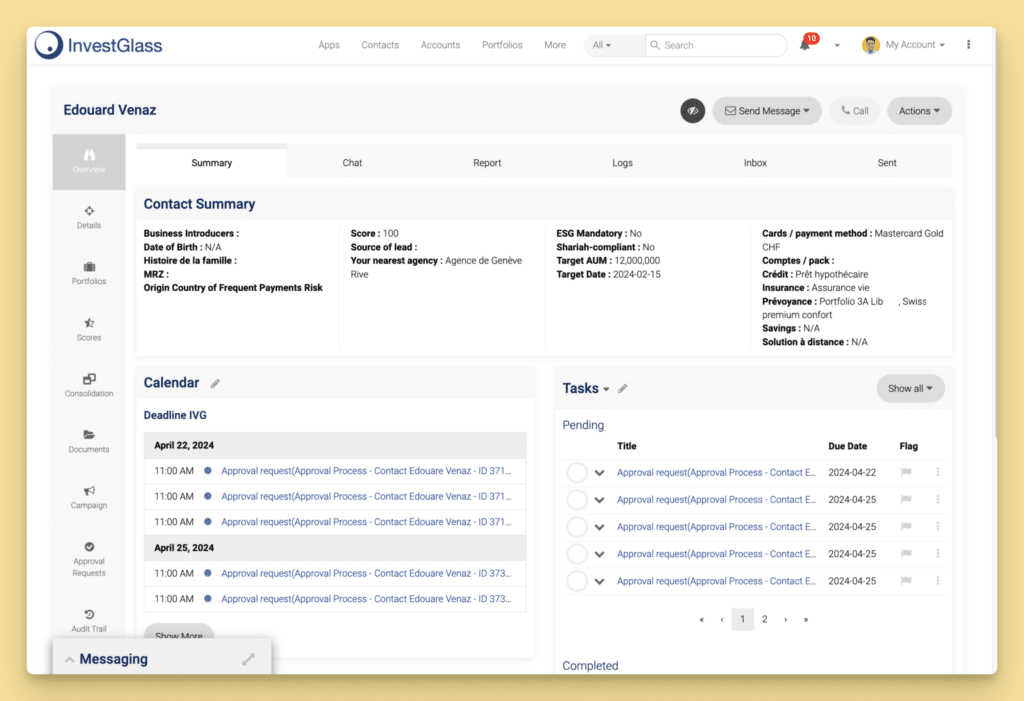
Client‑Facing Portals or Workspaces for Collaboration
Customer onboarding portals provide a branded, secure space where clients can upload documents, review agreements, and sign digitally. By leveraging customer workspaces and no code client portals, teams can create collaborative, customizable environments that streamline the onboarding process, standardize workflows, and improve communication. These portals offer visibility into onboarding progress,checklists, tasks, and next steps,reducing email back-and-forth and accelerating completion.
Scenario: Onboarding a Cross‑Border EU Client into a Swiss Bank
A French family office expresses interest in a discretionary mandate with a Zurich-based private bank. The RM sends a secure portal link. The client uploads passports, and conditional forms reveal CRS/FATCA declarations based on declared tax residencies. Sanctions screening runs automatically via an integrated provider. A suitability quiz captures ESG preferences as required by MiFID II. The client e-signs the mandate, and portfolio setup begins,total elapsed time: 5 days, compared to 15 days with manual processes.
Why Regulated Institutions Need Specialized Onboarding Software
Regulated institutions face onboarding challenges that generic SaaS or e-commerce tools simply cannot address. Consider the complexity of unraveling beneficial ownership in a family office with up to five or more layers, or the need to conduct annual KYC refreshes for existing users. MiFID II suitability requirements tie products to client profiles, and perpetual sanctions screening must adapt to geopolitical shifts. These are not edge cases,they are the daily reality for compliance and onboarding teams.
Manual methods amplify risks. Between 2022 and 2024, audits at financial institutions revealed spreadsheet errors causing fines, version control issues delaying approvals, and no central view of onboarding status,making it nearly impossible to scale when the firm enters new markets or grows its client base. Email-based onboarding creates gaps: documents are lost, steps are missed, and the entire customer journey becomes opaque to management.
Specialized customer onboarding software centralizes client data into a “golden record,” manages PEP and sanctions checks, and logs every change for regulators. Jurisdiction-specific logic ensures that Swiss DLT rules, EU DORA resilience requirements, or MENA regulatory expectations are baked into the onboarding flow. Compliance officers can configure approval workflows, run external screenings, and approve or reject clients,all with a full audit trail for FINMA, ESMA, or internal audit. By leveraging customer onboarding tools that monitor customer health during onboarding, institutions can track engagement and satisfaction in real time, enabling early intervention to address issues and significantly improving client retention.
The need for jurisdiction-specific logic cannot be overstated. A client from the UAE has different disclosure requirements than one from Germany or Singapore. Cross-border marketing rules add another layer. Software that supports these variations out of the box,or with no-code configuration,prevents costly manual workarounds.
Risks of not modernizing onboarding:
- Onboarding delays of 4–6 weeks, during which clients may lose confidence or choose a competitor
- Lost mandates and revenue leakage
- Regulatory fines (e.g., €millions under AMLD6 for AML lapses)
- Negative client word-of-mouth and reputational damage
- Audit findings and increased scrutiny from supervisors
InvestGlass Customer Onboarding: A Swiss Sovereign Approach
InvestGlass is a Swiss-hosted (or on-premise) CRM and onboarding stack built specifically for financial institutions. As a comprehensive customer success platform, InvestGlass integrates onboarding, CRM, and portfolio management to support seamless customer journeys and long-term success. Launched in the mid-2010s and continuously updated through 2025, InvestGlass unifies CRM, digital onboarding and KYC, portfolio management, and marketing automation into one platform. This all-in-one approach eliminates the data silos and integration headaches that plague institutions using point solutions.
Swiss data sovereignty is central to InvestGlass’s positioning. Hosting in Swiss data centers,outside the reach of the US CLOUD Act,resonates with EU, Middle East, and APAC institutions seeking to protect client data and avoid unnecessary transfers. For firms where on-premise deployment is required, InvestGlass supports that model as well.
A private bank in Geneva deployed InvestGlass and reduced onboarding time from 15 working days to 5. An independent asset manager in Dubai improved KYC quality and client satisfaction by replacing fragmented email and spreadsheet processes with a unified onboarding platform. These outcomes are typical for institutions that move from manual to digital onboarding with InvestGlass.
InvestGlass is not a generic CRM adapted for finance. It was designed from the ground up for regulated B2B financial services,banks, wealth managers, insurers, real estate, and the public sector. Every feature, from smart forms to compliance workflows, reflects the realities of operating under FINMA, MiFID II, FATF, and local data protection laws.
Digital Onboarding & KYC Workflows in InvestGlass
RMs or prospects can start a digital onboarding journey via a secure link, website widget, or embedded form. InvestGlass helps streamline onboarding for both clients and relationship managers by providing an intuitive, efficient process that enhances engagement and ease of use. The process is designed for flexibility: whether the client is referred by an external introducer, responds to a marketing campaign, or walks into a branch, the same templated journey can be initiated in a few clicks.
InvestGlass smart forms use conditional logic to adapt to product, jurisdiction, and risk profile. Multilingual support,English, French, German, Italian,is standard, reflecting the linguistic diversity of Switzerland and Europe. Forms reveal or hide fields dynamically based on prior answers, ensuring clients are never overwhelmed and compliance requirements are never missed.
KYC/KYB information is captured once and reused: identity details, tax residency, CRS/FATCA declarations, source of funds, investment objectives, and ESG preferences (as required by MiFID II’s 2022 ESG amendments). This eliminates duplicate data entry and reduces errors.
Compliance officers use configurable approval workflows to check documents, run external checks via integrated screening providers, and approve or reject clients. Task routing ensures the right person handles each step, with escalation rules for overdue items.
All actions are logged with timestamps and user IDs, building a full audit trail for FINMA, ESMA, or internal audit reviews. This level of traceability is essential for demonstrating compliance during inspections.

Client Portals and Collaborative Workspaces
InvestGlass includes a secure client portal, eliminating reliance on ad-hoc email threads. Clients can upload documents, review agreements, and sign digitally,all within a branded, white-label experience. The portal displays tasks, checklists, and onboarding steps visible both to internal teams and, where appropriate, to the client (“upload ID,” “complete risk questionnaire,” “review and sign agreement”). Both clients and relationship managers (RMs) can monitor customer progress in real time, ensuring transparency and enabling proactive support throughout the onboarding journey.
The white-label experience supports custom domains, bank or wealth manager branding, and multilingual content for international clients. Clients can continue using the portal beyond onboarding for reports, portfolio views, and secure messaging,turning onboarding into the beginning of a long-term digital relationship.
Scenario: A family office client receives a personalized onboarding portal link on day one. They upload passports, complete the suitability questionnaire, and sign agreements,all from their laptop. The RM monitors progress in real time and reaches out via secure messaging when a document is missing. The account is fully operational within a week.
CRM, Portfolio Management, and Marketing Automation in One Stack
Unlike point solutions, InvestGlass offers native CRM plus portfolio management. This removes data silos between onboarding and ongoing relationship management. Once onboarding is complete, client data automatically feeds:
- CRM profiles and pipelines: Sales and RMs see a complete history from first contact through onboarding.
- Portfolio/account structures: Investment mandates, risk profiles, and product holdings are pre-populated.
- Marketing segments: Clients onboarded with specific preferences (e.g., ESG-oriented investors in 2025) are tagged for targeted campaigns, and user segmentation enables more personalized onboarding and targeted marketing efforts based on customer data and behavior.
Automated sequences,emails, portal notifications,can be triggered based on onboarding stage or suitability profile, while respecting compliance constraints. RMs benefit from a 360° view of the client, reducing re-keying and errors.
From Spreadsheets to Standardized, Repeatable Onboarding Journeys
Many financial institutions in 2019–2022 relied on Excel trackers, email chains, and Word templates to onboard clients. The result: version confusion, missed beneficial owner disclosures, no central view of status, and onboarding delays of 4–6 weeks. Scaling to new markets or client segments only amplified these pain points.
InvestGlass replaces these manual methods with templated onboarding journeys grouped by:
- Client type: Retail, HNWI, institutional, corporate, fund
- Jurisdiction: Switzerland, EU, GCC, APAC
- Product: Discretionary mandate, advisory mandate, lending, insurance
By leveraging templated success plans, InvestGlass ensures consistency and repeatability in the onboarding process, enabling teams to deliver a standardized and reliable experience for every client.
Templates can be cloned, adjusted, and improved over time based on feedback from compliance and front-office. A mid-size Swiss private bank, for example, reduced onboarding from 15 working days to 5 after moving to InvestGlass,freeing RMs to focus on advisory work rather than chasing documents.
Sales‑to‑Onboarding Handoff Inside InvestGlass
Opportunities in InvestGlass CRM convert into onboarding cases without losing context. Notes, documents, and discussion history travel with the client record. The handoff process ensures new users are onboarded efficiently and without losing context, providing a seamless transition from sales to onboarding. Visibility rules ensure that sales, onboarding, and compliance teams see the same core record but have role-based access to sensitive data.
Example timeline:
- Monday: Client signs term sheet.
- Same day: Onboarding case auto-created with the appropriate template; client receives digital forms.
- Wednesday: Client completes forms and uploads documents.
- Friday: Compliance approves; account is activated.
This eliminates the “black hole” period after signature when clients often feel forgotten,a critical factor in customer retention and satisfaction.
Self‑Serve Resources and Guided Support for Faster Time‑to‑Value
Client expectations have shifted dramatically between 2024 and 2026. HNWIs and corporate treasurers expect digital self-service combined with human guidance. They want to complete onboarding tasks on their own schedule,uploading KYC documents over a weekend, for example,while still having access to their RM via secure messaging when questions arise.
InvestGlass can host or link to a variety of onboarding resources within the portal: FAQs about onboarding, product brochures, suitability explanations, and tax or regulatory disclosures reflecting 2023–2025 updates. Push notifications and in-app messages can be used to guide clients through onboarding steps, provide timely support, and deliver contextual information directly within the application, improving user experience and feature adoption. Clients can complete most required steps asynchronously, reducing the number of onboarding meetings and accelerating time to value.
This hybrid model is particularly useful for cross-border or time-zone-distant clients. A Dubai-based client, for instance, can open an account with a Zurich wealth manager entirely remotely using InvestGlass onboarding,no in-person meetings required.
Saving Hours of Administrative Work per Client
Typical manual work in financial onboarding includes data re-entry into multiple systems, document chasing, and internal status emails. This administrative burden consumes hours per client and diverts attention from higher-value advisory work.
InvestGlass automates:
- Form pre-filling from CRM: Data entered during the sales process carries forward.
- Task creation and reminders: Onboarding tasks are assigned and tracked automatically.
- Status notifications and escalations: Teams are alerted when steps are overdue.
- Document version management: The latest version is always available, with full history logged.
Realistic time savings per client onboarding range from 2–4 hours of RM time to 3–5 hours of back-office effort. Indirect savings include fewer errors, fewer compliance exceptions, and less time preparing for audits or regulatory inspections.
One mid-size European wealth manager reallocated two full-time equivalents from manual KYC checks to client-facing advisory roles after digitizing onboarding with InvestGlass.
Progressive Disclosure: Guiding Clients Step by Step
Progressive disclosure is a UX concept: rather than overwhelming clients with all forms and documents at once, information is revealed step by step as prerequisites are met. InvestGlass lets institutions structure onboarding into stages,identification, investment profile, agreements, funding,and reveal subsequent steps automatically.
Benefits for clients include clearer expectations, higher completion rates, and fewer abandoned processes. For internal teams, progressive disclosure helps prioritize which onboarding cases are genuinely stuck versus simply waiting for the next stage.
Measuring Onboarding Engagement and Predicting Retention
Onboarding engagement is a leading indicator of long-term relationship depth and revenue in wealth and banking. Tracking user engagement during onboarding,such as how clients interact with the onboarding flow, how quickly they complete steps, where they get stuck, and how often they log in,provides actionable insights for improving the process.
Metrics that customer onboarding software like InvestGlass should surface:
Metric | What It Tells You |
Time from first form sent to completion | Overall efficiency and client responsiveness |
Number of RM or compliance touches per case | Resource intensity and potential friction points |
Document rejection rates | Quality of client submissions and clarity of instructions |
Portal login and document view statistics | Client engagement and self-serve adoption |
These metrics can be visualized in dashboards for management to spot bottlenecks,particular jurisdictions, product types, or customer segments that are slower than average. Onboarding data also feeds into renewal or expansion decisions for products like discretionary mandates, insurance policies, or corporate lending facilities.
Example: A European private bank analyzed onboarding analytics in 2024 and discovered that clients in a specific jurisdiction consistently took twice as long to complete forms. Redesigning the form,simplifying language and adding tooltips,cut completion times by 30%.
Content Engagement and Regulatory Reporting
In regulated industries, it is important to know not only that a document was sent, but whether the client actually accessed it. PRIIPs KIDs, MiFID II ex-ante cost disclosures, and suitability questionnaires all carry regulatory weight,demonstrating that the client viewed these materials is essential for compliance.
InvestGlass logs document access events, supporting both UX optimization and regulatory evidence. Analytics highlight under-used onboarding content (e.g., a welcome video or ESG brochure), guiding marketing to improve or reposition resources. This data can be exported or presented during internal and external audits as proof of adequate client information at onboarding.
What to Look for in Customer Onboarding Software (Checklist for 2026)
This checklist is designed for heads of compliance, COOs, and heads of client onboarding at financial institutions evaluating customer onboarding solutions.
- Regulatory fitness: Does the platform support KYC/AML, suitability, and audit requirements in your jurisdictions? Look for built-in logic for MiFID II, FINMA, FATF, and local data protection laws.
- Data residency & sovereignty: Can you host in Switzerland or on-premise? Avoid unnecessary data transfers and exposure to foreign data access laws.
- Security & access control: Encryption, SSO, granular permissions, and detailed audit logs are non-negotiable for regulated institutions.
- No-code configurability: Business teams should be able to adjust forms, workflows, and risk rules without heavy IT projects or vendor intervention.
- Integration breadth: Connectors or APIs for CRM, core banking, PMS, document storage, and e-signature tools reduce silos and manual re-keying.
- Client experience: Branded portals, multilingual support, mobile-friendly design, and progressive onboarding flows keep customers engaged.
- Scalability: The platform should support growth in client numbers, entities, and cross-border operations from 2024–2030.
- Pricing structure & paid plans: Evaluate the pricing structure and availability of paid plans to ensure the solution fits your budget and business needs.
InvestGlass has been designed around these criteria for regulated B2B institutions.
Frequently Asked Questions About Customer Onboarding Software
This FAQ focuses on onboarding in banking, wealth management, insurance, and adjacent regulated sectors,not generic SaaS.
What is the difference between customer onboarding and KYC?
KYC (Know Your Customer) is a subset of onboarding focused on verifying client identity and assessing risk. Customer onboarding encompasses KYC but also includes suitability assessments, document collection, agreement signing, account activation, and first-value delivery. Good onboarding software covers both.
How long does it take to implement an onboarding solution like InvestGlass?
Implementation typically takes 4–12 weeks, depending on the number of templates, integrations, and jurisdictions involved. Institutions with well-defined processes can go live faster; complex multi-entity or cross-border setups may require additional configuration.
Can onboarding software coexist with an existing CRM?
Yes. InvestGlass offers integration capabilities for institutions with existing CRMs, but it also provides an all-in-one CRM, onboarding, and portfolio management stack. The right approach depends on your current technology landscape and long-term strategy.
How does digital onboarding affect regulator relationships?
Digital onboarding improves auditability and transparency. Regulators in 2023–2025 have increasingly expected traceable, digital processes. Institutions with robust onboarding software can demonstrate compliance more easily during inspections, reducing friction with supervisors.
What about older clients who prefer paper?
Hybrid digital-plus-paper workflows are supported. Clients can submit paper documents, which are scanned and uploaded to the platform. The software still centralizes data and approvals, ensuring compliance regardless of how the client prefers to interact.
Is e-signature accepted by regulators for account opening?
E-signature is accepted under Swiss ZertES and EU eIDAS for most account opening and agreement types. Local practices vary, so it’s important to confirm requirements in each jurisdiction. InvestGlass supports integration with leading e-signature providers.
How secure is client data in a cloud onboarding platform?
InvestGlass uses encryption, Swiss data centers, and industry-standard certifications. Data residency in Switzerland avoids exposure to foreign data access laws. Granular access controls and detailed audit logs provide additional layers of security.
Transform Your Onboarding with InvestGlass
Financial institutions can move from manual, fragmented onboarding to a unified, compliant, and client-friendly process with InvestGlass. By centralizing CRM, digital onboarding, KYC workflows, and portfolio management in a single Swiss-hosted platform, institutions reduce administrative burden, accelerate time to value, and build trust with clients and regulators alike.
Key differentiators set InvestGlass apart: Swiss data sovereignty, all-in-one CRM plus onboarding plus portfolio management, and a focus on regulated financial services rather than generic SaaS. Every feature is designed for the realities of banks, wealth managers, insurers, and the public sector operating under FINMA, MiFID II, FATF, and local data protection laws.
“After moving to InvestGlass, we cut onboarding time by two-thirds and dramatically improved KYC quality. Our RMs now spend their time on advisory, not paperwork.” , Compliance Director, European Private Bank
Ready to see how InvestGlass can transform your onboarding? Request a live demo or ask for a sandbox configured for your specific use case,whether Swiss private banking, EU wealth management, or MENA asset management. The next step is simple: schedule a consultation with the InvestGlass team and discover how compliant, white-glove onboarding can become your competitive advantage.
Learning Management System for Onboarding Education and Training
A Learning Management System (LMS) is an essential asset for financial institutions aiming to deliver a seamless and effective customer onboarding process. By integrating an LMS into the onboarding workflow, organizations can provide structured, on-demand education and training that empowers new clients to understand products, navigate compliance requirements, and maximize the value of their relationship from day one.
Key features of a learning management system for onboarding include personalized learning paths tailored to client segments,such as retail investors, HNWIs, or corporate clients,ensuring that each customer receives relevant onboarding content. Interactive modules, including video tutorials, quizzes, and scenario-based learning, help demystify complex financial products and regulatory obligations, boosting customer satisfaction and accelerating user adoption.
Analytics within the LMS allow onboarding teams to track user progress, identify knowledge gaps, and proactively offer support where needed. This data-driven approach not only reduces support requests but also ensures that clients are fully equipped to use the platform’s features, comply with regulatory requirements, and engage confidently with their financial institution. By embedding a robust LMS into the customer onboarding process, firms can deliver a white-glove onboarding experience that drives long-term loyalty and success.
Customer Feedback: Improving the Onboarding Experience
Continuous improvement of the onboarding process hinges on actively gathering and acting upon customer feedback. For customer success teams in financial institutions, structured feedback mechanisms,such as post-onboarding surveys, targeted interviews, and focus groups,provide invaluable insights into the real-world onboarding experience.
By analyzing this feedback, teams can pinpoint friction points, clarify confusing steps, and update onboarding content to better address client needs. This iterative approach enables the refinement of onboarding workflows, ensuring that each new client benefits from a smoother, more intuitive journey. Moreover, feedback-driven enhancements foster greater customer engagement, as clients see their suggestions reflected in tangible improvements.
Effective use of customer feedback transforms the onboarding process into a dynamic, customer-centric experience. It empowers customer success teams to develop targeted strategies that not only resolve pain points but also anticipate future needs,ultimately driving higher customer satisfaction, stronger engagement, and improved retention across the entire customer lifecycle.
Onboarding Benchmarking: Measuring Success Against Industry Standards
To ensure their onboarding process remains competitive and effective, financial institutions must regularly benchmark their performance against industry standards and best practices. Onboarding benchmarking involves tracking key metrics,such as time-to-value, customer satisfaction, and retention rates,and comparing them to those of industry peers.
By leveraging benchmarking data, organizations can identify strengths and uncover gaps in their onboarding workflows. For example, if time-to-completion lags behind industry averages, targeted process improvements can be implemented to accelerate onboarding and enhance customer engagement. Similarly, benchmarking customer satisfaction scores helps institutions understand how their onboarding experience stacks up, guiding investments in training, technology, or content updates.
Regular benchmarking not only drives continuous improvement but also supports strategic decision-making. It enables financial institutions to optimize onboarding workflows, deliver superior customer satisfaction, and achieve measurable gains in revenue growth and client retention.
Onboarding Best Practices for Financial Institutions
Financial institutions operate in a uniquely complex environment, where regulatory compliance, security, and diverse product offerings make customer onboarding especially challenging. Adopting onboarding best practices is crucial for delivering a frictionless, compliant, and engaging experience.
Personalized onboarding experiences are at the heart of these best practices. By leveraging project management tools and customer journey mapping, institutions can tailor onboarding workflows to individual client needs, ensuring that each step is relevant and value-driven. Automated task management streamlines the process, reducing manual effort and minimizing errors, while analytics provide real-time visibility into onboarding progress and customer satisfaction.
Institutions should also prioritize clear communication, proactive support, and the use of digital tools to keep customers engaged throughout the onboarding journey. By implementing these strategies, financial organizations can reduce customer churn, boost retention, and drive revenue growth,transforming onboarding from a regulatory hurdle into a competitive advantage.
Customer Advocacy: Turning Onboarded Clients into Brand Champions
Exceptional customer onboarding is the foundation for building lasting relationships and cultivating customer advocacy. When financial institutions deliver personalized, high-touch onboarding experiences and ongoing support, they not only ensure customer success but also inspire clients to become enthusiastic brand champions.
Customer advocacy programs harness the power of satisfied clients through referral incentives, testimonials, and user-generated content. These initiatives amplify positive word-of-mouth, drive new business, and reinforce trust in the brand. By prioritizing customer retention and nurturing advocacy, institutions create a virtuous cycle,where delighted clients attract new customers, and the organization’s reputation for excellence grows.
Ultimately, investing in customer advocacy transforms the onboarding process from a one-time event into the beginning of a long-term partnership, fueling sustainable growth and strengthening the institution’s position in a competitive market.

