
HNW and UHNW clients now expect mobile first, always on private banking experiences that still feel personal and discreet
A modern private banking model combines a secure client portal, digital onboarding and KYC, and AI assisted relationship management
Swiss data sovereignty and EU grade privacy are decisive for many cross border private banking clients in 2024 and beyond
A unified CRM like InvestGlass can centralize client data, compliance workflows, and portfolio insights in one secure Swiss hosted platform
Digital tools should free relationship managers to focus on strategic advice, succession planning, and complex family needs rather than manual tasks. For family offices, this means providing digital tools and services that support complex wealth management structures, with seamless, comprehensive, and highly personalized digital interfaces tailored to multi generational and multi entity arrangements.
Serving Private Banking Clients In A Fully Digital World
Private banking has transformed dramatically since 2020. Remote meetings, secure portals, and mobile signatures have become standard practice, yet the foundation of long term trust remains unchanged. The shift from branch visits to digital channels happened faster than most financial institutions anticipated.
Clients with more than 1 million CHF in investable assets now expect the same quality of digital service they receive from luxury retail and travel brands. They want speed, elegance, and discretion wrapped into every digital interaction. While online banking offers basic features like account access and simple transactions, private banking clients expect advanced digital experiences such as personalized dashboards, real time collaboration, and immediate transaction capabilities that go far beyond standard online banking. Their expectations have risen because technology in other sectors has set a new benchmark.
By 2025, more than 70 percent of new private banking relationships in Europe are initiated through a digital touchpoint such as a portal or video call rather than a branch visit. This represents a fundamental change in how wealthy individuals discover and engage with their financial providers.
The challenge for private banks is clear: provide this convenience without compromising confidentiality, regulatory compliance, or the human relationship. Many banks struggle to balance the demand for digital capabilities with the personalized service their clients expect.
InvestGlass is a Swiss made CRM and client lifecycle platform built specifically for regulated institutions that need sovereign hosting and audit ready processes. It enables private banks to deliver a premium service experience across every digital and physical touchpoint.
Redefining White Glove Service For The Digital Channel
White glove service must now extend to apps, portals, and messaging, not only to in person meetings and phone calls. The definition of exceptional service has expanded to include every form of digital interaction a client has with their bank.
The ideal digital experience for a private client in 2024 includes a personalized dashboard, secure chat with the relationship manager, and instant access to reports across all family entities. Every element should feel curated and exclusive, reflecting the standards of the bank’s brand.
Consider concrete examples: real time portfolio valuations updated several times per day, downloadable PDF reports branded for the bank and family office, and investment ideas tailored to the client’s stated preferences. These features demonstrate that digital banking can match the attention to detail of traditional service delivery.
Digital white glove service should still feel curated. This means surfacing only relevant investment ideas, research, and macro commentary based on the client profile. A client interested in sustainable investing should see ESG content, not generic market updates.
InvestGlass client portals can be fully white labeled with the private bank logo, colors, and custom menus. This preserves the bank’s identity and exclusivity while delivering a user friendly experience that clients appreciate.
Building A Digital First Private Banking Foundation
Fragmented tools and manual spreadsheets prevent banks from delivering consistent experiences across markets and booking centers. The status quo of disconnected systems creates operational inefficiencies that ultimately affect the customer experience.
A digital first foundation rests on three pillars: CRM, onboarding and KYC, and portfolio management, all integrated with the core banking system. These components must work together seamlessly to enable straight through processing and eliminate redundant data entry.
A central CRM such as InvestGlass stores relationship data, household structures, preferences, suitability information, and interaction history in a single client view. Relationship managers gain a comprehensive view of each client without switching between multiple applications.
Straight through digital processes reduce onboarding times from several weeks to a few days by eliminating repeated data entry and document emailing. This speed creates business value for both the bank and the client.
API based integration with core banking, custodians, and external data providers ensures that advisors see clean, reconciled data for every client. This integration, along with other key ingredients such as advanced technology, effective team structure, and streamlined process design, forms the essential components of a comprehensive digital private banking foundation for delivering accurate, timely advice.
Digital Relationship Manager Enablement
Relationship managers remain at the heart of private banking, but many currently lose significant hours each week to manual reporting, email filing, and compliance checks. This time spent on manual tasks takes them away from what matters most: building client relationships.
An advisor workspace in InvestGlass can present daily tasks, upcoming reviews, client alerts, and portfolio changes through configurable dashboards. Everything a relationship manager needs sits in one place, reducing context switching and improving focus.
AI assisted features add even more value. Automated meeting summaries, suitability checks, and proactive prompts when a client cash balance exceeds a defined level help advisors stay ahead of client needs. These tools support empowering relationship managers to serve more clients at the same quality level.
Digital notes, secure chat logs, and call records stored in the CRM simplify audit trails. When new team members join, they can quickly understand the client history without lengthy handover meetings. This continuity of service matters deeply to uhnw clients.
Automating documentation, approval routing, and client outreach frees relationship managers to spend more time on strategic conversations about succession, philanthropy, and tax planning. The technology handles the process while humans provide the insight.
Composable And Flexible Operating Model
Private banks cannot replace all legacy systems at once. They need a modular platform that can connect to existing infrastructure step by step, respecting budget constraints and risk appetite.
A composable approach works well: the bank first digitizes onboarding, then integrates portfolio data, then adds client portal capabilities over a period such as 2024 to 2026. Each phase delivers visible benefits while building toward a complete digital transformation.
InvestGlass offers on premise and Swiss cloud deployment options. Banks can align the technology with their risk appetite and regulatory requirements, treating transformation as a journey rather than a single big bang project.
Using open APIs and standardized data models makes it easier to add future tools such as robo advisory modules or external research marketplaces. This flexibility supports an operating model that can adapt as client expectations and market research reveal new opportunities.
A composable model reduces project risk and allows private banks to deliver visible client benefits early in the transformation program. Early wins build confidence for broader rollout.
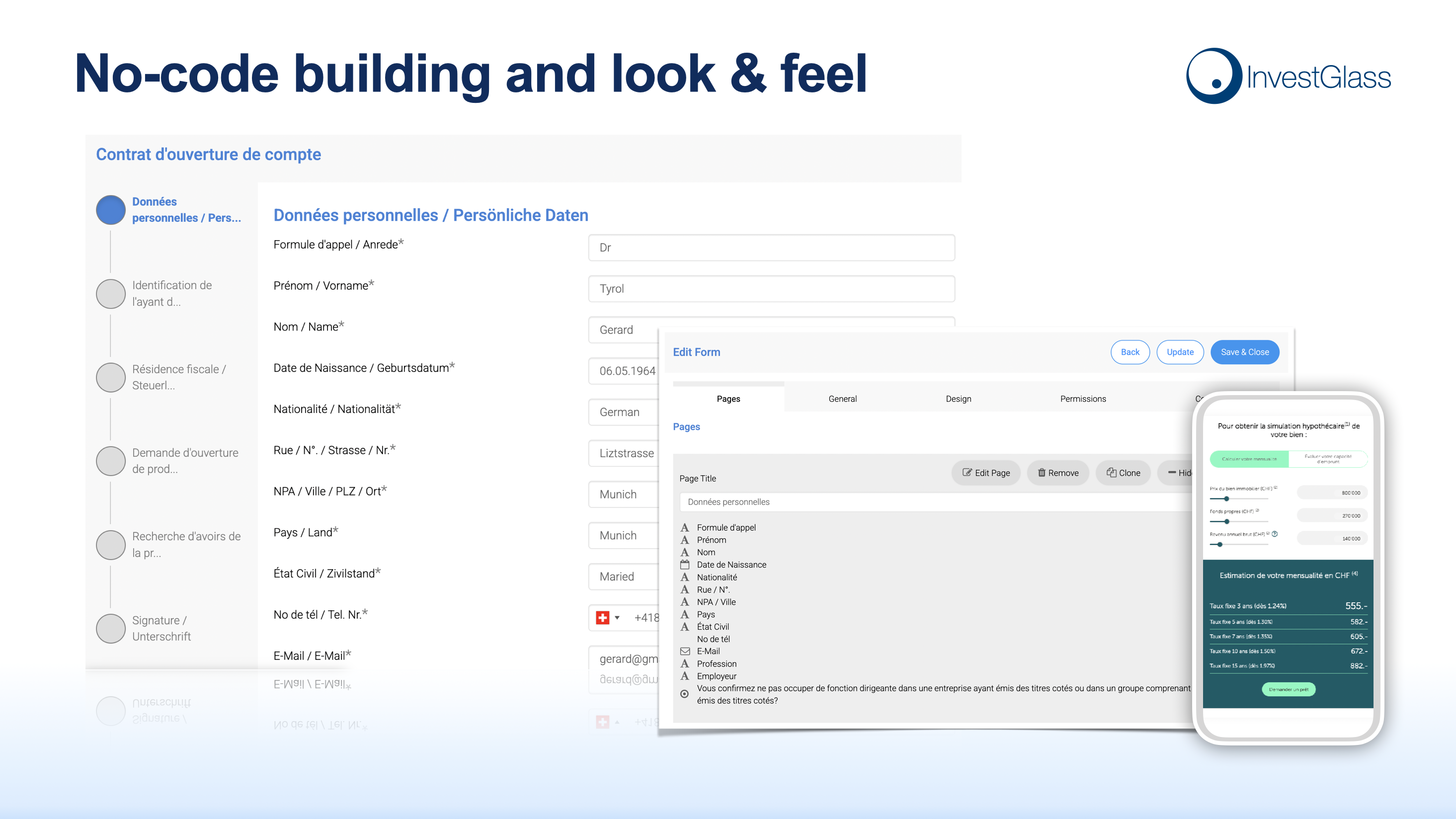
Digital Onboarding And KYC As The First Luxury Experience
Onboarding is the first real test of a bank’s digital promise for a prospective client. It often determines whether the relationship starts on a positive note or becomes a source of frustration.
Many European banks still need 20 to 40 days to fully onboard a complex family structure because of manual checks and repeated data requests. In contrast, retail banking typically features faster and more standardized onboarding processes, as retail clients usually have simpler profiles and requirements. This delay can push new clients toward competitors with faster, more modern digital solutions.
A well designed digital onboarding journey combines online forms, document upload, video identification where allowed, and automated screening. For standard risk clients, this approach can cut timelines to less than one week, delivering the speed that new customers expect.
InvestGlass digital onboarding gathers client data once and reuses it across KYC, suitability, and tax forms such as CRS and FATCA. This reduces frustration for the client and workload for the bank. The digital offering becomes a source of differentiation.
A secure portal lets clients upload passports, proof of address, corporate documents, and source of wealth narratives. Compliance teams review them in the backend without printing or emailing, maintaining security throughout the process.
Risk, Compliance, And Automated Reviews
Regulatory expectations in Switzerland, the EU, and the UK for AML, CTF, and tax transparency have risen significantly since 2018. Banks must demonstrate robust controls to regulators while also serving clients efficiently.
Integrated workflows in InvestGlass can trigger automatic AML screenings, PEP checks, and sanctions list reviews at onboarding and on a periodic basis such as every 12 months. This automation ensures consistency and reduces the risk of human error.
Rules based risk scoring categorizes clients by geography, activity, and product use. This scoring then controls the level of due diligence and approval needed, ensuring resources are allocated appropriately based on risk profile and personal characteristics.
Automatic reminders for KYC refresh dates and missing documents reduce the chance of regulatory breaches and late file updates. The system keeps track of deadlines so compliance teams can focus on substantive review rather than calendar management.
A digital audit trail with timestamps, user actions, and decisions simplifies both internal reviews and external regulator inspections. Everything is documented, accessible, and defensible.
Delivering Holistic Digital Wealth Management
Wealthy clients now see private banks as partners in all aspects of their wealth, not only in securities portfolios. They expect their bank to understand and help manage the full picture.
Consider scenarios such as managing multi currency accounts, private equity commitments, real estate holdings, art collections, and philanthropic vehicles. Clients want all of these visible in one place, with context and insight rather than just raw transactions.
InvestGlass can aggregate data from custodians, core banking, and external valuations into a single household level view. Both clients and advisors access this through the same portal, ensuring everyone works from the same information.
Goal based planning, scenario analysis, and cash flow projections can be presented digitally. Wealth managers leverage digital tools to analyze client behaviors and design tailored customer journeys, ensuring services and recommendations are closely aligned with each client’s unique needs. Clients review them ahead of a video meeting with their relationship manager, making conversations more productive and efficient. This enables more transactions and deeper engagement.
Holistic digital tools support family governance by giving different access rights to spouses, children, and family office staff. The primary client maintains control while allowing relevant family members appropriate visibility into multi entity structures.
Client Portals And Secure Collaboration
The client portal is often the main digital touchpoint and must therefore be intuitive, secure, and aligned with the private bank brand. It represents the bank in the digital first world.
Effective portals include key sections: an overview dashboard, portfolio analytics, document vault, secure messaging, and task approvals such as signing investment proposals. Each section should feel integrated and consistent.
InvestGlass portals support electronic signatures compliant with Swiss and European standards. This shortens the time needed to approve new investments or credit facilities, improving both client experience and operational efficiency.
Clients should be able to schedule video meetings, send instructions, and ask questions directly in the portal. All exchanges are recorded in the CRM for future reference, creating a complete record of every interaction.
The design should be clean, mobile responsive, and tested with actual clients from different age groups. Both first generation wealth holders and next generation inheritors should find it intuitive. The app experience matters as much as the desktop.
Using AI And Automation Without Losing The Human Touch
Artificial intelligence in private banking should augment, not replace, the relationship manager and the investment committee. Technology serves people, not the other way around.
AI models embedded in InvestGlass can help prioritize client outreach by detecting unusual movements, concentration risks, or life event signals such as large cash inflows. These insights help advisors determine which clients need attention and when.
Consider personalized content suggestions: a client in Geneva might receive a curated note about Swiss real estate or ESG investing based on their interests. This relevant content demonstrates that the bank understands their preferences without feeling automated.
Automation can handle routine tasks like sending birthday messages, portfolio review reminders, or tax season document alerts. The advisor focuses on meaningful conversations while the system handles the predictable line items.
Transparency and governance for AI in regulated environments remain essential. Swiss hosted models and clear approval workflows reduce operational and reputational risk. Clients trust that their data is handled responsibly.

Data Privacy, Swiss Hosting, And Client Trust
Data residency and sovereignty have become board level concerns, especially for cross border wealth management. Clients want to know where their information lives and who can access it.
InvestGlass offers hosting in Swiss data centers subject to Swiss privacy law. This is often a strong selling point for clients from Europe, the Middle East, and Latin America who value neutrality and stability.
Sensitive data such as KYC files, investment preferences, and communication history stays within the bank’s chosen jurisdiction. This approach avoids dependency on foreign hyperscalers and maintains control over data access.
Encryption, role based access controls, and least privilege principles are non negotiable components of any digital private banking stack. These security measures protect against both external threats and internal misuse.
Communicating this data protection posture clearly to clients can become a differentiator. In client acquisition meetings, Swiss hosting and data sovereignty often resonate strongly with high net worth and ultra high net worth individuals.
Practical Steps To Start Or Accelerate Digital Private Banking
Decision makers in private banks often face limited budgets and must prioritize their transformation roadmap for 2024 and 2025. Not everything can happen at once, so sequencing matters.
A phased approach works well: start with a pilot in one booking center or one client segment. For example, focus on next generation HNW entrepreneurs before scaling to the broader client base. Learn quickly and adapt based on feedback.
Concrete first projects might include:
Priority | Project | Expected Outcome |
|---|---|---|
1 | Digital onboarding and KYC workflow | Faster time to revenue for new clients |
2 | Secure client portal for reports | Reduced manual report distribution |
3 | Advisor cockpit with basic automation | More time for strategic advice |
InvestGlass can be deployed in a matter of months. Preconfigured templates for risk profiling, suitability, and MIFID and FINMA aligned processes reduce internal effort. Banks can deliver value without lengthy custom development.
Measure success with clear metrics: onboarding time, digital adoption rate, number of manual tasks eliminated, and client satisfaction scores gathered through portal surveys. Data drives continuous improvement.
Change Management And Relationship Manager Adoption
Technology projects fail when relationship managers do not adopt the new technology, regardless of how well the software is designed. People must see value in the tools they are asked to use.
Involve senior advisors early in the design of templates, dashboards, and reports. When the digital tools align with their daily routine, adoption happens naturally. Resistance often stems from tools that feel imposed rather than designed collaboratively.
Training programs, coaching, and clear explanation of benefits matter. Show advisors how the platform helps them serve more clients at the same level of quality. Connect new technology to outcomes they care about.
Early success stories create momentum. When a complex family onboards in days instead of weeks, or a large upsell results from a digital alert, share that story internally. Example by example, the case for digital transformation becomes undeniable.
Continuous feedback loops allow advisors to request small improvements to forms, workflows, or portal features. Regular updates based on frontline input show that the bank values their perspective and is committed to making tools work for them.
Frequently Asked Questions
How long does it take to implement a digital private banking platform like InvestGlass
Smaller private banks can often go live with a first phase focused on CRM and onboarding in three to six months, depending on internal resources and integration needs. The timeline depends heavily on how prepared the bank is to make decisions and allocate project resources.
More complex deployments with multiple booking centers, custom risk models, and full portfolio data integration typically follow a staged program over 12 to 18 months. Each phase delivers incremental value while building toward the complete vision.
Early workshops and clear ownership inside the bank significantly reduce implementation time. When stakeholders align quickly on requirements, the technology deployment can move faster.
Can a digital portal really work for older private banking clients
Many clients in their sixties and seventies already use tablets and smartphones for travel, health, and communication. They appreciate simple, readable interfaces that respect their time and intelligence.
Design matters: larger fonts, clear navigation, and hybrid support where a relationship manager or assistant can guide clients through the portal during the first months. The technology should adapt to clients, not demand that clients adapt to it.
Banks can still provide paper statements or phone calls where needed while gradually increasing digital adoption. The goal is meeting clients where they are comfortable while gently introducing new capabilities.
How does InvestGlass support cross border private banking with different regulations
InvestGlass allows banks to configure country specific workflows, suitability rules, and documentation requirements inside a single platform. This flexibility means one system can support multiple regulatory environments.
Client profiles store tax residency, citizenship, and permitted products, which helps advisors respect local regulations when proposing investments. The system guides compliant behavior rather than relying solely on advisor knowledge.
Compliance teams can update rules centrally as regulations evolve. This ensures consistent application across front office teams regardless of location, reducing the risk of regulatory breaches.
What is the role of relationship managers if so many processes are automated
Automation handles repetitive and low value tasks such as data capture, document chasing, and basic notifications. These activities consume time but do not require human judgment or relationship building skills.
Relationship managers become even more important in this environment. They can focus on complex advice, family governance, and navigating cross border issues. Their expertise and personal connection remain irreplaceable for wealthy individuals who value trust and discretion.
Digital tools simply give them better information and more time to deepen client relationships. The human touch remains central while the technology removes friction.
Is Swiss data hosting really an advantage for private banks
For many international clients, Swiss hosting is a strong signal of neutrality, stability, and respect for data privacy. Switzerland’s reputation as a financial center extends to data protection, which resonates with clients from regions where trust in local institutions may be lower.
Swiss data centers are subject to strict legal frameworks and are geographically close to many European private banks. This proximity can improve system performance and simplify support arrangements.
Some institutions still prefer on premise deployments based on their specific security or regulatory needs. InvestGlass offers this option, ensuring banks can choose the approach that fits their risk profile and client expectations.

