
Data privacy has moved from back office compliance checklists to boardroom strategy discussions. Regulations like the General Data Protection Regulation, the revised Swiss Federal Act on Data Protection effective September 2023, SEC Regulation S-P, and FINRA rules now impose explicit obligations on how wealth management firms handle client information. Data privacy is crucial for wealth managers because they handle sensitive information about clients’ personal finances and have a fiduciary duty to protect that information. Wealth managers hold some of the most sensitive data in the financial services industry, including KYC files, tax documents, portfolio statements, and detailed family structures, making them prime targets for cyber attacks and sophisticated privacy breaches. This article provides a practical framework that banks, private banks, and external asset managers can apply over the next 12 months to strengthen data privacy across governance, technical controls, and staff behavior.
Privacy breaches not only expose clients to financial and personal risks but also threaten the firm’s reputation. Data breaches can irreparably damage a firm’s reputation, leading to client attrition and legal repercussions, making reputation management a critical aspect of cybersecurity strategies.
Key Takeaways
- Data privacy in wealth management is now a board level concern driven by regulations including GDPR, Swiss FADP 2023, SEC Reg S-P, and FINRA rules that carry significant enforcement penalties.
- Wealth managers handle extremely sensitive client data such as passports, proof of address, source of wealth documentation, and portfolio positions that can expose entire family structures if breached.
- Effective data protection combines governance frameworks, technical controls like encryption and role based access, and consistent staff behavior rather than relying solely on cybersecurity tools.
- Swiss sovereign hosting and on premise deployments with InvestGlass help financial institutions preserve data sovereignty and reduce cross border privacy risk.
- The practical framework in this article addresses data inventories, privacy impact assessments, technical safeguards, incident response, and ongoing staff training that firms can implement systematically.
Why Data Privacy Has Become Strategic In Wealth Management
Since 2020, the acceleration of digital onboarding has transformed how wealth management firms collect and store personal information. The shift to remote client service during the pandemic pushed advisors to gather passports, proof of address, and source of wealth documentation through digital channels at unprecedented scale. Alongside this digital transformation, regulators worldwide have reported a sharp increase in financial sector data breaches, with cyber threats increasing roughly 300 percent in wealth management between 2020 and 2024.
Wealth managers now routinely store sensitive documents that go far beyond basic account details. These include full identification documents, detailed investment positions, risk profiles, tax residency information, and communication histories that can reveal family structures, business interests, and significant assets. When this sensitive information falls into the wrong hands, identity thieves can commit fraud, access financial accounts, or target clients for social engineering attacks.
Privacy failures carry consequences that extend well beyond regulatory fines. Research indicates that 71 percent of high net worth individuals would switch financial advisors following a breach, representing massive potential attrition for any wealth management firm. Reputational damage can lead to loss of cross border business licenses, withdrawal of institutional partnerships, and lasting harm to the firm’s reputation in competitive markets.
Concrete regulatory frameworks now impose explicit privacy obligations. Implementing comprehensive cybersecurity measures and adhering to regulations such as the General Data Protection Regulation (GDPR) and the Gramm-Leach-Bliley Act (GLBA) is essential to protect client information in wealth management. The General Data Protection Regulation governs the legal requirements for data privacy and applies to all companies that collect or process personal data about individuals in the European Union. It requires consent, data subject rights enforcement, and 72 hour breach notifications with penalties reaching 20 million euros or 4 percent of global annual turnover. The revised Swiss Federal Act on Data Protection aligns closely with GDPR principles while maintaining Swiss legal traditions. SEC Regulation S-P and FINRA rules create additional compliance layers for firms serving US clients. Large fines from GDPR enforcement, which totaled 2.7 billion euros by early 2025 with 20 percent against the financial sector, demonstrate that privacy enforcement is now routine rather than theoretical.
Understanding Data Privacy In A Wealth Management Context
Data privacy in wealth management concerns how firms decide what client data they collect, why they collect it, where they store it, and who can gain access to it. Unlike general consumer businesses, wealth managers, insurance providers, and other financial institutions operate under heightened scrutiny because they handle personally identifiable information combined with detailed financial data that could expose clients to significant harm if misused.
Privacy and security serve different but complementary purposes. Privacy governs the lawful, fair, and minimal use of client information, ensuring that firms collect only what they need and use it only for stated purposes. Security focuses on protecting sensitive client information against unauthorized access through technical controls like encryption and access management. A firm can have excellent security but poor privacy practices if it collects excessive data without proper justification or shares information inappropriately.
The main categories of personal and financial data held by wealth managers include:
Data Category | Examples |
|---|---|
Identification | Passports, national ID cards, proof of address |
Financial accounts | Account numbers, portfolio positions, transaction history |
Risk and suitability | Risk profiles, investment objectives, time horizons |
Tax information | Tax residency status, tax documents, reporting forms |
Communication records | Emails, meeting notes, recorded calls |
Behavioral data | Portal usage patterns, preferences, service interactions |
Cross border wealth management creates overlapping privacy obligations that must be addressed deliberately. A Swiss firm serving EU residents must comply with both Swiss FADP and GDPR, navigating potentially conflicting requirements around data transfers, client rights, and breach notification timelines. Firms operating across Asia face additional complexity with Singapore’s PDPA and Hong Kong’s PDPO, each carrying distinct consent and retention requirements.
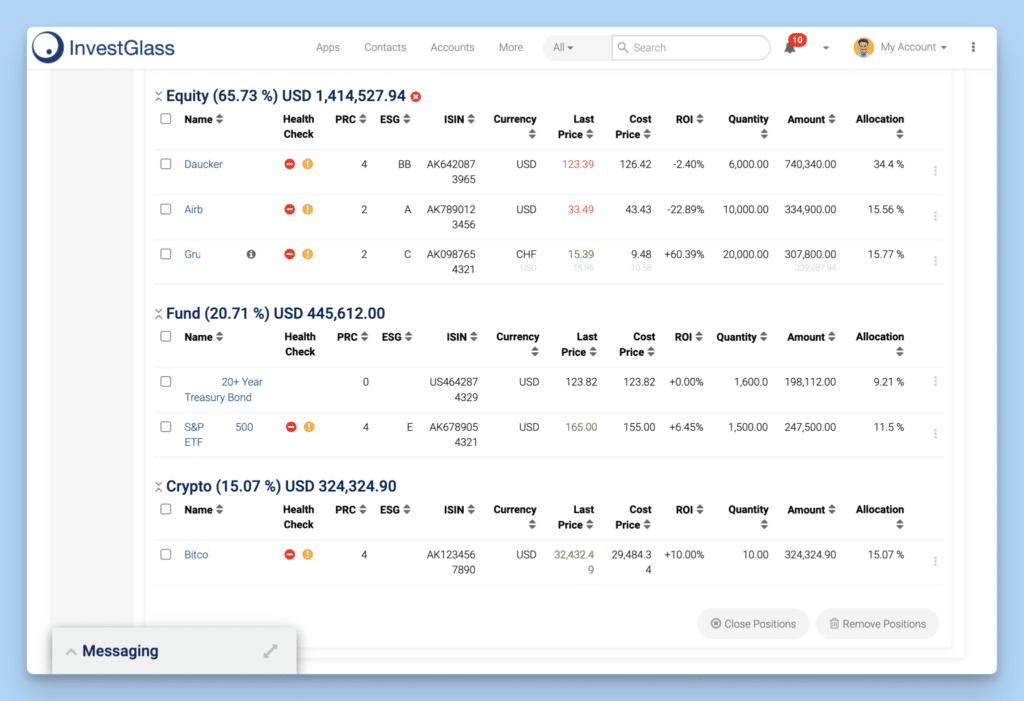
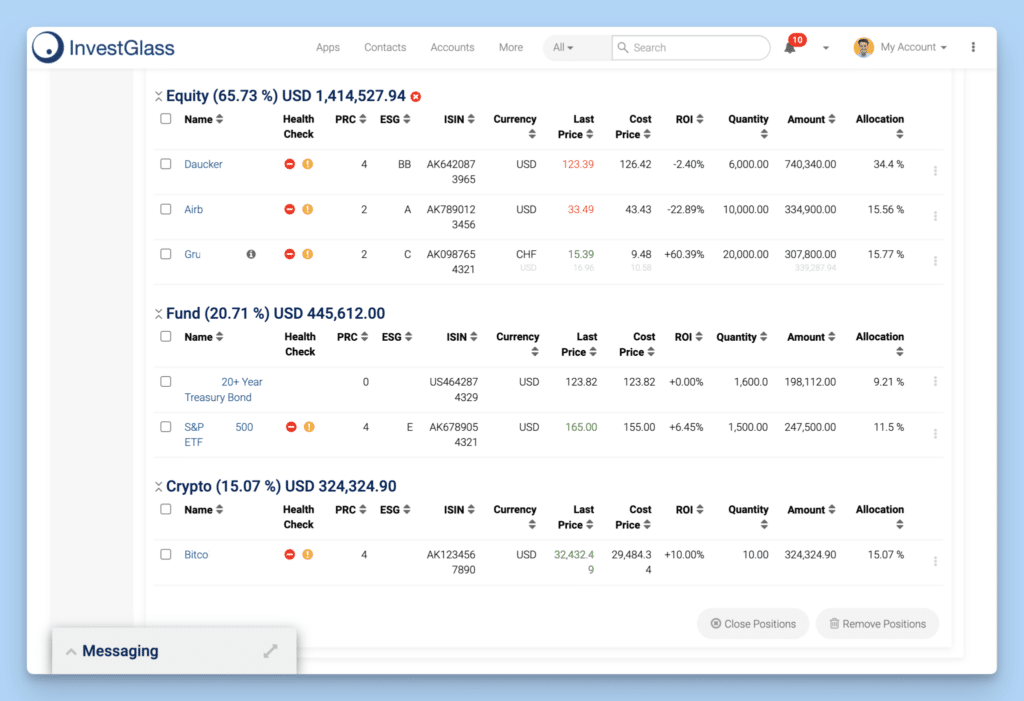
InvestGlass helps structure data models and fields so that personally identifiable information and sensitive financial attributes are consistently tagged across CRM and portfolio management tools. This consistent classification enables firms to apply privacy rules systematically rather than relying on manual judgment for each client record.
Core Principles For Maintaining Client Data Privacy
A clear set of principles guides day to day privacy decisions across advisory, compliance, and IT teams. These principles translate regulatory requirements into practical guidance that relationship managers and operations staff can follow consistently.
Data minimization requires firms to collect only the information necessary for suitability rules, KYC requirements, and investment advice. Wealth managers should avoid casual note taking that captures irrelevant personal details about clients’ families, health conditions, or personal relationships unless directly relevant to financial planning. Every additional data point creates additional exposure if the computer system is compromised.
Purpose limitation means documenting for each data category why it is collected and how it will be used. A firm might collect source of wealth documentation for anti money laundering checks, risk tolerance questionnaires for suitability assessment, and tax residency information for regulatory reporting. When data is collected for one purpose, using it for another, such as marketing campaigns, requires separate justification and often explicit client consent.
Storage limitation requires establishing retention periods and enforcing them consistently. Typical retention rules in Switzerland and the EU range from five to ten years depending on the data type and regulatory requirements. After retention periods end, firms should implement automated deletion rather than allowing sensitive data to accumulate indefinitely in archives that may lack current security controls.
Transparency and client rights ensure that clients understand how their information is used and can exercise their rights under applicable laws. Clients in many jurisdictions can request access to their data, correction of inaccuracies, and deletion of information no longer needed. Wealth managers should provide clear privacy notices during onboarding and offer self service portals where clients can review and manage their preferences.
InvestGlass workflows and audit trails can enforce these principles across onboarding, portfolio reviews, and marketing campaigns. Automated rules can flag data collection that exceeds defined parameters, route consent requests through proper approval channels, and trigger retention reviews when client relationships end.
Designing A Practical Data Privacy Governance Framework
Governance translates abstract principles into clear responsibilities, policies, and regular reviews. Without formal governance structures, privacy becomes dependent on individual judgment and inconsistent enforcement across teams.
Appointing a data protection officer or privacy lead provides accountability even in medium sized firms. This person should coordinate between legal, IT, compliance, and front office teams to ensure privacy requirements are understood and implemented consistently. In larger institutions, the DPO role may be full time; in boutique wealth managers, it might be combined with another compliance function but should have clear authority and direct reporting lines to senior management.
Creating a data inventory maps which systems hold client data and how information flows between them. A typical wealth management firm might have client data distributed across:
- CRM systems
- Portfolio management platforms
- Document repositories
- Client portals
- Email servers
- Marketing automation tools
- Third party custodians
Understanding these data flows is essential for assessing privacy risks, responding to client access requests, and demonstrating compliance to regulators during inspections.
Running privacy impact assessments when launching new services like mobile applications or new digital onboarding journeys helps identify risks before they materialize. The assessment should document what personal data the new service will collect, how it will be protected, who will have access, and what mitigations address identified risks.
Developing comprehensive policies should cover acceptable use of client data, secure document handling, remote access expectations, and escalation of suspected privacy incidents. These policies should be practical enough that staff can follow them in daily work, not abstract statements that sit unread in compliance manuals.
InvestGlass, as an integrated CRM and portfolio platform, reduces fragmentation by centralizing sensitive data and providing consistent permission models across functions. Rather than managing privacy controls in five or six separate systems, firms can configure and monitor access through a unified interface.
Technical Controls That Support Data Privacy
Technical controls enforce privacy rules at scale and reduce dependence on manual discipline. Even the most well intentioned staff cannot consistently apply privacy rules across thousands of client records without systematic technical support. A practical security framework for wealth managers includes basic hygiene measures like multi-factor authentication and advanced controls such as role-based access and immutable audit trails.
Access controls should implement role based access where only authorized individuals can view specific client information. Relationship managers see only their assigned clients. Compliance staff have read only oversight for monitoring purposes. Marketing teams work with anonymized or pseudonymized data that cannot identify specific individuals. Field level access control allows further granularity, such as hiding credit card details or tax documents from staff who do not need them.
Encryption protects client documents, communications, and data exports both in transit and at rest. Full lifecycle encryption is essential, involving encryption of sensitive client data at rest and in transit. Modern standards like AES 256 render data unreadable without proper cryptographic keys. This protection extends to backups, archives, and data transferred between systems. InvestGlass Swiss data centers implement encryption as standard practice across all stored client information.
Logging and immutable audit trails record who viewed, exported, or modified client data. These logs are crucial during regulatory inspections, internal investigations, and incident response. Auditors expect to see evidence that access was limited to appropriate personnel and that any unusual activity was detected and investigated. Immutable backups are crucial for ensuring recovery from ransomware attacks.
Secure portal configuration should enable multi factor authentication for all client and staff access, implement session timeouts that limit exposure from unattended devices, and restrict downloading full datasets from public networks. Multi-factor authentication should be enforced for all advisor logins, back office access, and client portal sessions to enhance security. MFA should require multiple forms of verification, such as passwords, physical tokens, or biometric data, to strengthen security and protect against credential theft and attacks. Clients should be able to access their information securely without exposing the firm to unnecessary risk from personal devices connecting over unsecured connections.
InvestGlass offers Swiss hosted and on premise deployment options so that cryptographic keys and access control policies remain under the financial institution’s direct control. The option to run on-premise inside a bank’s own infrastructure provides maximum control for institutions with strict data sovereignty requirements. This addresses concerns about third party cloud providers potentially having access to sensitive client information.

Embedding Privacy Into Onboarding, KYC, And Day To Day Operations
Onboarding and KYC processes are the most intensive data collection moments in the client lifecycle and therefore carry the highest privacy exposure. Getting these workflows right establishes the foundation for protecting client data throughout the relationship.
Secure digital onboarding should use dedicated client portals instead of email attachments for collecting passports, proof of residence, and source of wealth documentation. Using secure websites and portals for document exchange and digital onboarding is essential to minimise insecure email attachments and enhance data security during client interactions. Email lacks encryption in most cases, creates copies on multiple servers, and makes it difficult to control who ultimately accesses the attachments. Secure portals provide controlled access, automatic encryption, and clear audit trails.
Standardising document collection reduces unnecessary exposure by defining exactly what documents are required for each client type and jurisdiction. Free text fields that invite advisors to add “any other relevant information” often accumulate sensitive but irrelevant personal details that create risk without business value. Automated checks can validate that required documents are present and properly formatted, reducing back and forth that extends the period when sensitive documents are in transit.
Workflow routing ensures KYC files reach only specific reviewers with appropriate clearance. InvestGlass workflow tools can route documentation through defined approval paths, restricting access to compliance analysts during review and automatically limiting visibility once the review is completed and approved. This prevents the common problem where sensitive KYC files remain accessible to broad groups long after they were needed.
Operational privacy hygiene extends beyond onboarding to daily activities:
- Screen sharing during remote meetings should exclude sensitive client information visible in background applications
- Exporting spreadsheets with client data should require approval and logging
- Secure messaging within approved platforms should replace consumer chat applications for sensitive transactions
- Electronic communications containing financial information should flow through encrypted channels
Routine tasks like portfolio rebalancing, suitability reviews, and marketing campaigns should all run within systems that respect the same privacy and access rules applied to onboarding. InvestGlass provides this consistency by integrating CRM, portfolio management, and marketing automation within a single platform with unified access controls.
Swiss Data Sovereignty And Cross Border Privacy Compliance
For many private banks and external asset managers, where data is stored is as important as how it is stored. Client expectations, regulatory requirements, and competitive positioning all influence hosting decisions.
Data sovereignty means the ability of a bank or wealth manager to keep client information within a chosen legal jurisdiction, control who can access it, and respond to foreign data requests under local law rather than foreign legal processes. This concept has gained importance as governments worldwide assert greater authority over data held within their borders or by their corporate citizens.
Switzerland offers distinct advantages for data hosting that appeal to wealth managers serving international clients:
- Strong banking secrecy traditions embedded in legal and cultural frameworks
- The revised Swiss Data Protection Act effective September 2023, which aligns with international standards while maintaining Swiss legal sovereignty
- Political stability that reduces regulatory uncertainty
- ISO certified data centers with robust physical security and operational standards
- Clear legal frameworks for responding to foreign data requests that prioritize client protection
Global public cloud services present different considerations. While major providers offer significant security investments and operational excellence, they also create concerns around uncertain data residency guarantees, potential access under foreign laws like the US CLOUD Act, and complex cross border transfer assessments required under GDPR. For wealth managers serving European clients, standard contractual clauses and supplementary measures may be required, adding compliance complexity.
InvestGlass allows institutions to choose fully Swiss hosted deployments in ISO certified data centers or on premise installations where the financial institution maintains complete physical and logical control over infrastructure. This flexibility simplifies regulator conversations about outsourcing, data transfers, and third party access.
Cross border privacy management requires deliberate planning. Consider a practical example: an EU based client whose wealth is managed from Switzerland requires careful attention to GDPR data transfer rules. The firm might store client data in a Swiss data center, rely on the Swiss FADP adequacy determination from the EU, implement supplementary technical measures like encryption with locally held keys, and document the transfer mechanism in privacy notices. This structured approach demonstrates compliance while preserving the benefits of Swiss data sovereignty.
People, Culture, And Incident Readiness
Even the strongest technical setup can be undermined by careless behavior or unclear procedures. Digital security ultimately depends on people making good decisions in challenging situations.
Targeted training for relationship managers, assistants, and portfolio managers should cover realistic wealth management scenarios rather than generic cybersecurity awareness. Training should address situations like:
- Receiving passport copies or tax documents via personal email from clients who find portals inconvenient
- Client requests to send account statements via WhatsApp or other consumer messaging applications
- Phishing attempts that impersonate custodians, regulators, or internal executives
- Social engineering calls requesting client information under time pressure
Privacy topics should be included in annual mandatory training and testing, supplemented by periodic simulations that test staff responses to phishing attempts and social engineering. Research indicates that only 55 percent of wealth management firms conduct annual privacy training, leaving significant gaps in staff awareness.
Documented incident response procedures prepare firms to respond effectively when privacy incidents occur. These procedures should specify:
- Immediate containment steps to prevent ongoing unauthorized access
- Internal reporting lines and escalation thresholds
- Engagement protocols with regulators, noting the 72 hour notification requirement under GDPR
- Communication templates for affected clients
- Post incident analysis and remediation processes
Logs and audit trails from platforms like InvestGlass accelerate incident analysis by providing clear records of who accessed what information and when. These records help demonstrate accountability and cooperation to regulators, potentially reducing penalties and reputational damage.
Encouraging early escalation creates a culture where staff feel safe raising suspected privacy issues before they become serious incidents. Firms should recognize that early detection often prevents small issues from becoming major breaches. Staff who fear punishment for reporting mistakes are more likely to attempt quiet resolution, which often makes situations worse.
Client Education and Awareness
Client education and awareness are essential components of a robust data security strategy in the financial services industry. As wealth managers are entrusted with sensitive financial data and personally identifiable information, it is vital to ensure that clients themselves are equipped to play an active role in protecting their own sensitive data. In today’s digital landscape, where cyber threats evolve rapidly and identity thieves continually seek new ways to gain access to financial accounts, empowering clients with knowledge is a critical line of defence.
Wealth management firms should take a proactive approach to educating clients about the risks associated with digital financial services. This includes raising awareness about phishing attempts, malicious software designed to steal account details, and the dangers of sharing sensitive documents or financial information through unsecured electronic communications or personal devices. Clients should be encouraged to use strong passwords, enable multi-factor authentication on all financial accounts, and regularly update their security settings and operating system to reduce vulnerabilities.
Providing clear guidance on how to identify and report suspicious activity, such as unauthorised transactions, unexpected requests for personal information, or unusual account behaviour, helps clients act swiftly to prevent data breaches and protect sensitive client information. Regular security audits and awareness campaigns can keep clients informed about the latest cyber threats and best practices for digital security, ensuring that they remain vigilant as new risks emerge.
Aligning client education initiatives with regulatory obligations, such as the General Data Protection Regulation, is also crucial. Wealth management firms should provide transparent information about how client data is collected, stored, and protected, and explain the firm’s commitment to data privacy and information security. This transparency not only fulfils regulatory requirements but also builds client confidence and trust.
A well-structured client education programme can become a significant competitive advantage for a wealth management firm. By demonstrating a commitment to protecting client data and equipping clients with the tools to safeguard their financial picture, firms can strengthen client relationships, enhance client retention, and bolster their reputation in the wealth management industry.
How InvestGlass Helps Wealth Managers Maintain Data Privacy
InvestGlass is a Swiss sovereign CRM and automation platform purpose built for regulated wealth managers, private banks, and other financial institutions. The platform addresses data privacy challenges through integrated architecture, Swiss hosting options, and compliance focused features.
Consolidated data management reduces privacy complexity by bringing CRM, onboarding, KYC, portfolio management, and client portals into one platform. Rather than maintaining privacy controls across five or six separate systems, with the associated risk of inconsistent configuration and fragmented audit trails, firms can manage sensitive financial data through unified governance structures.
Privacy supporting features include:
Feature | Privacy Benefit |
|---|---|
Granular role based permissions | Ensures only authorized individuals access specific client data |
Field level access control | Hides sensitive fields like tax documents from users who do not need them |
Immutable audit logs | Provides evidence for regulatory inspections and incident investigations |
Configurable data retention policies | Automates deletion when retention periods expire |
Consent management | Tracks and enforces client communication preferences |
Deployment flexibility addresses data sovereignty requirements through Swiss hosted cloud in ISO certified data centers and fully on premise installations. On premise deployment gives institutions complete control over their infrastructure, including physical security, network configuration, and cryptographic key management. This flexibility supports business continuity planning and regulatory obligations across different jurisdictions.
Automation capabilities embed privacy rules into operational workflows. Digital onboarding flows collect only required documentation through secure portals. Approval workflows route sensitive decisions through appropriate reviewers. Marketing segmentation respects consent status, subscription preferences, and jurisdiction specific privacy rules automatically.
InvestGlass works with compliance teams to align platform configurations with local regulatory requirements including GDPR, Swiss FADP, and industry specific guidance like FINMA circulars. This collaboration ensures that technical controls support the specific regulatory obligations each institution faces.
Staying Ahead Of Emerging Privacy And Security Threats
As cyber threats evolve, wealth managers must continuously adapt their privacy and security practices. Emerging threats include deepfake identity fraud that can defeat video verification, AI assisted phishing campaigns that create highly convincing impersonations, and increasingly aggressive data extortion schemes targeting high net worth families.
Regular assessments should occur at least annually and include:
- Penetration testing of client portals and internal systems
- Configuration reviews for access controls and encryption settings
- Updated privacy impact assessments for new products and services
- Vendor security reviews for third parties handling client data
Advanced analytics and machine learning can detect unusual access patterns or data exports that might signal insider misuse or compromised accounts. Anomaly detection systems flag behavior like bulk downloads of client records, access outside normal working hours, or queries across unusual numbers of client files. These alerts enable rapid investigation before significant harm occurs.
Industry participation keeps firms informed about emerging threats. Information sharing groups, regulator briefings, and vendor led security updates provide threat intelligence specifically relevant to the wealth management industry. The financial sector faces sophisticated adversaries who share techniques and tools, making collective defense valuable.
InvestGlass continuously updates platform security controls to address emerging vulnerabilities and works with clients to implement new privacy features as regulations and threats evolve. This proactive measures approach helps firms stay informed about industry developments without requiring dedicated security research teams.
The regulatory landscape continues to evolve as well. The EU AI Act classifies certain wealth management AI applications as high risk, requiring impact assessments and ongoing monitoring. Zero knowledge proofs and privacy enhancing technologies gain traction for verifying wealth or identity without revealing underlying data. Quantum computing advances may eventually threaten current encryption standards, prompting early adoption of quantum safe cryptography by forward thinking institutions.

FAQ
How often should a wealth management firm review its data privacy framework?
Formal review of privacy policies, data inventories, and governance structures should occur at least once per year. This annual review ensures that documentation remains current as the business evolves. Beyond annual reviews, targeted assessments should occur when entering new markets, launching new products or services, experiencing significant staffing changes in compliance or IT roles, or following any privacy incident. The continuous process of maintaining privacy controls benefits from both scheduled reviews and event triggered reassessments.
What is the difference between data privacy and data security in practice?
Data privacy governs why and how client information is collected, used, shared, and retained. It addresses questions like whether collecting certain information is necessary, whether clients have provided appropriate consent, and whether usage aligns with stated purposes. Data security focuses on protecting sensitive information against unauthorized access, loss, or corruption through technical controls like encryption, access management, firewalls, and monitoring. A firm might have strong security but weak privacy if it collects excessive data without justification. Conversely, good privacy policies are ineffective without security controls to enforce them. Both disciplines are essential components of protecting client data.
Can smaller independent wealth managers realistically meet strict data privacy requirements?
Smaller firms can absolutely meet modern privacy standards by using specialized platforms that embed privacy controls, sovereign hosting, and compliance workflows without requiring massive internal infrastructure investments. InvestGlass provides boutique wealth managers with the same privacy capabilities available to large institutions, including role based access, encryption, audit trails, and Swiss data hosting. The key is selecting technology partners who understand regulatory requirements and configure systems appropriately from the start. This approach delivers competitive advantage by building client trust and demonstrating professionalism without the overhead of building custom solutions.
How should wealth managers handle client requests to use personal email or messaging apps for sensitive documents?
Firms should politely but firmly redirect clients to secure portals or encrypted channels, explaining the privacy risks of unprotected email and consumer messaging applications. Personal devices and consumer apps lack the encryption, access controls, and audit trails necessary for protecting sensitive client information. This preference should be documented in engagement letters, client guides, and onboarding materials so expectations are clear from the relationship’s beginning. Educating clients about why these measures protect their financial picture and personal information usually generates understanding and appreciation rather than resistance.
What quick steps can a firm take in the next six months to improve data privacy?
Immediate priorities should include mapping where client data is stored across all systems, identifying any unexpected repositories or shadow IT. Next, review and tighten role based access rights to ensure only what is necessary for each role is accessible. Implement or verify encryption for data at rest and in transit, and enable multi factor authentication for all systems containing client information. Update privacy notices to ensure they accurately reflect current practices and client rights. Finally, roll out targeted staff training using realistic case studies from wealth management contexts rather than generic security awareness materials. These steps provide meaningful improvement within practical timeframes while establishing foundations for longer term privacy maturity.


