
In an era of escalating geopolitical tensions and growing concerns over data privacy, the concept of digital sovereignty has become a critical priority for nations worldwide. For Greece, a country undergoing a rapid and ambitious digital transformation, the ability to control its own data and digital infrastructure is not just a matter of policy, but a cornerstone of its future economic and national security. This comprehensive article explores the digital sovereignty landscape in Greece, the challenges posed by reliance on US-based cloud providers like Salesforce and Microsoft, and why a Swiss-made solution like InvestGlass offers a compelling and secure alternative for Greek businesses and government institutions.
What You Will Learn
This article provides a thorough examination of digital sovereignty in the Greek context and presents InvestGlass as a strategic solution for organisations seeking data independence and regulatory compliance.
In this article, you will discover:
•The current state of digital transformation in Greece and its strategic goals under the EU Digital Decade framework.
•The meaning and importance of digital sovereignty for Greece and the broader European Union.
•The inherent risks of using US-based cloud providers due to the US CLOUD Act and its conflict with GDPR.
•How InvestGlass, a Swiss sovereign CRM, provides a secure and compliant alternative.
•The key features and benefits of InvestGlass for Greek government agencies, financial institutions, and enterprises.
•A detailed comparison between InvestGlass and US-based solutions like Salesforce and Microsoft Dynamics.
Greece’s Digital Decade: A Nation in Transformation
Greece is in the midst of a profound digital revolution that is reshaping its economy, public administration, and society. The country’s digital transformation strategy, known as the “Digital Transformation Bible 2020-2025,” outlines an ambitious roadmap to modernise public services, enhance digital skills across the population, and foster a thriving digital economy capable of competing on the European stage.
The Greek government has demonstrated its commitment to this transformation through substantial financial investment. According to the European Commission’s 2025 Digital Decade Country Report, Greece’s roadmap includes 125 measures representing a total public funding estimated at €6.1 billion, which amounts to approximately 2.57% of the country’s GDP. This investment is complemented by €7.4 billion from Greece’s Recovery and Resilience Plan and an additional €2.7 billion from EU Cohesion funds, all directed towards advancing the nation’s digital transformation.
Progress and Achievements
Greece has made notable strides in several key areas of digital development. The country’s 5G coverage is now among the highest in the European Union, approaching the Digital Decade 2030 target. This achievement provides the foundational infrastructure necessary for advanced digital services and applications. Furthermore, Greece has been selected to host one of the seven first AI Factories in the EU, confirming the country’s commitment to building technological leadership and participating in the continent’s artificial intelligence ecosystem.
In the realm of public services, Greece has launched a large-scale project to establish a new electronic identity (eID) infrastructure, integrating it with the government Wallet and new ID cards. The country has also introduced the innovative “Kids Wallet” application as part of an overall strategy to protect minors online, demonstrating a forward-thinking approach to digital citizenship and safety.
Persistent Challenges
Despite these achievements, significant challenges remain that threaten to slow Greece’s digital progress. The 2025 Digital Decade Country Report identifies several critical areas requiring attention:
Digital Skills Gap: Greece continues to struggle with a severe digital gap in basic digital skills among its population. The number of ICT specialists in employment remains one of the biggest challenges faced by the country in its digital transition, with the share of ICT specialists far below the EU average.
SME Digitalisation: The uptake of digital technologies by businesses remains a challenge, especially for small and medium-sized enterprises. While there has been encouraging growth in the digitalisation of SMEs, many Greek businesses have yet to adopt advanced technologies such as artificial intelligence, cloud computing, and data analytics.
Citizen Concerns: Perhaps most significantly, Greek citizens express considerable concern about their digital rights and data protection. According to the Special Eurobarometer on the Digital Decade, only 33% of respondents in Greece believe that the EU protects their digital rights well, significantly below the EU average of 47%. Concerns are escalating, with 62% worried about children’s online safety and 51% about control over personal data.
These statistics underscore a fundamental truth: as Greece accelerates its digital transformation, the question of who controls the data and the digital infrastructure becomes increasingly critical.
Understanding Digital Sovereignty: A Strategic Imperative
Digital sovereignty refers to the ability of a nation, organisation, or individual to have control over their digital destiny, including the data they generate, the digital infrastructure they rely upon, and the legal frameworks that govern their digital activities. In an increasingly interconnected world where data has become one of the most valuable assets, digital sovereignty has emerged as a strategic imperative for nations seeking to protect their economic interests, national security, and citizens’ fundamental rights.
The European Perspective
The European Union has placed digital sovereignty at the heart of its digital policy agenda. On 18 November 2025, EU Member States signed the Declaration for European Digital Sovereignty, marking a significant milestone in the continent’s efforts to reduce dependency on foreign technology providers and establish greater control over its digital future.
“At the heart of European digital policy lies digital sovereignty. It refers to the EU and its Member States’ ability to act autonomously and make independent decisions in the digital sphere.”
The EU’s approach to digital sovereignty is built upon four key pillars:
| Pillar | Description |
| Data Residency | Ensuring that data is stored within the EU and subject to European laws |
| Data Privacy | Protecting citizens’ personal information through robust regulations like GDPR |
| Security and Resilience | Building secure digital infrastructure resistant to cyber threats |
| Legal Controls | Maintaining legal authority over data and digital services |
For Greece, embracing digital sovereignty means more than simply complying with EU regulations. It represents an opportunity to build a digital economy that serves Greek interests, protects Greek citizens, and positions the country as a leader in the European digital landscape.
Why Digital Sovereignty Matters for Greece
The importance of digital sovereignty for Greece cannot be overstated. As the country digitises its public services and encourages businesses to adopt cloud-based solutions, the question of where data is stored and who has access to it becomes paramount.
Economic Considerations: Greece’s digital economy is growing rapidly, and the data generated by Greek businesses and citizens represents significant economic value. Ensuring that this data remains under Greek and European control protects the country’s economic interests and prevents value extraction by foreign entities.
National Security: Government agencies handle sensitive information related to national security, critical infrastructure, and citizen welfare. Entrusting this data to foreign cloud providers subject to foreign laws creates potential vulnerabilities that could be exploited.
Citizen Trust: As the Eurobarometer data reveals, Greek citizens are concerned about their digital rights and data protection. Building a digital infrastructure based on sovereign principles can help restore trust and encourage greater participation in the digital economy.
Regulatory Compliance: Greek organisations must comply with the GDPR and other European data protection regulations. Using cloud providers that cannot guarantee compliance creates legal risks and potential penalties.
The Sovereignty Dilemma: US CLOUD Act vs. GDPR
The widespread adoption of cloud services from US technology giants like Microsoft and Salesforce presents a significant challenge to Greece’s digital sovereignty aspirations. The core of the issue lies in the direct and irreconcilable conflict between the US CLOUD Act and the EU’s General Data Protection Regulation (GDPR).
Understanding the CLOUD Act
The Clarifying Lawful Overseas Use of Data Act, commonly known as the CLOUD Act, is a US federal law passed in 2018. This legislation grants US law enforcement agencies the authority to compel American technology companies to provide access to data stored on their servers, regardless of where in the world that data is physically located.
The implications of this law are profound:
Extraterritorial Reach: The CLOUD Act applies to any company headquartered in the United States or subject to US jurisdiction. This means that even if a Greek organisation’s data is stored in a data centre located within the European Union, it remains subject to US legal demands if the cloud provider is an American company.
Bypassing International Agreements: Unlike traditional mechanisms such as Mutual Legal Assistance Treaties (MLATs), which require cooperation between governments and judicial review in both jurisdictions, the CLOUD Act allows US authorities to access data unilaterally, without involving European courts or authorities.
Limited Recourse: While the CLOUD Act includes provisions allowing service providers to challenge requests that conflict with foreign laws, these challenges are rare, complex, and discretionary. In practice, US companies typically comply with government requests.
The GDPR Framework
The General Data Protection Regulation represents the EU’s comprehensive approach to data protection and privacy. Under the GDPR, the transfer of personal data outside the European Economic Area is strictly regulated and requires a valid legal basis.
Article 48 of the GDPR specifically addresses this issue, stating that court orders or administrative decisions from third countries (such as the United States) requiring data transfers are only valid if they are based on an international agreement, such as a Mutual Legal Assistance Treaty. The CLOUD Act, by design, bypasses these requirements.
The Irreconcilable Conflict
This creates an impossible situation for organisations using US-based cloud services:
| Scenario | Consequence |
| Comply with US CLOUD Act request | Risk breaching GDPR, facing fines up to €20 million or 4% of global turnover |
| Refuse US CLOUD Act request | Risk legal penalties in the United States |
The European Data Protection Board has made its position clear: service providers subject to EU law cannot legally base data transfers to the United States solely on CLOUD Act requests. This means that any Greek organisation using US cloud services is operating in a legal grey zone, potentially exposing themselves to significant regulatory and reputational risks.
The Schrems II Implications
The conflict between US surveillance laws and European data protection was further highlighted by the landmark Schrems II ruling by the Court of Justice of the European Union in 2020. This decision invalidated the Privacy Shield framework, which had previously provided a legal basis for EU-US data transfers, on the grounds that US surveillance laws did not provide adequate protection for European citizens’ data.
While subsequent frameworks have attempted to address these concerns, the fundamental conflict remains. As long as US companies are subject to the CLOUD Act, they cannot guarantee the level of data protection required by European law.
The False Promise of “Sovereign Cloud” from US Providers
In response to growing concerns about data sovereignty, major US cloud providers have introduced offerings marketed as “sovereign cloud” solutions. Microsoft offers the “EU Data Boundary,” Amazon has launched a “European Sovereign Cloud,” and Google provides “Sovereign Controls.” However, these offerings often provide more marketing appeal than genuine sovereignty.
Why US “Sovereign Cloud” Falls Short
The fundamental problem with these solutions is that sovereignty is not merely about where data is stored it is about who controls it and under what legal framework. A US company, regardless of where it locates its data centres, remains subject to US law, including the CLOUD Act.
Jurisdiction Follows Ownership: Even if Microsoft stores your data in a data centre in Frankfurt or Athens, Microsoft as a US company can be compelled to provide that data to US authorities. The physical location of the data provides no protection against the extraterritorial reach of US law.
Operational Control: US companies retain operational control over their cloud infrastructure, including the ability to access customer data for maintenance, support, and compliance purposes. This access creates potential vulnerabilities.
Encryption Limitations: While US providers offer encryption, they typically retain access to encryption keys, meaning they can decrypt data when required by law enforcement.
Contractual vs. Legal Protection: Contractual commitments to data protection cannot override legal obligations. If a US company receives a valid CLOUD Act request, contractual promises to customers become secondary to legal compliance.
The Reality for Greek Organisations
For Greek government agencies, financial institutions, and enterprises handling sensitive data, the implications are clear. Using US-based cloud services, even those marketed as “sovereign,” creates inherent risks:
•Potential exposure of sensitive citizen data to foreign government access
•Legal uncertainty regarding GDPR compliance
•Reputational risks if data breaches or foreign access become public
•Dependency on foreign providers for critical national infrastructure
InvestGlass: The Swiss Sovereign Alternative
In this complex landscape, InvestGlass emerges as a powerful and genuinely sovereign alternative. As a 100% Swiss-owned and operated company headquartered in Geneva, InvestGlass is not subject to the US CLOUD Act or any other foreign legislation that could compromise data sovereignty.
Swiss Neutrality and Data Protection
Switzerland has long been recognised as a global leader in data protection and privacy. The country’s political neutrality, combined with some of the world’s strictest data protection laws, makes it an ideal jurisdiction for organisations seeking to protect sensitive information.
Key aspects of Swiss data protection include:
Constitutional Protection: Data protection is enshrined in the Swiss Federal Constitution, providing a fundamental legal basis for privacy rights.
Federal Data Protection Act: Switzerland’s data protection legislation is recognised by the European Commission as providing an adequate level of protection, allowing seamless data transfers between Switzerland and the EU.
No CLOUD Act Equivalent: Switzerland has no legislation equivalent to the US CLOUD Act that would allow foreign governments to access data stored within its jurisdiction.
Banking Secrecy Tradition: Switzerland’s long tradition of banking secrecy has created a culture and legal framework that prioritises confidentiality and data protection.
InvestGlass: A Complete Digital Transformation Platform
InvestGlass offers far more than just a CRM system. It provides a comprehensive suite of tools designed to support the complete digital transformation of organisations across multiple industries. The platform combines customer relationship management, portfolio management, marketing automation, and compliance tools in a single, integrated solution.
Core Product Offerings
Customer Relationship Management (CRM): The InvestGlass CRM provides a flexible and powerful platform for managing customer relationships, sales pipelines, and business processes. Unlike rigid US alternatives, InvestGlass can be customised to match the specific workflows and requirements of each organisation.
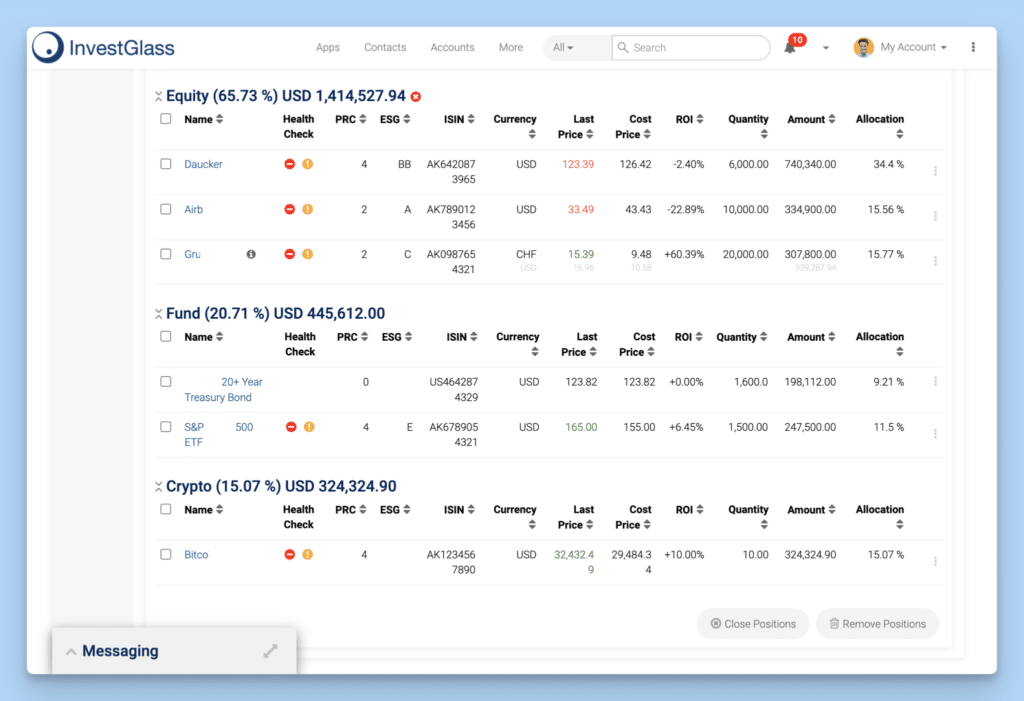
Portfolio Management System (PMS): For financial institutions, InvestGlass offers a sophisticated portfolio management system that integrates seamlessly with the CRM. This enables banks, asset managers, and wealth advisors to manage client portfolios, track performance, and ensure compliance from a single platform.
Digital Onboarding: The digital onboarding capabilities of InvestGlass streamline the client intake process, automating data collection, verification, and compliance checks. This is particularly valuable for financial institutions subject to KYC (Know Your Customer) and AML (Anti-Money Laundering) requirements.
Marketing Automation: InvestGlass includes comprehensive marketing tools for email campaigns, SMS communications, and social media engagement, enabling organisations to attract, retain, and convert customers through targeted promotional techniques.
Client Portal: The customer portal functionality allows organisations to deliver personalised interactions and self-service capabilities to their clients, improving customer satisfaction while reducing operational costs.
Artificial Intelligence: InvestGlass incorporates AI capabilities to automate tasks, provide personalised recommendations, and enhance user experience across the platform.
Data Sovereignty Features
InvestGlass has been designed from the ground up with data sovereignty as a core principle. The platform offers multiple deployment options to meet the specific sovereignty requirements of each organisation:
Swiss Cloud Hosting: By default, InvestGlass data is hosted in secure Swiss data centres, benefiting from Switzerland’s robust legal protections and world-class infrastructure.
On-Premise Deployment: For organisations requiring the highest level of control, InvestGlass can be deployed on-premise, with data stored entirely on the organisation’s own servers within their own country.
Local Data Centre Options: InvestGlass can be hosted in local data centres in various countries, allowing Greek organisations to keep their data within Greek borders if required.
Data Encryption: Sensitive data is encrypted using industry-standard protocols, with organisations retaining control over their encryption keys.
Access Controls: Unique SUDO access controls ensure that organisations always maintain control over who can access their data.
InvestGlass vs. Salesforce and Microsoft: A Comprehensive Comparison
When evaluating CRM and digital transformation platforms, Greek organisations should carefully consider the differences between InvestGlass and US-based alternatives like Salesforce and Microsoft Dynamics.
Comparison Table
| Feature | InvestGlass | Salesforce | Microsoft Dynamics |
| Headquarters | Geneva, Switzerland | San Francisco, USA | Redmond, USA |
| Subject to CLOUD Act | No | Yes | Yes |
| GDPR Compliance | Native | Requires configuration | Requires configuration |
| On-Premise Option | Yes | Limited | Yes |
| Data Residency | Switzerland or customer choice | US or EU data centres | US or EU data centres |
| True Data Sovereignty | Yes | No | No |
| Industry Focus | Financial services, Government | General enterprise | General enterprise |
| Pricing Model | Transparent, scalable | Complex, expensive | Complex, expensive |
| Integration Ecosystem | 500+ integrations | Extensive | Extensive |
| Support | 24/7 with dedicated team | Tiered support | Tiered support |
Key Differentiators
Legal Jurisdiction: The most fundamental difference is legal jurisdiction. InvestGlass, as a Swiss company, operates under Swiss law and is not subject to US legislation. This provides a level of legal certainty and data protection that US companies simply cannot offer.
Industry Expertise: While Salesforce and Microsoft offer general-purpose CRM solutions, InvestGlass has been specifically designed for regulated industries such as banking, insurance, and government. This specialisation means the platform includes built-in compliance features and workflows tailored to these sectors.
Flexibility and Customisation: InvestGlass offers greater flexibility in deployment options and customisation capabilities. Organisations can choose exactly how and where their data is stored, and can customise the platform to match their specific processes without extensive development work.
Cost Effectiveness: Many organisations find that switching from Salesforce to InvestGlass results in significant cost savings, both in licensing fees and in reduced implementation and customisation costs.
European Values: InvestGlass is built on European values of privacy, data protection, and individual rights. The company’s commitment to these principles is reflected in every aspect of the platform’s design and operation.
InvestGlass for Greek Government and Public Administration
The Greek government’s digital transformation agenda creates significant opportunities for sovereign technology solutions. InvestGlass offers specific capabilities designed to meet the unique needs of government agencies and public administration.
Government-Specific Features
Citizen Relationship Management: InvestGlass enables government agencies to manage citizen interactions across multiple channels, providing a unified view of each citizen’s engagement with public services.
Digital Onboarding for Public Services: The platform’s digital onboarding capabilities can be leveraged for various government services, from tax collection to social welfare programmes, streamlining processes and reducing administrative burden.
Emergency Communication: InvestGlass provides tools for emergency communication, reporting, tracking, and coordination, enabling more efficient crisis response and recovery.
Document Management: Government agencies can use InvestGlass for secure document management, including the handling of sensitive citizen information and official records.
Embassy and Consular Services: For Greece’s diplomatic missions abroad, InvestGlass offers features for managing consular services, appointment scheduling, and citizen support.
Geopolitical Neutrality
InvestGlass positions itself as “The Geopolitical Safe Choice” for government agencies. As a Swiss company, InvestGlass operates from a position of political neutrality, without interference from any other governments. This neutrality is particularly valuable for government agencies that need to ensure their technology partners do not create geopolitical dependencies or vulnerabilities.
InvestGlass for Greek Financial Services
Greece’s financial sector is undergoing significant transformation, driven by regulatory requirements, changing customer expectations, and competitive pressures. InvestGlass provides a comprehensive solution for financial services organisations seeking to modernise their operations while maintaining the highest standards of compliance and data protection.
Banking and Wealth Management
InvestGlass has established itself as a trusted partner for banks and wealth management firms across Europe. Notable clients include Crédit Agricole Next Bank, which partnered with InvestGlass for lead management and CRM, and Arab Bank Switzerland, which selected InvestGlass for its digital onboarding solution.
The platform offers specific features for banking and wealth management:
Client Lifecycle Management: From initial onboarding through ongoing relationship management to eventual offboarding, InvestGlass supports the complete client lifecycle.
Portfolio Management: Integrated portfolio management tools enable wealth managers to track client investments, analyse performance, and generate reports.
Compliance Automation: Built-in compliance features help financial institutions meet regulatory requirements, including KYC, AML, and suitability assessments.
Advisory Tools: InvestGlass provides tools to support the advisory process, including risk profiling, investment recommendations, and client reporting.
Insurance
For insurance companies, InvestGlass offers capabilities for policy management, claims processing, and customer service, all within a sovereign and compliant framework.
The Migration Path: Switching from US Providers to InvestGlass
For Greek organisations currently using Salesforce, Microsoft Dynamics, or other US-based CRM solutions, InvestGlass provides a structured migration path to achieve data sovereignty without disrupting business operations.
The Five Phases of Switching
InvestGlass has developed a proven methodology for migrating organisations from US platforms:
Phase 1: Assessment and Planning
The migration begins with a comprehensive assessment of the organisation’s current systems, data, and processes. This phase identifies what data needs to be migrated, what integrations need to be rebuilt, and what customisations are required.
Phase 2: Data Migration
Customer records, portfolios, transactions, and other data are exported from the existing platform and imported into InvestGlass. The InvestGlass team provides tools and support to ensure data integrity throughout the migration.
Phase 3: Integration Setup
Critical business applications are connected to InvestGlass using pre-built connectors or custom API integrations. With over 500 integrations available, most common business tools can be connected quickly.
Phase 4: Automation and Workflow Configuration
Existing automation rules, workflows, and business processes are recreated and optimised within InvestGlass. This often provides an opportunity to streamline and improve processes.
Phase 5: Training and Go-Live
The final phase includes comprehensive training for users and a supported go-live process to ensure a smooth transition.
Support Options
InvestGlass offers multiple support options for migration:
InvestGlass-Led: The InvestGlass team can manage the entire migration process, working directly with the organisation’s staff.
Partner-Led: InvestGlass has a network of certified partners who can manage migrations and provide ongoing support.
Hybrid: A combination approach where InvestGlass provides guidance and best practices while working alongside the organisation’s team or consulting partners.
Building a Sovereign Digital Future for Greece
As Greece continues its journey towards a fully digital future, the choices made today regarding technology partners and data infrastructure will have profound implications for decades to come. The convenience of US cloud giants is tempting, but the inherent risks to data privacy, regulatory compliance, and national sovereignty cannot be ignored.
The Strategic Imperative
Greek organisations whether government agencies, financial institutions, or private enterprises must recognise that digital sovereignty is not merely a technical consideration but a strategic imperative. The data generated by Greek citizens and businesses represents significant value, and ensuring that this data remains under Greek and European control is essential for:
•Protecting citizens’ fundamental rights to privacy and data protection
•Maintaining control over critical national infrastructure
•Ensuring compliance with European regulations
•Building trust in digital services
•Fostering a competitive and innovative Greek digital economy
InvestGlass as a Strategic Partner
By choosing InvestGlass, Greek organisations gain more than just a technology platform. They gain a strategic partner committed to the principles of data sovereignty, privacy, and European values. InvestGlass’s Swiss heritage provides the legal certainty and neutrality that US providers cannot offer, while its comprehensive feature set ensures that organisations have the tools they need to succeed in the digital economy.
The path to a prosperous and sovereign digital future for Greece lies in partnering with trusted European technology providers who share its values and respect its laws. InvestGlass represents exactly this kind of partnership a Swiss-made solution designed for European needs, built on principles of sovereignty, security, and trust.
Frequently Asked Questions (FAQ)
1. What is digital sovereignty and why is it important for Greece?
Digital sovereignty refers to the ability of a nation or organisation to have control over its digital destiny, including data, infrastructure, and the legal frameworks governing them. For Greece, digital sovereignty is crucial for protecting citizens’ data, ensuring national security, maintaining regulatory compliance, and building a competitive digital economy that serves Greek interests.
2. What is the conflict between the US CLOUD Act and GDPR?
The US CLOUD Act allows American authorities to compel US companies to provide access to data stored anywhere in the world. This directly conflicts with the GDPR, which restricts data transfers outside the EU and requires that any such transfers have a valid legal basis. This conflict creates legal uncertainty for organisations using US cloud providers.
3. How does InvestGlass solve the data sovereignty problem?
As a Swiss company, InvestGlass is not subject to the US CLOUD Act or any equivalent foreign legislation. The platform offers true data sovereignty by allowing organisations to host their data in Switzerland or on their own servers, ensuring full GDPR compliance without the legal risks associated with US providers.
4. What are the key features of InvestGlass?
InvestGlass offers a comprehensive suite of tools including CRM, portfolio management system (PMS), digital onboarding, marketing automation, client portal, and AI capabilities. All features are designed with security, compliance, and flexibility as core principles.
5. Is InvestGlass suitable for Greek government agencies?
Yes, InvestGlass is an ideal solution for government agencies due to its on-premise hosting options, robust security features, political neutrality, and commitment to data sovereignty. The platform includes specific features for citizen relationship management, digital public services, and emergency communication.
6. Can Greek financial institutions use InvestGlass?
Absolutely. InvestGlass has been specifically designed for regulated industries including banking, wealth management, and insurance. The platform includes built-in compliance features for KYC, AML, and other regulatory requirements, and is already used by major European financial institutions.
7. How does InvestGlass compare to Salesforce in terms of data protection?
Unlike Salesforce, which is subject to the US CLOUD Act, InvestGlass operates under Swiss law and is not subject to foreign government data access requests. This fundamental difference means InvestGlass can provide genuine data sovereignty and GDPR compliance that Salesforce cannot guarantee.
8. Can I migrate from Salesforce or Microsoft Dynamics to InvestGlass?
Yes, InvestGlass provides a structured migration path with dedicated support. The migration process includes data transfer, integration setup, workflow configuration, and user training. Many organisations have successfully migrated from US platforms to InvestGlass.
9. Where is InvestGlass data hosted?
InvestGlass offers flexible hosting options including Swiss cloud hosting, on-premise deployment on the organisation’s own servers, and local data centre options in various countries. Organisations can choose the option that best meets their sovereignty requirements.
10. How can Greek organisations get started with InvestGlass?
Greek organisations interested in InvestGlass can visit investglass.com to learn more about the platform’s capabilities. The InvestGlass team offers demonstrations, consultations, and free trials to help organisations evaluate the solution for their specific needs.
This article was prepared to provide Greek organisations with comprehensive information about digital sovereignty and the benefits of Swiss-made technology solutions. For more information about InvestGlass and its capabilities, visit investglass.com or contact the InvestGlass team directly.

