The Cayman Islands, a titan of international finance, has built its formidable reputation on a foundation of unshakeable stability, deep-seated expertise, and an unwavering commitment to client confidentiality. As the financial world hurtles through a digital revolution, the very platforms that promise progress cloud services from US behemoths like Salesforce and Microsoft are quietly introducing a systemic vulnerability that strikes at the heart of the jurisdiction’s core principles: the erosion of digital sovereignty. This comprehensive analysis delves into the critical imperative of digital sovereignty for the Cayman Islands’ financial services industry, dissecting the profound risks of technological dependency and presenting InvestGlass, a Swiss-hosted sovereign platform, as the definitive and strategic solution to fortify its digital future.
In this article, you will gain a deep understanding of:
•The intricate data sovereignty challenges and the stringent regulatory landscape confronting the Cayman Islands’ financial sector.
•The explicit and unavoidable risks posed by the US CLOUD Act and the jurisdiction’s reliance on American technology providers.
•How a truly sovereign Swiss solution like InvestGlass provides a fortified, compliant, and functionally superior alternative.
•A detailed exploration of the key features that establish InvestGlass as the premier all-in-one platform for modern financial institutions.
•The broader regional context and why embracing digital sovereignty is a strategic imperative for the entire Caribbean.
The Cayman Islands’ Digital Dilemma: Balancing Technological Advancement and Enduring Trust
The Cayman Islands’ success as a financial centre is no accident. It is the result of a meticulously crafted legal and regulatory environment that inspires global confidence. The Data Protection Act (DPA), 2021 Revision, is a cornerstone of this framework. Enacted in 2019, the DPA is a sophisticated piece of legislation, harmonised with international data privacy standards like the GDPR, which governs the processing of personal data with stringent, principle-based rules. It enshrines privacy as a fundamental right, a principle deeply embedded in the Cayman Islands’ Constitution. This legal rigour is enforced by the Cayman Islands Monetary Authority (CIMA), which provides robust oversight and has issued specific, detailed guidance on cybersecurity, risk management, and the outsourcing of material functions for the entities it regulates. This unwavering commitment to data protection is not merely a matter of legal compliance; it is the very essence of the jurisdiction’s brand and its promise to the world.
However, the inexorable global migration to cloud computing has introduced a complex and perilous new variable into this carefully balanced equation. The hyper-scale cloud infrastructures offered by American giants such as Microsoft (Azure) and Salesforce, while offering undeniable benefits in scalability and computational power, are fundamentally bound by the laws of their home country. This creates a direct and irreconcilable conflict with the principles of data confidentiality and legal certainty that are the lifeblood of Cayman’s financial industry. The market’s recognition of this vulnerability is growing, evidenced by the establishment of local data centres offering residency and the flourishing of initiatives like Cayman Enterprise City, which are dedicated to nurturing a self-sufficient local technology ecosystem. Financial institutions now find themselves at a critical juncture, compelled to innovate and digitise their operations without fracturing the foundational promise of data privacy that underpins their clients’ trust.
The CIMA Imperative: Regulatory Red Lines on Outsourcing and Data Risk
The Cayman Islands Monetary Authority (CIMA) has made its position unequivocally clear: outsourcing a function does not mean outsourcing responsibility. The Board and Senior Management of a regulated entity remain fully accountable for all outsourced activities. CIMA’s Statement of Guidance on Outsourcing (April 2023) establishes a set of minimum expectations that create a high bar for any outsourcing arrangement, particularly those involving technology and data.
This guidance is not a mere suggestion; it is a framework against which regulated entities will be judged. A close examination of its key tenets reveals a fundamental incompatibility with the legal realities of using US-based cloud providers.
The Gauntlet of CIMA’s Outsourcing Guidance
1. Comprehensive Risk Assessment: Before engaging any service provider, CIMA mandates a thorough risk assessment. This isn’t a simple box-ticking exercise. It requires a deep evaluation of the provider’s home jurisdiction’s legal and regulatory landscape. For any Cayman firm using a US cloud provider, this assessment must explicitly identify the US CLOUD Act as a significant, inherent legal risk that is practically impossible to mitigate.
2. Rigorous Due Diligence: The guidance demands extensive due diligence on the provider’s financial stability, technical competence, and, most importantly, their ability to comply with the regulated entity’s obligations under Cayman law, including the DPA. A US provider, subject to the CLOUD Act, cannot, by definition, guarantee its ability to uphold the confidentiality requirements of Cayman law in all circumstances.
3. The Sanctity of the Written Agreement: CIMA requires a legally binding written agreement that contains several critical clauses:
•Unrestricted Access: The agreement must grant the regulated entity, its auditors, and CIMA itself timely and unrestricted access to the service provider’s relevant information, records, and systems. This is a non-negotiable requirement for regulatory oversight. However, a US provider’s ability to grant such access could be restricted or superseded by a US national security order or a warrant under the CLOUD Act, creating a direct contractual and regulatory conflict.
•Governing Law and Jurisdiction: The contract must specify the governing law. While a Cayman firm would insist on Cayman law, the legal reality is that a US court order under the CLOUD Act would override such a clause for a US company.
•Data Protection and Confidentiality: The agreement must ensure data is protected in line with the DPA. As Microsoft’s own executive admitted, a US company cannot guarantee this protection when faced with a lawful US data request.
•Orderly Exit and Data Repatriation: The contract must detail a clear exit strategy, ensuring the regulated entity can retrieve all its data and transfer the function without disruption. The potential for data to be locked or accessed during a legal dispute with a foreign power adds a layer of unacceptable risk to this process.
Failure to meet these stringent requirements is not just a business risk; it is a direct regulatory breach. CIMA’s framework effectively draws a red line, making it clear that true data sovereignty is a prerequisite for compliant outsourcing. Relying on a provider that cannot contractually and legally guarantee these points is a gamble with regulatory sanction and reputational ruin.
The Sword of Damocles: Unpacking the Inescapable Risks of US Hyperscalers
The single greatest threat to the data sovereignty of any organisation utilising US-based cloud services is a piece of legislation known as the Clarifying Lawful Overseas Use of Data (CLOUD) Act. Passed into law in 2018, this act grants US federal law enforcement agencies sweeping authority to compel US-based technology companies to produce requested data, irrespective of where that data is physically stored on the globe. The implications are chillingly clear: sensitive, confidential client information entrusted to a Cayman financial institution be it a bank, a fund administrator, or a trust company and stored on a Microsoft Azure or Salesforce server, is subject to seizure by US authorities. The physical location of the server, whether in a European data centre or even one located within the Cayman Islands itself, offers no protection.
This is not a hypothetical or exaggerated threat. It is a documented and admitted reality. In a moment of startling candour before the French Senate, a senior Microsoft executive, under oath, made the stunning admission that the company cannot guarantee that data belonging to French citizens would be shielded from US government access. When pressed on whether Microsoft would be obligated to transmit data if presented with a legally sound injunction from US authorities, the response was unequivocal: “Absolutely.” This testimony strips away the marketing veneer of ‘data residency’ and exposes the raw legal reality: for any US-headquartered company, the duty to comply with US law will always supersede any contractual privacy assurances made to foreign clients.
For a Cayman-based financial institution, the consequences of this legal entanglement are severe and multi-faceted:
•A Fundamental Breach of Client Confidentiality: The very ability to uphold the sacred duty of confidentiality is compromised. The promise of privacy, a cornerstone of the client relationship in wealth management and offshore finance, is rendered hollow.
•Acute Regulatory and Compliance Risk: Storing client data with a service provider that cannot guarantee sovereignty creates a direct conflict with CIMA’s stringent guidelines on outsourcing and data protection. This exposes the institution to significant regulatory scrutiny, potential enforcement actions, and substantial financial penalties.
•Irreparable Reputational Damage: The mere perception that client data is not absolutely secure can inflict catastrophic damage on an institution’s reputation. In the world of high-finance, trust is the most valuable currency, and once lost, it is almost impossible to regain. This risk extends to the jurisdiction of the Cayman Islands as a whole.
A Stark Contrast: US Cloud vs. Sovereign Cloud
The table below provides a clear, at-a-glance comparison of the fundamental differences between relying on US cloud providers and adopting a true sovereign solution.
| Feature | US Cloud Providers (e.g., Salesforce, Microsoft) | Swiss Sovereign Provider (InvestGlass) |
| Governing Legal Jurisdiction | United States Federal Law | Swiss Federal Law |
| Exposure to US CLOUD Act | Direct and unavoidable; data access can be legally compelled. | None. Governed by strict Swiss law, which does not recognise foreign subpoenas automatically. |
| Guarantee of Data Sovereignty | Cannot be guaranteed, as publicly admitted by Microsoft. | Fully guaranteed through Swiss-based hosting or on-premise deployment. |
| Core Design Philosophy | Generic, one-size-fits-all business software for a global mass market. | Purpose-built from the ground up for the specific compliance, security, and workflow needs of the financial services industry. |
| Deployment and Control | Primarily public cloud, with limited and often complex ‘sovereign’ offerings that do not eliminate US jurisdiction. | Flexible deployment: a secure Swiss private cloud or a client-controlled on-premise installation for ultimate control and sovereignty. |
The Swiss Aegis: Why InvestGlass is the Strategic and Sovereign Choice for Cayman’s Financial Future
In the face of these undeniable risks, InvestGlass stands out as the clear, strategic, and technologically superior alternative. Conceived and engineered in Geneva, Switzerland a nation synonymous with privacy, legal precision, and financial stability InvestGlass is a comprehensive, integrated platform designed specifically to deliver true digital sovereignty to the global financial services industry.
InvestGlass was built to directly counter and neutralise the existential threat posed by extra-territorial legislation like the US CLOUD Act. It achieves this through a flexible and uncompromisingly sovereign architecture, offering two distinct deployment models:
1.The Swiss Private Cloud: All client data is hosted in state-of-the-art, ISO 27001-certified data centres located exclusively within the sovereign territory of Switzerland. This places the data firmly and exclusively under the protection of Swiss law, which is renowned for its robust data privacy protections and does not grant automatic authority to foreign legal demands or subpoenas.
2.On-Premise Deployment: For institutions that demand the absolute zenith of control, InvestGlass can be installed directly onto their own servers. This could be within the institution’s own data centre in the Cayman Islands or another secure, client-controlled location. This model provides the ultimate expression of data sovereignty, as the institution retains complete physical, logical, and legal control over its entire technology stack.
However, the power of InvestGlass extends far beyond its sovereign foundations. It is a powerful, all-in-one solution engineered to streamline and automate the entire client lifecycle, thereby obviating the need for a patchwork of multiple, disconnected, and often insecure software tools. Its seamlessly integrated modules provide a unified and powerful operational hub:
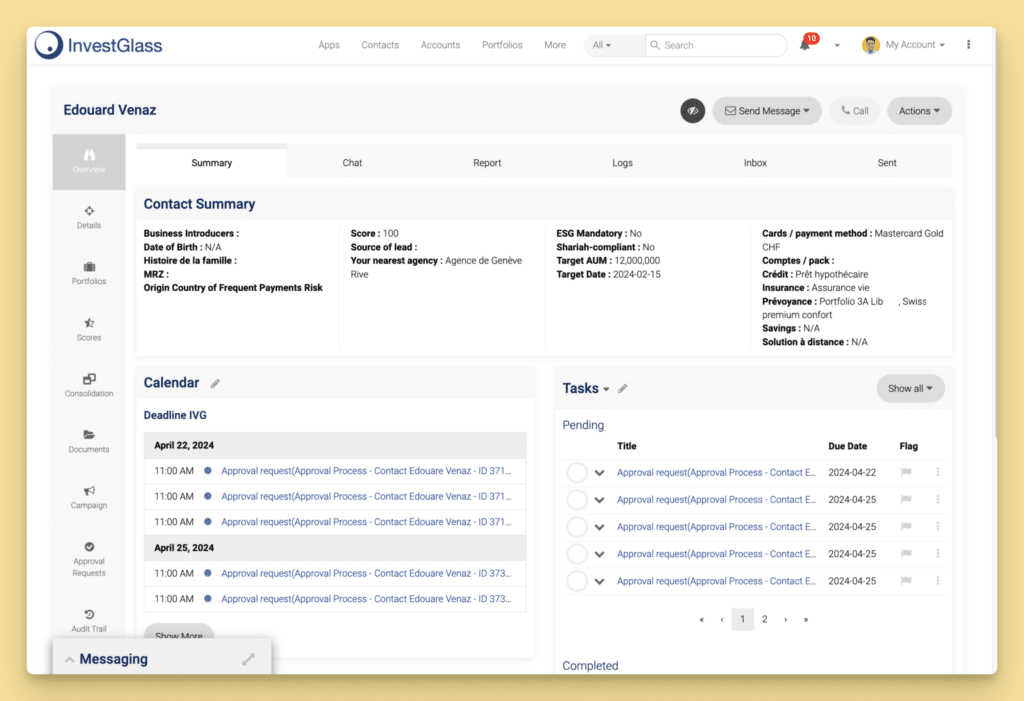
•A CRM Built for Finance: This is not a generic sales tool retrofitted for finance. It is a purpose-built Customer Relationship Management system designed to understand and manage complex multi-generational family relationships, intricate trust structures, risk profiles, ESG preferences, and detailed investment mandates.
•Frictionless Digital Onboarding & KYC: InvestGlass offers a sophisticated, yet easy-to-use, no-code solution for onboarding clients digitally. It automates the entire Know Your Customer (KYC) and Anti-Money Laundering (AML) process, from data collection and document verification to risk scoring, all while ensuring every piece of data remains within the secure, auditable, and compliant ecosystem.
•Integrated Portfolio Management (PMS): The platform includes a comprehensive PMS that provides a 360-degree view of client portfolios, including positions, performance analytics, and risk metrics. This data is fully integrated with the client’s CRM profile, empowering advisors with the context they need to provide informed, high-value advice.
•A Secure Client Portal: InvestGlass provides a secure, custom-branded digital gateway for clients. Through this portal, clients can access their portfolio information, download statements, securely share documents with their advisors, and engage in encrypted communication, fostering transparency and trust.
•Compliant Marketing Automation: The platform includes a sophisticated marketing automation engine designed for the regulatory realities of the financial world. It enables targeted, personalised communication while strictly adhering to banking secrecy laws and respecting granular client opt-in preferences.
For financial institutions contemplating the necessary move away from compromised US providers, InvestGlass provides a clear, proven, and structured migration pathway. The platform is equipped with robust tools and methodologies for switching from Salesforce and other legacy CRM systems, ensuring a seamless and secure transition without business disruption or data integrity risks.
A Regional Clarion Call: The Caribbean’s Collective Push for Digital Autonomy
The Cayman Islands’ urgent need to secure its digital sovereignty is not an isolated phenomenon. It is a leading indicator of a much broader strategic awakening across the entire Caribbean. As influential regional bodies like CARICOM have highlighted, there is a growing and astute recognition that an over-reliance on foreign-controlled digital infrastructure represents a profound and unacceptable risk to economic stability, national security, and regional self-determination. The ability of foreign powers to impose digital sanctions or gain access to sensitive data is a threat that can no longer be ignored.
By choosing a truly sovereign solution like InvestGlass, the financial institutions of the Cayman Islands are doing more than just protecting their own businesses; they are acting as pioneers, forging a path towards greater digital and economic autonomy for the entire region. This strategic shift towards technological self-reliance resonates deeply with the needs of other critical sectors, including government bodies that require robust, secure, and sovereign platforms to manage public services and protect citizen data. The versatility of the InvestGlass platform, as demonstrated by its dedicated CRM for Government, underscores its capacity to serve as a foundational technology for a new era of regional digital independence.
The Business Case for Sovereignty: Beyond Compliance to Competitive Advantage
While the compliance and risk mitigation arguments for adopting a sovereign cloud solution are compelling on their own, the business case extends far beyond simply avoiding regulatory penalties. Embracing a platform like InvestGlass is not a defensive move; it is a proactive strategy that builds a stronger, more resilient, and more profitable business.
Calculating the Total Cost of Ownership (TCO)
A common misconception is that a specialized, sovereign solution is inherently more expensive than a mass-market US cloud product. This view fails to consider the total cost of ownership. A platform like Salesforce, while seemingly straightforward at the outset, often requires a vast and costly ecosystem of third-party add-ons, consultants, and custom development to make it suitable for the nuanced world of financial services. These hidden costs quickly accumulate.
InvestGlass, by contrast, is an all-in-one solution. The functionalities that would require multiple paid add-ons in the Salesforce ecosystem such as a client portal, portfolio management views, and compliant marketing automation are integrated into the core InvestGlass platform. This consolidation leads to:
•Reduced Subscription Fees: One predictable subscription replaces a multitude of disparate and often escalating vendor costs.
•Elimination of Integration Costs: The seamless integration between modules eliminates the need for expensive and fragile custom integrations, which are a constant source of maintenance headaches and security vulnerabilities.
•Lower Implementation and Customization Costs: Because InvestGlass is purpose-built for finance, it requires significantly less customization to meet the industry’s specific needs, leading to faster, more cost-effective implementations.
Enhancing Operational Efficiency and Advisor Productivity
The fragmentation of data across multiple systems is a major drag on productivity. Relationship managers waste valuable time toggling between their CRM, their portfolio management system, their compliance checklists, and their email. This context-switching is inefficient and increases the risk of errors.
InvestGlass solves this by creating a single, unified interface a ‘single source of truth’ for all client-related information. When a relationship manager can see a client’s portfolio, their risk profile, their recent communications, and any outstanding compliance tasks all in one place, the benefits are immediate:
•More Time for Clients: Advisors spend less time on administrative tasks and more time on high-value activities like building relationships and providing strategic advice.
•Improved Decision-Making: With a complete and contextualized view of the client, advisors can make better, more informed decisions, leading to improved client outcomes.
•Enhanced Compliance: The integrated nature of the platform ensures that compliance is not an afterthought but is woven into the daily workflow of every user, reducing the risk of inadvertent breaches.
Building a Brand on Trust and Security
In the competitive landscape of global finance, trust is the ultimate differentiator. By proactively choosing a sovereign solution, a Cayman financial institution sends a powerful message to its clients and the market:
We take your privacy more seriously than anyone else. This is not just a marketing slogan; it is a demonstrable fact, proven by the technological and legal architecture that underpins the business. In a world of increasing geopolitical instability and digital espionage, the ability to offer clients a true safe haven for their data is a powerful competitive advantage.
Conclusion: Forging a Secure, Sovereign, and Prosperous Digital Future
The digital transformation of the global financial system presents both immense opportunities and significant perils. For the Cayman Islands’ esteemed financial sector, the path forward must be navigated with strategic foresight and an uncompromising commitment to its core principles. The risks associated with US-based cloud providers are no longer a matter of speculation; they are a documented, admitted, and unavoidable reality. To continue to build the future of Cayman finance on such a compromised foundation is an untenable position for an industry whose very existence is predicated on trust and confidentiality.
InvestGlass offers a solution that is not merely a piece of software, but a profound strategic advantage. It represents a steadfast commitment to true digital sovereignty, a technologically advanced and compliant operational framework, and a powerful catalyst for growth and efficiency. By embracing a Swiss sovereign solution, the financial institutions of the Cayman Islands can confidently accelerate into the digital future, secure in the knowledge that their clients’ most sensitive data and their own hard-won reputation is protected by the highest global standards of privacy, security, and law. The moment to declare digital independence and fortify the future of Cayman finance is now.
Frequently Asked Questions (FAQs)
1. What exactly is digital sovereignty and why is it so critical for the Cayman Islands?
Digital sovereignty is the fundamental principle that a nation’s or an organization’s digital assets and data are subject to the exclusive laws and governance of its own jurisdiction. For the Cayman Islands’ financial sector, it is critical because it ensures that the promise of client confidentiality the bedrock of its industry is not undermined by foreign laws like the US CLOUD Act, which could compel the disclosure of sensitive data.
2. I thought using a data centre in Europe or locally made my data safe. Is this not the case?
No, this is a common and dangerous misconception. The US CLOUD Act’s jurisdiction applies to the company providing the service, not the physical location of the data centre. If your cloud provider is a US-based company like Microsoft or Salesforce, your data is subject to US law, regardless of where the server is located.
3. How does InvestGlass, as a Swiss company, legally protect my data from foreign government requests?
InvestGlass, being a Swiss company with data hosted in Switzerland, operates under Swiss law. Switzerland has some of the world’s most stringent data privacy laws and does not automatically recognise or comply with foreign subpoenas. Any request for data must go through a formal, rigorous Swiss legal process (Mutual Legal Assistance Treaty), which provides a high barrier of protection that is absent with US providers.
4. We are a small to mid-sized firm. Is a platform like InvestGlass affordable and manageable for us?
Absolutely. InvestGlass is designed to be scalable and offers a lower total cost of ownership (TCO) than many alternatives. By consolidating the functions of multiple different software systems (CRM, PMS, Onboarding, Portal, Marketing) into one integrated platform, it reduces subscription costs, eliminates integration headaches, and improves operational efficiency, making it a cost-effective solution for firms of all sizes.
5. Our firm has highly customised workflows. Can InvestGlass adapt to our specific needs?
Yes. Flexibility is a core design principle of InvestGlass. The platform is highly configurable, featuring no-code tools for building digital forms, custom fields, and automated workflows. This allows financial institutions to tailor the platform to their unique business processes and compliance requirements without the need for expensive, time-consuming custom development projects.
6. What is the process for migrating from our current CRM, like Salesforce, to InvestGlass?
InvestGlass has a proven and structured migration methodology. The process typically involves a data audit, mapping of data fields, test imports to validate data integrity, and user training. The InvestGlass team provides expert support throughout the process to ensure a smooth, secure, and minimally disruptive transition from legacy systems.
7. How does the on-premise deployment option enhance our security and sovereignty?
The on-premise option provides the ultimate level of control. By installing the InvestGlass software on your own servers within your own data centre (e.g., in the Cayman Islands), you retain complete physical, network, and legal control over your data and the entire application stack. This completely removes any third-party cloud provider from the sovereignty equation.
8. Beyond sovereignty, what is the single biggest business advantage of using an integrated platform like InvestGlass?
The single biggest advantage is the creation of a ‘single source of truth’ for all client information. When your CRM, portfolio data, compliance documents, and communication history are all in one place, your relationship managers can deliver a higher level of service, your compliance team can operate more efficiently, and your management can make better-informed strategic decisions.
9. How does InvestGlass keep up with evolving financial regulations?
As a platform built specifically for the financial industry, regulatory compliance is at the core of InvestGlass’s development roadmap. The team constantly monitors the global regulatory landscape (including changes from bodies like CIMA, FINMA, and the EU) and updates the platform to ensure its clients have the tools they need to remain compliant.
10. How can we start the conversation with InvestGlass?
The best way to begin is to request a personalised demo. This will allow the InvestGlass team to understand your specific challenges and demonstrate how the platform can be configured to meet the unique needs of your institution, ensuring a perfect fit for your sovereignty and operational requirements.
Deep Dive: A Clause-by-Clause Analysis of CIMA’s Guidance vs. US Cloud Realities
To fully appreciate the chasm between CIMA’s expectations and what US cloud providers can legally offer, a more granular, clause-by-clause examination of the Statement of Guidance (SoG) on Outsourcing is necessary. This deep dive reveals that the conflict is not a matter of interpretation but a hard-coded legal reality.
The Due Diligence Mandate: An Impossible Hurdle
Section 5 of the SoG requires a regulated entity to conduct exhaustive due diligence. This includes assessing the “legal and regulatory environment of the country in which the service provider is located.” When the service provider is a US company, this due diligence, if performed honestly, must conclude that the legal environment includes a law (the CLOUD Act) that is fundamentally at odds with the principles of Cayman’s DPA. The due diligence process must also assess the provider’s “ability to protect the confidentiality of the regulated entity’s information.” A US provider cannot, in good faith, attest that it has an absolute ability to do so. It can only state that it will protect the data to the extent permitted by US law, which is a critically different and insufficient assurance.
The ‘Unrestricted Access’ Clause: A Contractual Impasse
Section 6.1(j) of the SoG is perhaps the most direct point of conflict. It mandates that the outsourcing agreement must secure for the regulated entity, its auditors, and CIMA, “timely, unrestricted, and direct access to any relevant information, data, records, systems, and premises of the service provider.” The word “unrestricted” is key. A US cloud provider operates under a legal framework where access can be, and is, restricted by government and judicial orders. A provider cannot contractually promise “unrestricted” access to CIMA when a US court could simultaneously be issuing a secret warrant prohibiting the disclosure of that very access to the foreign regulator. Attempting to write such a clause into a contract with a US provider would be to create a legal fiction, a promise that the provider knows it may be legally prohibited from keeping.
Governing Law: A Battle of Jurisdictions
Section 6.1(p) requires the agreement to specify the governing law. A Cayman entity will naturally insist on Cayman Islands law. The US provider will agree. However, this contractual agreement on governing law for disputes between the two parties does not negate the provider’s statutory obligations under US federal law. In a conflict between a contractual obligation to a foreign client under Cayman law and a legal obligation to the US government under the CLOUD Act, US law will prevail for the US company. The governing law clause, therefore, provides a false sense of security. It governs the commercial relationship but offers no shield against the jurisdictional overreach of a foreign state.
This detailed analysis shows that compliance with CIMA’s SoG is not a matter of clever contract drafting. It is a matter of fundamental legal and jurisdictional alignment. The framework is implicitly designed to favor providers from jurisdictions with compatible legal structures and strong data privacy laws, like Switzerland, while making it demonstrably difficult for regulated entities to compliantly use providers from jurisdictions with conflicting legal obligations, like the United States. For a Cayman financial institution, the choice is becoming increasingly clear: align with a provider that is structurally compliant, or assume a significant and ongoing regulatory risk.

