
What You Will Learn
- Understand the critical challenges financial institutions face in managing client accounts.
- Discover how InvestGlass provides a holistic solution for client account management.
- Explore the key features of InvestGlass that streamline and enhance account operations.
- Gain insights into the significant benefits of adopting InvestGlass for your organisation.
- Learn best practices for implementing InvestGlass to maximise its impact.
- See how InvestGlass outperforms traditional and legacy account management systems.
Introduction
This guide is intended for banking professionals, compliance officers, and IT decision-makers seeking to modernize their client account management systems. In today’s dynamic financial landscape, client account management software for banks is no longer a luxury but a fundamental necessity. Effective client account management software is critical for banks today due to increasing regulatory pressures (such as MiFID II, GDPR, and FINMA), rising customer expectations for digital-first, personalized service, and the ongoing digital transformation reshaping the industry. Financial institutions, from retail banks to sophisticated brokerage firms, are constantly seeking robust solutions to enhance client relationships, streamline operations, and ensure regulatory compliance.
This article delves into how InvestGlass, a leading Swiss-based sovereign CRM, portfolio management system (PMS), client portal, and digital onboarding platform, is transforming the way financial organisations manage their client accounts, offering an unparalleled blend of innovation, security, and user-centric design.
Summary: What Is Client Account Management Software for Banks and Why Is It Needed?
Aspect | Definition/Explanation |
|---|---|
What is Client Account Management Software for Banks? | A digital platform that enables banks and financial institutions to manage all aspects of client relationships, account data, compliance, and service delivery in a secure, centralised, and efficient manner. |
Why Is It Needed? | – To meet strict regulatory requirements (e.g., MiFID II, GDPR, FINMA)<br>- To deliver seamless, personalised, and digital-first customer experiences<br>- To eliminate data silos and manual inefficiencies<br>- To support digital transformation and future-proof operations |
How Does InvestGlass Fulfill This Need? | – Provides an all-in-one platform combining CRM, PMS, client portal, and digital onboarding<br>- Ensures Swiss data sovereignty and robust security<br>- Automates compliance, onboarding, and client communications<br>- Offers no-code/low-code customisation for rapid adaptation<br>- Delivers AI-powered insights and workflow automation |
Key Concepts and Definitions
- Client Account Management Software: A comprehensive digital solution that centralises and automates the management of client accounts, interactions, compliance, and data for banks and financial institutions.
- CRM (Customer Relationship Management): A system that helps banks manage customer data, track interactions, and nurture relationships throughout the customer lifecycle.
- PMS (Portfolio Management System): A platform for tracking, analysing, and reporting on client investment portfolios, often integrated with CRM for a unified client view.
- Sovereign Data: Data that is hosted and managed within a specific jurisdiction (e.g., Switzerland), ensuring compliance with local data protection laws and giving organisations full control over their information.
- No-Code/Low-Code: Software platforms that allow users to customise workflows, forms, and dashboards with minimal or no programming knowledge. For example, a bank can create a custom onboarding process using drag-and-drop tools rather than writing code.
These systems are interrelated: CRM manages client relationships and data, PMS handles investment portfolios, and both are integrated within client account management software to provide a seamless, compliant, and efficient banking experience. Sovereign data hosting ensures that all sensitive information remains secure and under the bank’s control.
Understanding the Banking Industry
The banking industry operates within a complex and highly regulated framework, where financial institutions and financial organizations face mounting pressure to deliver tailored solutions whilst maintaining strict regulatory compliance. To remain competitive, banks must prioritise investment in advanced customer relationship management products that enable them to manage client relationships with precision, support sophisticated sales processes, and maintain a flexible account structure that emphasises control and sovereignty.
Platforms designed specifically for the banking industry must offer comprehensive CRM functionality that streamlines operations and ensures compliance with regulatory requirements, particularly those that prioritise data sovereignty and secure infrastructure over foreign alternatives. A platform that integrates multiple functions and processes serves as a comprehensive solution for managing customer relationships and financial workflows, supporting digital transformation in financial services.
By leveraging such CRM platforms, banks can enhance customer satisfaction, improve client retention, and drive sustainable business growth through trusted, compliant systems. These solutions provide the essential tools needed to ensure regulatory compliance, personalise customer experiences, and support the entire customer lifecycle, positioning financial institutions for long-term success in a rapidly changing market where data sovereignty and operational control remain paramount for regulated organisations.
Transition: As the industry evolves, banks face a range of new challenges in client account management, which are explored in the next section.
The Evolving Landscape: Challenges in Client Account Management
Client account management in the financial services industry is increasingly complex due to stringent regulations, evolving customer expectations, and the need for digital transformation. Managing client accounts effectively requires more than just transactional processing; it demands a deep understanding of client needs, proactive communication, and seamless operational workflows.
Fragmented Systems and Data Silos
One of the most pervasive challenges is the reliance on disparate systems for various aspects of client management. Often, client data resides in multiple applications: one for CRM, another for portfolio management, a third for onboarding, and perhaps an outdated core banking system. This fragmentation leads to data inconsistencies, a lack of a unified client view, and the absence of unified data, making it difficult to provide consistent service across channels and further contributing to significant operational inefficiencies. Relationship managers spend valuable time navigating different interfaces and manually consolidating information, detracting from client-facing activities.
Key Insight
Fragmented data systems not only impede efficiency but also create a disjointed client experience, making it difficult for financial institutions to offer truly personalised services.
Regulatory Compliance and Risk Management
The regulatory burden on financial institutions is immense and ever-growing. Regulations such as MiFID II (Markets in Financial Instruments Directive II), GDPR (General Data Protection Regulation), and FINMA (Swiss Financial Market Supervisory Authority) impose strict requirements on client data handling, record-keeping, transparency, and reporting. Ensuring continuous compliance across all client accounts is a monumental task, especially when relying on manual checks and outdated systems. Non-compliance can result in hefty fines, reputational damage, and a loss of client trust. Risk management, including AML (Anti-Money Laundering) and KYC (Know Your Customer) processes, also demands robust, auditable systems.
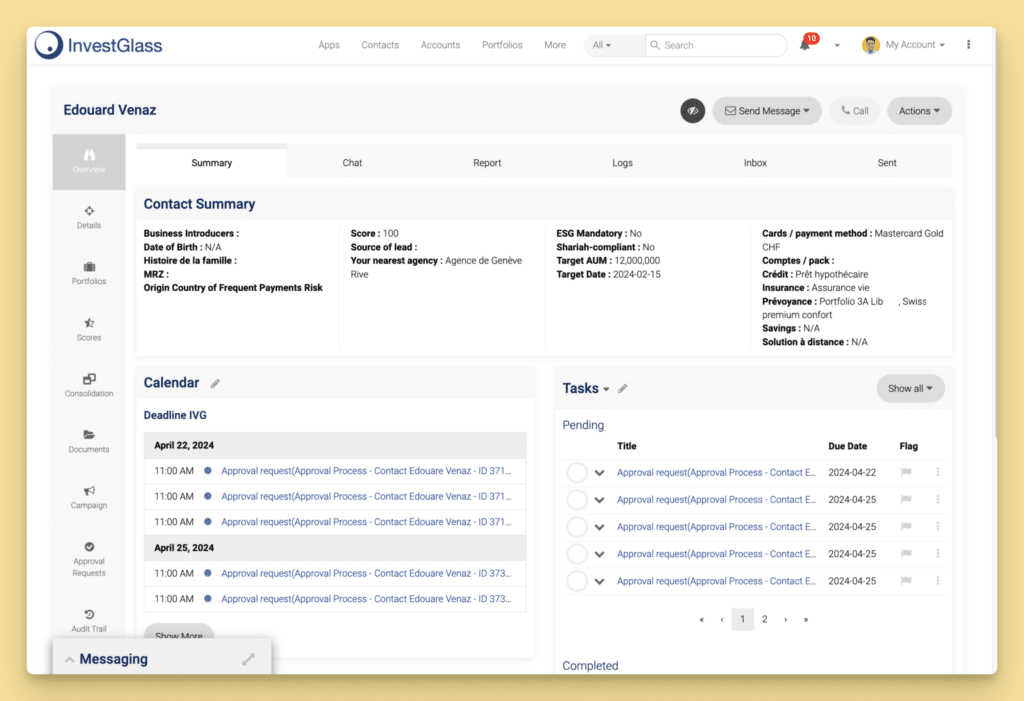
To address these challenges, banks require integrated compliance tools that seamlessly connect with their banking and CRM systems. These tools are essential for maintaining regulatory compliance, as they enable the tracking and documentation of customer interactions for audit and reporting purposes, helping financial institutions meet regulatory requirements and reduce operational risks.
Enhancing Client Experience and Personalisation
Modern clients expect a seamless, personalised, and digital-first experience from their financial providers. They want easy access to their account information, proactive advice, and efficient service delivery across multiple channels. Legacy systems often fall short in providing the necessary tools for deep client segmentation, personalised communication, and self-service capabilities. Leveraging insights into customer behavior enables banks to personalise customer experiences, provide personalised advice, and tailor offerings to individual client needs. This can lead to client dissatisfaction, churn, and a missed opportunity for cross-selling and up-selling, making the delivery of personalised service essential for improving satisfaction, retention, and ultimately driving customer retention.
Operational Inefficiencies and Cost Pressures
Manual processes, redundant data entry, and inefficient workflows are common in institutions using outdated account management systems, making it difficult for staff to efficiently complete tasks such as research, summarisation, and account updates. These inefficiencies translate directly into higher operational costs, longer processing times, and a greater risk of human error. The pressure to reduce costs while simultaneously improving service quality is a constant balancing act for financial institutions. Optimising operational efficiency through automation and streamlined processes is crucial for long-term sustainability.
Transition: To address these challenges, InvestGlass offers a comprehensive solution, as detailed in the next section.
InvestGlass: A Holistic Solution for Client Account Management
InvestGlass addresses these multifaceted challenges head-on by offering an integrated, all-in-one platform specifically designed for the complexities of financial services. Its comprehensive suite of tools encompasses CRM, portfolio management, a client portal, and digital onboarding, all unified under a single, secure architecture. This eliminates data silos, automates workflows, and provides a 360-degree view of every client account.
Swiss Data Sovereignty and Security
A key differentiator for InvestGlass is its commitment to Swiss data sovereignty. For financial institutions, data security and privacy are paramount. Hosting data in Switzerland, known for its stringent data protection laws, provides an unparalleled level of assurance regarding data integrity and confidentiality. This is particularly attractive for banks, broker-dealers, and wealth managers who handle sensitive client financial information.
Key Insight
Swiss data sovereignty offered by InvestGlass provides financial institutions with a competitive advantage in an era of heightened data privacy concerns, building unparalleled client trust.
All-in-One Platform Approach
Unlike solutions that require integrating multiple vendors, InvestGlass provides an end-to-end platform. This means that client data, from initial lead generation through onboarding, account management, portfolio tracking, and ongoing client communication, resides within a single ecosystem, eliminating the need to manage multiple systems and consolidating data into one platform. This unified approach vastly simplifies IT infrastructure, reduces integration costs, and ensures data consistency across all functions. It truly acts as a comprehensive broker client account management platform.
AI-Powered Automation and GPT Integration
InvestGlass leverages cutting-edge artificial intelligence and GPT integration to automate routine tasks, provide intelligent insights, and enhance client interactions. AI and automation deliver actionable insights, leverage advanced analytics, and provide data driven insights and data insights to improve decision-making and operational efficiency for banks. This includes automating document generation, compliance checks, personalised communication, and even assisting relationship managers with data analysis and predictive modelling. AI capabilities free up valuable human capital, allowing financial professionals to focus on higher-value activities.
No-Code/Low-Code Customisation
The platform’s no-code/low-code capabilities empower financial institutions to tailor the system to their specific needs without extensive programming knowledge. For example, a bank can use drag-and-drop tools to create a custom onboarding workflow or reporting dashboard. This flexibility allows for rapid adaptation to changing market conditions, regulatory requirements, and internal processes. Customisation can range from designing unique client onboarding workflows to creating bespoke reporting dashboards, ensuring the system perfectly aligns with the organisation’s operational framework.
Transition: Next, we explore the key features of InvestGlass that enable banks to optimise client account management.
Key Features of InvestGlass for Enhanced Account Management
InvestGlass boasts a rich set of features meticulously designed to optimise every aspect of client account management. Below is a summary of the core capabilities before diving into each in detail:
- Centralised CRM for unified client data and relationship management
- Integrated Portfolio Management System (PMS) for real-time investment oversight
- Secure, branded Client Portal for self-service and communication
- Digital Onboarding and KYC/AML automation for efficient client acquisition
- Document management and workflow orchestration
CRM Functionality for Client Accounts
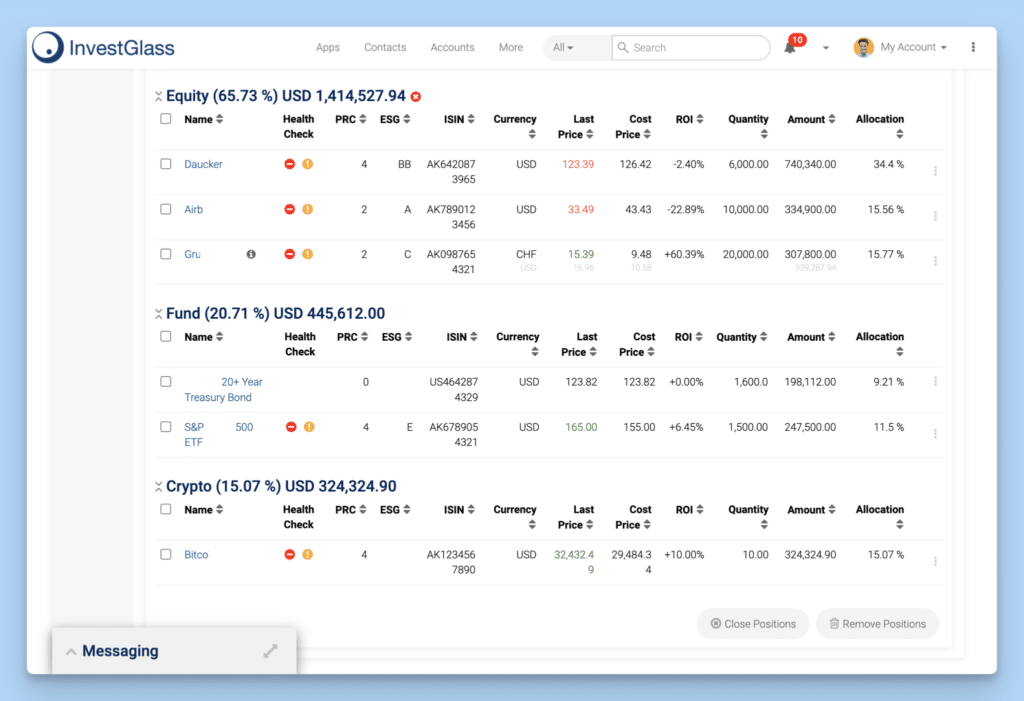
The core CRM within InvestGlass provides a centralised repository for all client information. This includes personal details, financial objectives, risk profiles, communication history, product holdings, and transactional data. Relationship managers gain a 360-degree view of each client, enabling them to understand needs better, anticipate requirements, and offer tailored advice.
Comprehensive Client Profiling
InvestGlass allows for detailed client profiling, capturing a wide array of data points essential for personalised service. This includes demographic information, financial goals (e.g., retirement planning, wealth accumulation, legacy planning), investment preferences, risk tolerance, and even behavioural insights derived from interactions. Such comprehensive profiling is vital for any bank CRM for managing customer accounts.
Activity Tracking and Communication History
Every interaction with a client, whether an email, phone call, meeting, or portal login, is automatically logged and tracked within the CRM. This creates a complete communication history, ensuring that all team members have access to the latest client context, preventing redundant inquiries, and improving continuity of service.
Lead Management and Sales Pipeline
Beyond existing accounts, InvestGlass also provides robust lead management tools. Financial advisors can track prospects through various stages of the sales pipeline, nurture relationships with targeted communication, and convert leads into new client accounts seamlessly.
Portfolio Management System (PMS)
For brokerage firms and wealth managers, the integrated PMS is a game-changer. It provides real-time tracking, analysis, and reporting of client portfolios, directly linked to their CRM profiles.
Real-time Portfolio Tracking
Clients’ investment portfolios can be monitored in real-time, displaying asset allocations, performance metrics, and market values. This immediate access to data allows advisors to react swiftly to market changes and client requests.
Performance Reporting and Analytics
InvestGlass generates comprehensive performance reports, offering insights into portfolio returns, risk-adjusted performance, and comparisons against benchmarks. Customisable dashboards allow advisors and clients to visualise key metrics easily.
Trade Execution and Order Management Integration
While InvestGlass is not an execution platform, it can integrate with existing trading systems, allowing for a streamlined workflow from portfolio analysis to order generation and execution, and then back to portfolio updates. This integration is crucial for a modern brokerage account management system for financial institutions.
Client Portal
The InvestGlass client portal is a secure, branded gateway that empowers clients with self-service capabilities and enhances transparency.
Secure Document Exchange
Clients can securely upload and download sensitive documents, such as statements, tax forms, and agreements, directly through the portal. This eliminates the need for insecure email exchanges and provides an auditable trail.
Account Access and Self-Service
Clients can view their account balances, portfolio holdings, transaction history, and performance reports at their convenience. The portal can also be configured to allow clients to initiate certain service requests or update their personal information, reducing the administrative burden on relationship managers.
Personalised Communication and Alerts
The portal serves as a channel for personalised communication, delivering relevant news, market insights, and account-specific alerts directly to the client. This proactive engagement fosters stronger client relationships.
Digital Onboarding and KYC Automation
Streamlining the onboarding process is critical for client acquisition and retention. InvestGlass offers a fully digital, compliant, and efficient onboarding solution.
Automated KYC and AML Checks
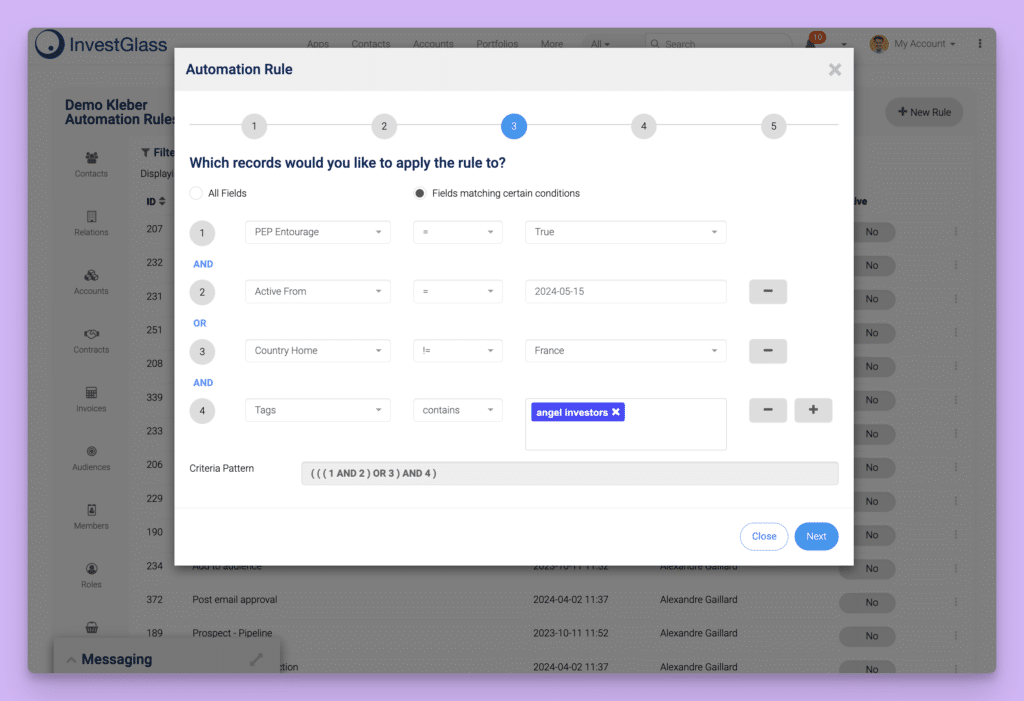
The platform automates much of the Know Your Customer (KYC) and Anti-Money Laundering (AML) process, integrating with third-party data providers for identity verification, sanction list screening, and risk assessments. This significantly reduces manual effort and speeds up compliance checks.
Digital Forms and E-Signatures
Clients can complete all necessary forms digitally, with pre-filled information where possible, and sign documents electronically. This eliminates paper-based processes, reduces errors, and accelerates the account opening timeline.
Workflow Orchestration
InvestGlass allows financial institutions to design and automate complex onboarding workflows, ensuring that all necessary steps, approvals, and compliance checks are completed in sequence, regardless of the complexity of the client or account type.
Transition: With these features, InvestGlass delivers a range of benefits for banks and financial institutions, as outlined in the next section.
Benefits of Adopting InvestGlass for Account Management
Implementing InvestGlass for client account management yields a multitude of benefits, translating into improved operational efficiency, enhanced client satisfaction, and stronger financial performance. The platform also empowers banks, including those in retail banking, to optimise their marketing efforts by consolidating customer data and enabling personalised interactions.
Enhanced Client Experience and Loyalty
- Provides a unified view of the client, personalised interactions, and a convenient client portal.
- Clients feel understood, valued, and empowered, leading to increased loyalty and reduced churn.
- The ability to access information and interact digitally aligns with modern client expectations.
Key Insight
A superior client experience, driven by InvestGlass’s integrated platform, is a powerful differentiator in a competitive market, fostering deeper relationships and long-term client loyalty.
Increased Operational Efficiency and Productivity
- Automation of routine tasks, streamlined workflows, and elimination of data silos free up valuable time for financial professionals.
- Relationship managers can dedicate more time to client engagement and strategic advice, rather than administrative overhead.
- This boost in productivity directly impacts the bottom line.
Improved Compliance and Risk Management
- Built-in compliance features, automated KYC/AML, audit trails, and secure data handling capabilities significantly reduce the risk of non-compliance.
- The platform ensures that institutions adhere to regulatory requirements like FINMA, MiFID II, and GDPR, safeguarding against penalties and reputational damage.
Data-Driven Decision Making
- With all client data consolidated and accessible, financial institutions can leverage powerful analytics to gain insights into client behaviour, investment trends, and market opportunities.
- This data-driven approach enables more informed decision-making, from product development to marketing strategies.
Scalability and Future-Proofing
- InvestGlass is designed to scale with the growth of your organisation.
- Its flexible architecture and no-code/low-code customisation ensure that the platform can adapt to evolving business needs and technological advancements, future-proofing your investment in client account management software.
Transition: To maximise these benefits, it is essential to follow best practices during implementation, as described in the next section.
Implementation Best Practices for InvestGlass
Successful implementation of InvestGlass requires careful planning, strategic execution, and a commitment to change management. The following steps outline best practices to ensure a smooth transition and maximise the return on investment.
Phased Rollout Strategy
- Define Clear Objectives: Clearly define what success looks like. Identify specific pain points and KPIs to measure the impact of InvestGlass.
- Pilot Programme: Start with a pilot group or department, gather feedback, refine processes, and then expand to other areas. This minimises disruption and allows for continuous improvement.
Data Migration and Integration
- Data Cleansing and Standardisation: Before migration, remove duplicates, correct inaccuracies, and standardise data formats to ensure clean, reliable data.
- API-First Approach: Utilise InvestGlass’s open API ecosystem for seamless integration with existing systems, ensuring real-time data synchronisation and avoiding manual data entry.
User Training and Support
- Tailored Training Modules: Develop training modules specific to different user roles (e.g., relationship managers, compliance officers).
- Post-Implementation Support: Establish clear channels for support, such as a help desk, FAQs, and a knowledge base, to address user queries and issues promptly.
Change Management and Communication
- Champion Programme: Identify and empower internal champions to advocate for InvestGlass and assist colleagues.
- Continuous Feedback Loop: Establish mechanisms for ongoing feedback from users to identify areas for improvement and adapt workflows as needed.
Transition: With a successful implementation, InvestGlass can be leveraged across a variety of financial institutions, as illustrated in the following use cases.
Real-World Use Cases for InvestGlass in Account Management
InvestGlass’s versatility makes it applicable across various financial institutions, each leveraging its capabilities to solve specific challenges and enhance their account management processes.
Retail Banks: Streamlining Customer Account Management
Use Case: Automated Customer Onboarding for Current Accounts
A retail bank uses InvestGlass to digitise its current account opening process. Prospective customers can complete all application forms online, upload necessary identification documents, and undergo automated KYC checks. E-signatures expedite the process, reducing account opening time from days to minutes. Relationship managers receive alerts for incomplete applications and can proactively follow up, improving conversion rates and customer satisfaction.
Wealth Management Firms: Enhancing High-Net-Worth Client Relationships
Use Case: Personalised Portfolio Reviews and Client Communication
A wealth management firm utilises InvestGlass’s integrated CRM and PMS to prepare for client meetings. Advisors access a 360-degree view of the client, including their financial goals, risk profile, and real-time portfolio performance. They can generate custom performance reports through the client portal and share them securely. AI-powered insights help advisors identify cross-selling opportunities for new investment products or estate planning services, fostering deeper client relationships.
Brokerage Firms: Optimising Broker Client Account Management
Use Case: Streamlined Trade Allocation and Reporting
A brokerage firm uses InvestGlass to manage its institutional and retail trading accounts. After executing block trades, the system facilitates efficient allocation to individual client accounts based on pre-defined mandates and preferences. Clients receive automated trade confirmations and daily portfolio updates via the secure client portal. Compliance officers can easily access audit trails of all trade allocations and client communications for regulatory reporting.
Private Banks: Ensuring Compliance and Discretion
Use Case: Digital Client Fact-Finding and Compliance Audits
A private bank employs InvestGlass for its digital fact-finding process during client reviews. Clients can securely update their financial situation, risk tolerance, and investment objectives through the portal. The system automatically flags any changes that require review by a relationship manager or compliance officer. For internal and external audits, all client data, communication logs, and compliance checks are readily accessible, ensuring adherence to FINMA and GDPR regulations. This makes it an invaluable bank CRM for managing customer accounts.
Investment Firms: Centralising Client Data and Portfolio Oversight
Use Case: Unified Investor Relations and Reporting
An investment firm manages several funds and mandates. InvestGlass provides a single platform to manage all investor relations, track capital commitments, and distribute fund reports. Investors can log into the client portal to view their holdings, fund performance, and download quarterly reports. Relationship managers use the CRM to track investor queries and ensure timely responses, enhancing transparency and investor confidence.
Transition: To further clarify the advantages of InvestGlass, the following section compares it to traditional and legacy account management approaches.
InvestGlass vs. Traditional/Legacy Approaches to Account Management
To truly appreciate the value of InvestGlass, it’s helpful to compare its capabilities against traditional or legacy approaches that many financial institutions still employ. The contrast highlights the significant advancements and efficiencies offered by a modern, integrated platform.
Feature/Aspect | Traditional/Legacy Approaches | InvestGlass Approach |
|---|---|---|
Data Management | Fragmented across disparate systems; data silos common. | Unified, all-in-one platform; single source of truth for client data. |
Client View | Incomplete; requires manual aggregation from multiple sources. | 360-degree view; comprehensive client profile readily available. |
Operational Efficiency | Manual processes, redundant data entry, high administrative burden. | Automated workflows, AI-powered assistance, reduced manual effort. |
Client Onboarding | Paper-based, slow, prone to errors, high compliance risk. | Fully digital, automated KYC/AML, e-signatures, rapid account opening. |
Client Experience | Inconsistent, reactive, limited self-service options. | Proactive, personalised, secure client portal, digital communication. |
Regulatory Compliance | Manual checks, difficult to audit, high risk of non-compliance. | Built-in compliance features, automated audit trails, FINMA/MiFID II/GDPR ready. |
Scalability | Difficult and costly to scale; rigid architecture. | Flexible, no-code/low-code customisation, easily adapts to growth. |
Security | Varies; often reliant on outdated infrastructure. | Swiss data sovereignty, robust security protocols, enterprise-grade protection. |
Cost Structure | High hidden costs (integration, maintenance, errors, inefficiency). | Predictable SaaS or on-premise costs, significant operational cost savings. |
Innovation | Slow to adopt new technologies, limited AI/automation. | AI-powered, GPT integration, continuous innovation and feature development. |
This comparison clearly illustrates that while legacy systems might offer basic functionality, they fall short in meeting the demands of the modern financial landscape. InvestGlass provides a future-proof solution that not only addresses current challenges but also positions institutions for long-term success.
Frequently Asked Questions
What is InvestGlass, and how does it help with account management?
InvestGlass is a comprehensive, all-in-one financial technology platform based in Switzerland. It combines CRM, portfolio management, a client portal, and digital onboarding into a single system. For account management, it provides a unified view of clients, automates workflows, ensures regulatory compliance, and enhances the client experience by centralising all client data and interactions.
Is InvestGlass suitable for small financial institutions or only large banks?
InvestGlass is designed to be scalable and flexible, making it suitable for a wide range of financial institutions. Its no-code/low-code customisation allows smaller firms to tailor the platform to their specific needs without extensive IT resources, while larger organisations benefit from its robust features and enterprise-grade security.
How does InvestGlass ensure data security and regulatory compliance?
InvestGlass prioritises data security through its commitment to Swiss data sovereignty, meaning client data is hosted under Switzerland’s strict data protection laws. The platform is built with compliance readiness for regulations such as FINMA, MiFID II, and GDPR, offering features like automated KYC/AML, audit trails, and secure document exchange to meet regulatory requirements.
Can InvestGlass integrate with our existing core banking or trading systems?
Yes, InvestGlass features an open API ecosystem specifically designed for seamless integration with other critical financial systems. This allows for real-time data synchronisation with core banking platforms, trading systems, and other third-party applications, ensuring a cohesive and efficient operational environment.
What are the key benefits of using InvestGlass’s client portal?
The InvestGlass client portal offers numerous benefits, including empowering clients with self-service capabilities to view account information and portfolio performance. It facilitates secure document exchange, enables personalised communication and alerts, and enhances transparency and engagement, ultimately leading to improved client satisfaction and loyalty.
Does InvestGlass support digital onboarding for new client accounts?
Absolutely. InvestGlass provides a fully digital onboarding solution that automates KYC/AML checks, allows for digital form completion and e-signatures, and orchestrates complex onboarding workflows. This significantly reduces the time and effort required to open new client accounts, enhancing efficiency and improving the initial client experience.
How does InvestGlass use AI and automation in account management?
InvestGlass leverages AI and GPT integration to automate routine tasks such as document generation, compliance checks, and personalised communication. AI also provides intelligent insights, assists relationship managers with data analysis, and can predict client needs, freeing up human capital for more strategic, client-facing activities.
Is it possible to customise InvestGlass to fit our specific business processes?
Yes, InvestGlass offers extensive no-code/low-code customisation capabilities. This allows financial institutions to tailor workflows, design bespoke dashboards, modify forms, and adapt the platform to their unique business processes and branding without requiring deep programming expertise, ensuring the system aligns perfectly with operational needs.
What kind of support and training does InvestGlass offer during implementation?
InvestGlass provides comprehensive support and training to ensure a successful implementation. This includes strategic planning, assistance with data migration, tailored training programmes for different user roles, and ongoing post-implementation support to ensure users are proficient and comfortable with the platform.
How does InvestGlass compare to traditional CRM or PMS systems?
InvestGlass stands out by offering an all-in-one, integrated platform that traditional standalone CRM or PMS systems often lack. It eliminates data silos, provides a holistic client view, and incorporates modern features like AI automation and digital onboarding, resulting in superior operational efficiency, compliance, and client experience compared to fragmented legacy approaches.
Conclusion
In summary, effective client account management remains fundamental for banks and credit unions seeking to establish enduring customer relationships, drive sustainable business growth, and maintain rigorous regulatory compliance. By investing in sophisticated CRM systems, financial institutions can optimise processes, strengthen customer engagement, and secure valuable insights into customer behaviour whilst retaining full control over their data and workflows.
Selecting the appropriate CRM platform whether Salesforce Financial Services Cloud, Microsoft Dynamics 365, or Zoho CRM enables banks and credit unions to support comprehensive customer lifecycle management, cultivate trusted customer relationships, and deliver personalised services with complete sovereignty over their operations. Ultimately, a properly implemented CRM solution empowers financial institutions to enhance customer satisfaction, ensure secure communication protocols, and maintain competitive advantage within the increasingly regulated banking sector.
Account Data Management Features
Account data management represents the fundamental cornerstone of any robust banking CRM system, underpinning a financial organisation’s capacity to manage customer relationships whilst delivering truly personalised service. Comprehensive account data management ensures that banks can efficiently handle vast quantities of customer information required to nurture client relationships, optimise operations, and maintain rigorous regulatory compliance. A sovereign approach to data management prioritises control, security, and compliance, emphasising the critical features essential for regulated financial institutions seeking trusted, integrated solutions that protect client data sovereignty whilst meeting stringent regulatory requirements across the banking sector.
Centralised Account Data Repository
A centralised account data repository functions as the trusted foundation for all client account information, encompassing account history, transaction records, and every client interaction within a secure, compliant framework. By consolidating client data within one integrated platform, relationship managers across regulated organisations can access accurate, real-time information whilst maintaining complete control over data sovereignty, enabling them to deliver a higher standard of personalised service. This centralisation not only enhances client engagement but also strengthens compliance protocols and reduces operational risk, leading to improved client satisfaction and regulatory confidence. Sovereign platforms that prioritise data protection and organisational control exemplify how a centralised repository can empower financial services teams to manage client relationships more effectively, ensuring that every interaction remains both informed and compliant with regulatory requirements.
Data Quality Controls and Validation
Maintaining the integrity and accuracy of account data remains paramount for sound decision-making and regulatory compliance within today’s stringent financial landscape. Robust data quality controls and validation mechanisms including comprehensive validation rules, data normalisation, and sophisticated cleansing processes enable regulated financial organisations to identify and rectify inconsistencies or errors whilst maintaining complete sovereignty over their customer data. By prioritising these essential controls, banks and wealth managers can ensure their account data remains both reliable and current, supporting operational efficiency whilst meeting the most demanding compliance requirements. Sovereign technology platforms that emphasise data protection and regulatory control offer advanced validation and cleansing capabilities, enabling financial institutions to uphold the highest standards of data quality across their client base whilst retaining complete control over their digital infrastructure and sensitive customer information.
Audit Trails and Access Management
Ensuring the security and traceability of customer account data remains fundamental for maintaining regulatory compliance and protecting sensitive information within regulated financial organisations. Comprehensive audit trails provide a trusted record of all modifications made to account data, detailing precisely who implemented each change and when these alterations occurred. When integrated with robust access management capabilities including role-based permissions and secure authentication protocols these features ensure that only authorised personnel can access or modify customer data. This approach not only supports regulatory compliance but also significantly mitigates the risk of data breaches whilst maintaining organisational control. Sovereign CRM platforms that prioritise data protection offer advanced audit trail and access management capabilities, helping regulated institutions to safeguard account data and demonstrate compliance with industry regulations whilst retaining complete control over their digital infrastructure.
Data Retention and Compliance Tools
Robust data retention and compliance tools prove essential for managing customer account data in accordance with regulatory requirements. These tools facilitate the archiving, purging, and reporting of data, ensuring that information is retained for the appropriate duration and disposed of securely when no longer required. By leveraging comprehensive compliance tools, banks can reduce the risk of non-compliance whilst optimising their operational processes. For instance, sovereign CRM platforms provide sophisticated data retention and compliance features, enabling financial institutions to manage account data efficiently whilst adhering to regulatory standards and maintaining complete control over their data infrastructure.
In summary, robust account data management features remain indispensable for any banking CRM system. By implementing a centralised account data repository, rigorous data quality controls, detailed audit trails, and advanced compliance tools, financial institutions can manage customer relationships more effectively, deliver personalised service, and maintain regulatory compliance. These capabilities not only enhance customer satisfaction but also drive operational excellence and support the long-term success of financial services organisations seeking trusted, sovereign solutions that prioritise data privacy and regulatory adherence.

