
A CRM in a financial firm must support strict regulations, complex portfolios, and multi channel client communication, not just contact management. Investment firms, as a specific type of financial business, require tailored CRM solutions to manage client portfolios, ensure regulatory compliance, and support growth strategies.
A successful CRM rollout starts with clear regulatory, revenue, and client experience goals agreed by compliance, IT, and front office teams. A CRM system helps manage and improve all of a company’s interactions with clients and prospects, organizing and enhancing communication across departments.
Selecting a financial grade CRM such as InvestGlass that offers Swiss data hosting, digital onboarding, KYC, and portfolio management in one platform is essential for regulated institutions.
Careful data migration, change management, and role based training are just as critical as technology choices.
Continuous optimisation, new AI features, and regular compliance reviews keep the CRM aligned with evolving regulations such as MiFID II, FINMA rules, and GDPR.
Introduction: Why CRM Implementation Matters In Financial Firms
Competition in banking, wealth management, and insurance has never been more intense. Clients expect instant responses, personalized offerings, and seamless digital experiences. At the same time, regulators demand complete audit trails, rigorous KYC documentation, and demonstrable suitability processes. For financial services firms, implementing a customer relationship management system is no longer an optional IT project. It is a strategic imperative that determines how well you serve clients, manage risk, and grow revenue.
Financial institutions today manage thousands of customer relationships across email, meetings, video calls, secure messaging, and in person consultations. Without a central crm system, relationship managers struggle to keep client information consistent and to properly store, manage, and analyze customer information key for understanding customer behavior and improving business processes. Compliance teams lack visibility into interactions, and leadership cannot generate reports that show the true health of client portfolios. A fragmented approach creates risk, delays onboarding, and frustrates both advisors and clients.
InvestGlass is a Swiss sovereign CRM and automation platform built specifically for regulated institutions. It combines digital onboarding, KYC, portfolio management, marketing automation, and a client portal in one environment, all hosted in Switzerland or on premise. This article provides a practical, step by step implementation guide tailored to banks, wealth managers, asset managers, and other regulated financial entities. Whether you are replacing a legacy system or building from scratch, the following roadmap will help you achieve crm success.
Key Features of a CRM for Financial Firms
A robust customer relationship management (CRM) system tailored for financial services firms must go beyond basic contact management to truly support business growth and long term client relationships. The right CRM platform empowers financial advisors and teams to deliver personalized service, streamline operations, and ensure regulatory compliance all while safeguarding sensitive client data. Here are the essential features to look for in a financial services CRM:
- Contact and Deal ManagementA financial CRM should provide a centralized hub for tracking all client details, recording every interaction, scheduling follow ups, and monitoring the progress of deals. This enables financial advisors to manage client portfolios efficiently and deliver a seamless, personalized experience at every touchpoint.
- Workflow AutomationAutomating routine tasks such as onboarding, data entry, and follow up reminders helps financial services firms streamline operations and reduce manual errors. Workflow automation frees up valuable time for advisors, allowing them to focus on building stronger client relationships and growing the business.
- Low Code or No Code CustomizationThe ability to customize workflows and processes without heavy IT involvement is crucial. A CRM platform with low code or no code tools enables business users to adapt automation rules and forms quickly, ensuring the system evolves with changing business needs and regulatory requirements.
- Marketing Campaign AdministrationEffective CRM systems support targeted marketing by enabling customer segmentation, tracking campaign performance, and providing behavioral insights. This allows firms to deliver relevant content and offers to the right clients, improving engagement and client satisfaction.
- Data Analytics and ReportingBuilt in analytics and reporting tools help financial firms generate actionable insights from client data. By continuously monitoring key metrics, firms can make data driven decisions, optimize their CRM investment, and enhance both client satisfaction and business outcomes.
- Security and Data ProtectionProtecting client data is non negotiable in the finance industry. A financial CRM must offer robust security features such as encryption, multi factor authentication, and role based access control to ensure sensitive information remains secure and compliant with regulatory standards.
- Complementary Software IntegrationSeamless integration with existing tools such as accounting software, portfolio management platforms, and communication systems ensures that client information flows smoothly across the organization. This reduces operational friction and provides a unified view of each client relationship.
- Lead ManagementEffective lead management features help capture, categorize, and track potential customers from various sources, including referrals, events, and digital marketing. Automated lead nurturing and intelligent routing ensure that no opportunity is missed and that new clients are engaged promptly.
- Client Portfolio ManagementA financial CRM should provide a comprehensive view of each client’s portfolio, including investment holdings, risk tolerance, and financial goals. This enables advisors to deliver tailored advice and monitor client progress toward their objectives.
- Regulatory Compliance SupportThe CRM system must facilitate compliance by maintaining detailed records, tracking transactions, and generating reports required by financial regulators. This ensures that firms can demonstrate adherence to industry standards and respond efficiently to audits.
By incorporating these key features, a customer relationship management CRM becomes a powerful engine for business growth in the finance industry. Financial services firms that invest in the right CRM platform can streamline workflows, improve customer relationships, and continuously monitor their CRM strategy for ongoing success. Ultimately, a well implemented CRM system lays the foundation for improved client satisfaction, stronger compliance, and sustainable business performance.
Step 1: Define Clear CRM Objectives For Your Financial Firm
Before you select software or start migrating data, you need to define what success looks like. Objectives must be specific and measurable. For example, reducing onboarding time from ten days to forty eight hours, increasing cross sell rates by 20 percent in 2025, or improving first response time to client requests from 48 hours to under four hours.
Typical goals for financial firms include:
Objective Category | Example Goals |
|---|---|
Compliance | Improving KYC and AML completeness to 100% |
Efficiency | Consolidating client data across multiple booking centers |
Productivity | Increasing adviser productivity per relationship manager by 25% |
Revenue | Growing wallet share through better lead management |
Client Experience | Achieving higher client and customer satisfaction scores |
When setting objectives, align them with regulatory frameworks like FINMA circulars in Switzerland, MiFID II in the European Union, and SEC rules for US registered investment advisers. Your crm strategy must support regulatory requirements from day one, not as an afterthought.
Involve front office, compliance teams, risk, operations, and IT in a short series of workshops to agree on three to five primary CRM outcomes. This cross functional alignment ensures everyone is on the same page and reduces resistance during rollout. Define success metrics before implementation, such as:
- First response time to client requests
- Completeness of suitability documentation
- Percentage of automated processes
- User adoption rates by department
Step 2: Map Current Client Journeys And Compliance Workflows
Understanding your current state is essential before configuring any new system. This step requires documenting how your firm actually operates today, not how you think it operates.
Start by mapping end to end processes for key client interactions:
- Onboarding a private banking client: From initial meeting to account activation, including document collection, risk profiling, and compliance approvals
- Opening an investment account: Covering product selection, suitability assessment, and regulatory disclosures
- Approving a loan: Including credit checks, collateral evaluation, and committee approval workflows
- Handling a suitability review: Documenting how periodic KYC refresh and investment appropriateness checks are managed
Capture all touchpoints such as relationship manager meetings, email exchanges, document collection, credit checks, and portfolio reviews. Look at your 2024 workflows and identify where manual steps generate risk or delay. Common pain points include spreadsheets for client risk profiles, paper signatures, manual sanctions checks, and duplicated data entry across systems.
Mark the points where regulation applies, such as source of wealth verification, transaction monitoring thresholds, and investment appropriateness checks. This mapping ensures your new crm can support compliance by design rather than bolting on controls later.
Step 3: Choose A Financial Grade CRM Platform
Generic CRMs often fail in financial services because they lack KYC, portfolio, and regulatory features. They cannot satisfy local data sovereignty expectations or provide the audit trails that regulators demand. Choosing the right crm is a decision that will shape your firm’s operations for years.
Selection criteria should include:
Requirement | Why It Matters |
|---|---|
Digital onboarding | Reduces client drop off and accelerates account opening |
KYC and AML workflows | Ensures compliance with regulations from the start |
Portfolio management | Gives advisors visibility into holdings and suitability |
Client portal | Enhances client engagement and self service |
Marketing automation | Enables targeted campaigns and client communication |
Audit trails | Supports regulatory inspections and internal reviews |
Data protection requirements are equally critical. Look for Swiss data hosting or on premise deployment, encryption at rest and in transit, role based access control, and detailed audit logs. These crm features protect client information and demonstrate to regulators that you take data security seriously.
InvestGlass is purpose built for banks and wealth managers. It offers Swiss data sovereignty, integrated portfolio tools, automated suitability checks, and the flexibility to run on a private cloud or inside your firm. Unlike general crm software that requires extensive customization, InvestGlass comes with financial services workflows ready to configure, allowing advisors to customize and adapt the system to their specific workflows and needs.
Run a structured evaluation process during a defined period, for example a three month proof of concept in Q3 2026. Use real client data templates and sample compliance workflows rather than abstract demos. This approach reveals how the crm platform handles your specific business processes.

Step 4: Design Your Data Model And Integration Architecture
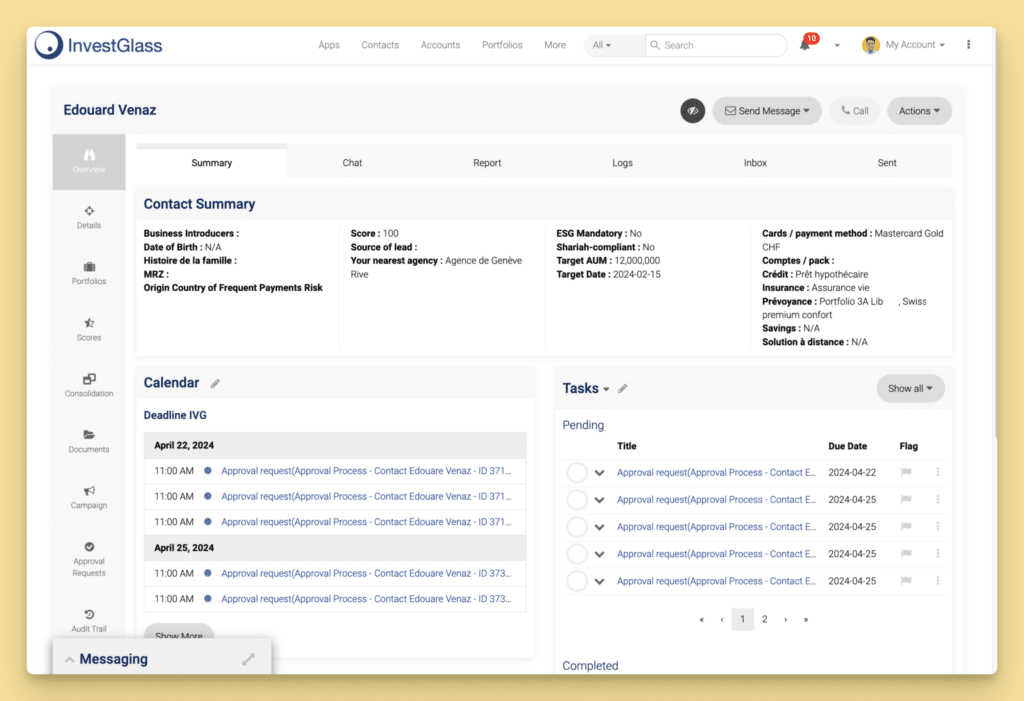
Financial firms often have fragmented data spread across core banking systems, portfolio managers, transfer agency platforms, and email servers. A successful crm implementation requires unifying this information into a coherent data model.
The data model should cover key entities:
- Clients (individuals, households, legal entities)
- Portfolios (discretionary mandates, advisory accounts, model portfolios)
- Products (investment products, loans, insurance)
- Risk profiles and investment objectives
- KYC records and compliance documentation
- Interactions (meetings, calls, emails, document exchanges)
Map how the CRM will connect to existing tools through APIs or file based interfaces. Common integrations include core banking systems, portfolio management platforms, order management systems, accounting software, and e signature tools. Each integration must be carefully designed to ensure customer data flows correctly and securely.
Establish a single client identifier across systems so that positions, transactions, and documents from 2015 onward can be consistently matched in the CRM. This unified view is essential for understanding long term client relationships and providing personalized service.
Involve a data architect to define which system is the primary source for each data type. For example, positions might come from the portfolio engine daily, while contact information updates in real time from the CRM. Clear data ownership prevents conflicts and ensures data quality.
Step 5: Plan And Execute Secure Data Migration
Poor data migration is one of the main reasons CRM projects fail in financial institutions. Migrating data from legacy systems requires careful planning, rigorous cleansing, and robust security controls.
Typical legacy sources include:
- Excel contact lists and spreadsheets
- Old CRMs and contact databases
- Core banking exports
- Local address books and email contacts
- KYC repositories and document management systems
Before migrating data, organize data cleansing workshops to:
- Remove duplicates and merge records for the same client
- Correct outdated addresses and contact details
- Close dormant relationships that no longer require active management
- Standardize fields such as risk ratings, investment objectives, and client segments
Use a phased migration approach. Start with a pilot segment, for example moving one region or a limited book of clients in May 2026. Validate results, fix issues, and then roll out to the full client base. This approach reduces risk and allows you to refine processes before the enterprise wide launch.
Security during migration is paramount. Encrypt all files in transit and at rest. Restrict access to migration teams with documented permissions. After go live, confirm that temporary copies are securely deleted. These controls protect client information and demonstrate your commitment to data protection.
Step 6: Configure CRM For Onboarding, KYC, And Portfolio Management
Configuration is where the crm solution becomes specific to your finance business. This step covers forms, workflows, and automation rules that match your operating model.
Digital Onboarding Flows
Set up online forms for client information collection, document upload, e signature, and automatic KYC checks. Create separate flows for individuals, corporates, and trusts, each with the appropriate fields and compliance requirements. A well designed onboarding process can reduce client drop off by 40 percent and significantly improve client satisfaction.
KYC Questionnaires
Create standardized KYC questionnaires aligned with internal policies. Include source of wealth questions, politically exposed person checks, and risk scoring logic. Implement these as templates inside the CRM so that compliance teams can easily update them as regulations evolve.
Portfolio Integration
Connect client portfolios so that advisors can see holdings, performance, and suitability flags directly inside the client record. Examples include:
- Equity and bond portfolios
- Discretionary mandates with specific investment guidelines
- Model portfolios for different risk tolerance levels
InvestGlass can be configured with visual workflows, no code automation, and approval chains. For example, compliance can be required to approve high risk clients or complex products before accounts become active. This workflow automation ensures that business rules are consistently applied.
Step 7: Build Client Communication, Marketing, And Service Processes
Consistent, documented communication is essential for both client satisfaction and regulatory evidence. Every interaction should be captured in the CRM, creating a complete communication history for each relationship.
Configure email templates, meeting agendas, and call notes so every contact is recorded. Include channels like video meetings and secure messaging. This documentation supports regulatory audits and helps relationship managers maintain continuity when colleagues are unavailable.
Segmentation and Targeting
Use segmentation to create groups such as:
- High net worth individuals in Switzerland
- Family offices in the Middle East
- Mass affluent clients in the European Union
- Institutional investors with specific product interests
Segmentation enables targeted campaigns and personalized offerings that resonate with each client segment.
Marketing Automation
Leverage marketing automation capabilities to:
- Send investment outlooks each quarter automatically
- Trigger reminders before portfolio reviews
- Launch campaigns when a client reaches a new asset threshold
- Deliver educational content based on investment interests
Service Workflows
Build service workflows for routine tasks like change of address, standing order updates, and complaint handling. Define response time targets and escalation paths inside the CRM. These workflows streamline operations and ensure consistent service levels across your client base.
Step 8: Incorporate Compliance, Risk, And Audit Requirements
For regulated institutions, CRM is also a compliance system that must support audits by regulators and internal risk teams. This dual purpose requires careful configuration of controls and monitoring capabilities.
Configure mandatory fields that must be completed before proceeding:
- Suitability assessments before trade proposals
- Risk tolerance documentation before portfolio changes
- Investment objectives before product recommendations
- Disclosure acknowledgments for complex products
Enable audit trails that log every change to client data, KYC status, and portfolio recommendations. Each log entry should include time stamps and responsible users for later review. This documentation is essential for demonstrating compliance during regulatory inspections.
Set up automated alerts for:
- Expiring KYC documents requiring renewal
- Unusual transaction patterns that may need investigation
- Missing disclosures for complex or high risk products
- Clients approaching regulatory thresholds
Create compliance dashboards that show the head of compliance real time indicators:
Metric | Description |
|---|---|
KYC Status | Percentage of clients with up to date KYC in 2026 |
Outstanding Alerts | Number of alerts awaiting resolution |
Pending Approvals | Compliance approvals in the queue |
Documentation Gaps | Clients missing required suitability documentation |
Step 9: Train Relationship Managers And Back Office Teams
Adoption depends on people. Financial advisors and back office teams will only embrace CRM if it saves time and reduces risk. Proper training is the bridge between technology investment and actual business value.
Recommend role based training programmes:
Role | Training Focus |
|---|---|
Relationship Managers | Client onboarding, portfolio views, meeting documentation |
Assistants | Document management, task scheduling, client updates |
Compliance Staff | Alert management, KYC workflows, audit reporting |
IT Support | Integration troubleshooting, user administration |
Run small group training sessions using real life workflows. For example, walk through onboarding a new client from Zurich or executing a portfolio rebalancing request. Avoid generic feature tours that do not connect to daily work.
Provide ongoing support through:
- A CRM champion network in each department
- Help desk resources for quick questions
- Short video tutorials accessible directly from within the platform
- Regular refresher sessions as new crm tools and features are released
Measure user adoption through simple indicators such as log in frequency, percentage of meetings recorded in CRM, and completeness of interaction notes. Use these metrics in 2026 performance reviews to reinforce the importance of comprehensive training and enabling users to succeed.
Step 10: Go Live, Monitor, And Continuously Improve
This is the point where technology, data, and training come together. For large institutions, a phased go live reduces risk compared to a big bang approach.
A typical phased plan might look like:
Phase | Timeline | Scope |
|---|---|---|
Pilot | Month 1 | One business unit or country |
Review | Month 2 | Fix issues, refine processes |
Expansion | Month 3 | Roll out to additional entities |
Full Deployment | Month 4+ | Complete enterprise coverage |
Set up monitoring dashboards to track:
- System performance and uptime
- User activity and adoption rates
- Data quality metrics
- Key business outcomes such as onboarding times or NPS scores
Establish a quarterly CRM steering committee that includes business, compliance, and IT leaders. This committee reviews feedback, prioritizes enhancements, and approves new automation ideas. Gathering feedback from users ensures the system evolves to meet changing needs.
Firms using InvestGlass can roll out new AI features, reports, and workflows iteratively. This continuous improvement approach keeps the CRM aligned with evolving products, regulations, and client expectations beyond 2026. Remember to continuously monitor system performance and user adoption to identify opportunities for enhancement.
Leveraging AI And Automation In A Financial CRM
AI is shifting from buzzword to daily tool in wealth management, private banking, and insurance. Modern crm platforms use machine learning to enhance data analysis, predict client behavior, and improve communication efficiency.
Specific AI use cases include:
- Predicting client interest: Identifying which clients are likely to respond to a new structured product based on their portfolio and interaction history
- Next best actions: Suggesting what relationship managers should discuss or recommend based on client profiles and recent market events
- Interaction summaries: Automatically summarizing long communication histories before meetings so advisors arrive prepared
- Risk signals: Flagging potential customers who may be at risk of attrition based on engagement patterns
Automation handles repetitive routine tasks without manual intervention:
- Follow up reminders after client meetings
- Document collection requests for KYC renewals
- Risk profile renewal scheduling
- Campaign scheduling based on client events
InvestGlass offers AI driven tools that operate on data hosted in Switzerland, helping institutions benefit from automation while respecting data sovereignty and internal risk policies. This combination of intelligence and control is essential for regulated entities.
Implement AI in controlled pilots with clear human oversight. Strategic planning is crucial to align AI and CRM integration with business goals and to optimize technology deployment for better outcomes. Document how AI decisions support rather than replace the judgement of licensed financial professionals. This approach builds trust and ensures regulatory compliance.
Why Many Financial Firms Choose InvestGlass For CRM Implementation
Financial firms need a crm vendor who understands regulation, onboarding, and portfolio management, not only generic sales pipelines. Generic platforms require extensive customization and often lack the compliance features that regulators expect.
InvestGlass is a Swiss sovereign crm platform that combines customer relationship management crm, digital onboarding, KYC, portfolio tools, and marketing automation in one environment. Key differentiators include:
- Swiss data sovereignty: Hosting in Switzerland or on premise deployment
- Privacy guarantees: Strong alignment with European and Swiss regulatory expectations
- All in one platform: No need to juggle multiple tools or complex integrations
- Financial workflows: Pre built templates for suitability, KYC, and client engagement
Banks, independent asset managers, and insurers use InvestGlass to shorten onboarding, improve compliance evidence, and give advisors a single view of the client on desktop and tablet. The platform supports both small business wealth managers and large financial services firms with equal effectiveness.
Consider a structured pilot implementation with InvestGlass, using a defined business unit and a three month roadmap to prove value before an institution wide rollout. This crm investment approach minimizes risk while demonstrating tangible business growth.
Summary: Building A Compliant, Client Centric CRM Foundation
Implementing CRM in a financial firm is a multi step journey covering objectives, process mapping, platform selection, data migration, configuration, training, and continuous improvement. Each phase builds on the previous one, creating a reliable foundation for improved customer relationships and regulatory compliance.
A successful crm implementation strengthens compliance, enhances client engagement, and improves the productivity of relationship managers and support teams. It transforms how your firm handles customer interactions, manages client portfolios, and supports new clients through their entire lifecycle.
Swiss hosted platforms such as InvestGlass allow financial institutions to combine modern digital tools with strong data sovereignty and privacy safeguards. This combination is increasingly important as regulators scrutinize how firms handle customer details and sensitive financial information.
Treat CRM as a long term strategic investment with regular reviews and enhancements, rather than a one time IT project completed in a single year. The finance industry continues to evolve, and your CRM must evolve with it.
Take the next step by evaluating your current client data and workflows. Consider a discovery workshop to identify quick wins and plan a concrete pilot implementation. The firms that move decisively on crm implementation process will be best positioned to improve customer relationships, streamline workflows, and achieve sustained business growth.
Frequently Asked Questions About Implementing CRM In Financial Firms
How long does CRM implementation usually take in a financial institution?
Smaller wealth management firms can complete a focused implementation in eight to twelve weeks, including data migration and training. Larger banks with multiple systems, jurisdictions, and regulatory requirements may require six to twelve months for a complete rollout.
Timelines depend heavily on the complexity of integrations with core banking and portfolio systems. The time needed for compliance review and approvals also significantly impacts the schedule. Plan the project in clearly defined phases, with realistic milestones for discovery, configuration, pilot, and full rollout. This phased approach ensures each stage receives adequate attention before moving forward.
What are the biggest risks when implementing CRM in a regulated financial firm?
Common risks include poor data quality from legacy systems, lack of user adoption among relationship managers, underestimating compliance requirements, and choosing a generic CRM that cannot handle financial workflows. Each of these risks can derail an implementation or limit the value delivered.
Mitigate these risks by involving compliance and business stakeholders from the start. Invest in data cleansing before migration begins. Select a platform built specifically for financial services, such as InvestGlass, that includes regulatory features out of the box. Document risks and mitigation measures in a formal project plan that is reviewed regularly by senior management and the sales process owners.
Can a CRM handle both retail and private banking clients in the same system?
A well designed financial CRM can support multiple client segments, including retail, affluent, and private banking, with different onboarding flows, suitability rules, and service levels. Segmentation, role based access, and configurable workflows allow the same single platform to adapt to different units while providing a consolidated view for management.
InvestGlass can be configured with separate journeys, forms, and approval chains for each segment. All data remains secured in a single Swiss or on premise environment. This flexibility allows firms to serve their entire client base without maintaining separate systems for each segment.
How does a CRM support regulatory audits and inspections?
CRM captures a complete history of customer interactions, advice, and approvals, along with time stamps and responsible users. This information can be exported during an audit to demonstrate how the firm handled each client relationship.
Audit trails, document versioning, and event logs help demonstrate that the firm followed suitability, KYC, and disclosure procedures consistently. Work with compliance teams to design standard reports that can be generated from the CRM ahead of planned inspections by regulators. This preparation reduces stress during audits and demonstrates your firm’s commitment to regulatory requirements.
Is it possible to implement CRM while keeping all client data in Switzerland?
Financial firms can absolutely implement a modern CRM while ensuring all client data remains in Switzerland. This is achieved either through a Swiss data center or on premise infrastructure within your own facilities.
InvestGlass is designed with Swiss data sovereignty in mind, giving banks and wealth managers confidence that sensitive information stays under their chosen jurisdiction. Include data location, residency, and access questions in your vendor due diligence questionnaires during CRM selection. This due diligence ensures your new system meets both regulatory expectations and client trust requirements.

