
Modern sales and investment teams in regulated financial services face mounting pressure to replace fragmented spreadsheets and email chains with centralised, auditable systems. Deal management software has emerged as the backbone of this transformation, acting as a centralized platform that consolidates all deal-related activities, communications, and documents. This reduces data silos and improves workflow efficiency, enabling banks, wealth managers, insurers, and regulated B2B organisations to track every opportunity from initial contact through to signed contract and beyond.
This guide is written in British English and aimed at organisations preparing for 2026 and beyond. Whether you manage retail lending pipelines, private banking mandates, or complex corporate transactions, effective deal management replaces manual tracking with a real-time, compliance-ready platform. InvestGlass offers a sovereign, Swiss-hosted deal management solution ideal for organisations that do not want American or Chinese platforms controlling their client data.
Why Deal Management Matters Now
Three converging pressures demand attention:
- Remote and hybrid work models have eliminated informal hallway conversations, requiring explicit documentation of every deal step
- Stricter regulations across Europe and Switzerland (MiFID II, FINMA, FCA requirements) demand comprehensive audit trails and approved workflows
- Longer buying cycles in B2B financial services create significant coordination overhead when managed manually across multiple stakeholders
What is Deal Management Software?
Deal management software is a digital system that tracks, organises, and optimises deals across defined stages. It covers the entire deal lifecycle, from initial lead or prospect identification through qualification, proposal, compliance review, legal documentation, onboarding, and post-sale review.
Lead Generation and Management
Modern deal management software often integrates lead generation tools such as web forms and chatbots to attract and capture potential clients at the earliest stage. Robust lead management features help teams organise, nurture, and prioritise prospects, ensuring that sales representatives can efficiently qualify leads and focus on the most promising sales opportunities throughout the pipeline.
Key Differences from Traditional CRM
The critical distinction from a generic CRM lies in focus:
- Traditional CRM: Stores contacts and activities, answering questions like “When did we last speak to this prospect?”
- Deal management software: Focuses on deal stages, momentum, stakeholders, and revenue forecasting, answering questions like “Which deals are at risk of slipping past Q2?” and “Why are 40% of our deals stuck in legal review?”
Collaboration Across Teams
Deal management tools help diverse teams collaborate on the same opportunities:
- Sales teams and relationship managers track opportunities and manage next steps
- Compliance and risk teams monitor regulatory requirements and approvals
- Finance teams track transaction values and forecasting accuracy
- Legal teams manage document requirements and deadlines
- Investment teams coordinate due diligence and credit committee reviews
- Operations teams handle onboarding and post-sale integration
Concrete Example: Swiss Private Bank in Q1 2026
A UHNW client approaches a Swiss private bank about a CHF 50 million discretionary mandate. In a contact-focused CRM, the team would simply log client details and record that a meeting occurred on 15 January 2026. A deal management system does far more. It creates a deal record tracking the mandate through defined stages:
- Initial Consultation
- Suitability Assessment
- KYC/AML Review
- Legal Documentation
- Portfolio Design
- Account Opening
- Funding
Each stage has entry and exit criteria, required approvals, and timelines. The deal record captures not merely “we met with the client” but specific status information: “KYC documentation due by 31 January,” “Credit Committee approval pending,” “Portfolio recommendation ready for client review,” “Legal awaiting client signature on mandate agreement.” Different stakeholders access the same record with role-based permissions, ensuring compliance officers see KYC status while portfolio managers focus on investment parameters.

Key Benefits of Modern Deal Management Software
Deal management software delivers tangible improvements across time savings, accuracy, collaboration, and visibility. For regulated institutions, these benefits directly support both commercial objectives and compliance obligations.
Time Savings Through Automation
- Manual spreadsheet updates, email-based approval requests, and informal follow-up reminders consume hours each week.
- Deal management software automates reminders, document requests, and status updates.
- Sales reps spend more time progressing deals rather than performing data entry.
Improved Accuracy and Reduced Human Error
- When deal data exists across multiple spreadsheets, Outlook calendars, and email chains, inconsistencies emerge.
- A single source of truth eliminates discrepancies in deal values, close dates, KYC status, and product combinations.
- This precision feeds more reliable forecasts and regulatory reports.
Enhanced Collaboration Across Departments
- A revenue team including sales, legal, finance, and operations benefits from shared access to deal data, streamlining deal cycles and improving efficiency.
- Siloed systems slow decision making and create communication gaps.
- Centralised deal records allow every contributor to work from the same information, with access tailored to their role.
Better Visibility on Deal Velocity
- Understanding how long deals stay in each stage, and how this correlates with win rates and revenue predictability, enables management to identify bottlenecks.
- If deals consistently stall in legal review for 20 days when the target is 7, intervention becomes possible before quarter-end.
Stronger Regulatory Compliance
- Full audit trails document every change to deal status, approvals, and documents.
- This supports MiFID II, FINMA, and other regulatory requirements by demonstrating documented decision-making processes.
More Predictable Revenue Through Better Forecasting
- AI-powered forecasting uses historical win rates and pipeline data to predict revenue more accurately than manual estimates.
- Removes optimism bias and grounds projections in actual patterns.
What to Look for in Deal Management Software
This section serves as a buyer’s checklist for decision makers in regulated environments evaluating platforms in 2025 and 2026.
Customisable Pipelines Reflecting Real Workflows
- Platforms should allow configuration of pipelines at the business line level.
- Avoid generic pipeline stages designed for a one-size-fits-all sales process.
Strong Reporting and Analytics
Dashboards should cover key metrics including:
Metric Category | Example Measures |
|---|---|
Pipeline health | Deal value by stage, forecast by month/quarter |
Performance | Win rate by segment, individual/team targets |
Efficiency | Time in stage, deal velocity trending |
Compliance | Deals pending KYC, awaiting legal/compliance sign-off |
Automation for Repetitive Tasks
- Automate follow-up reminders, KYC expiry alerts, and notifications when a deal remains stuck beyond a defined SLA.
- Focus teams on high value deals by automating repetitive tasks.
Native Integration with Core Systems
- Integrate with email, calendar, portfolio management, document management, and digital onboarding tools.
- Prevent duplicate customer master data by integrating with core banking or policy administration systems.
- Unify CRM, marketing automation, and lead management into a single cohesive system.
Security, Data Sovereignty, and Audit Trails
- Granular role-based access control
- Full audit trails capturing who changed what and when
- Data stored in jurisdictions compliant with internal governance policies
- Clear records supporting regulatory examinations
User Experience and Adoption
- Intuitive interfaces, visual boards, mobile access, and minimal training requirements drive adoption.
- Ensure the platform is user-friendly for relationship managers to encourage high usage.
Deal Management vs Traditional CRM and Deal Flow Tools
Many teams already use a CRM, but not all CRMs provide serious deal management. Some firms also use specialist deal flow tools for investments. Understanding these distinctions matters for platform selection.
Feature/Focus | Traditional CRM (Contact-Centric) | Deal Management (Opportunity-Centric) | Deal Flow Management Software for Investments |
|---|---|---|---|
Core Entity | Contacts, companies, activities (calls, emails, meetings) | Deals/opportunities | Deals, investments, relationships |
Pipeline Structure | Simple linear: Prospecting, Qualification, Proposal, Negotiation, Close | Customisable, multi-stage, approval gates | Sourcing, due diligence, fundraising |
Use Case | High-volume, standardised sales processes | Complex, multi-stakeholder workflows | Private equity, venture capital, network mapping |
Key Questions Answered | “When did we last speak to this prospect?” | “Which deals are at risk of slipping?” “Where are bottlenecks?” | “What is the status of due diligence?” “Who are the key contacts?” |
Revenue Focus | Recurring revenue, cross-sell, client lifecycle (limited) | Revenue predictability, deal health, momentum | Less concerned with recurring revenue, more on deal sourcing and fundraising |
Collaboration | Limited, often siloed | Real-time, role-based, audit-ready | Focused on investment teams, less on compliance or operations |
Compliance & Audit | Basic activity tracking | Full audit trails, compliance workflows | Varies, often less robust for regulatory compliance |
Example Platform | Salesforce, Microsoft Dynamics | InvestGlass, other regulated deal management platforms | Affinity, DealCloud, other investment-specific tools |
A universal bank using one sovereign platform like InvestGlass can manage deals across retail lending, wealth management mandates, and institutional mandates in parallel. Each business line configures its own pipeline stages while maintaining shared compliance, risk, and operations workflows. This integrated approach avoids data silos and reduces the number of systems staff must learn.
Essential Features of Effective Deal Management Software
This section breaks down the key features that effective deal management software should provide. Each feature category supports specific workflows and objectives for regulated organisations.
Visual Pipelines for Tracking Deal Stages
- Real-time visibility into where each deal stands within the sales process
- Allows teams to quickly assess status and prioritise actions
Automated Activity Capture to Reduce Manual Data Entry
- Automatic logging of emails, calendar events, and calls against deal records
- Automatic task creation for follow ups after meetings
- Alerts for expiring documents or KYC reviews due within a defined timeframe
- Stage-based triggers that create compliance and onboarding tasks automatically
AI-Powered Deal Insights and Forecasting
- Suggests next best actions when engagement drops
- Predicts close probabilities based on historical win rates and pipeline data
- Flags deals where typical patterns suggest risk of slipping
- Provides predictive insights that support informed decisions
Real-Time Team Collaboration with Role-Based Permissions
- Central comment streams replacing long email chains
- File attachments with version control on each deal record
- Checklists for stage requirements and approvals
- Full audit trails capturing every change to deal fields, stage, documents, and approvals
Analytics Dashboards for Performance Management
- Deal value by stage
- Forecast by month or quarter
- Win rate by product
- Time-in-stage trending
- Individual performance against targets
Integrations and Mobile Access
- Email and calendar for automatic activity capture
- Document storage for agreement versioning
- Digital onboarding for triggered workflows when deals close
- Portfolio management for syncing newly funded accounts
- Core banking or policy administration for customer master data
- Secure mobile access for relationship managers and salespeople on the move
Regulated Organisation Features
- KYC/AML workflow integration
- Documentation tracking
- Role-based access control supporting banking secrecy requirements
Prioritise features that directly support closing deals faster and meeting compliance obligations, rather than cosmetic options that add complexity without value.
Visual Pipeline Tracking and Full Deal Visibility
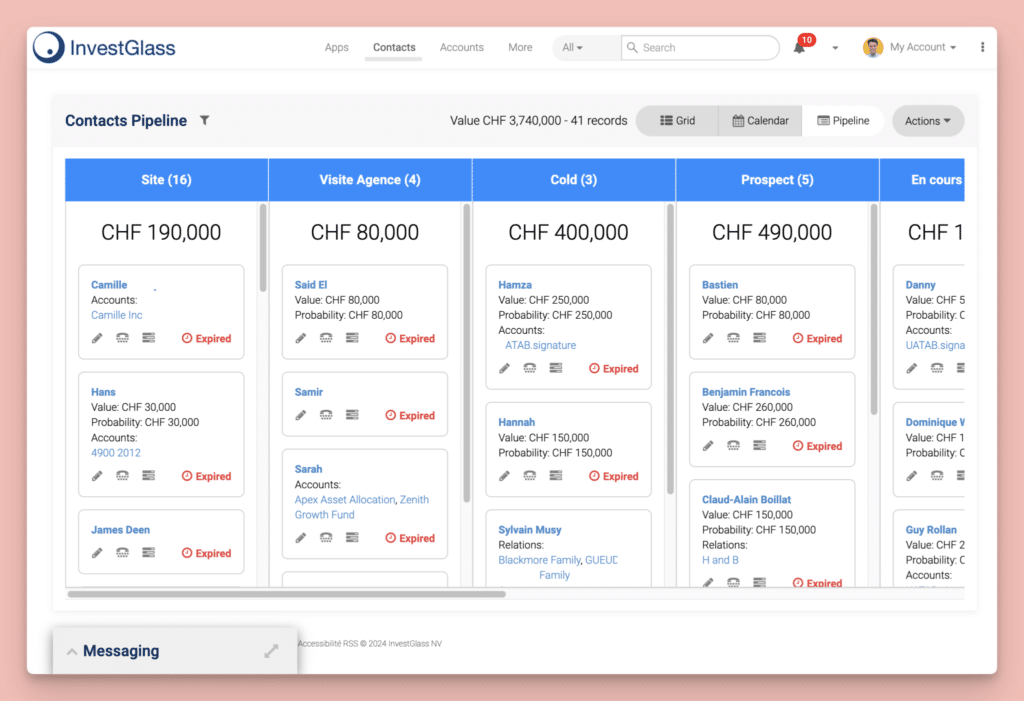
A Kanban or stage-based pipeline view displays each deal as a card showing value, owner, expected close date, and next step. This visual layout provides immediate, intuitive visibility into the overall portfolio of opportunities.
Benefits of a 360-Degree View
- Quickly seeing all open deals, their stages, expected close dates, and risks across a given quarter
- Spotting bottlenecks such as too many deals stuck in compliance review or legal approval for more than 14 days
- Colour-coded flags highlighting risk status (unresolved KYC issues, pending approvals, fully compliant deals)
Mini-scenario: A relationship manager starts the day by opening their visual sales pipeline, sorting deals by close date and expected value. They immediately see that three high value opportunities require compliance sign-off this week, while one deal has been stuck awaiting client documents for 12 days. This visibility enables prioritised action before the morning client call.
Automated Activity Capture and Task Management
Salespeople lose valuable selling time when they manually log calls, emails, and meetings. Automated activity capture addresses this by electronically recording interactions against the relevant deal record.
Key Capabilities
- Automatic logging of emails, calendar events, and calls against deal records
- Automatic task creation for follow ups after meetings
- Alerts for expiring documents or KYC reviews due within a defined timeframe
- Stage-based triggers that create compliance and onboarding tasks automatically
The outcome: increased selling time, fewer missed follow ups, and complete activity histories that support audit requirements.
AI-Powered Deal Insights and Forecasting
AI serves as a practical assistant that analyses patterns in activity, deal size, sector, and past outcomes. AI-driven insights provide real-time recommendations and intelligent data analysis, enhancing decision-making and overall sales effectiveness.
Practical AI Applications
- Suggesting next best actions when engagement drops (such as scheduling a call when a deal has been dormant for over 20 days)
- Predicting close probabilities based on historical win rates and pipeline data
- Flagging deals where typical patterns suggest risk of slipping
- Providing predictive insights that support informed decisions
Specific example: AI detects that deals involving clients in a particular country are taking 30% longer than historical averages due to new regulatory requirements. The system suggests updated stage expectations and flags affected deals for relationship manager attention.
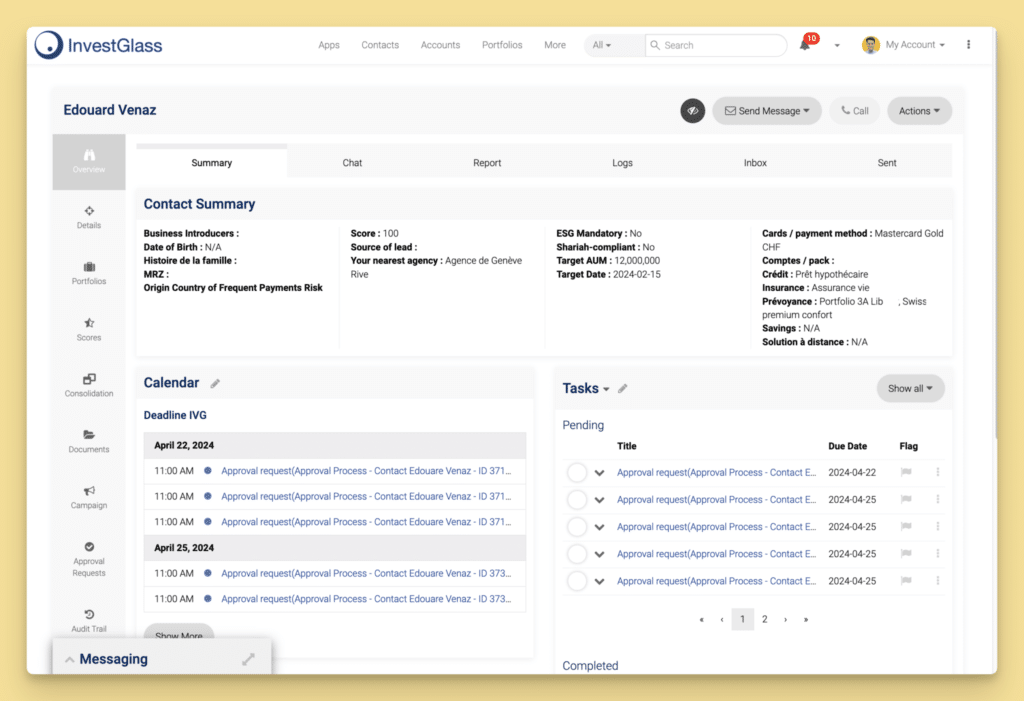
Collaboration, Permissions and Audit-Ready Records
Complex deals such as corporate lending, M&A advisory, or multi-account wealth mandates require real-time collaboration across sales, compliance, risk, legal, and operations.
Collaboration Features
- Central comment streams replacing long email chains
- File attachments with version control on each deal record
- Checklists for stage requirements and approvals
- Full audit trails capturing every change to deal fields, stage, documents, and approvals
Analytics Dashboards and Performance Management
Dashboards transform deal data into actionable insight for team leaders, risk managers, and executives. Different roles require different views:
Role | Dashboard Focus |
|---|---|
Head of Sales | Regional pipelines, forecast accuracy, team performance |
Compliance Officer | Deals awaiting KYC, pending approvals, overdue items |
Risk Officer | Deals by risk rating, concentration by client/industry |
Executive | Overall pipeline health, quarter-over-quarter trends |
Key metrics displayed typically include:
- Deal value by stage
- Forecast by month or quarter
- Win rate by product
- Time-in-stage trending
- Individual performance against targets
Example chart description: A bar chart showing deal count by risk rating (low, medium, high) across pipeline stages, enabling risk officers to monitor concentration at a glance.
Integrations and Mobile Access
Deal management software must avoid data silos by connecting to core systems already in use. Critical integrations include:
- Email and calendar for automatic activity capture
- Document storage for agreement versioning
- Digital onboarding for triggered workflows when deals close
- Portfolio management for syncing newly funded accounts
- Core banking or policy administration for customer master data
Secure mobile access enables relationship managers and salespeople travelling to client meetings to update deal status, add notes, and review deal details on the move.
Complex Deal Management in Regulated Sales Environments
Managing complex deals in regulated sales environments demands a level of precision and transparency that goes far beyond standard sales processes.
Centralised Platform for Compliance
- Provides a centralised platform where sales teams can track deals, manage customer data, and automate repetitive tasks
- Ensures that nothing falls through the cracks
Streamlined Deal Flow and Audit Trails
- Consolidates all deal-related activities, communications, and documents in one secure environment
- Improves efficiency and ensures every action is logged and accessible for compliance reviews
Automated Workflows for Regulatory Adherence
- Prompts required approvals
- Flags missing documentation
- Maintains a clear audit trail for each deal
Risk Reduction and Operational Excellence
- Reduces the risk of non-compliance and associated penalties
- Manages complex deal structures, coordinates multiple stakeholders, and maintains up-to-date customer data
InvestGlass: Sovereign Deal Management for Regulated Organisations
InvestGlass is a Swiss sovereign CRM and deal management platform built for banks, wealth managers, insurers, and regulated B2B firms. It provides a European alternative to American and Chinese platforms, with hosting in Switzerland or on-premise for full data control.
Integrated Features
- CRM for contact and relationship management
- Digital onboarding and KYC verification
- Portfolio management tools
- Marketing automation capabilities
- Secure client portal access
InvestGlass is particularly suitable for institutions that must comply with strict data residency and secrecy requirements, such as those regulated by Swiss and EU financial authorities.
End-to-End Regulated Deal Lifecycle in InvestGlass
A typical deal lifecycle in InvestGlass covers:
- Lead capture and qualification
- Initial consultation and needs assessment
- Proposal and risk assessment
- KYC and AML checks
- Legal documentation
- Credit committee or compliance approval
- Onboarding and account opening
- Post-sale review and relationship management
Each stage can trigger automated workflows for documentation requests, internal approvals, and reminders based on local regulations. For organisations subject to FINMA, CSSF, or FCA requirements, these workflows ensure no compliance step is missed.
Concrete example: A cross-border mandate for a European UHNW client involves relationship management in Zurich, KYC verification coordinated across multiple jurisdictions, legal documentation reviewed by counsel in Luxembourg, and portfolio design by asset managers in Geneva. All parties work on the same deal record within InvestGlass, with full audit trails and no data exported to third-party clouds.
Data Sovereignty, Hosting Options and Compliance
InvestGlass can be hosted in Swiss data centres or fully on-premise in the client’s own infrastructure.
Sovereign Approach Supports:
- Data sovereignty laws requiring financial data to remain within specific jurisdictions
- Banking secrecy requirements restricting data access
- Internal risk policies limiting where client data may be stored
- Regulatory expectations around cloud concentration risk
Security features include encryption, granular access controls, and segregation of environments. Organisations avoid transferring sensitive financial data to foreign jurisdictions, which has become increasingly important following 2024 and 2025 regulatory updates in Europe and Switzerland.
Customised Workflows for Banks, Wealth Managers and Insurers
InvestGlass pipelines and fields can be configured differently for:
- Retail lending
- Private banking
- Asset management
- Corporate finance
- Insurance distribution
Sector-specific fields might include risk profile, portfolio objective, premium amount, policy term, collateral type, or credit committee references.
Configuration Example
A European retail bank configures a seven-stage mortgage deal pipeline:
- Application Received
- Document Collection
- Credit Analysis
- Valuation
- Credit Committee
- Legal Completion
- Funding
Each stage has mandatory fields and automated reminders for overdue items.
How to Choose the Right Deal Management Solution for Your Organisation
Decision makers in regulated environments should follow a structured approach when evaluating platforms in 2025 and 2026.
Map Your Real Deal Workflow and Stakeholders
Before evaluating software, document how deals actually move today:
- Identify every stage, including informal steps and manual approvals
- Map handoffs between departments
- List every stakeholder group: sales, relationship managers, compliance, risk, legal, operations, product, and finance teams
- Identify special cases requiring extra review (cross-border business, high-risk clients, complex corporate structures)
Use this mapped workflow as the baseline when comparing platforms, rather than adapting to a vendor’s generic template. InvestGlass partners or internal project teams can facilitate workshops to capture these flows accurately.
Evaluate Sovereignty, Security and Regulatory Fit
Critical questions for evaluation:
Question | Why It Matters |
|---|---|
Where is data stored? | Determines regulatory jurisdiction |
Which legal framework applies? | Affects client rights and obligations |
Are sub-processors based in conflicting jurisdictions? | May create surveillance law conflicts |
What encryption and access controls exist? | Supports security requirements |
How are audit trails maintained? | Essential for regulatory examinations |
For European and Swiss institutions, sovereign platforms like InvestGlass reduce legal and reputational risks compared with American or Chinese hyperscaler-dependent tools. Involve information security, legal, and compliance teams early in evaluation to avoid late-stage project blockage.
Calculate Total Cost and Time-to-Value
Evaluate beyond licence price to include:
- Implementation and configuration costs
- Integration with existing systems
- Training and change management
- Ongoing administration and support
Long, complex rollouts extending beyond 6 to 12 months often lead to outdated requirements and poor adoption. Platforms like InvestGlass can be implemented in phased pilots, enabling a first live pipeline within a few weeks before expanding.
Example scenario: A wealth management firm implements InvestGlass for its private banking division. A 10 to 15 percent increase in win rates combined with 20 percent faster deal cycles delivers clear return within one year. Improved forecast revenue accuracy enables better resource planning, while reduced manual work frees relationship managers for client-facing activities.
Run a Real-World Pilot with Critical Deals
A pilot using real deals, real data, and representative users provides far more insight than theoretical demonstrations.
During the pilot, assess:
- Ease of use for daily workflows
- Data quality and completeness
- Reporting relevance for different roles
- Fit with existing routines
Track adoption metrics including logins per user, percentage of deals fully updated, and usage of core features like tasks and dashboards. Strong positive feedback from both front-office and control functions indicates likely long-term success.
InvestGlass can support pilot projects hosted in Swiss infrastructure from day one, ensuring no need to migrate data after evaluation.
Scalability: Growing with Your Deal Management Platform
As organisations expand, their requirements for deal management software evolve in both scale and complexity.
Supporting Increased Deal Volumes and Teams
- A scalable deal management platform is vital for supporting increased deal volumes, larger sales teams, and the integration of new business lines or markets.
- Modern deal flow management software is designed to handle this growth seamlessly, ensuring that performance remains robust even as the number of users, deals, and data points increases.
Integration and Automation
- The platform can integrate with other essential systems, such as CRM, marketing automation, and portfolio management tools.
- Automates routine processes and enables real-time updates, helping sales teams maintain deal velocity and adapt quickly to changing market conditions.
Future-Proofing Your Investment
- Choosing a scalable solution future-proofs your investment, allowing your deal management platform to grow alongside your business.
- Supports more predictable revenue, as the software continues to deliver value through improved sales performance, enhanced collaboration, and accurate forecasting.
Implementing Deal Management Software Rapidly and Safely
A phased implementation roadmap suits financial and regulated organisations that need both speed and compliance assurance. Start with one business line or region, then scale once workflows and governance are validated.
Early communication with users, clear success metrics, and continuous feedback loops support successful adoption.
Phase 1: Design Your Pipeline and Data Model
This phase translates real-world workflows into discrete stages, fields, and rules within the platform.
- Prioritise clarity over complexity
- Avoid too many stages or fields that slow users
- Involve both senior leaders and active front-line staff
- Define mandatory fields for each stage, especially for regulatory data and risk information
InvestGlass consultants or partners can help map financial products and regulatory requirements into the data model efficiently.
Phase 2: Configure Automations and Approvals
Set up core automations including:
- Stage-based reminders
- Document expiry alerts
- Assignment rules for new deals
- Approval workflows for credit committees, legal reviews, and compliance sign-offs with clear SLAs
Start with a small, high-impact set of automations to avoid overwhelming teams, then extend gradually. No-code workflow builders in InvestGlass allow operations and risk teams to adjust rules as regulations or policies change.
Document each automation and approval for transparency and training purposes.
Phase 3: Train Users and Launch with Support
Role-specific training sessions work best:
- Separate materials for sales, relationship managers, compliance, operations, and management
- Focus on real scenarios from existing pipelines
- Appoint internal champions in each team to support colleagues
Provide quick-reference guides and short screen-recorded tutorials for common tasks such as updating deal stages or generating reports. InvestGlass can provide training resources tailored to financial and regulated use cases.
Phase 4: Measure, Refine and Expand
After launch, monitor key metrics:
- User adoption rates
- Stage conversion rates
- Time-in-stage trending
- Forecast accuracy
- Manual exceptions and workarounds
Run short feedback cycles every 2 to 4 weeks, adjusting pipelines, fields, and automations based on user experience. Expand to additional business lines or regions only after the first implementation reaches stable performance.
Review security and compliance controls periodically, especially when adding new integrations or data sources. InvestGlass dashboards and audit logs help both management and regulators verify the platform’s impact and reliability over time.

Onboarding: Ensuring Smooth User Adoption
A successful deal management implementation hinges on effective onboarding.
Structured Onboarding Process
- Tailored training sessions
- Interactive tutorials
- Ongoing support
Comprehensive onboarding ensures that users understand how to navigate pipeline management, track deals, and leverage automation tools to enhance their daily workflows.
Real-World Scenarios and Collaboration
- Focus on real-world scenarios and practical use cases
- Foster team collaboration by ensuring all users become proficient in using the same platform and processes
Prioritising onboarding also reduces resistance to change and enables the organisation to realise the full benefits of deal management software more rapidly.
Support: Ensuring Reliability and Compliance
Reliable support is a fundamental component of any effective deal management solution.
Multi-Channel Support Options
- Phone
- Live chat
Compliance Expertise
- Support teams should be well-versed in compliance requirements and industry best practices
- Ensures guidance aligns with regulatory standards
By offering robust support, deal management software providers contribute directly to more predictable revenue and business growth.
Measuring ROI of Deal Management Software
Evaluating the return on investment (ROI) of deal management software is essential for understanding its true impact on your organisation’s sales process and bottom line.
Key Metrics to Track
- Deal velocity
- Win rates
- Length of sales cycles
- Reduction in manual data entry
- Accuracy of revenue forecasts
- Quality of team collaboration
Regularly analysing these metrics allows organisations to make informed decisions about their deal management strategy, optimise workflows, and maximise the value derived from their management software.
Future Trends in Deal Management for 2026 and Beyond
Deal management will continue evolving in response to AI advances, stricter regulations, and changing client expectations.
Growth of Intelligent Agents
- AI assistants will prepare proposals, summarise calls, and flag compliance risks before they become issues.
- Relationship managers will enter client meetings with fully updated deal context, AI-generated briefings, and suggested talking points.
Increasing Regulatory Scrutiny of Data Residency
- European and Swiss regulators continue to examine cloud concentration risk and cross-border data flows.
- This reinforces the move towards sovereign, European-controlled platforms like InvestGlass.
Platform Convergence
- CRM, deal management, digital onboarding, portfolio management, and client portals are converging into unified, end-to-end platforms.
- Organisations benefit from single sources of truth rather than multiple disconnected tools requiring manual synchronisation.
2026 scenario: A relationship manager at a Swiss private bank prepares for a client meeting using InvestGlass. The AI assistant has analysed recent client communications, identified that KYC renewal is due in 45 days, noted that the client’s portfolio has outperformed benchmarks, and suggested discussing an additional mandate. All deal information, compliance status, and market data are available in one sovereign platform.
Conclusion: Choosing Sovereign Deal Management Software with Confidence
Deal management software enables regulated organisations to track deals, maintain deal momentum, and close deals faster while meeting compliance obligations. The benefits extend from time savings and improved accuracy through enhanced collaboration and more predictable revenue forecasting.
For banks, wealth managers, insurers, and regulated B2B firms, the choice of platform extends beyond features to encompass data sovereignty, regulatory alignment, and long-term control. Platforms hosted in Switzerland or on-premise, such as InvestGlass, protect client data sovereignty while improving sales and deal outcomes.
Map your processes, run a structured evaluation, conduct a real-world pilot, and focus on adoption as much as on features. Contact sales at InvestGlass to explore a demo showcasing regulated deal management across CRM, onboarding, compliance, and portfolio tools in one sovereign platform.

