
In an era where data reigns as the most valuable strategic asset for nations and businesses alike, the principle of digital sovereignty has ascended from a niche technical concept to a critical pillar of national strategy. For Colombia, a nation charting a dynamic and ambitious course in the global digital economy, achieving sovereignty over its digital destiny is not merely a policy preference but a fundamental imperative for future prosperity, security, and autonomy. This comprehensive article explores Colombia’s determined journey towards digital independence, dissects the inherent risks of dependency on US technology titans like Salesforce and Microsoft, and presents a compelling, sovereign alternative: InvestGlass, the Swiss-hosted CRM platform engineered for a new age of data governance and digital self-determination.
What You’ll Learn
This article provides a thorough analysis of digital sovereignty in the Colombian context. You will discover the core tenets of digital sovereignty and its profound implications for a nation navigating the complexities of the 21st-century digital landscape. We will delve into Colombia’s ambitious national strategies, including landmark projects such as BioNube and legal reforms designed to fortify its digital infrastructure and protect its data. The analysis will then pivot to the significant, often underestimated, risks tied to the dominance of US-based cloud providers, with a special focus on the far-reaching consequences of the US CLOUD Act for data privacy in Latin America. Finally, you will be introduced to the key features and strategic benefits of InvestGlass as a premier Swiss sovereign CRM solution, complete with a detailed comparison against Salesforce and Microsoft, offering a clear path for Colombian organisations to achieve genuine digital independence.
Understanding Digital Sovereignty in the Modern Age
Digital sovereignty represents a nation’s capacity to control its own digital destiny, encompassing everything from data and infrastructure to the legal and regulatory frameworks that govern the digital space. In an increasingly interconnected world, where data flows across borders at unprecedented speeds, the question of who controls this data has become a matter of national security and economic competitiveness.
The concept has gained particular urgency in recent years as governments and businesses have come to recognise the strategic importance of data. The World Economic Forum estimates that over 92% of all data in the Western world is stored on servers owned by US-based companies, creating a significant concentration of power in the hands of a few large technology corporations. This concentration raises profound questions about privacy, security, and the ability of nations to protect their citizens and businesses from foreign interference.
For Latin American nations, the challenge is particularly acute. The European Council on Foreign Relations has warned that foreign technology companies cannot be entrusted with meeting growing digital needs, noting that three US giants provide approximately 70% of the world’s cloud computing infrastructure. This dependency creates vulnerabilities that extend far beyond the realm of technology, touching on issues of economic sovereignty, national security, and democratic governance. Colombia, with its vibrant and rapidly expanding digital economy, sits at the very centre of this global conversation.
The Rise of Digital Sovereignty in Colombia: A Nation Takes Control
Colombia is actively and strategically pursuing a future where it exercises full control over its digital ecosystem spanning infrastructure, data, software, and the legal frameworks governing its cyberspace. This is not a tentative step but a determined national movement, underscored by significant government initiatives and a robust, evolving legal landscape. The Colombian government understands that in the digital age, true sovereignty is incomplete without control over the nation’s data and the digital platforms that manage it.
BioNube: The Cornerstone of Colombia’s Sovereign Cloud
Leading this charge is the BioNube project, a cornerstone of Colombia’s digital sovereignty ambitions. With an investment exceeding $80 million and developed in collaboration with the United Arab Emirates, this sovereign cloud initiative aims to establish three state-of-the-art data centres with a projected energy capacity of up to 30 MW. The primary objective of BioNube is to drastically reduce the nation’s reliance on foreign-owned infrastructure, ensuring that the Colombian state’s sensitive data is stored and processed securely within its own borders. This project signals a clear intent to build a resilient and autonomous digital foundation for the country.
As Maximiliano Rico, a leader in the public sector technology space, has noted, initiatives like BioNube represent an excellent opportunity not only to modernise the infrastructure of multiple public sector entities but also to drive innovation in areas such as machine learning, generative artificial intelligence, and agentic AI. The project has attracted attention from major global technology firms, with Microsoft reportedly involved in evaluating potential sites for the data centres. However, the fundamental question remains: should sovereignty be defined by ownership of infrastructure, or by the guarantee that data governance and processing occur within national territory under national law?
Colombia’s Evolving Legal and Regulatory Framework
This infrastructural push is supported by a strong and continuously evolving legal framework. The foundation was laid with Law 1581 of 2012, Colombia’s General Data Protection Law (Ley de Protección de Datos Personales), a comprehensive regime that established the core principles for data handling. This law, rooted in Articles 15 and 20 of the Colombian Constitution, which recognise the fundamental rights to privacy and data rectification, has served as the bedrock of data governance in the country for over a decade.
More recently, in August 2025, the Superintendencia de Industria y Comercio (SIC) began advancing crucial amendments to this law, aiming to modernise the framework to address the challenges of the digital era. Key changes under consideration include introducing new legal bases for data processing, expanding the scope of the law, and revising rules on the processing of sensitive data. The SIC has also been an active participant in international forums on data sovereignty, stressing the importance of promoting sovereignty and sound governance in the processing of personal data belonging to residents of Colombia.
Further cementing this commitment, Colombia introduced new Model Contractual Clauses for international data transfers in February 2026, creating stricter protocols for data leaving its jurisdiction. Article 26 of Law 1581 already generally prohibits transferring personal data to countries that do not provide an adequate level of protection, and these new clauses add another layer of rigour to cross-border data flows. The launch of the National Digital Security Strategy 2025–2027 further demonstrates the government’s holistic approach to securing its digital future.
Interoperability and the Digital State
Tangible symbols of this new era are already emerging. In February 2026, the government unveiled a new Colombian passport embedded with a data sovereignty model, incorporating microchips, holograms, and real-time electronic reading capabilities. This move, along with the adoption of the X-Road platform for secure and standardised information exchange between government entities, demonstrates a holistic approach to building a sovereign digital state.
X-Road, an open-source platform originally developed by Estonia and Finland, has been adapted for the Colombian context by Software Colombia. It guarantees the confidentiality, integrity, and interoperability of data exchanged between connected state entities, serving as the backbone for Servicios Ciudadanos Digitales (Digital Citizen Services). These efforts, driven by key government bodies like the Ministry of Information and Communications Technologies (MinTIC) and the Departamento Nacional de Planeación (DNP), are positioning Colombia as a leader in digital sovereignty within Latin America.
Colombia’s Booming Digital Economy and the Need for Sovereign Tools
The urgency of the digital sovereignty conversation is amplified by the sheer scale and dynamism of Colombia’s digital economy. The country’s fintech ecosystem has reached a remarkable level of maturity, with over 410 active companies and a 66% adoption rate of artificial intelligence technologies. Revenues in the sector are projected to double by 2027, and approximately 75% of the banked population already uses a digital financial service. Cloud computing is gaining significant traction, with projections indicating that cloud-related jobs in Colombia will increase by 64% by 2038, representing 2.3 million individuals.
This explosive growth creates an enormous demand for sophisticated customer relationship management (CRM) tools, digital onboarding platforms, and data analytics solutions. Currently, a significant portion of this demand is met by US-based providers like Salesforce and Microsoft Dynamics 365. However, as the regulatory environment tightens and the strategic risks of foreign dependency become clearer, Colombian organisations from banks and insurers to government agencies and fintech startups are beginning to question whether their current technology stack is aligned with the nation’s sovereign ambitions.
The Superintendencia Financiera de Colombia is also advancing its digital supervision capabilities, placing a premium on regulatory compliance and risk management within the financial sector. For organisations operating under this scrutiny, the ability to demonstrate that customer data is stored and governed within a jurisdiction that is free from foreign legal overreach is becoming a competitive advantage, not merely a compliance checkbox. Leading institutions like Bancolombia are already investing heavily in modernising their technology operations, increasing in-house IT staff and migrating to cloud-native architectures. The question is no longer whether to digitise, but how to do so without sacrificing sovereignty.
The Perils of Big Tech Dependency: The US CLOUD Act and Beyond
While Colombia forges its path towards digital independence, a significant obstacle remains: the pervasive influence of US-based technology giants. The dominance of companies like Microsoft and Salesforce in the global cloud and CRM market presents a direct challenge to the very notion of digital sovereignty. For Colombian organisations, relying on these platforms introduces a complex web of risks that extend beyond commercial considerations into the realms of legal jurisdiction and national security.
The US CLOUD Act: A Fundamental Threat to Data Privacy
The most potent threat emanates from the US CLOUD (Clarifying Lawful Overseas Use of Data) Act. Enacted in 2018, this piece of US legislation grants American law enforcement agencies the authority to compel US-based technology companies to provide requested data, regardless of where that data is physically located. This means that even if a Colombian company’s data is held in a data centre within Latin America or Europe, it remains subject to US warrants and legal processes, effectively bypassing Colombian law and international data protection agreements.
The implications are stark. This dependency was cast into sharp relief in May 2025 when Microsoft, despite public pledges from its President Brad Smith to challenge “any government” that requested his company to suspend services, blocked the email accounts of International Criminal Court (ICC) staff in compliance with US OFAC sanctions. This incident serves as a sobering reminder that US technology companies are, first and foremost, subject to US law, and their commercial commitments can be superseded by geopolitical directives at any moment.
This creates a direct conflict with data protection regimes like Colombia’s Law 1581 and Europe’s GDPR. For Colombian financial institutions, healthcare providers, and government agencies handling sensitive citizen and state data, the CLOUD Act represents an unacceptable vulnerability. It negates the very principle of data localisation, rendering investments in local data centres insufficient as a sole means of protection if the service provider is US-based.

Geopolitical Risks and the Weaponisation of Technology
Recent reports from February 2026, indicating that the US administration has ordered diplomats to actively lobby against data sovereignty initiatives globally, further underscore the geopolitical tensions at play. This directive reveals a systemic effort to maintain the dominance of US technology platforms and resist the trend towards data localisation that countries like Colombia are pursuing.
The experience of recent years has demonstrated that technological dependencies can be weaponised for political purposes. The freezing of accounts, the imposition of sanctions on technology access, and the use of the OFAC list to isolate individuals and institutions from global internet services are all tools in a geopolitical arsenal that directly affects any organisation relying on US-based cloud infrastructure. In 2024 alone, the number of individuals and entities designated by OFAC as “Specially Designated Nationals” increased by 25% compared to the previous year, illustrating the expanding reach of these measures.
For Colombia, achieving true digital sovereignty is impossible while its most critical data remains within the legal reach of a foreign power. The question is not whether these risks will materialise, but when and how severely they will impact organisations that have not taken proactive steps to secure their data independence.
Vendor Lock-in and Economic Disadvantage
Beyond the legal and geopolitical risks, reliance on US-based CRM platforms creates significant economic vulnerabilities. The high costs and technical complexity of switching from one CRM platform to another can create a situation of vendor lock-in, where businesses become dependent on a single provider and face prohibitive barriers to switching. This dependency can stifle innovation and create an uneven playing field for local and regional competitors.
The dominance of a few large US players in the CRM market has created a situation where Colombian businesses are effectively channelling revenue to American technology corporations, while local technology ecosystems struggle to compete. This economic imbalance has broader implications for Colombian competitiveness and innovation, and it runs counter to the government’s stated goals of fostering a self-reliant digital economy. The complex and tiered pricing structures of platforms like Salesforce and Microsoft Dynamics further exacerbate this issue, often resulting in unexpected costs that strain budgets and limit the ability of organisations to invest in other strategic priorities.
InvestGlass: The Swiss Sovereign Alternative for Colombia
As Colombian organisations awaken to the risks of technological dependency, the search for a secure, powerful, and truly sovereign alternative becomes a strategic priority. This is precisely where InvestGlass emerges as the definitive solution. Headquartered in Geneva, Switzerland, InvestGlass offers a comprehensive CRM platform built from the ground up on the principles of data sovereignty, privacy, and security. It positions itself as the “#1 Sovereign Swiss CRM,” with a tagline that captures its core value proposition: “The Power of Automation. The Freedom of Sovereignty.”
Why Switzerland Matters for Data Sovereignty
Switzerland occupies a unique and privileged position in the global data protection landscape. The country is not a member of the European Union, but it has been recognised by the EU as providing an adequate level of data protection, meaning that data can flow freely between the EU and Switzerland. At the same time, Switzerland is not subject to US jurisdiction in the way that other nations can be through various transatlantic agreements or the CLOUD Act.
The Swiss Federal Act on Data Protection (nFADP), which came into effect in September 2023, further strengthens individual rights while maintaining Switzerland’s adequacy status with the European Union. The Digital Switzerland Strategy outlines the country’s commitment to prioritising digital services and ensuring that the entire population benefits from a sustainable digital transformation. Switzerland’s strengths in research and development, combined with its role as a host country for major international organisations and its centuries-old tradition of neutrality, make it an ideal jurisdiction for companies seeking to protect their data from foreign interference.
Unlike its US-based counterparts, InvestGlass provides a clear and unambiguous guarantee of data sovereignty. Clients have the choice of hosting their data in a secure Swiss cloud, protected by some of the world’s most stringent privacy laws, or deploying the platform on-premise within their own infrastructure. This flexibility gives Colombian organisations complete control over their data, ensuring full compliance with national data protection requirements and the spirit of the BioNube initiative.
Key Features of the InvestGlass Platform
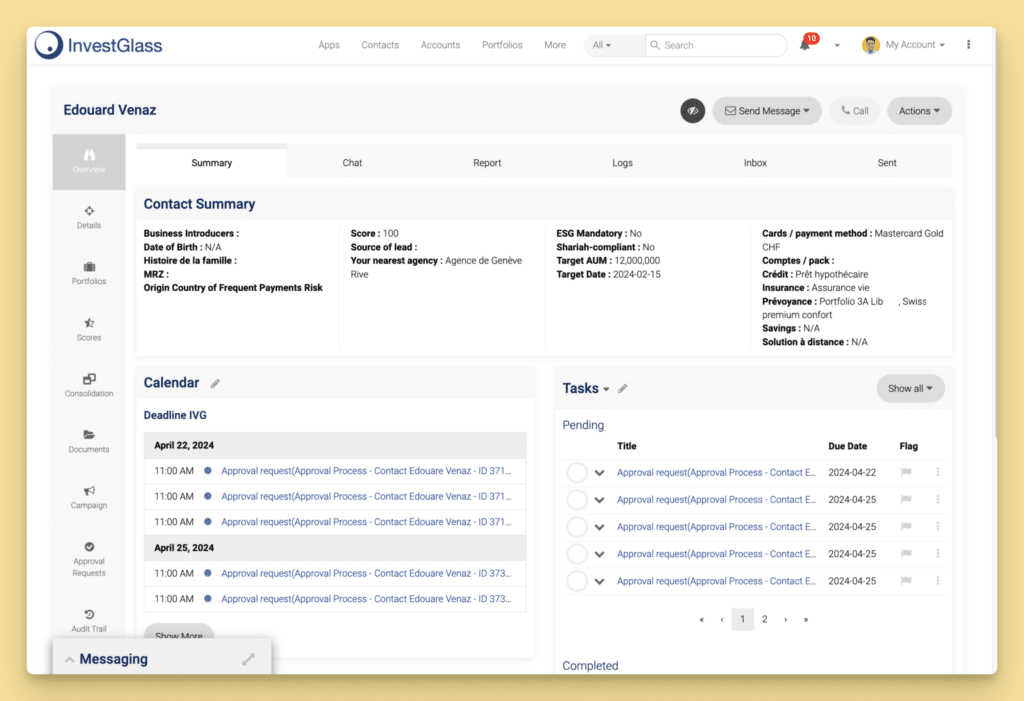
The InvestGlass platform is a complete, all-in-one solution designed to meet the specific needs of regulated industries. It seamlessly integrates a powerful suite of tools that cover the entire customer lifecycle:
Customer Relationship Management (CRM) capabilities allow organisations to organise and optimise all customer interactions, maximising satisfaction and retention. The InvestGlass CRM is designed to be intuitive and user-friendly, with customisable dashboards and drag-and-drop features that allow users to tailor the system to their specific needs without requiring extensive programming knowledge.
Digital Onboarding is a core strength of the platform, enabling organisations to collect new leads and introduce new customers to digital products or services efficiently and compliantly. The platform streamlines the onboarding process, reducing friction and improving the customer experience while ensuring that all regulatory requirements, including KYC (Know Your Customer) and AML (Anti-Money Laundering) checks, are met.
Portfolio Management System (PMS) functionality streamlines investment and banking operations by providing real-time insights into customer data, enabling informed decision-making. This is particularly valuable for Colombian financial services organisations that need to manage complex portfolios while maintaining compliance with the Superintendencia Financiera’s requirements.
Marketing Automation tools enable organisations to plan and execute sophisticated marketing campaigns, with tracking and reporting across all channels. The platform supports customised segmentation of audiences by demographic and other factors, ensuring that the right message reaches the right audience at the right time.
Secure Client Portal functionality improves communication between clients and businesses, providing easy access to documents, invoices, and other important information. This self-service capability reduces the burden on customer service teams while improving the client experience.
Automation and Approval Processes, including Robotic Process Automation (RPA), help businesses become more efficient, reduce costs, and remain competitive. These tools automate routine tasks, freeing up staff to focus on higher-value activities, a critical advantage in Colombia’s fast-paced fintech environment.
For Colombian government agencies and NGOs, InvestGlass offers a tailored solution that addresses the unique challenges of the public sector, including citizen engagement, secure data management, and compliance with national digital governance standards.
Data Sovereignty with InvestGlass
The cornerstone of the InvestGlass value proposition is its unwavering commitment to data sovereignty. With InvestGlass, organisations have the choice of hosting their data in a secure Swiss cloud or on their own on-premise servers. This flexibility gives clients complete control over their data and ensures compliance with local data protection requirements.
The platform’s cloud infrastructure is hosted in data centres certified to ISO 27001 standards, with enterprise-grade encryption at rest and in transit. Audit logging captures every sensitive action. Fine-grained access control ensures that team members see only the customer information relevant to their roles. Administrators can configure data residency to remain within Switzerland only, supported by clear data processing agreements under Swiss jurisdiction. This means no automatic compliance with foreign subpoenas or data requests, a clear contractual framework specifying Swiss jurisdiction, and transparent data processing registers for regulator review.
Whether it is data residency options, data protection policies, or governance processes, InvestGlass is adept at navigating the complexities of data sovereignty requirements, making it an ideal choice for companies conducting business across multiple jurisdictions. The platform prevents potential transfer of data sovereignty to the US and helps organisations respect local legal requirements, a capability that is directly aligned with Colombia’s evolving regulatory landscape.
Comparing InvestGlass with Salesforce and Microsoft Dynamics
For Colombian organisations considering their CRM options, a detailed comparison of the available platforms is essential. The following table provides a comprehensive overview of how InvestGlass compares with the leading US-based alternatives across the dimensions that matter most for digital sovereignty:
| Feature | InvestGlass | Salesforce | Microsoft Dynamics 365 |
| Headquarters | Geneva, Switzerland | San Francisco, USA | Redmond, USA |
| Data Sovereignty | Swiss Cloud or On-Premise | US-based Cloud | US-based Cloud |
| CLOUD Act Exposure | No | Yes | Yes |
| GDPR Compliance | Full | Limited by US law | Limited by US law |
| Swiss nFADP Compliance | Full | No | No |
| Customisation | High (No-code/Low-code) | Medium (Requires consultants) | Medium (Requires consultants) |
| Pricing Transparency | High | Complex and Tiered | Complex and Tiered |
| Financial Services Focus | Strong (Pre-built workflows) | General | General |
| Government Sector Support | Strong | Limited | Limited |
| On-Premise Option | Yes | No | Limited |
| Implementation Speed | Months | Often 12+ months | Often 12+ months |
| Integration Ecosystem | 500+ integrations & flexible API | Extensive | Extensive |
| 24/7 Support | Yes | Varies by plan | Varies by plan |
The comparison reveals that while Salesforce and Microsoft Dynamics offer extensive functionality and large ecosystems, they cannot match InvestGlass on the critical dimension of data sovereignty. For Colombian organisations that must comply with data localisation requirements and protect sensitive data from foreign access, InvestGlass offers a compelling and decisive advantage.
Making the Switch: Migrating from Salesforce to InvestGlass
For Colombian businesses currently using Salesforce or other US-based CRM solutions, the transition to a sovereign platform like InvestGlass is a strategic imperative. The process of switching from Salesforce to InvestGlass is well-defined and supported, with the InvestGlass team working closely with clients throughout the migration journey.
Many scaling companies have made the switch because they wanted to operate in “minutes and hours” instead of “weeks and months,” align sales, compliance, marketing, and operations teams with access to data from one unified system, boost adoption and usage across their teams for reliable data output, connect the CRM to a bank-grade portfolio management tool, and move from a US-based CRM to a European, Swiss-hosted solution.
The InvestGlass migration process is structured into five clear phases. Phase 1: Records Migration involves defining which data should be moved, building custom fields, and exporting data from the current platform into CSV format for cleaning and preparation. Phase 2: Integration focuses on rebuilding the technical architecture, eliminating and consolidating where possible, and connecting critical business applications using pre-built connectors or the InvestGlass API library. Phase 3: Automation documents existing workflows and redesigns them for the InvestGlass platform, leveraging its powerful automation and approval process tools. Phase 4: Portfolio Management connects data sources and rebuilds suitability assessments, universe lists, appropriateness checks, risk metrics, and strategies. Phase 5: Monitor and Reports inventories all active reports and defines future-state reporting needs, with the option for custom reporting solutions.
Before beginning the migration, organisations are encouraged to review and document their existing sales processes, prepare data by merging and eliminating deprecated records, and upskill their teams on the InvestGlass platform through its free certification programme. This structured approach ensures that the transition is not only smooth but also serves as an opportunity to optimise and modernise business processes.
The Strategic Case for Digital Sovereignty in Colombia
The decision to adopt a sovereign CRM platform is more than a technical migration; it is a strategic declaration of independence. It is an act of aligning an organisation’s digital posture with Colombia’s national ambitions, thereby contributing to the collective resilience of the country’s digital economy. By embracing a sovereign solution, Colombian businesses and public institutions can mitigate the legal and geopolitical risks associated with US providers, build deeper trust with their clients and citizens by demonstrating an unwavering commitment to data privacy, and foster innovation on a secure and independent platform.
This move supports the development of a more balanced global digital ecosystem, one where nations like Colombia are not merely consumers of foreign technology but architects of their own digital future. In a landscape where the Colombian fintech sector boasts over 410 companies and the government is investing billions in digital infrastructure, the choice of CRM and data management platform is a decision with consequences that reverberate far beyond the IT department.
The benefits of digital sovereignty extend beyond compliance and risk management. Organisations that control their own data can innovate more freely, developing new products and services without concern about how their data might be used by third parties. They can build deeper relationships with customers by demonstrating a commitment to privacy and security. And they can contribute to the development of a more equitable digital ecosystem, one in which Colombian organisations are not merely consumers of American technology but active participants in shaping the digital future.
As Sandra Ortiz, a prominent expert in the field, has emphasised, the goal must always be to “guarantee the rights of citizens and businesses.” The choice of technology platform is a direct expression of this commitment. By choosing a sovereign platform like InvestGlass, Colombian organisations send a clear message: that they prioritise the protection of their stakeholders’ data above the convenience of a dominant but compromised US platform.
Conclusion: A Sovereign Choice for a Sovereign Nation
Colombia’s determined pursuit of digital sovereignty is a necessary and forward-thinking strategy to secure its place in the global digital age. As the nation builds its own digital infrastructure through projects like BioNube, strengthens its legal frameworks through amendments to Law 1581, and fosters a world-class fintech ecosystem, the choice of technology partners becomes a matter of paramount importance. Continuing to entrust the nation’s most sensitive data to US tech giants, subject to the laws and political pressures of a foreign government, is a risk that is fundamentally incompatible with the goal of true sovereignty.
InvestGlass presents a clear, powerful, and secure alternative. It is a platform that delivers the sophisticated automation and comprehensive features of the leading US providers but with the invaluable freedom and security that only true data sovereignty can offer. With its commitment to data protection, its comprehensive feature set, and its collaborative approach to customer success, InvestGlass is the ideal partner for Colombian organisations looking to build a sovereign digital future.
The choice is clear: a sovereign future requires sovereign solutions. For Colombia, and for Latin America, InvestGlass represents a path forward that combines technological excellence with the protection of fundamental values. In making this choice, Colombian organisations are not only protecting their own interests but contributing to the broader project of building a digital ecosystem that serves the interests of citizens and businesses alike.
Frequently Asked Questions (FAQs)
1. What is digital sovereignty and why is it critical for Colombia?
Digital sovereignty is a nation’s ability to control its own digital infrastructure, data, and the legal frameworks governing its digital space. It is critical for Colombia to protect citizen data, foster a competitive digital economy, ensure the resilience of critical services, and maintain autonomy in an increasingly complex geopolitical landscape. With projects like BioNube and reforms to Law 1581, Colombia is demonstrating a clear national commitment to this principle.
2. What is the US CLOUD Act and how does it impact Colombian businesses?
The US CLOUD Act, enacted in 2018, allows US law enforcement to demand data from US-based tech companies, regardless of where that data is stored globally. This means Colombian businesses using platforms like Salesforce or Microsoft Dynamics 365 have their data exposed to US jurisdiction, which can undermine Colombian data protection laws and national sovereignty. This risk is particularly acute for financial institutions and government agencies handling sensitive data.
3. How does InvestGlass provide a sovereign alternative to Salesforce and Microsoft?
InvestGlass is a Swiss-based company headquartered in Geneva. It offers hosting in secure Swiss data centres, which are protected by Switzerland’s strong privacy laws (nFADP) and are not subject to the US CLOUD Act. It also offers an on-premise deployment option, giving Colombian organisations complete control over their data’s physical location and legal jurisdiction.
4. Is migrating from a platform like Salesforce to InvestGlass difficult?
No, the process is well-defined and supported. InvestGlass provides a structured five-phase migration plan covering records migration, integrations, automation, portfolio management, and reporting. The InvestGlass team works closely with clients throughout the journey, and many companies report that the transition is significantly faster and less complex than expected.
5. What are the main government initiatives driving digital sovereignty in Colombia?
Key initiatives include the BioNube project to create a sovereign state cloud with an investment exceeding $80 million, the continuous strengthening of the General Data Protection Law (Law 1581), the adoption of the X-Road platform for secure government data exchange, the launch of a new passport with a data sovereignty model, and the National Digital Security Strategy 2025–2027.
6. Can InvestGlass serve industries other than finance in Colombia?
Absolutely. While InvestGlass has deep expertise in the financial services sector, including banking, wealth management, and insurance, its flexible and secure platform is also specifically designed to meet the needs of government agencies, NGOs, and other regulated industries. Its CRM for Government solution addresses the unique challenges of the public sector, including citizen engagement and secure data management.
7. How does Swiss data protection law compare to Colombia’s Law 1581 and GDPR?
Switzerland’s Federal Act on Data Protection (nFADP) is one of the strongest in the world and is officially recognised by the EU as providing a level of data protection adequate and equivalent to GDPR. Like Colombia’s Law 1581, it enshrines the fundamental right to privacy and imposes strict rules on data processing and cross-border transfers. The critical advantage is that Swiss law is not subject to the extraterritorial reach of the US CLOUD Act.
8. What is ‘vendor lock-in’ and how does choosing InvestGlass help avoid it?
Vendor lock-in occurs when a customer becomes dependent on a single vendor for products and services, unable to switch to another without substantial costs and complexity. By offering flexible deployment options (Swiss cloud or on-premise), a transparent pricing model, and a flexible API library, InvestGlass provides greater freedom and reduces the risk of dependency common with large, monolithic US cloud platforms like Salesforce.
9. Does InvestGlass integrate with other business applications used in Colombia?
Yes, InvestGlass has a rich ecosystem with over 500 integrations and a flexible API library. This allows it to connect with critical business applications, including banking systems, payment gateways, and communication tools, ensuring that a move to a sovereign platform does not mean sacrificing functionality or creating data silos. For integrations that do not exist natively, the API enables custom development.
10. Why is on-premise hosting important for digital sovereignty in Colombia?
On-premise hosting offers the ultimate level of control, as it allows an organisation to store its data on its own servers, within its own physical facilities, and entirely within Colombian jurisdiction. For government bodies, critical infrastructure operators, and financial institutions in Colombia, this can be the most secure path to achieving full digital sovereignty, fully aligned with the objectives of the BioNube project. InvestGlass is one of the few modern CRM platforms to offer this option alongside its Swiss cloud hosting.

