
Written by InvestGlass on 27 February 2026.
Peru stands at a defining moment in its digital journey. As the nation accelerates its digital transformation agenda, a fundamental question demands attention: who truly controls the data that powers Peru’s economy, government services, and financial institutions? The answer, for most Peruvian organisations today, is uncomfortable. The vast majority of sensitive data flows through infrastructure owned and operated by a handful of US-based technology corporations, principally Microsoft and Salesforce, whose legal obligations to the United States government create an irreconcilable tension with Peru’s own data protection ambitions.
This article examines the digital sovereignty landscape in Peru, the structural risks of depending on American cloud providers, and why InvestGlass, a 100% Swiss sovereign CRM and automation platform, represents a fundamentally superior alternative for Peruvian businesses, banks, and government entities seeking genuine control over their digital assets.
What you will learn in this article:
•The current state of digital sovereignty in Peru and Latin America, including key regulatory frameworks.
•Why the US CLOUD Act makes it impossible for Salesforce and Microsoft to guarantee true data sovereignty.
•The critical distinction between data residency and data sovereignty.
•How InvestGlass delivers genuine Swiss sovereign protection for CRM, onboarding, portfolio management, and compliance.
•Practical steps Peruvian organisations can take to reclaim control of their digital infrastructure.
The State of Digital Sovereignty in Peru
Peru has taken meaningful steps to establish a regulatory foundation for data protection and digital governance. The Personal Data Protection Law (Ley No. 29733), enacted in July 2011, provides a comprehensive framework governing the collection, use, and disclosure of personal data by both private and state entities. The law guarantees the fundamental right to the protection of personal data, as enshrined in Article 2.6 of the Political Constitution of Peru. Crucially, it requires that transborder data flows only occur to countries that maintain a “sufficient level of protection” for personal information.
In addition, the government has pursued an ambitious digital transformation agenda. Emergency Decree No. 006-2020 created the National Digital Transformation System, promoting collaboration between public and private sectors. The National Policy of Digital Transformation (085-2023-PCM) explicitly aims to align Peru with international good practices and standards, attract investment, and enable interoperability across government systems. INDECOPI, Peru’s national competition authority, has also approved a Government and Digital Transformation Plan for 2024–2026.
Yet despite these regulatory advances, Peru’s digital infrastructure remains overwhelmingly dependent on foreign providers. Latin America as a whole hosts a mere 4.8% of the world’s data centre infrastructure, according to the United Nations Development Programme, compared with 38.5% for the United States alone. The region accounts for 6.6% of global GDP but attracts just 1.1% of worldwide artificial intelligence investment, according to the ECLAC-CENIA Latin American Artificial Intelligence Index. AWS, Microsoft Azure, and Google Cloud collectively control roughly two-thirds of global cloud infrastructure, and their dominance in Latin America is even more pronounced.
The Peruvian Army’s Centre for Strategic Studies (CEEEP) has warned that the proliferation of foreign technologies is part of a global strategy that seeks to consolidate economic and political influence through standardised solutions, increasing “regional vulnerability in terms of digital sovereignty.” This vulnerability is not theoretical. Peru has been a frequent target of cyberattacks from both state-linked groups and organised crime, including ransomware incidents and data leaks affecting urban surveillance systems and government databases.
Data as the New Raw Material: A Pattern of Extraction
In earlier centuries, colonial systems extracted minerals, agricultural products, and energy resources from Latin America. In the digital age, data has become the most valuable resource, and the extractive pattern is repeating itself in new forms.
Every online action leaves a trace. That information is collected and refined by a small number of global technology firms. Through advanced analytics, these companies construct behavioural forecasts that anticipate how individuals will act, consume, and vote. The result is what scholars increasingly describe as data neocolonialism: a system in which technological powers extract and control digital value generated elsewhere, whilst the countries producing that data see little of the return.
As Carlos Cantero, a Chilean academic at the International University of La Rioja, wrote in a February 2026 analysis for UPI: “Without clear data governance strategies, Latin American economies risk a form of structural dependence in which digital platforms operate much as extractive industries once did, profiting from local resources while concentrating wealth and decision-making power elsewhere.”
For Peru, this dynamic is particularly acute. Banco de Crédito del Peru (BCP), the country’s largest bank, invested more than USD 650 million in a hybrid cloud modernisation initiative with Microsoft and Kyndryl. Whilst such investments drive operational efficiency, they also deepen structural dependence on US-headquartered technology providers whose legal obligations may conflict with Peruvian data protection requirements.
The CLOUD Act: Why Salesforce and Microsoft Cannot Guarantee Data Sovereignty
The most significant risk facing Peruvian organisations that rely on US-based cloud providers is not a technical vulnerability. It is a legal one.
The US CLOUD Act (Clarifying Lawful Overseas Use of Data Act), enacted in 2018, explicitly grants US law enforcement the right to demand data stored abroad by US companies, even when that data is located in a foreign jurisdiction. This law applies to every company “subject to US jurisdiction,” which includes all US-headquartered firms and their global subsidiaries.
This is complemented by FISA Section 702, which allows US intelligence agencies to conduct warrantless surveillance on foreign individuals using US electronic communication services. The surveillance operates in secret, often under gag orders that prevent the affected company from disclosing the data request to its customers.
Executive Order 12333 introduces yet another layer, permitting the bulk collection of communications data intercepted overseas without judicial oversight. Together, these three legal instruments create a comprehensive surveillance framework that overrides any local protections provided by Peru’s Ley No. 29733 or any other national data protection law.
The implications were laid bare in a remarkable admission before the French Senate in 2025, when a Microsoft executive testified under oath that the company “cannot guarantee” data sovereignty for its European clients. The executive acknowledged that Microsoft would be compelled, however unlikely the scenario, to comply with US government data requests, regardless of where the data is physically stored.
Key insight: Data residency is simply about where your data is physically stored. Data sovereignty is about which country’s laws govern that data. US cloud providers can offer data residency in Latin America, but they cannot offer data sovereignty, because US law follows the provider, not the data.
Víctor Ruiz, founder of the SILIKN cybersecurity centre in Mexico, has warned that “this dynamic reinforces technological dependence and compromises digital sovereignty,” noting that access to information on “mobility patterns, infrastructure, and urban behaviour gives companies strategic knowledge that could be used to expand their commercial presence or as a tool for geopolitical influence.”
In February 2026, Reuters reported that the Trump administration ordered US diplomats to actively lobby against data sovereignty initiatives worldwide, further underscoring the geopolitical dimension of this challenge for nations like Peru.
Comparing InvestGlass with Salesforce and Microsoft: A Sovereignty Analysis
The following comparison table illustrates the fundamental differences between InvestGlass and the two dominant US-based CRM and cloud providers operating in Peru.
| Aspect | InvestGlass (Swiss) | Salesforce (US) | Microsoft Dynamics 365 (US) |
| Legal Jurisdiction | Swiss law (nFADP) | US law (CLOUD Act, FISA) | US law (CLOUD Act, FISA) |
| Data Hosting | Swiss data centres or on-premise | Multi-tenant global cloud | Azure global cloud |
| Foreign Government Access | Not subject to US CLOUD Act | Subject to US government requests | Subject to US government requests |
| True Data Sovereignty | Guaranteed under Swiss law | Cannot be legally guaranteed | Cannot be legally guaranteed |
| Encryption Key Control | Customer-managed keys available | Provider retains access capability | Provider retains access capability |
| Regulatory Independence | Independent Swiss company | US corporate structure | US corporate structure |
| Financial Services Workflows | Pre-built for banking, KYC, PMS | Requires extensive customisation | Requires extensive customisation |
| On-Premise Deployment | Available | Not available | Available but complex |
| Compliance with Peru Ley 29733 | Fully aligned (adequate protection) | Conflict with US legal obligations | Conflict with US legal obligations |
| Time to Value | Months | Typically 12–18 months | Typically 12–18 months |
This comparison reveals a structural reality that no amount of marketing can obscure. Salesforce and Microsoft, regardless of their technical capabilities, operate under a legal framework that fundamentally prevents them from offering true data sovereignty to Peruvian clients. InvestGlass, by contrast, operates exclusively under Swiss law, which provides one of the strongest data protection regimes in the world.
Why Switzerland? The Advantage of Neutrality and Privacy
Switzerland’s reputation as a data sanctuary is not accidental. It is the product of decades of banking tradition, political neutrality, and deliberate legislative action. The revised Swiss Federal Act on Data Protection (nFADP), effective from September 2023, strengthens individual rights whilst maintaining Switzerland’s adequacy status with the European Union. This dual protection means that data hosted in Switzerland benefits from both Swiss and EU-level privacy safeguards.
Switzerland is not a member of the European Union, which means it is not subject to the political pressures that can influence EU data policy. At the same time, it is not subject to US surveillance laws. This unique position makes Switzerland the ideal jurisdiction for organisations seeking genuine data sovereignty.
The Swiss approach to data protection rests on several pillars that are directly relevant to Peruvian organisations:
Jurisdictional independence. Swiss authorities do not automatically comply with foreign subpoenas or data requests. Any request for data must go through Swiss legal channels, where it is subject to rigorous scrutiny.
Banking-grade privacy. Switzerland’s centuries-old tradition of banking secrecy has evolved into a modern framework for data protection that is unmatched globally. Financial institutions, government entities, and corporations benefit from this heritage.
Political neutrality. Switzerland’s neutrality is not merely a diplomatic posture. It is a constitutional principle that extends to the digital realm, ensuring that Swiss-hosted data is not caught in the crossfire of geopolitical competition between the United States and China.
EU adequacy recognition. The European Commission has recognised Switzerland as providing an adequate level of data protection, meaning that data transfers between the EU and Switzerland are permitted without additional safeguards. This is particularly relevant for Peruvian organisations with European operations or clients.
InvestGlass: A Comprehensive Swiss Sovereign Platform
InvestGlass is far more than a CRM. It is a complete digital suite designed for organisations that refuse to compromise on sovereignty. Built in Geneva, the platform combines customer relationship management, digital onboarding, KYC automation, portfolio management, marketing automation, and a secure client portal in a single Swiss sovereign solution.
CRM and Client Relationship Management
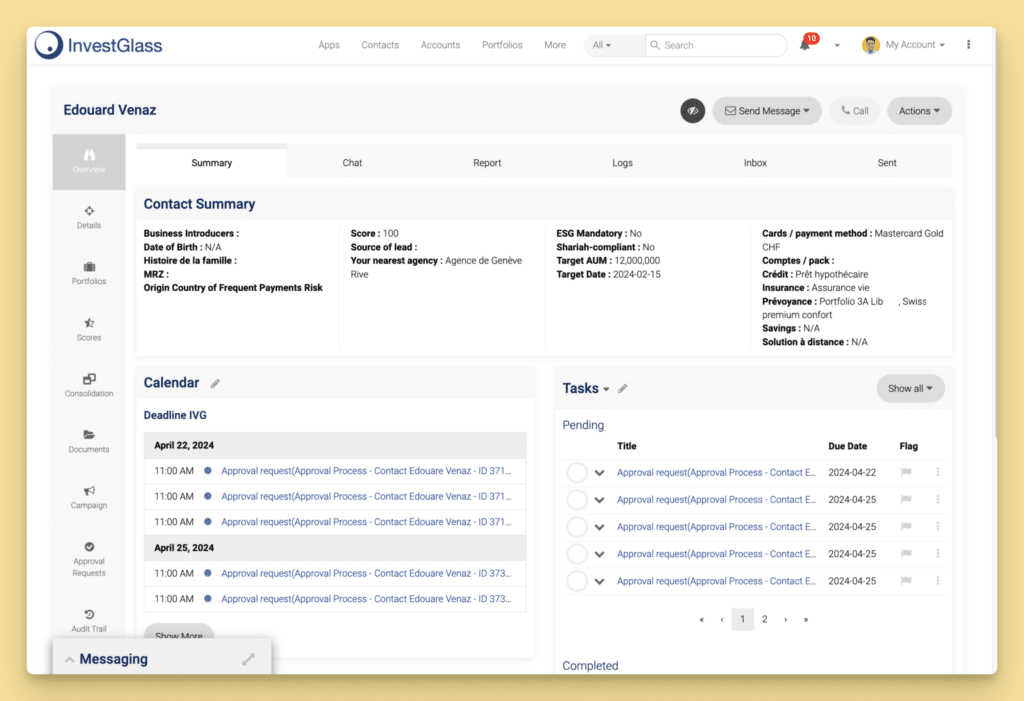
The InvestGlass CRM manages leads, opportunities, pipelines, and revenue forecasting for private banks, independent asset managers, insurance brokers, and government entities. Each client record stores risk profiles, investment objectives, ESG preferences, and completed suitability questionnaires. Relationship managers access complete client histories without switching between disconnected systems, whilst compliance officers gain visibility into every customer interaction through integrated audit trails.
Digital Onboarding and KYC Automation
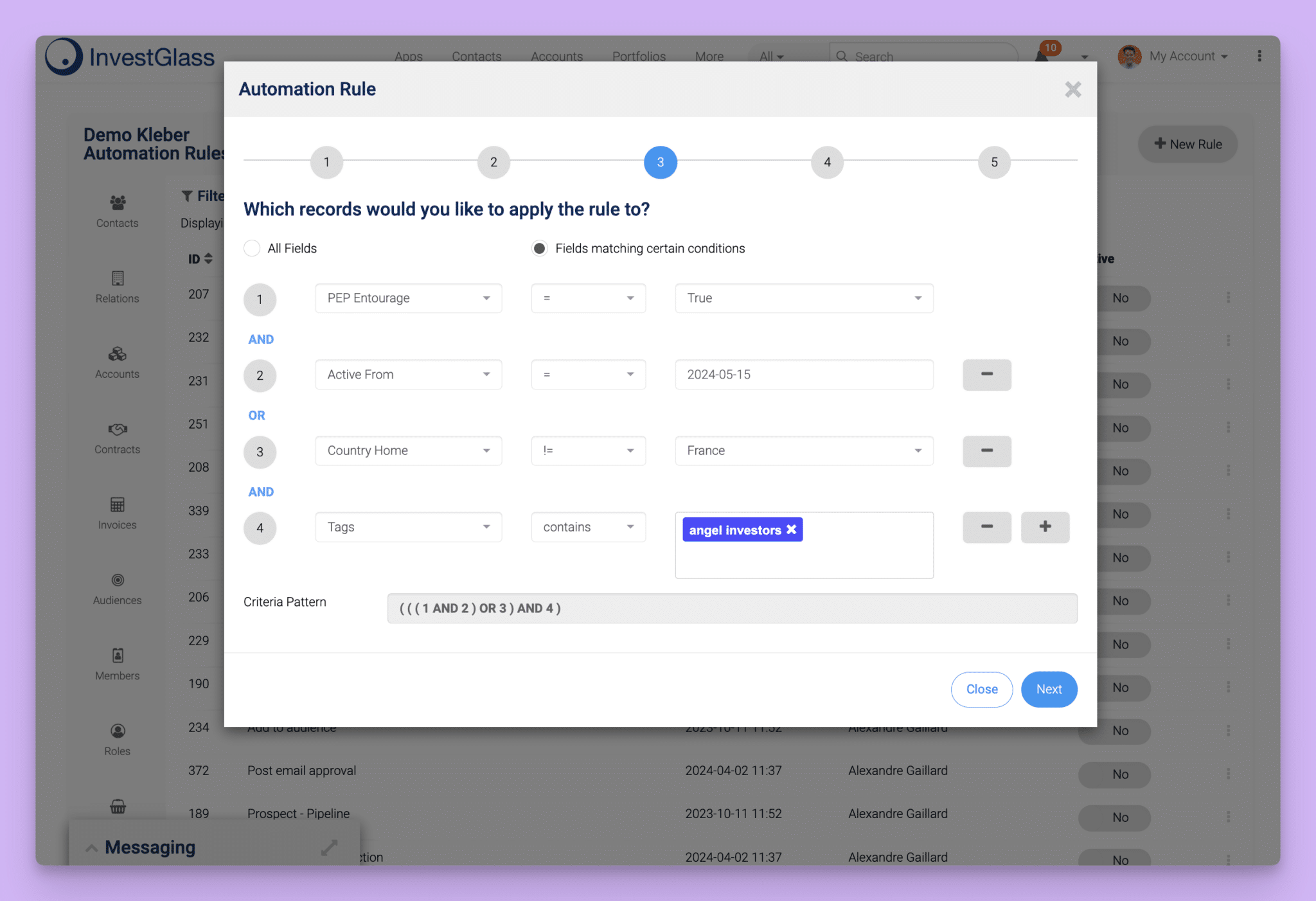
Remote client acquisition has become essential across all sectors, and digital onboarding now determines competitive advantage. InvestGlass digital onboarding forms allow clients to complete applications from their mobile devices. E-signature integration captures legally binding consent. Document upload functionality collects identification and proof of address. KYC automation connects to Swiss and international screening providers, checking prospects against sanctions lists, PEP databases, and adverse media sources. All results flow directly into InvestGlass client records, keeping core compliance data within Swiss hosting rather than scattered across third-party platforms.
Portfolio Management and Client Portal
InvestGlass extends beyond traditional CRM to provide portfolio management and a secure client portal, all hosted within Swiss infrastructure. Relationship managers view positions, transactions, performance metrics, and risk exposures attached to each client directly within the platform. The client portal gives end clients self-service access to their portfolios, enabling them to view holdings, download reports, upload documents, and communicate with advisers without leaving the Swiss-hosted environment.
Marketing Automation
Regulated firms need compliant marketing automation rather than generic email tools. InvestGlass includes Swiss-hosted marketing automation for email campaigns, client journeys, and event invitations. Compliance teams approve campaign content before distribution. Opt-in preferences synchronise automatically with CRM records, ensuring that marketing respects client choices and regulatory boundaries.
AI Capabilities with Sovereign Data Protection
InvestGlass is actively developing AI capabilities that respect data sovereignty principles. Unlike AI services from US providers, which might route customer data through foreign servers for processing, InvestGlass keeps models and data within Swiss infrastructure where possible. This reduces exposure from sending customer data to foreign AI providers whilst still delivering advanced features such as churn prediction, lead prioritisation, and next-best-action recommendations.
The Peruvian Context: Geopolitical Pressures and Strategic Choices
Peru finds itself at the centre of growing strategic competition between the United States and China in Latin America. Chinese companies such as Huawei, Hikvision, Dahua, and ZTE have deployed video surveillance, AI, and 5G technology networks in key Peruvian cities. Meanwhile, US technology firms dominate the cloud infrastructure and enterprise software markets.
Neither framework was designed with Peruvian interests at the centre. As the ECLAC-CENIA index demonstrates, most national AI strategies in Latin America lack sufficient financing and clear implementation mechanisms. The talent gap continues to widen as AI specialists migrate abroad. No country in Latin America meets the global average for AI investment relative to GDP per capita.
In this context, choosing a neutral, Swiss sovereign technology partner represents a strategic decision that transcends mere technology procurement. It is a statement of digital autonomy. By selecting InvestGlass, Peruvian organisations signal that they will not accept the false choice between American and Chinese technological dependence. Instead, they choose a third path: genuine sovereignty through Swiss neutrality.
The South American cloud computing market is expected to reach USD 55.21 billion in 2025 and grow at a compound annual growth rate of 9.81% to reach USD 88.17 billion by 2030. Peru’s share of this market is growing rapidly, but the question remains: will this growth benefit Peruvian sovereignty, or will it deepen dependence on foreign providers?
Practical Steps for Peruvian Organisations Seeking Digital Sovereignty
Achieving digital sovereignty is not an overnight transformation. It requires a deliberate, phased approach. The following framework provides guidance for Peruvian businesses and government entities:
Conduct a data sovereignty audit. Map where all sensitive data currently resides, which providers host it, and which jurisdictions govern it. Identify any data flows that route through US-based infrastructure.
Assess legal exposure. Evaluate the implications of the US CLOUD Act, FISA, and Executive Order 12333 for your organisation’s data. Consider whether your current providers can legally guarantee that your data will not be accessed by foreign authorities.
Evaluate Swiss sovereign alternatives. Explore platforms like InvestGlass that offer genuine data sovereignty under Swiss law. Request demonstrations showing how your specific data flows and regulatory compliance requirements would be handled within a Swiss-hosted environment.
Plan a phased migration. InvestGlass supports structured migration from Salesforce, Microsoft Dynamics, HubSpot, or legacy systems using CSV exports or API connectors. Data never routes through intermediate jurisdictions during migration. A typical mid-size organisation completes migration to InvestGlass over three to six months, including training and parallel operation periods.
Engage compliance and legal teams early. Ensure that your compliance officers and legal counsel are involved from the outset. They will need to assess how the migration aligns with Peru’s Ley No. 29733 and any sector-specific regulations.
The Total Cost of Sovereignty
A common misconception is that Swiss sovereign solutions are prohibitively expensive. In reality, InvestGlass often delivers significant cost savings compared with the total cost of ownership for Salesforce or Microsoft Dynamics implementations.
InvestGlass replaces separate CRM, KYC, portfolio management, client portal, and marketing automation subscriptions with a single integrated platform. Organisations avoid the add-ons and customisation expenses that US-based CRMs require for financial services functionality. Implementation costs decrease when complex integration projects are eliminated. Support relationships simplify. Training requirements reduce.
| Cost Factor | InvestGlass | Salesforce / Microsoft |
| Licence Fees | Single platform subscription | Multiple product subscriptions |
| Customisation | Pre-built financial workflows | Extensive consultant-led customisation |
| Integration | Unified platform, minimal integration | Multiple integration projects required |
| Implementation Timeline | 3–6 months | 12–18 months typical |
| Ongoing Maintenance | Managed Swiss cloud or on-premise | Complex multi-vendor management |
| Compliance Overhead | Built-in audit trails and workflows | Manual compliance processes |
| Hidden Costs | Transparent pricing | Add-ons, API charges, storage fees |
Productivity gains emerge when relationship managers and compliance teams work within a single interface. Context switching disappears. Data entry happens once. Reporting draws from unified records rather than assembled spreadsheets. These efficiency improvements free teams to focus on client service rather than system management.
Hosting Options: Swiss Cloud or On-Premise
InvestGlass offers deployment flexibility that matches different institutional requirements. Organisations choose between Swiss private cloud hosting and on-premise installation within their own data centres.
The Swiss cloud option delivers a fully managed service. InvestGlass handles updates, monitoring, and security from Switzerland. High-performance infrastructure ensures low-latency access for users across the Americas. This model suits firms prioritising speed to deployment and minimal IT overhead.
The on-premise option runs InvestGlass software on client-owned servers. InvestGlass engineers provide support whilst the institution maintains direct hardware control. Banks and government entities with strict internal IT policies often prefer this arrangement for production environments.
Hybrid scenarios combine both approaches. Testing and development environments run in the InvestGlass Swiss cloud whilst production systems operate on-premise. This flexibility accelerates development cycles without compromising production security standards.
Security Architecture: Defence in Depth
InvestGlass uses Swiss data centres certified to ISO 27001 standards with enterprise-grade encryption at rest and in transit. Audit logging captures every sensitive action. Fine-grained access control ensures that team members see only the customer information relevant to their roles. Administrators configure data residency to remain within Switzerland only, supported by clear data processing agreements under Swiss jurisdiction.
The platform’s security model connects client devices to Swiss data centres through encrypted channels. Third-party service integrations route through controlled interfaces that maintain data within Swiss jurisdiction. Administrative tools provide visibility into all connection points, enabling security teams to verify that backend operations meet institutional standards.
Every sensitive action generates audit log entries. Administrators access dashboards monitoring access patterns from different locations. Unusual activity triggers alerts for security team review. This visibility supports both internal governance and regulator expectations for traceable processes.
A Vision for Peru’s Digital Future
The path to digital sovereignty is not without its challenges, but it is a path that Peru must take to secure its future. Technology need not be rejected. It must be governed. That means enforceable data sovereignty frameworks that give citizens and nations real control over how their data is stored and commercialised. It means algorithmic accountability with independent oversight of the systems that shape public discourse and economic opportunity.
Peru has real assets for this challenge: renewable energy resources that data centres increasingly require, a young and growing digital population, and established universities that produce capable researchers. What remains uncertain is whether organisations will move from strategy documents to coordinated action before the window closes.
By embracing Swiss sovereign solutions like InvestGlass, Peru can break free from the risks of digital dependence and build a digital future that is secure, prosperous, and truly its own. The architecture of the digital order is being built now. Peru must decide whether it will help set the rules of the digital age or accept standards imposed from abroad.
Frequently Asked Questions
1. What is digital sovereignty, and why does it matter for Peru?
Digital sovereignty refers to a nation’s ability to exercise control over its own digital infrastructure, data, and the legal frameworks that govern them. For Peru, digital sovereignty matters because the country’s growing reliance on foreign technology providers, particularly those based in the United States and China, creates vulnerabilities ranging from foreign surveillance to loss of control over critical national data. Peru’s Personal Data Protection Law (Ley No. 29733) establishes a framework for data protection, but true sovereignty requires that data be hosted under jurisdictions that cannot be overridden by foreign legal demands.
2. What is the US CLOUD Act, and how does it affect Peruvian organisations?
The US CLOUD Act (Clarifying Lawful Overseas Use of Data Act) is a federal law enacted in 2018 that grants US law enforcement agencies the authority to compel US-based technology companies to hand over data, regardless of where that data is physically stored. This means that any Peruvian organisation using Salesforce, Microsoft, or other US-headquartered cloud providers is potentially exposed to US government data requests, even if the data is stored in a Latin American data centre.
3. What is the difference between data residency and data sovereignty?
Data residency refers to the physical location where data is stored. Data sovereignty refers to which country’s laws govern that data. US cloud providers can offer data residency in Latin America by building local data centres, but they cannot offer data sovereignty because US law follows the provider, not the data. A Peruvian organisation storing data with a US provider in a local data centre is still subject to US law.
4. Why is Switzerland considered a safe jurisdiction for data?
Switzerland has a long-standing tradition of political neutrality, banking secrecy, and robust data protection laws. The revised Swiss Federal Act on Data Protection (nFADP), effective from September 2023, provides one of the strongest privacy frameworks in the world. Switzerland is not subject to US surveillance laws such as the CLOUD Act or FISA, and it maintains EU adequacy status, meaning data transfers between Switzerland and the EU are permitted without additional safeguards.
5. What is InvestGlass, and how does it differ from Salesforce or Microsoft?
InvestGlass is a 100% Swiss sovereign CRM and automation platform headquartered in Geneva. Unlike Salesforce and Microsoft, InvestGlass operates exclusively under Swiss law and is not subject to the US CLOUD Act. The platform combines CRM, digital onboarding, KYC automation, portfolio management, marketing automation, and a client portal in a single Swiss-hosted solution, providing genuine data sovereignty that US-based providers cannot legally guarantee.
6. Can InvestGlass be deployed on-premise in Peru?
Yes. InvestGlass offers both Swiss private cloud hosting and on-premise installation within an organisation’s own data centres. This flexibility allows Peruvian banks, government entities, and corporations to maintain direct hardware control whilst benefiting from InvestGlass’s pre-built financial services workflows and compliance capabilities.
7. How does InvestGlass handle regulatory compliance for Peruvian organisations?
InvestGlass enables compliance with multiple regulatory frameworks through built-in audit trails, configurable approval workflows, and automated compliance reporting. The platform supports data subject rights, retention rules, and export logs directly within the CRM. For Peruvian organisations subject to Ley No. 29733, InvestGlass’s Swiss hosting ensures that transborder data flow requirements are met, as Switzerland provides an adequate level of data protection.
8. What is the typical timeline for migrating from Salesforce or Microsoft to InvestGlass?
A typical mid-size organisation completes migration to InvestGlass over three to six months, including training and parallel operation periods. InvestGlass imports data from Salesforce, Microsoft Dynamics, HubSpot, or legacy systems using CSV exports or API connectors. Data never routes through intermediate jurisdictions during migration, maintaining sovereignty throughout the process.
9. Is InvestGlass more expensive than Salesforce or Microsoft?
InvestGlass often delivers significant cost savings compared with the total cost of ownership for Salesforce or Microsoft Dynamics implementations. By consolidating CRM, KYC, portfolio management, client portal, and marketing automation into a single platform, organisations avoid the add-ons, customisation expenses, and integration costs that US-based CRMs typically require. Implementation timelines are shorter, reducing consulting fees and accelerating time to value.
10. How can a Peruvian organisation get started with InvestGlass?
Peruvian organisations can visit www.investglass.com to request a tailored demonstration. The InvestGlass team provides workshops, proof-of-concept projects, and data sovereignty assessments focused on migrating to a Swiss-hosted CRM that supports growth whilst managing risks. The platform offers a 14-day free trial with no credit card required.

