
Wealth management is a dynamic and demanding field where the strength of client relationships often determines a firm’s long term success. Financial advisors are expected to deliver highly personalized client service, manage complex portfolios, and respond quickly to evolving client needs all while navigating regulatory requirements and increasing competition. In this environment, customer relationship management (CRM) software has become an essential tool for wealth managers seeking to differentiate themselves and achieve scalable growth.
A robust CRM system acts as the central hub for all client data, allowing financial advisors to organize contact details, track every client interaction, and automate key tasks. This centralized approach not only streamlines daily operations but also empowers advisors to deliver a higher standard of client service. By having instant access to comprehensive client profiles, advisors can anticipate needs, personalize communications, and ensure that no opportunity or follow-up is missed.
Operational efficiency is another major benefit of CRM adoption in wealth management. By automating routine processes and consolidating information from multiple systems, CRM software frees up valuable time for advisors to focus on building stronger client relationships and growing their client base. In a rapidly changing industry, firms that leverage CRM tools are better positioned to adapt, exceed client expectations, and drive sustainable business growth.
Key Takeaways
- A modern customer relationship management platform serves as the core growth engine for any wealth management firm by centralising client data, automating follow ups, and supporting compliant advice delivery across the entire client lifecycle.
- Firms that combine crm software with digital onboarding, KYC workflows, and portfolio data typically achieve higher client retention and gather more assets per adviser within 12 to 24 months.
- A specialised wealth CRM like InvestGlass hosted in Switzerland meets regulatory expectations on data sovereignty while still enabling marketing automation and AI driven insights for scalable growth.
- Sustainable growth comes from consistent processes inside the CRM including lead management, prospect nurturing, cross selling, and referral tracking rather than simply purchasing software.
- Change management matters just as much as technology. Targeted training and clear KPIs turn CRM adoption into measurable revenue and AUM expansion.
Why Wealth Management Firms Need CRM To Drive Organic Growth
Many mid sized wealth firms still rely on spreadsheets, email folders, and disconnected tools to manage client relationships. This approach creates significant compliance risk, limits growth potential, and makes it nearly impossible to deliver the personalised service that clients now expect.
In addition to implementing a CRM, it is important to evaluate other tools that can be integrated to enhance workflow efficiency, scalability, and compliance across the firm.
Fee pressure continues to intensify across the wealth management industry, while client expectations have risen sharply through 2024 and 2025. High net worth individuals and mass affluent clients want advisers who understand their goals, anticipate their needs, and communicate proactively. Delivering this level of client service at scale simply cannot happen without a centralised system that brings together every piece of client information.
Industry research confirms this reality. More than two thirds of wealth executives and asset managers now view data management and client insight as the primary lever for growth strategies, particularly during periods of economic uncertainty when clients become less likely to switch providers.
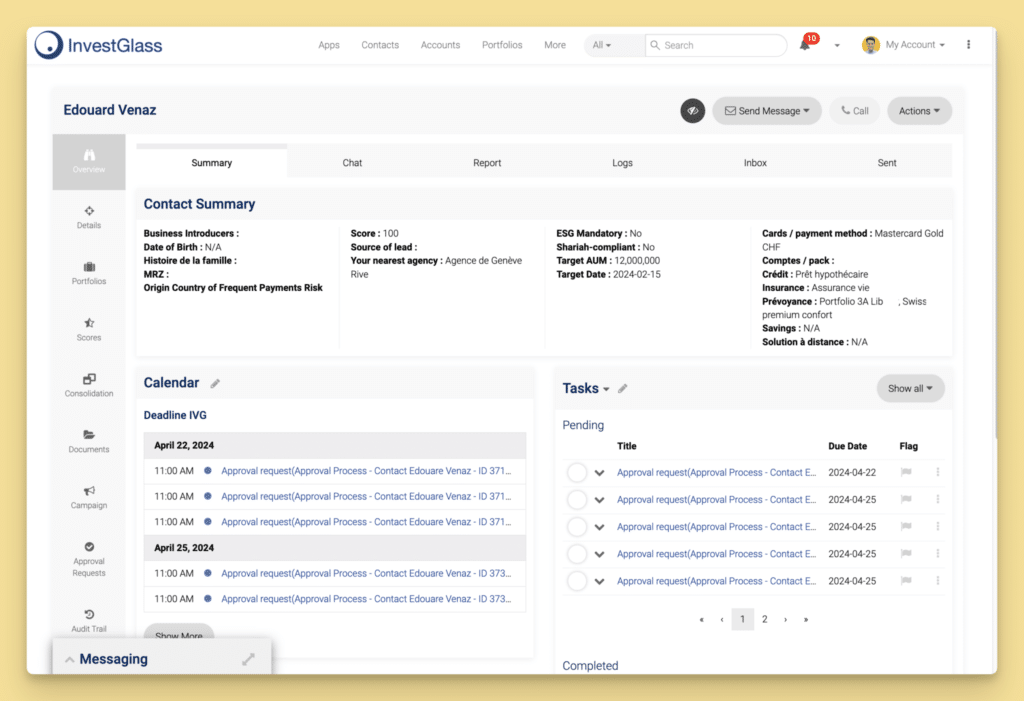
A well implemented CRM moves the firm from reactive to proactive engagement. Financial advisors gain a complete view of households, goals, portfolios, and communication history in one place. This visibility transforms how advisers prepare for client meetings and how firms identify opportunities for deepening relationships.
InvestGlass was built specifically for regulated financial institutions. Our clients use CRM as the backbone for organic growth rather than treating it as a simple contact database. The difference lies in how every feature connects to real business outcomes.
Common pain points that CRM solves:
- Scattered client data across multiple systems making it impossible to get a unified view
- Missed follow ups and inconsistent communication damaging client satisfaction
- Manual work consuming adviser time that should go toward relationship building
- Compliance gaps from poor record keeping of advice interactions
- Limited visibility into pipeline health and adviser productivity for leadership
How CRM Directly Supports Growth Of Assets Under Management
Every additional unit of assets under management comes from doing four things better: prospecting, converting, onboarding, and retaining the right clients. A properly configured CRM directly supports each of these stages.
Lead Generation And Prospect Engagement
- CRM pipelines track potential clients from first website visit or referral introduction through to signed mandate
- Management gains visibility into where leads stall, allowing optimisation of conversion rates
- Segmentation tools identify which prospect types convert at higher rates, improving targeting
- Referral tracking connects new opportunities to existing clients who made introductions
Conversion And Deal Management
- Centralised suitability data, risk profiles, and investment preferences help advisers build proposals that clients act on faster
- Template libraries for proposals and presentations ensure consistent quality across the team
- Activity tracking shows which adviser behaviours correlate with won mandates
- Real time insights into pipeline value help forecast AUM growth accurately
Client Onboarding
- Digital forms and automated document collection reduce onboarding time from weeks to days
- KYC workflows ensure all compliance requirements are met before accounts go live
- Welcome sequences introduce new clients to the full range of services available
- Task automation ensures nothing falls through the cracks during the critical first 90 days
Client Retention And Expansion
- Review meeting reminders and portfolio update notifications keep advisers in regular contact
- Behavioural flags identify clients showing signs of potential churn before they leave
- Cross selling campaigns surface additional services relevant to each client’s evolving needs
- Upsell opportunities become visible when crm tools track assets held elsewhere
Example scenario: A firm uses automated campaigns to re engage dormant leads who downloaded a guide six months ago but never booked a meeting. The campaign delivers three targeted emails over two weeks, resulting in 15 new discovery calls and four mandates worth a combined 8 million in new AUM within a single quarter.
Key CRM Capabilities Wealth Managers Should Use For Growth
Not every CRM feature matters equally for wealth managers. This section focuses on the growth critical functions that drive measurable results.
Client Profile Management
- Store goals, family structure, risk tolerance, invested assets, and KYC data in one place
- Maintain complete contact details and communication preferences for every household member
- Track life events such as retirement dates, business sales, and inheritance expectations
- Support holistic advice by giving advisers instant access to everything they need
Task Automation And Workflow Management
- Automatic follow up reminders after client meetings ensure no opportunity goes cold
- Document chase sequences reduce manual work and speed up onboarding
- Periodic review schedules trigger tasks for advisers at the right intervals
- Key tasks never get forgotten because the system keeps everyone accountable
- CRM platforms can automate workflows to streamline processes, improve efficiency, and ensure compliance by automating repetitive tasks within client management and portfolio tracking
Integrated Portfolio And Performance Views
- Holdings and allocation from the portfolio management system appear directly in client records
- Advisers see performance metrics without switching to separate financial planning software
- Clients with underperforming segments become visible for proactive outreach
- Custodial platforms integration ensures data stays current without manual updates
- Integration with Power BI in Microsoft Dynamics 365 provides real-time dashboards, investment analytics, and embedded business intelligence features for comprehensive data visualization and reporting
Marketing Automation
- Segmented email journeys for prospects, existing clients, and centres of influence
- Campaigns triggered by behaviour such as portal logins, document downloads, or inactivity
- Personalised content based on client lifecycle stage and investment interests
- Performance tracking shows which campaigns generate qualified pipeline
Client Portals
- Portals pull data from the CRM so clients see reports, sign documents, and message advisers securely
- Single login eliminates friction from multiple systems
- Mobile access ensures clients can engage from anywhere
- Secure messaging replaces insecure email for sensitive communications
InvestGlass Specific Features
- Swiss hosted client profiles meeting data sovereignty requirements
- Digital forms for suitability assessments and account opening
- Automated KYC refresh workflows keeping compliance current
- Pre built templates for wealth management use cases reducing setup time
Using CRM To Deliver Personalised Client Engagement At Scale
High net worth and mass affluent clients expect bespoke contact. They want advisers who remember their children’s names, understand their business challenges, and anticipate their needs. Yet wealth managers often handle hundreds of relationships per adviser. CRM makes this level of personalised service possible without burning out the team.
Building Complete Client Timelines
CRM timelines store every call, email, meeting, and note in chronological order. Advisers can reference life events, promotions, liquidity events, and family changes in seconds. When a client mentions their daughter’s wedding during a call, that note becomes visible to anyone on the team who speaks with them next. This consistency builds trust and demonstrates genuine understanding.
Segmentation Strategies For Relevant Communication
Effective segmentation transforms generic outreach into meaningful client interaction. CRM fields such as age, liquidity event date, business owner status, or risk tolerance allow firms to send timely and relevant messages.
Segment | Trigger | Campaign Example |
|---|---|---|
Pre retirees within 5 years | Age field | Income planning webinar invitation |
Business owners | Entity type field | Exit planning guide delivery |
High risk tolerance | Risk score | Alternative investment opportunities |
Recent widows or widowers | Life event flag | Estate planning check in |
Automated Personal Touches
- Birthday greetings sent automatically but appearing personal
- Contract maturity reminders prompting review conversations
- Anniversary messages celebrating the length of the relationship
- Market commentary tailored to each client’s portfolio holdings
InvestGlass Example: During a market volatility event in early 2024, one firm used marketing automation to trigger a portfolio volatility update email for all clients above a defined risk score. The message went out within hours, reassuring clients before they called in with concerns. This proactive approach reduced inbound calls by 40 percent and generated positive feedback that strengthened client relationships.
Referral Tracking And Growth
Personalised engagement increases referrals. Satisfied clients naturally mention their advisers to friends and colleagues. CRM tracks referrer relationships and referral conversion rates, making it possible to identify top advocates and nurture those relationships intentionally.
Building A CRM Powered Operating Model For Your Wealth Firm
Technology alone will not grow the firm. Processes need to be redesigned around the CRM as the primary system of record. This requires intentional change across how advisers work, how leadership measures success, and how support teams enable client engagement.
Map The Full Client Journey
- Document every touchpoint from first website visit to long term quarterly review
- Identify which moments matter most for client satisfaction and retention
- Configure CRM stages and workflows to mirror this journey exactly
- Ensure nothing important happens outside the system
Standardise Adviser Playbooks
- Define how advisers should log meetings, set tasks, and use templates
- Create consistent client experiences regardless of which adviser a client works with
- Reduce variability that leads to dropped balls and inconsistent service
- Make it easier for new hires to reach productivity quickly
Build Leadership Dashboards
- Track pipeline value and velocity by segment
- Monitor AUM growth by adviser and by client cohort
- Measure client activity levels to identify at risk relationships
- Use CRM data as the single source of truth for team performance reviews
Leverage Pre Built Workflows
InvestGlass offers pre built workflows for onboarding, periodic KYC reviews, and suitability checks that advisory firms can adapt to their own policies. These templates accelerate implementation and encode best practices from day one.
Appoint A CRM Owner
- Designate an internal champion to govern fields, processes, and training
- Prevent data quality decay over time through regular audits
- Coordinate ongoing optimisation based on user feedback
- Ensure the system evolves as the firm’s needs change
CRM Tools for Asset Managers
Asset management firms face unique challenges when it comes to managing large volumes of client data, ensuring compliance, and delivering timely insights to both clients and internal teams. The right CRM tools can transform how asset managers operate by providing a centralized system for managing relationships, automating workflows, and integrating with other critical platforms.
Modern CRM solutions designed for asset management firms such as Salesforce Financial Services Cloud, Microsoft Dynamics, and Maximizer CRM offer advanced features tailored to the needs of asset managers. These platforms enable seamless integration with portfolio management systems, custodial platforms, and financial planning software, ensuring that client records and performance metrics are always up to date. Customizable dashboards and reporting tools provide real-time insights into key performance indicators, helping teams monitor client engagement, track sales activities, and identify growth opportunities.
Task automation is another key advantage, allowing asset managers to streamline compliance processes, automate follow-ups, and manage deal pipelines with greater efficiency. CRM tools also support team collaboration by providing a central hub for client information, making it easy for multiple advisors and support staff to coordinate on client service and asset management strategies.
Mobile access and cloud-based deployment further enhance flexibility, enabling advisors to access client data and manage relationships from anywhere. With robust security features and role-based access controls, these CRM platforms help asset management firms meet stringent compliance requirements while maintaining client trust.
By leveraging the right CRM tools, asset managers can improve operational efficiency, deliver more personalized client engagement, and position their firms for scalable growth in a competitive marketplace.
Data Sovereignty Compliance And Trust As Growth Drivers
Regulatory confidence directly affects a firm’s ability to attract institutional clients, family offices, and cross border investors. When prospects conduct due diligence, they want assurance that their data will be protected and that the firm operates within a rigorous compliance framework.
Regulatory Environment For Wealth Managers
Wealth managers operate under strict regulations including European data protection rules like GDPR and Swiss financial supervision expectations. CRM systems must support this environment rather than creating additional risk. Requirements such as SEC Rule 17a 4 for audit trails and MiFID II suitability documentation demand systematic record keeping that only a purpose built system can provide.
Swiss Data Hosting Advantage
Swiss data hosting and on premise options available with InvestGlass help satisfy clients who require that sensitive records stay under specific jurisdictions. Switzerland’s long standing reputation for financial stability and strong privacy laws resonates with clients who prioritise confidentiality. This becomes a competitive advantage when firms operating internationally seek to demonstrate trustworthiness.
CRM Based Compliance Workflows
- Automated KYC renewals ensure client documentation never lapses
- Recording of advice interactions creates audit ready logs
- Every portfolio recommendation captured for regulatory review
- Role based access controls protect sensitive client records
Freeing Advisers For Growth Activities
When compliance workflows run efficiently through CRM, advisers spend less time on manual document tracking and more time on client facing growth activities. The operational efficiency gains translate directly into capacity for engaging clients and winning new mandates.
Differentiation In Due Diligence
Being able to demonstrate strong data governance in prospect meetings differentiates firms from competitors using generic tools. Institutional investors and family offices often include technology and compliance assessments in their selection process. A Swiss sovereign CRM signals seriousness about protecting client interests.
Practical Steps To Implement A CRM Growth Strategy With InvestGlass
Successful firms treat CRM implementation as a strategic change programme with clear milestones over six to twelve months. Rushing to go live without proper preparation leads to low adoption and wasted investment.
Phased Approach
Phase | Duration | Key Activities |
|---|---|---|
Discovery | Weeks 1 to 4 | Process mapping, requirements gathering, stakeholder interviews |
Configuration | Weeks 5 to 10 | System setup, third party integrations, workflow design |
Pilot | Weeks 11 to 14 | Small adviser group testing, feedback collection, refinement |
Rollout | Weeks 15 to 20 | Firm wide deployment, training sessions, go live support |
Optimisation | Ongoing | Continuous improvement based on performance metrics |
Data Preparation Checklist
- Clean and deduplicate existing client data before migration
- Standardise naming conventions for households and entities
- Map fields from legacy systems to new CRM structure
- Validate data quality with spot checks before import
Define Concrete KPIs
- Increase in qualified pipeline volume within six months
- Reduction in average onboarding cycle time
- Improvement in client retention rate year over year
- Growth in AUM per adviser
- Adviser adoption rate measured by activity logging
InvestGlass Onboarding Support
InvestGlass provides template libraries for forms and emails, standard workflows designed for wealth managers, and training tailored to both advisers and compliance officers. This support accelerates time to value and reduces the learning curve for teams new to CRM adoption.
Start With High Impact Automations
- Review meeting reminders ensuring no client goes too long without contact
- Onboarding task sequences keeping new mandates on track
- Document expiry alerts for KYC compliance
- Pipeline stage progression notifications for management visibility
Once these foundations work smoothly, firms can expand into advanced features like predictive analytics for identifying clients likely to add assets or ai tools for sentiment analysis during client interactions.
Managing Resistance
- Link CRM usage to practical benefits for advisers such as less manual reporting
- Provide training that focuses on daily workflows rather than abstract features
- Keep screen layouts simple with customizable dashboards showing what matters
- Set clear leadership expectations that CRM records are the official record of activity
Choosing the Best CRM for Financial Advisors
Selecting the best CRM for financial advisors is a critical decision that can shape the future growth and efficiency of an advisory firm. With a wide range of CRM software options available, it’s important to focus on solutions that align with the unique needs of the wealth management industry.
Key features to look for include comprehensive client profile management, seamless integration with financial planning tools and custodial platforms, and robust compliance support. The best CRM platforms such as HubSpot CRM, Zoho CRM, Salesforce Financial Services Cloud, and InvestGlass offer customizable dashboards, advanced automation, and third-party integrations that streamline daily workflows and enhance client engagement.
Ease of use and a manageable learning curve are essential, especially for mid sized firms and independent advisors who may not have dedicated IT resources. Look for CRM solutions that offer intuitive interfaces, mobile access, and strong onboarding support to ensure high adoption rates across your team. Scalability is also important; the right CRM should grow with your firm, supporting more clients, additional advisors, and evolving business processes without requiring disruptive migrations.
Consider the platform’s ability to centralize client information, automate key tasks, and provide real-time insights into sales activities and team performance. Reporting tools and AI-driven analytics can help identify trends, predict client needs, and drive more effective prospect engagement.
Finally, evaluate the CRM’s compliance features, such as audit trails, role-based access, and secure data hosting especially if your firm serves international or institutional clients. By carefully assessing these factors, financial advisors can choose a CRM that not only meets today’s requirements but also supports long-term, scalable growth.
FAQ
How quickly can a wealth management firm see growth results from a new CRM
Firms usually see early efficiency gains within three months including fewer missed follow ups, faster onboarding, and better team collaboration. However, measurable AUM growth typically appears between six and eighteen months as pipelines mature and retention improvements compound. The key is setting realistic expectations while tracking leading indicators that predict future growth.
Is a specialised wealth management CRM really necessary for a small advisory team
Even teams with fewer than five advisers benefit significantly from industry specific features. A financial advisor crm designed for wealth management handles suitability tracking, KYC workflows, portfolio integration, and compliance requirements that generic platforms like zoho crm or hubspot crm rarely manage well without extensive customisation. Starting with the right crm early avoids painful and expensive migrations later as the firm scales.
How does a Swiss hosted CRM help with international clients
Switzerland has a long standing reputation for financial stability, neutrality, and strong privacy laws. Hosting client data in Swiss data centres reassures cross border clients and institutional partners about confidentiality and legal protection. For asset management firms serving international clients, this positioning can differentiate the firm from competitors using cloud based solutions in less regulated jurisdictions.
Can CRM help advisers prepare for client meetings more effectively
Absolutely. With an integrated system, advisers can review updated portfolio metrics, recent interactions, open tasks, and life event notes in one central hub. This preparation allows them to walk into meetings with clear talking points and tailored recommendations rather than scrambling to remember the last conversation. Better prepared advisers deliver stronger client relationships and higher conversion rates.
What should a firm do if advisers resist using the CRM
Resistance often comes from advisers who see CRM as administrative burden rather than growth enabler. The solution involves linking CRM usage to practical benefits they care about such as more efficiency in reporting, clearer priorities, and better support staff preparation. Training should focus on actual daily workflows using planning tools they will need, with simple screen layouts that reduce friction. Leadership must also set clear expectations that CRM records serve as the official record of sales activities and client engagement. Independent advisors and experienced team members often become advocates once they experience the benefits of having all client information available with instant access.
Conclusion
In today’s wealth management industry, adopting a modern CRM is no longer optional it’s a strategic necessity for firms that want to deliver exceptional client service, achieve operational efficiency, and drive sustainable growth. By centralizing client data, automating workflows, and supporting compliance, CRM software empowers financial advisors and asset managers to build stronger client relationships and respond proactively to client needs.
Whether you’re a small advisory team or a large asset management firm, choosing the right CRM can transform your business, streamline daily operations, and unlock new opportunities for client engagement and retention. As the industry continues to evolve, firms that invest in the best CRM tools and integrate them into their core processes will be best positioned to thrive in a competitive landscape.


