
Growth in 2026 will come from a deliberate mix of organic client acquisition, next generation retention, and carefully selected mergers and acquisitions rather than relying on market appreciation alone.
Firms that industrialise growth with data driven CRM, AI tools, and automation will outpace competitors who simply add headcount or expand product shelves.
Unified client data, Swiss grade security, and compliance by design have become competitive advantages rather than mere regulatory necessities.
Advisors must evolve into AI augmented relationship managers while platforms like InvestGlass handle onboarding, KYC, marketing, and portfolio workflows.
InvestGlass represents a practical example of how a sovereign Swiss CRM and wealth management stack can support every growth pillar described in this article.
Introduction: Why 2026 Is A Breakout Year For Growth
The wealth management industry stands at an inflection point. The great wealth transfer is accelerating, fee pressure continues to squeeze margins, and consolidation among banks and RIAs has hit record levels. For many firms, organic growth rates remain stuck in the low single digits while leading platforms and mega RIAs pull ahead through disciplined use of technology and data.
This is not another generic trends list. This article serves as a practical playbook for firm leaders who want to grow in 2026 by combining people, process, and technology into a coherent strategy. We will examine how to redesign your growth model, capture organic growth through data driven systems, win the next generation of wealthy clients, make advisors AI augmented relationship leaders, and expand thoughtfully through partnerships and acquisitions.
InvestGlass, a Swiss wealthtech company, helps transform these strategies into execution through its sovereign CRM, digital onboarding, KYC workflows, portfolio tools, and marketing automation. Throughout this article, we will illustrate how such a platform supports each growth lever.
2026 Growth Lever | What It Requires | How Technology Supports It |
|---|---|---|
Organic client acquisition | CRM data, marketing automation, advisor playbooks | Unified pipelines, campaign triggers, lead scoring |
Next generation retention | Family mapping, digital engagement, flexible onboarding | Client portals, secure messaging, mobile first journeys |
Strategic M&A and partnerships | Integration capability, common workflows | Single CRM layer, API connectivity, white label options |
Redesign Your Growth Model For 2026
In 2026, growth must be deliberately designed, not left to market appreciation or opportunistic acquisitions. Firms that treat growth as a structured business process rather than an aspirational goal will achieve measurably better results. According to advisory industry research, firms implementing structured growth programs report up to 20 percent higher client acquisition rates and double digit improvements in efficiency.
Start by setting explicit targets for net new money, client segments, and revenue mix for the period 2026 to 2028. Annual budgets are insufficient. You need a multi year roadmap that defines where growth will come from and how you will measure progress quarterly.
Many firms still rely on individual advisors to find growth through personal networks and sporadic prospecting. Leading wealth management firms build firm level growth engines based on CRM, shared playbooks, and analytics. This transforms growth from advisor heroics into a repeatable, scalable system.
A platform such as InvestGlass CRM can track every stage of the funnel from first lead to multi product client. When you see conversion rates at each stage, you can identify bottlenecks, coach advisors on specific skills, and allocate marketing spend where it delivers results. Growth becomes predictable and measurable rather than a quarterly surprise.
Consider a mid sized European wealth manager that shifted from ad hoc growth to an intentional growth model in late 2024. By implementing weekly pipeline reviews, standardised discovery processes, and CRM based activity tracking, the firm increased net new client acquisition by 18 percent in one year. The change was not headcount. The change was process and data.
Capture Organic Growth With A Data Driven Engine
Organic growth is becoming the key valuation driver as deals get more selective and private equity favours firms with clear client acquisition systems. Buyers want to see that a firm can generate new assets without relying solely on market appreciation or serial acquisitions. This means building a repeatable growth machine using CRM data, marketing automation, and next best action prompts for advisors.
The mechanics involve establishing what industry analysts call a weekly operating rhythm around net new money. This includes transparent pipelines, win rates tracked by channel and advisor, and clear attribution for where growth originates. When this rhythm becomes ingrained, growth transforms from an annual hope into a monthly scorecard.
Use a platform like InvestGlass to automate campaigns for specific niches. Consider entrepreneurs approaching a liquidity event in 2026 who need planning around concentrated stock positions. Or cross border families needing new KYC reviews as regulations evolve. These are moments of truth when clients are most receptive to deeper engagement.
Key components of a data driven growth engine:
- Unified CRM with complete client and prospect data
- Marketing automation for segment specific campaigns
- Lead scoring to prioritise advisor follow up
- Activity dashboards showing advisor engagement metrics
- Pipeline visibility from first contact through conversion
Measure growth weekly with dashboards that show net new money, sales pipeline stages, and advisor activity. Waiting for quarterly reports means waiting too long to correct course. Success depends on real time visibility.
Referrals, Digital Marketing, And Segment Specific Campaigns
While referrals still generate the highest quality leads, 2026 winners industrialise referrals rather than waiting for them to happen. This means tracking every advocate in your CRM, tagging them by relationship strength and influence, and triggering periodic check ins and referral asks supported by compliant email templates.
Advisors can log advocates in InvestGlass, schedule automated outreach, and receive reminders when the right moment arrives for a referral conversation. This systematic approach turns an occasional gift into a consistent source of high quality introductions.
Pair referral strategies with content driven digital marketing. Webinars for executives with unvested stock, educational content for pre retirees with large cash balances, and digital onboarding journeys for affluent prospects all generate leads that feed the CRM.
Examples of segment specific campaigns:
- Upper affluent professionals in major European cities seeking comprehensive planning
- Pre retirees with significant cash balances needing retirement income strategy
- Entrepreneurs within 18 months of a liquidity event requiring exit planning
- Cross border families facing new compliance requirements in 2026
Each campaign should have defined triggers, content sequences, and handoff points to advisors. InvestGlass marketing automation enables this level of sophistication without requiring a dedicated marketing technology team.
Win The Next Generation And The Great Wealth Transfer
By the mid 2040s, tens of trillions of dollars will change hands as baby boomers transfer assets to heirs. Research from Cerulli Associates and other industry observers suggests that roughly two thirds of heirs plan to switch wealth managers within one or two years after inheriting assets. This represents both a threat and an opportunity.
2026 is the time to build relationships with heirs of existing high net worth clients. Waiting until after a transfer event means competing with every other firm already courting them.
Practical steps to engage the next generation:
- Capture family trees and successor details inside your CRM, including contact information, career stages, and financial circumstances
- Create joint meetings that include family members alongside primary clients
- Offer planning relevant to heirs’ current concerns such as career development, equity compensation, and first liquidity events
- Deploy digital portals the next generation actually wants to use
- Provide flexible communication channels including secure messaging, mobile onboarding, and digital signatures
InvestGlass enables firms to map families, track relationships across generations, and deliver digital experiences that appeal to younger clients. Secure messaging, mobile first design, and electronic document handling are native features rather than afterthoughts.
Design Propositions For Upper Affluent And Core High Net Worth Segments
Most future volume and profit will come from upper affluent and core high net worth clients who expect a mix of digital convenience and human guidance. This segment is the new battleground for growth.
Design a tiered service model where entry affluent clients receive digital first, execution only journeys while higher tiers receive dedicated advisors, comprehensive planning, and access to private markets and alternative investments.
Client Tier | Assets Under Management | Service Model | Advisor Capacity |
|---|---|---|---|
Mass affluent | Under 500K | Digital first, robo enhanced | High volume per advisor |
Upper affluent | 500K to 2M | Hybrid digital and human | 150 to 200 households |
Core high net worth | 2M to 10M | Dedicated advisor, planning | 75 to 100 households |
Ultra high net worth | Above 10M | Team based, family office style | 25 to 50 households |
Configure service tiers and entitlements inside a CRM like InvestGlass so that meeting frequency, reporting depth, and client onboarding flows differ by segment. When the system knows a client’s tier, it can automatically apply the right workflows and expectations.
The goal is creating clear pathways for clients to move up tiers as their assets and needs grow, while ensuring each tier is profitable and sustainable.
Make Your Advisors AI Augmented Relationship Leaders
The traditional model of advisors as stock pickers is giving way to a new role: AI augmented relationship leaders who focus on complex advice, behaviour coaching, and family governance. The advisory work that matters most is deeply human. The routine work that consumes time can increasingly be handled by technology.
Generative AI can prepare meeting briefs, summarise client calls, suggest follow up actions, and draft initial planning recommendations. When embedded in a platform like InvestGlass, these tools become part of the daily workflow rather than separate applications advisors must remember to use.
How AI supports advisors in 2026:
- Automated meeting preparation pulling together holdings, recent activity, and life events
- Call summarisation that creates searchable notes without manual transcription
- Next best action prompts suggesting which clients need outreach and why
- Document classification and data extraction from onboarding materials
- Suitability questionnaire completion and preliminary analysis
Address client concerns about AI by stressing human oversight, clear disclosure, and strict data governance. In regulated European and Swiss contexts, this is not optional. Clients and regulators both demand transparency about where automation assists decision making.
Advisor capacity increases when tools handle routine tasks. One firm found that AI assisted meeting preparation enabled advisors to serve twice as many households because 90 percent of meeting materials were generated automatically, freeing time for the high value conversations that build client relationships.
Build The Unified Client View As Your New Competitive Edge
The concept of a unified client brain combines holdings, relationships, behaviours, and risk data for each household in one governed repository. This is not just a technology project. It is the foundation for differentiated advice and growth.
Firms without unified data struggle to personalise advice, manage conduct risk, or identify opportunities to deepen relationships. When client information is scattered across spreadsheets, email inboxes, and disconnected systems, advisors cannot deliver the seamless client experience that wealthy clients now expect.
InvestGlass acts as this unified layer by integrating onboarding data, KYC documents, portfolio positions, and communication history in a single Swiss hosted environment. Every interaction feeds the client record, creating a complete picture available to anyone who needs it.
What unified data enables:
- Proactive outreach to clients sitting on idle cash or concentrated positions
- Detection of life events that trigger planning needs
- Consistent service regardless of which team member handles a request
- Compliance monitoring across all client interactions
- Personalisation at scale based on complete relationship context
Ask your technology teams to deliver this unified view in 2026. It is the infrastructure that makes everything else possible.
Streamline Onboarding, KYC, And Compliance To Unlock Capacity
Consider how much advisor and operations capacity is lost to manual onboarding, fragmented KYC processes, and rekeying data between systems. In many firms, bringing on a new client takes weeks of document collection, manual data entry, and back and forth emails. This friction costs money and creates poor first impressions.
In 2026, regulators continue to tighten standards around suitability, anti money laundering, and cross border business. Automation is not a luxury. It is essential for compliance and scale.
Digital onboarding with dynamic forms, document upload, electronic signatures, and automated KYC checks can cut onboarding times from weeks to days. InvestGlass offers these capabilities in a package designed for tightly regulated banking and wealth management environments, hosted in Switzerland or deployed on premise.
Before and after onboarding modernisation:
Metric | Before | After |
|---|---|---|
Average onboarding time | 3 to 4 weeks | 3 to 5 days |
Documents handled manually | 15 to 20 | 2 to 3 requiring exception handling |
Advisor hours per new client | 6 to 8 hours | 2 to 3 hours |
Error rate in data entry | 8 to 12 percent | Under 2 percent |
A mid sized wealth manager in Europe that digitised onboarding in 2025 reclaimed significant advisor time. That freed capacity was redirected to organic growth initiatives in 2026, including more prospect meetings and deeper planning conversations with existing clients.
Turn Compliance And Security Into Trust Builders
High value clients now rank cybersecurity and data protection alongside investment performance when evaluating providers. The ability to answer questions about data location, access controls, and breach protocols has become a competitive differentiator.
Swiss data sovereignty offers distinct benefits. Hosting client data in Swiss based infrastructure or dedicated on premise deployments provides clients with clarity about jurisdiction and privacy protections. For families, entrepreneurs, and institutions concerned about data exposure, this matters.
InvestGlass helps embed compliance into daily workflows through permission controls, approval chains, and monitoring. Rather than relying on manual checks that can be forgotten or bypassed, compliance becomes automatic and auditable.
Position strong security as a marketing asset:
- Tell clients exactly where their data is stored
- Explain who can access their information and under what circumstances
- Demonstrate audit trails for every significant action
- Highlight Swiss or on premise hosting when relevant to client concerns
This transparency builds trust. In competitive situations, the firm that can clearly articulate its data practices holds an advantage over competitors who cannot.
Expand Thoughtfully Through M&A And Partnerships
The ongoing consolidation wave in wealth management shows no signs of slowing. Deal volume has hit record levels, with private equity interest in firms with recurring fee income driving valuations for well run practices. Larger firms continue acquiring to build scale, while smaller firms seek partners to access capabilities they cannot build alone.
However, most firm leaders should treat mergers and acquisitions as a way to accelerate strategic goals, not as a substitute for weak organic growth or broken operations. Buying growth is expensive and integration is hard. Firms that cannot grow organically often struggle to extract value from acquisitions.
Questions to ask before acquiring:
- Does the target share our values and client service philosophy?
- Is their technology stack compatible with ours, or will integration be painful?
- What is the age profile of their client base and advisor roster?
- What is their own organic growth history over the past three years?
- What is the true cost of integration including systems, people, and client retention risk?
Using a platform like InvestGlass as a common CRM and onboarding layer can make post merger integration faster. When all teams share one client view and one process set, the cultural and operational challenges of bringing firms together become more manageable.
Leverage Embedded Wealth And Strategic Ecosystem Partnerships
Embedded wealth is rising. This model places advice and investment services inside payroll platforms, corporate benefits portals, and digital wallets. Rather than clients seeking out wealth managers, wealth management comes to them where they already are.
Wealth managers can either defend their own channels or act as manufacturers and service providers behind partner front ends. Both strategies can work, but the choice affects firm size, economics, and identity.
APIs and modular journeys powered by systems like InvestGlass allow firms to deliver white label or co branded solutions without losing control of suitability checks and economics. A bank might offer a digital wealth journey inside an employer benefit platform for upper affluent employees, using InvestGlass to handle onboarding, KYC, and portfolio management behind the scenes.
The commercial appeal is clear: access to new client pools and lower acquisition costs when partnering with established ecosystems. The coming years will see more of these arrangements as firms seek growth beyond their direct distribution channels.
Future Proof Your Operating Model And Talent
Sustainable growth in 2026 depends on operating models that can absorb shocks, handle more clients per advisor, and adapt to regulatory changes. This requires honest assessment of current capabilities and targeted investment in improvement.
What to review in 2026 leadership offsites:
- Legacy systems that create inefficiency or data fragmentation
- Redundant tools that overlap in function and confuse users
- Advisor capacity constraints that limit growth
- Talent gaps in digital skills, planning expertise, or specialist knowledge
- Incentive structures that reward activity rather than outcomes
Simplify by retiring redundant tools and standardising on a modern core platform such as InvestGlass for CRM, onboarding, and client servicing. The cost of maintaining multiple systems often exceeds the cost of proper consolidation.
Talent challenges include an ageing advisor base and shortages of next generation professionals willing to prospect. Technology can make roles more attractive by eliminating drudgery and enabling advisors to focus on meaningful work. Create specialist roles where some team members focus on marketing and digital journeys while senior advisors handle complex relationships and planning.
Build Downturn Readiness And Resilience
Firms must prepare for sudden market corrections or macro shocks rather than assuming a smooth path for 2026 and beyond. The firms that maintain client trust through volatility are those with prepared responses, not improvised reactions.
Downturn readiness checklist:
- Pre agreed communication templates for market decline scenarios
- Risk reduction guidelines specifying when and how to rebalance
- Portfolio review cadences that intensify during stress periods
- Client vulnerability segmentation to prioritise proactive outreach
- Coordination protocols across email, portal, and advisor calls
InvestGlass can help segment clients by vulnerability, schedule proactive outreach, and coordinate messages across channels. When a correction hits, the system helps ensure no high risk client goes without contact.
Success in a downturn is measured not just by retained assets but by strengthened trust and demonstrated calm. The firms that execute well during stress build lasting loyalty that competitors cannot easily displace.
How InvestGlass Supports Growth In 2026
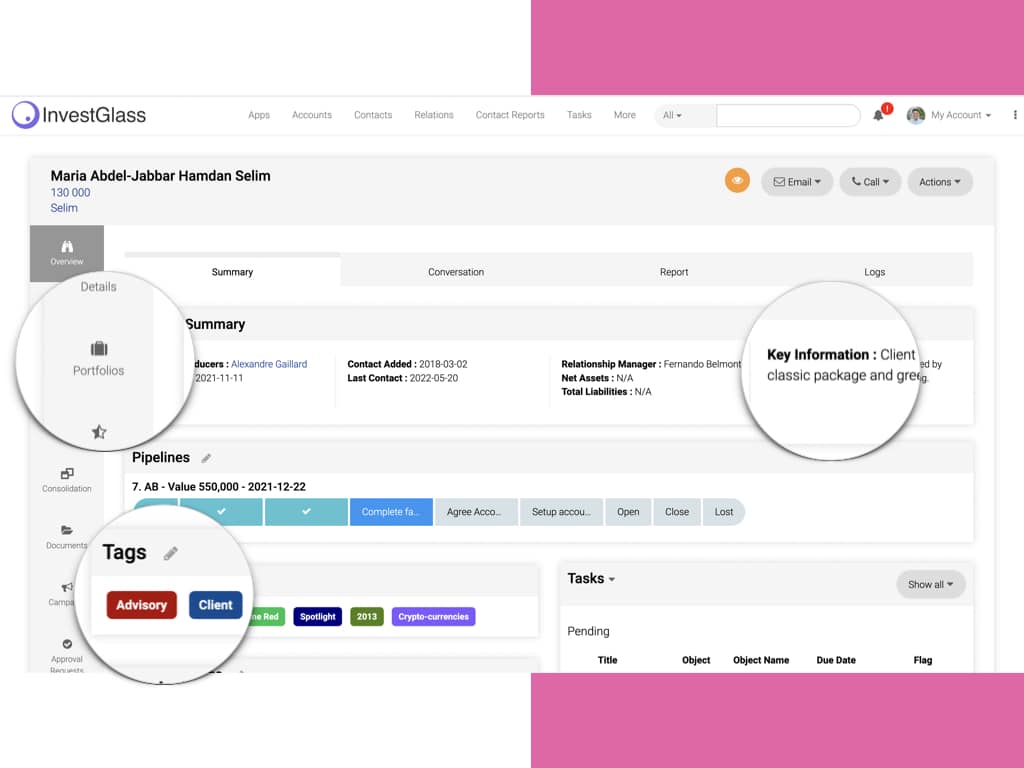
Throughout this article, we have referenced how technology supports each growth lever. InvestGlass brings these capabilities together in a single platform designed for wealth management.
InvestGlass capabilities aligned with 2026 growth priorities:
Growth Priority | InvestGlass Capability |
|---|---|
Unified client data | Swiss sovereign CRM consolidating all client information |
Automated marketing | Campaign tools with triggers, templates, and tracking |
Digital onboarding | Dynamic forms, document upload, electronic signatures |
KYC and compliance | Workflow automation with audit trails and monitoring |
Portfolio management | Position tracking, model portfolios, reporting |
Advisor enablement | AI assisted preparation, activity logging, task management |
A bank using InvestGlass reduced onboarding times by 60 percent in 2025 and reassigned saved capacity to organic growth initiatives in 2026. The investment in technology paid for itself through increased advisor productivity and faster client acquisition.
InvestGlass differentiates from generic CRMs through Swiss data sovereignty, wealth specific features, and flexibility for banks, independent wealth managers, and family offices. The platform can be hosted in Switzerland or deployed on premise for institutions requiring maximum control.
If your firm is planning growth initiatives for 2026, consider exploring how InvestGlass can align with your strategy. Demos and consultations are available to help refine priorities and define a realistic roadmap.
Conclusion: Turning 2026 Into A Foundation Year For The Next Decade
Treat 2026 as a foundation year where you build the data, technology, and talent structures for the next decade of growth. The decisions you make now about CRM, onboarding, AI adoption, and growth process will determine competitive position for years to come.
The key moves are clear: redesign your growth engine to be deliberate and measurable, capture the next generation before the wealth transfer happens, deploy AI wisely with human oversight, streamline compliance to unlock capacity, and choose M&A partners carefully based on strategic fit rather than opportunistic availability.
Firms that act decisively in 2026 will be best positioned to benefit from the great wealth transfer, ongoing consolidation, and rising client expectations. Those that wait will find themselves playing catch up as competitors pull further ahead. The tools exist. The strategies are proven. The question is execution.
Frequently Asked Questions
How quickly can a mid sized wealth management firm modernise its tech stack for growth in 2026?
Realistic transformation timelines range from nine to eighteen months depending on complexity, but firms can deliver early wins within the first three to six months. Start with CRM consolidation and digital onboarding, which provide immediate efficiency gains. Then add marketing automation, AI assistance, and deeper portfolio integration in subsequent phases.
InvestGlass is designed to be implemented in stages, allowing firms to realise benefits without waiting for a full scale replacement of every legacy system. Prioritise high impact areas such as client onboarding and data quality before attempting advanced analytics projects that depend on clean, complete data.
What types of client segments should a growing wealth firm prioritise in 2026?
Focus on upper affluent professionals, core high net worth families, and next generation heirs who are open to digital engagement. These segments offer a mix of current profitability and strong lifetime value, especially when firms capture assets before major liquidity or inheritance events.
Use CRM and analytics to identify the most promising segments already in your book of business. Often the greatest growth opportunity is not acquiring entirely new clients but deepening relationships with existing ones. InvestGlass segmentation features and marketing tools support this level of targeted growth.
How can firms use AI without creating regulatory or reputational risk?
Start with AI use cases that support internal efficiency, such as note summarisation, task suggestions, and document classification, where human review remains central. These applications improve productivity without placing AI in client facing decision making roles.
Establish clear AI governance policies including data access rules, validation requirements, and written guidelines for advisors on appropriate use. Platforms like InvestGlass can embed AI in controlled workflows where results are logged, auditable, and subject to compliance oversight. Be transparent with clients about where automation assists service while emphasising that final decisions remain human led.
Does Swiss data sovereignty really matter for non Swiss wealth managers?
Swiss data hosting is attractive to many European, Middle Eastern, and international clients who value strong privacy laws and political stability. For cross border wealth managers, having core client data in Switzerland can simplify conversations with privacy conscious families and institutions.
InvestGlass offers both Swiss hosted and on premise options, enabling firms outside Switzerland to benefit from the same sovereign approach. Even when not legally required, the ability to point to Swiss grade data protection differentiates a firm in competitive pitches against providers with less clear data policies.
What is the first concrete step a firm leader should take after reading this article?
Run a short internal audit that assesses current organic growth rates, onboarding times, data fragmentation, and advisor capacity constraints. This establishes a baseline and identifies where the greatest opportunities for improvement exist.
Select one or two high leverage projects to complete in 2026, such as implementing digital onboarding or consolidating CRM systems. Involve both frontline advisors and operations staff in designing these projects so that new tools fit real workflows. Speaking with a platform provider like InvestGlass can help refine priorities and define a realistic roadmap aligned with your firm’s strategy and regulatory context.

