
Financial institutions now operate in an always connected environment where a single breach can destroy customer trust in days and trigger seven figure fines. Protecting client data requires a combination of governance, technology, and culture rather than a single tool or policy. Swiss data sovereignty and on premise hosting options are strategic advantages for institutions serving privacy conscious clients. A modern CRM tailored to regulated industries, such as InvestGlass, can centralise onboarding, portfolio data, and communications while enforcing consistent protection controls. This article offers a practical blueprint for CISOs, COOs, and compliance officers to raise their data protection maturity in 2024 and beyond.
Introduction
In 2019, Capital One suffered one of the most significant breaches in the finance sector when a misconfigured cloud environment exposed approximately 100 million customer records. The aftermath included $190 million in fines and class action settlements, reputational damage that took years to repair, and a stark reminder that even well resourced financial institutions can fail at protecting sensitive financial data. This was not an isolated event. Banks, wealth managers, and insurers now hold decades of transaction history, identity documents, and suitability data for every client, turning their CRM and core banking stacks into prime targets for threat actors.
Sensitive financial client data extends far beyond payment card details. It includes KYC documents, passport scans, tax reports, portfolio holdings, bank account details, and communication history accumulated over long relationships. When attackers access this information, they gain everything needed for identity theft, financial fraud, and revealing sensitive information that can devastate individuals and families.
This article serves as a structured guide from the perspective of InvestGlass, a Swiss CRM and automation platform serving regulated financial institutions. The focus is on actionable measures that can realistically be implemented in small and mid sized institutions, not only global banks with unlimited security budgets.
Understanding Sensitive Financial Client Data
Sensitive financial client data refers to any nonpublic personal and financial information that regulators treat with elevated protection requirements. This includes personally identifiable information such as names, addresses, and Social Security numbers, as well as financial details like account numbers, IBANs, portfolio positions, performance reports, and suitability assessments.
Modern CRM and portfolio systems aggregate this sensitive customer data into a single client view. While this consolidation dramatically improves service quality and enables personalised advice, it also concentrates risk. A breach of one system can expose everything an institution knows about a client.
Financial institutions must also contend with long retention periods. MiFID II requires certain records to be kept for five to seven years, while FINMA circulars and AML regulations may extend this to ten years or more. This extended timeline means the volume of data requiring protection continues to grow.
Common data categories in financial institutions:
Category | Examples |
|---|---|
Identity Documents | Passports, driving licences, proof of address |
Financial Records | Account statements, cardholder data, transaction histories |
Risk Assessments | Suitability questionnaires, risk tolerance profiles |
Tax Information | Tax residency declarations, W8/W9 forms |
Communications | Emails, meeting notes, advisory recommendations |
A clear data classification scheme with labels such as public, internal, confidential, and strictly confidential forms the foundation of any protection strategy. The measures outlined in this article assume such a scheme is already in place.
Main Threats to Financial Client Data
Threat actors in 2024 range from financially motivated cybercriminals to insiders and state sponsored groups targeting financial infrastructure. According to IBM research, the average cost of a data breach in financial services reached $5.9 million, significantly higher than the cross industry average of $4.88 million. The financial sector accounted for approximately 25 percent of all recorded breaches in recent years.
External cyber threats represent the most visible danger. These include:
- Phishing campaigns designed to harvest credentials
- Credential stuffing attacks using leaked password databases
- API abuse targeting online banking and wealth portals
- Account takeover schemes exploiting weak authentication
- Ransomware campaigns that encrypt systems and demand payment
- Malicious software designed to exfiltrate sensitive information
Insider threats are equally concerning. Disgruntled employees may export customer records before departure. Relationship managers sometimes bypass controls to use personal mobile devices for client communication. Even well intentioned staff can carelessly handle spreadsheets containing customer information, creating unauthorised copies that live outside protected systems.
Third party risks have grown as financial institutions rely on cloud services, outsourced KYC providers, and regtech tools connected through APIs. The SolarWinds incident demonstrated how a single compromised vendor could affect 18,000 organisations globally.
A newer concern involves generative AI tools. Staff who paste client information into consumer chatbots risk exfiltrating data without realising it. Financial institutions must establish clear policies governing AI usage to prevent unauthorized transmission of sensitive data.
Why Financial Institutions Collect and Centralise Client Data
Regulatory obligations drive much of the data collection. KYC and AML requirements under EU AML directives, the Swiss AML Act, and FATF recommendations mandate capturing identity documents and source of funds information. Institutions cannot simply choose to collect less when regulators require comprehensive documentation.
Business reasons also drive centralisation. Consolidated portfolio reporting enables relationship managers to provide holistic advice. Client segmentation supports tailored investment proposals and marketing campaigns. Comprehensive customer data allows institutions to anticipate needs and deliver financial products that match client objectives.
CRM platforms like InvestGlass aggregate onboarding data, risk profiles, product documentation, and communication history into one environment. This centralisation is not optional for most regulated firms that must demonstrate audit trails and consistent advice across channels.
This reality makes the CRM a crown jewel system. It contains everything needed to understand, serve, and potentially harm clients. The controls described in subsequent sections must be applied with corresponding rigour.
Core Principles for Protecting Financial Client Data
Before implementing specific controls, institutions should embrace overarching principles that guide decision making:
Least privilege means that relationship managers, compliance officers, and external partners should each see only what they strictly need. A junior assistant does not require access to all client portfolios. An external auditor does not need real time trading permissions.
Data minimization encourages collecting only data required for regulation and service quality. Avoid storing unnecessary copies in spreadsheets, email archives, or personal drives. Every additional copy increases the attack surface.
Privacy by design ensures that each new onboarding flow, mobile app feature, or client portal module considers data protection requirements from the start. Security cannot be bolted on after deployment.
Security by default means systems ship with protective settings enabled. Users must actively disable protections rather than remember to enable them.
InvestGlass applies these principles through granular permission models, configurable data retention, and audited workflows that enforce policy automatically.
Technical Controls for Securing Financial Client Data
Technical controls form the backbone of any protection strategy but must be configured to match financial sector risk levels.
Data Encryption
Data encryption protects information both at rest and in transit. For data at rest, AES 256 encryption applied to databases, file storage, and backup archives ensures that stolen media cannot be read without the decryption key. For data in transit, TLS 1.2 or higher protects communications between client devices, APIs, and servers.
Advanced encryption standards must also prepare for emerging threats. Post quantum cryptography using lattice based algorithms like Kyber is expected to become necessary as quantum computing advances toward viability around 2030.
Strong Authentication
Multi factor authentication should be mandatory for all access to CRM and portfolio tools. Options include hardware tokens, authenticator apps, and biometric logins. The goal is ensuring that only authorized individuals can access financial systems, even if passwords are compromised.
Granular Access Controls
Role based access control and attribute based access control allow institutions to define precisely what each user can see. A wealth manager might view portfolio details for assigned clients while an assistant sees only contact information. Strict access controls on the same household enable compliance officers to access different data than relationship managers.
Continuous Monitoring
Centralised log collection, anomaly detection, and retention of audit logs for at least five years support both security investigations and regulatory compliance. Security systems should alert on unusual patterns such as bulk downloads, access outside business hours, or connections from unexpected locations.
Secure Configuration and Patch Management
Application servers, mobile apps, and database clusters require regular security audits and documented change management. Establish regular patch windows and test updates before deployment to production systems.
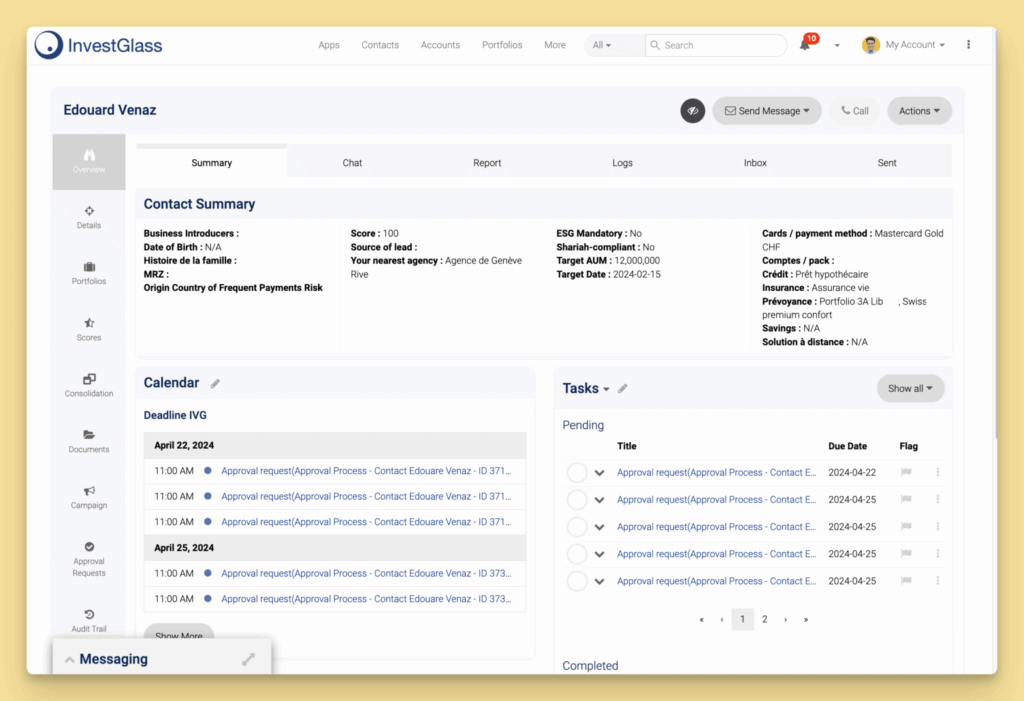
InvestGlass instances can be deployed in Swiss data centres or on premise with full encryption, MFA enforcement, and IP restrictions for back office users. This architecture ensures data integrity while maintaining the flexibility institutions require.
Data Governance, Policies, and Employee Training
Technology only works when staff understand and respect the rules that govern client data.
Formal data protection policy approved by the board should cover acceptable use, remote work guidelines, removable media restrictions, and personal device rules. This policy becomes the authoritative reference for all data handling decisions.
Data handling standards must clearly state how client documents are captured, tagged, stored, shared with partners, and eventually deleted. Ambiguity leads to inconsistent practices and security incidents.
Employee training for front office teams, compliance staff, and IT should include regular sessions on phishing recognition, social engineering tactics, and safe use of collaboration tools. Studies show that effective training can reduce human errors by up to 40 percent.
Simulated phishing campaigns conducted a few times per year help identify vulnerable teams. Results should be reported to management with targeted follow up training for high risk groups like sales and relationship managers.
Modern CRM platforms such as InvestGlass support governance by embedding compliance workflows, mandatory fields, and approval steps into daily tasks. Policy is enforced automatically rather than relying on memory alone.
Regulatory Compliance and Data Sovereignty
Financial institutions operate under overlapping privacy and financial regulations that define how customer data must be protected.
Key regulations include:
Regulation | Scope | Key Requirements |
|---|---|---|
General Data Protection Regulation | EU clients | Data minimisation, breach notification within 72 hours, records of processing |
California Consumer Privacy Act | California residents | Right to know, delete, and opt out of data sales |
Swiss Federal Act on Data Protection (2023) | Swiss residents | Strengthened transparency, data protection impact assessments |
FINMA Circulars | Swiss financial institutions | Operational risk management, outsourcing controls |
PCI DSS | Payment card handling | Card industry data security standard for cardholder data protection |
The data protection regulation GDPR and related frameworks require institutions to implement appropriate technical and organisational measures, maintain records of processing, and report qualifying breaches within strict timelines.
Data sovereignty has become increasingly important. Clients in Switzerland, the EU, and the Middle East increasingly expect their data to remain within specific jurisdictions. This expectation goes beyond compliance to become a competitive advantage for institutions that can demonstrate local data residency.
InvestGlass offers Swiss hosted and on premise deployments, enabling institutions to keep client data under Swiss or local jurisdiction while still benefiting from cloud style automation. Legal and compliance teams should be involved early when selecting CRM, onboarding, or AI tools to ensure contracts and processing locations meet local requirements.
Securing Digital Onboarding, KYC, and Client Portals
Digital onboarding and client portals are now primary entry points for sensitive data, including scanned passports, proof of address, and tax forms. These touchpoints require particular attention.
Secure onboarding practices include:
- Encrypted web forms using TLS
- Document upload with automatic virus scanning
- Automatic redaction of unnecessary fields
- Secure storage of video identification sessions
- Clear consent mechanisms that support regulatory compliance
Risk based KYC uses dynamic questionnaires and checks that adjust based on client type, geography, and product risk. A high net worth individual opening a discretionary mandate requires different scrutiny than a retail client purchasing a simple fund.
Identity validation should leverage trusted sources including document authenticity checks and politically exposed person screening. All data flows must remain traceable to satisfy audit requirements.
Client portal best practices:
- Strong authentication with MFA
- Session timeouts after periods of inactivity
- Device recognition for trusted access
- Clear separation between accounts of different family members or legal entities
InvestGlass consolidates onboarding, KYC, document vault, and portfolio reporting into a single Swiss hosted portal. This approach reduces the need to spread copies of client documents across multiple systems, strengthening data access controls and simplifying compliance.
Managing Third Party and Cloud Risks
Very few financial institutions operate entirely alone. Every payment processor, regtech tool, and cloud provider introduces additional risk that must be managed systematically.
Vendor due diligence should include:
- Security questionnaires covering encryption, access controls, and incident response
- Review of certifications such as ISO 27001
- Assessment of data centre locations relative to sovereignty requirements
- Reference checks with existing clients
Contract requirements for third party vendors that process client data must include data processing agreements, clear sub processor lists, breach notification timelines (the payment card industry data security standard PCI DSS and industry data security standard provisions often inform these), and right to audit clauses.
Data minimisation with partners limits what is shared through API scopes and filtered data feeds. Third parties should never see more customer data than strictly necessary for their specific function.
Architectural approaches matter. Using a central CRM or orchestration layer like InvestGlass to integrate external providers keeps the master client record under institution control. Changes flow outward in controlled ways rather than scattering data across disconnected systems.
Continuous oversight through access reviews, periodic security assessments, and review of SOC reports ensures ongoing compliance. Industry regulations often require documented evidence of third party risk management.
Using Automation and AI Safely in Wealth Management
Automation and AI are increasingly used for client segmentation, next best action suggestions, and document classification. These tools can streamline operations and improve client relationships, but must be implemented with strict governance.
Benefits of automation include:
- Reduced manual data entry and associated errors
- Consistent application of KYC rules across all clients
- Real time alerts for unusual financial transactions or profile changes
- Faster response to client inquiries
Safe patterns for AI usage:
- Models operating on pseudonymised or tokenised data
- Training sets excluding raw client identifiers whenever possible
- Processing contained within institution infrastructure
- Clear audit trails for all AI assisted decisions
Staff must never copy client data into public AI tools. InvestGlass uses AI to assist relationship managers with compliant templates and reminders while keeping processing within Swiss data centres or client infrastructure.
AI governance requires model validation, human in the loop review for sensitive decisions affecting clients, and documentation sufficient to satisfy regulators asking about automated decision making. Industry leaders are increasingly expected to demonstrate explainability in areas like credit scoring and suitability assessment.
Backup, Business Continuity, and Incident Response
Protection is not only about preventing breaches but also about recovering quickly and transparently when security incidents occur.
Backup strategies should include:
- Regular encrypted backups stored in geographically separate locations
- Defined recovery time objectives (RTO) and recovery point objectives (RPO)
- Immutable backup copies that cannot be altered by ransomware
- The 3-2-1 rule: three copies, two different media types, one offsite
Testing restores at least once or twice per year validates that backups actually work. Test both full system recovery and granular exports of individual client files.
Incident response plan components:
- Detection: Identifying that an incident has occurred
- Containment: Preventing further damage or data loss
- Eradication: Removing threat actors and closing vulnerabilities
- Recovery: Restoring systems and data to normal operations
- Post incident review: Learning from the event to prevent recurrence
Clear communication procedures with regulators, clients, and partners are essential. Legal requirements for breach notifications vary by jurisdiction but often require disclosure within 72 hours for qualifying incidents.
Platforms like InvestGlass support continuity through high availability architectures, export functions for regulatory reporting, and detailed audit trails that assist forensic analysis when investigating security incidents.
Continuous Improvement and Security Culture
Financial data security is a continuous programme rather than a one time project. Threats evolve, regulations change, and new vulnerabilities emerge in systems that were previously considered secure.
Regular assessments should include:
- Annual risk assessments with results presented to senior management
- Vulnerability scans after major releases
- Periodic penetration tests on client facing portals and APIs
- Review of access patterns to identify dormant accounts or excessive privileges
Building security culture means making every employee feel responsible for protecting sensitive financial information. Simple practices matter:
- Locking screens when stepping away
- Avoiding printing client lists unnecessarily
- Reporting suspicious emails immediately
- Using approved tools rather than personal workarounds
Useful metrics for tracking progress:
Metric | Target |
|---|---|
High risk vulnerabilities | Remediate within 30 days |
Access revocation after departure | Same day |
Security training completion | 95%+ annually |
Phishing simulation failure rate | Below 5% |
Customer confidence depends on institutions demonstrating that they take protection seriously. Client trust translates directly to retention and referrals. Security becomes not just a cost centre but a foundation for competitive advantage.
Choosing a secure CRM and onboarding platform like InvestGlass that evolves with regulatory and threat landscapes positions institutions for continuous improvement rather than perpetual catch up.
Frequently Asked Questions
How can small or boutique wealth managers protect client data without a large security team
Smaller firms can start with a secure cloud or Swiss hosted CRM like InvestGlass that bundles encryption, access controls, and audit logs out of the box. Focus on fundamentals first: multi factor authentication, strong passwords, regular software updates, and staff training on phishing and document handling. Outsource specialised tasks like penetration testing and security monitoring to reputable providers while keeping client data stored in a sovereign environment. Document a simple but clear incident response plan so everyone knows what to do during a suspected breach, even if the organisation is small.
What is the difference between privacy and security in financial client data protection
Security focuses on safeguarding sensitive information from unauthorised access, loss, or alteration through controls like encryption, firewalls, and authentication. Privacy concerns how and why client data is collected, processed, and shared, including consent, purpose limitation, and data minimization principles. Regulators expect financial institutions to address both dimensions. A CRM like InvestGlass supports this dual mandate through configurable data retention and processing records that demonstrate accountability. Align security projects with privacy impact assessments so both objectives are met in a coordinated way.
How often should access rights to financial client data be reviewed
Formal access reviews should occur at least quarterly for high risk systems such as CRM, core banking, and document vaults, with clear sign off from managers. Immediate access adjustment processes must activate when staff change roles or leave the organisation, with rights revoked or updated on the same day whenever possible. Automated reports from platforms like InvestGlass help identify dormant accounts, excessive privileges, and unusual data access patterns. Many regulators expect documented periodic reviews as part of supervisory assessments, so retaining evidence of these checks is essential.
Can financial institutions use public cloud while still keeping data sovereign
Many institutions now combine public cloud services with strict controls on data location, encryption, and access, sometimes using regional data centres. A common approach keeps sensitive client data in a Swiss or on premise environment such as an InvestGlass instance while non sensitive workloads run in public cloud environments. Customer managed encryption keys ensure that only the institution can decrypt customer records even when infrastructure is hosted externally. Consult legal and compliance experts to understand cross border data transfer constraints before adopting any cloud service, and ensure information sharing practices align with applicable regulations.
How should institutions handle client data used for testing or training new systems
Production client data should never be copied directly into test environments or developer laptops without strong controls. Use data masking or synthetic data that preserves structure but removes real identifiers and sensitive values. Restrict access to any environment containing partial real data and ensure that backups and logs from test systems are also protected. Platforms like InvestGlass can provide controlled exports or anonymised views specifically designed for safe testing and training scenarios, helping institutions mitigate risks while still enabling effective system development.


