
Scalable wealth management firms use clear client segmentation, standardised service models, and disciplined processes instead of ad hoc work. By defining ideal client profiles and creating distinct service tiers, firms can deliver consistent experiences while handling significantly more clients per advisor. This focus eliminates the chaos that comes from trying to serve everyone with the same approach.
Technology such as a Swiss hosted CRM, digital onboarding, automated KYC, and client portals is now the backbone of scale. Platforms like InvestGlass enable firms to automate routine tasks, reduce manual processes, and free advisors to focus on meaningful client interactions. Forward thinking advisors who embrace technology report 30 to 50 percent time savings on repetitive work.
Compliance, data privacy, and Swiss data sovereignty are growth enablers when embedded into workflows rather than treated as obstacles. Automated audit trails, rule based document validation, and templated disclosures reduce preparation time for regulatory inspections and external audits. Firms that integrate compliance into their operating model move faster and with more confidence.
Sustainable scale comes from a coordinated approach across positioning, pricing, operations, team design, and marketing rather than from any single tactic. Firms should treat scaling as a continuous improvement system, with clear KPIs, regular reviews, and progressive automation over multiple years. Intelligent scale is stepwise, and forcing hyper growth without feedback loops often damages reputation and margins.
Introduction: Why Scalability Matters Now
The wealth management industry faces unprecedented pressure in 2024 and 2025. Fee compression continues to squeeze margins, while regulatory tightening in Europe and Asia demands more documentation, transparency, and client protection. Meanwhile, clients expect seamless digital experiences alongside high touch service. These converging forces make the question of how to build a scalable wealth management business more urgent than ever.
Many firms hit a common growth ceiling somewhere between 200 and 500 million in assets under management. Referrals slow because partners are too busy serving existing clients to cultivate new relationships. Service quality strains as advisors juggle too many accounts. Partners become bottlenecks for every decision. This is where many advisors find themselves stuck, working harder but not growing faster.
Understanding the difference between growth and scale is essential. Growth means adding more clients and assets. Scale means revenue and assets grow faster than headcount and operating costs. A firm that doubles its AUM but also doubles its team has grown but not scaled. True scalability delivers measurable outcomes: higher revenue per advisor, lower cost per client, and predictable growth without proportional increases in complexity.
InvestGlass is a Swiss sovereign CRM and automation platform built specifically for regulated financial institutions. It helps wealth management firms streamline operations, manage compliance, and deliver exceptional client service without sacrificing control over data or client intimacy. Throughout this article, we will reference how platforms like InvestGlass enable the strategies and processes needed to successfully scale.
This article provides a practical roadmap covering strategy, operating model, technology stack, team structure, marketing, and measurement. It is written for owners and leaders of regulated wealth firms who want to achieve sustainable growth without burning out their teams or compromising their core values.
Define a Scalable Strategy and Client Target
Scale begins with focus. Firms serving everyone from mass affluent to ultra high net worth with the same model cannot scale efficiently. When your advisory practice tries to be everything to everyone, you spread resources thin, dilute your message, and struggle to create repeatable processes. The most successful wealth management firms know exactly who they serve and why.
Defining Your Ideal Client Profile
Start by defining your ideal client using concrete criteria:
Criteria | Example Parameters |
|---|---|
Net worth bands | $1 million to $5 million investable assets |
Geography | Swiss based or EU expatriates |
Life stage | Pre retirement executives or business owners approaching exit |
Profession | Technology executives, healthcare professionals, entrepreneurs |
Complexity of needs | Multi currency portfolios, cross border tax planning |
Your ideal client profile should be specific enough that you can describe them in one sentence. For example: “We serve Swiss based entrepreneurs with $2 million to $10 million in liquid assets who are planning to sell their companies within five years.”
Building Clear Client Segments
Create no more than three clear client segments, each with a distinct value proposition:
Emerging Affluent ($500K to $2M): Digital first experience with periodic advisor check ins, automated portfolio management, and educational content. These clients value accessibility and transparent pricing.
Core High Net Worth ($2M to $10M): Regular personal interaction, comprehensive financial planning, and customized investment management. Service includes quarterly reviews, tax optimization strategies, and estate planning support.
Ultra High Net Worth ($10M+): White glove service with dedicated relationship teams, bespoke investment solutions, and multi generational wealth transfer planning. Communication is frequent and highly personalized.
Each segment should have different service levels, communication frequency, and digital access while running on the same underlying process framework. This allows your firm to serve more clients without reinventing workflows for each relationship.
Choosing Market Positioning
Strategic planning requires choosing a market positioning that supports scalable marketing. Firms that position themselves as specialists attract referrals naturally because their networks can easily identify good matches. Consider positions like:
- Cross border planners for EU expatriates relocating to Switzerland
- Wealth advisors for tech executives with complex equity compensation
- Family office services for multi generational business families
One mid sized Swiss wealth management firm narrowed its focus exclusively to medical professionals in 2021. Within two years, referrals from existing clients doubled because doctors naturally recommended the firm to colleagues. The firm’s marketing became more efficient, client acquisition costs dropped by 40 percent, and advisors developed deep expertise in the specific financial goals and challenges of their niche.
Design Standardised Service Models and Processes
Scalable firms run on standard operating procedures, not on the memory of senior partners. When every client interaction depends on individual expertise rather than documented processes, your firm cannot grow beyond the capacity of your most experienced people. Operational excellence requires careful planning and systematic documentation.
Creating Service Tiers
Design service tiers for each client segment with clearly defined expectations:
Service Element | Bronze | Silver | Gold |
|---|---|---|---|
Meeting frequency | Annual review | Quarterly reviews | Monthly check ins |
Reporting format | Digital quarterly statements | Custom quarterly reports | Real time portal access plus written commentary |
Response time | Within 48 hours | Within 24 hours | Same business day |
Planning depth | Investment management only | Investment plus basic planning | Comprehensive wealth planning |
These tiers create predictable growth by setting clear expectations for both clients and staff. Advisors know exactly what each client relationship requires, and clients understand the value they receive.
Mapping End to End Processes
Document your key processes step by step to enhance efficiency and enable automation:
Lead Qualification: Initial inquiry received, basic information captured, segment determination made, qualified leads assigned to appropriate advisor.
Risk Profiling: Questionnaire delivered digitally, responses scored automatically, profile reviewed by advisor, documentation stored in CRM.
Onboarding: Digital forms completed, KYC documents collected and validated, account opening initiated, welcome sequence triggered.
Periodic Review: Review scheduled automatically based on segment tier, preparation materials generated, meeting conducted, action items logged and assigned.
Rebalancing: Drift alerts triggered based on thresholds, recommendations prepared, client approval captured, trades executed, confirmation delivered.
Offboarding: Exit interview conducted, final statements prepared, assets transferred, relationship closed in system, feedback collected.
Embedding Compliance Into Workflows
Compliance should be built into processes rather than added as an afterthought. For example:
- Mandatory suitability checks triggered automatically before any investment recommendation
- KYC refresh dates embedded in workflow reminders
- Document expiration alerts surfaced before issues arise
- Communication logging captured automatically in CRM
When you document workflows thoroughly, they can be automated inside tools like InvestGlass rather than living in spreadsheets and email chains. This is how firms rely on systems instead of individual memory.
The Client Journey Workflow
Here is how a prospect moves through a scalable onboarding process:
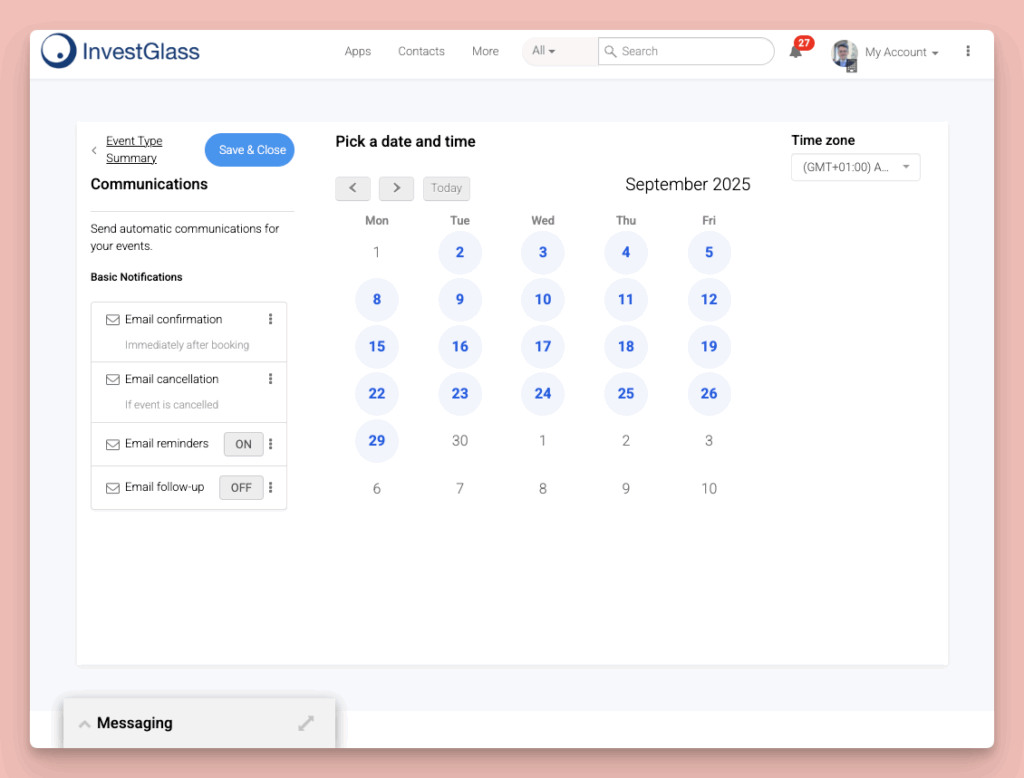
A potential client completes a digital form on your website expressing interest. This form automatically creates a lead record in InvestGlass and triggers a welcome email. An advisor reviews the submission and schedules an initial consultation. During the meeting, the prospect’s information is captured directly in the platform. Following a positive conversation, the digital onboarding workflow launches. The client receives secure links to complete KYC documentation, risk profiling questionnaires, and investment policy agreements. Once all documents are validated automatically, the account opening proceeds. Within days, the client has portal access and receives their first portfolio proposal. This entire journey is tracked, documented, and repeatable.
Use Technology and Data as the Scaling Engine
Technology is the main lever that lets a team handle more clients per advisor without losing personalisation. Manual processes create drag, introduce errors, and limit capacity. Leveraging technology effectively is how firms break through the growth ceiling that stops many advisors from expanding.
The Modern Wealth Management Tech Stack
A complete technology stack for scalable wealth management includes:
- CRM Platform: Central hub for all client data, interactions, and relationship management
- Digital Onboarding: Paperless account opening with integrated form collection
- E Signature: Legally compliant remote document signing
- Portfolio Management: Investment tracking, performance reporting, and rebalancing tools
- Client Portal: Secure access for clients to view portfolios, documents, and messages
- Marketing Automation: Segmented campaigns, lead nurturing, and communication workflows
- Compliance Tools: Audit trails, document validation, and regulatory reporting
Many firms struggle with fragmented systems that create data silos and manual reconciliation work. An integrated platform like InvestGlass consolidates these capabilities, reducing complexity and total technology costs over time.
Swiss Data Sovereignty as Competitive Advantage
For banks, external asset managers, and family offices dealing with cross border clients, Swiss data sovereignty provides a meaningful competitive advantage. Hosting client data in Swiss data centres or on premise addresses concerns about privacy, regulatory compliance, and data protection that matter deeply to high net worth clients.
InvestGlass offers Swiss hosting or on premise deployment options, ensuring client data stays under Swiss law. This satisfies privacy and sovereignty requirements that differentiate your firm in a competitive market where clients expect their most valuable asset to be protected.
Digital Onboarding and KYC Automation
Digital onboarding with integrated KYC and AML checks transforms the client acquisition process. What traditionally took days of paperwork, courier services, and manual verification can now happen in hours:
- Clients complete forms on any device at their convenience
- Document uploads are validated automatically against requirements
- Identity verification integrates with trusted third party providers
- Risk profiling questionnaires are scored and stored automatically
- Suitability documentation is generated and archived for compliance
This approach frees specialists for higher value work and dramatically improves the client experience during a critical first impression.
AI Enhanced Advisory Workflows
Artificial intelligence inside a CRM enables productivity gains without replacing human judgment. Practical AI applications include:
- Email drafting assistance for common client communications
- Next best action suggestions based on client behaviour and needs
- Automatic classification and routing of client documents
- Meeting preparation summaries drawn from CRM data
- Sentiment analysis on client interactions
Human oversight remains essential. AI handles routine tasks and surfaces actionable insights while advisors make final decisions and maintain the personal touch that defines excellent client relationships.
Example Workflow in Practice
Consider this concrete example of how technology supports scalability:
A new lead fills a web form expressing interest in retirement planning services. Data enters InvestGlass automatically, creating a lead record. Based on the information provided, the system routes the lead to an appropriate advisor and triggers a nurture sequence. The advisor schedules a discovery call. After a positive meeting, the advisor launches the onboarding workflow with one click. The prospect receives secure links to complete KYC documentation and risk profiling. Once validated, portfolio proposals are generated using the firm’s investment models. The client reviews proposals through their portal, asks questions via secure messaging, and approves electronically. Account opening proceeds, and the new relationship is fully documented from first touch to funded account.
Build a Team and Operating Model for Scale
Scaling wealth management is a team sport. Owner centric models hit capacity ceilings fast because partners cannot delegate effectively and every decision flows through the same few people. Human capital is the foundation of long term success, and building the right structure enables firms to serve more clients without exhausting key individuals.
A Scalable Team Structure
A typical scalable structure includes clearly defined roles:
Role | Responsibilities |
|---|---|
Lead Advisor | Client relationship ownership, strategic advice, rainmaking |
Associate Advisor | Client meeting support, planning analysis, relationship development |
Client Service Associate | Scheduling, documentation, client communications, portal support |
Portfolio Specialist | Investment research, portfolio construction, rebalancing execution |
Compliance Officer | Regulatory oversight, policy maintenance, audit preparation |
Marketing Coordinator | Content creation, campaign execution, lead tracking |
Separating Front, Middle, and Back Office
Clear separation of responsibilities prevents confusion and enables specialisation:
Front Office: Client facing activities including meetings, relationship building, and advice delivery. This is where advisor productivity directly impacts revenue.
Middle Office: Investment operations, compliance monitoring, and risk management. These functions support front office activities without direct client contact.
Back Office: Administrative tasks including billing, reporting, and system maintenance. These are often candidates for automation or outsourcing.
All roles should operate from a single source of truth in the CRM platform. When everyone accesses the same client data, communication improves and errors decrease.
Delegation Rules for Advisors
Effective delegation requires clarity about what advisors should and should not handle:
Advisors Should Always Handle: Strategic advice conversations, complex planning discussions, key relationship decisions, rainmaking activities.
Advisors Should Never Handle: Scheduling, document collection, data entry, routine compliance documentation, standard reporting.
Automation Should Handle: Reminder sequences, document expiration alerts, meeting preparation summaries, routine client communications, portfolio drift monitoring.
Building Playbooks for Consistency
Create playbooks for recurring client interactions so that any trained team member can deliver consistent service quality during absences or growth spurts:
- Annual review meeting preparation checklist
- New client welcome call script and agenda
- Portfolio rebalancing communication template
- Complaint handling procedure
- Market volatility client outreach protocol
These playbooks preserve your firm’s culture even as new team members join and take on responsibilities.
Scaling from Partnership to Team
Consider how a firm can grow from a two person partnership to a ten person multi role team over five years:
Year One: Two partners handle everything. They begin documenting processes and implementing CRM.
Year Two: First hire is a client service associate to handle administrative tasks. Partners free 10 to 15 hours weekly.
Year Three: Associate advisor joins to support client meetings. Compliance responsibilities formalised. Marketing automation launched.
Year Four: Second client service associate hired. Portfolio specialist role created. Leadership development begins for associate advisor.
Year Five: Marketing coordinator joins. Associate advisor promoted to lead advisor with own client book. Partners focus on rainmaking and strategic direction.
Throughout this growth, the firm maintains consistent client experience because processes and playbooks scale with the team. Retain talent by creating clear career paths and meaningful work.
Make Compliance, Risk, and Data Privacy a Growth Driver
In regulated markets such as Switzerland, the EU, and the Middle East, compliance is often seen as a drag on growth. However, integrated compliance actually enables faster expansion. Firms that embed regulatory requirements into their workflows move with confidence while competitors hesitate.
Key Regulatory Themes for Wealth Managers
Understand the regulatory landscape relevant to your business:
Suitability and Appropriateness: Ensuring investment recommendations match client profiles, goals, and risk tolerance. Documentation must demonstrate the rationale for each recommendation.
KYC and AML: Know Your Customer and Anti Money Laundering requirements demand thorough identity verification and ongoing monitoring for suspicious activity.
Data Protection: GDPR in Europe, Swiss data protection laws, and similar frameworks require explicit consent, data minimisation, and clear retention policies.
Record Keeping: Regulators expect comprehensive audit trails of client interactions, advice given, and decisions made.
Automated Policy Enforcement
Digital onboarding and KYC tools inside platforms like InvestGlass can enforce policy rules automatically:
- Block account opening until all required documents are validated
- Flag incomplete risk profiles before investment recommendations proceed
- Trigger re verification when documents approach expiration
- Require manager approval for transactions above defined thresholds
- Generate compliance reports automatically for regulatory submissions
This automation reduces human error and ensures consistent policy application across all client relationships.
Swiss Data Sovereignty Benefits
Hosting client data in Swiss data centres or on premise addresses concerns that matter to private banks, family offices, and public entities:
- Swiss law provides strong privacy protections recognised globally
- Data residency requirements can be satisfied with clear documentation
- Access controls limit who can view sensitive information
- Audit trails demonstrate compliance with data protection obligations
For cross border clients, this becomes a meaningful differentiator. Clients entrust you with their most valuable asset, their financial information, and they expect protection.
Streamlined Audit Preparation
Automated audit trails, notes logged in CRM, and templated disclosures reduce preparation time for regulatory inspections and external audits:
- All client communications captured automatically
- Suitability documentation linked to specific recommendations
- Compliance reviews logged with timestamps and approvals
- Missing documentation flagged proactively before it becomes an issue
Firms that maintain this discipline spend hours rather than weeks preparing for audits.
Ongoing Risk Monitoring
Dashboards that provide real time visibility help identify issues early:
- Missing periodic reviews requiring attention
- Expiring documents needing refresh
- Unusual transaction patterns warranting investigation
- Compliance task completion rates across the team
- Performance trends indicating potential client concerns
This proactive approach prevents small issues from becoming significant problems.
Create a Scalable Client Acquisition and Marketing System
Referrals alone are rarely enough for sustained scale beyond the first growth phase. While client testimonials and word of mouth remain powerful, firms need systematic approaches to drive growth consistently. A scalable marketing system generates qualified leads predictably rather than relying on luck.
Defining Your Message
Your message must speak directly to your chosen niche. Generic marketing wastes resources and fails to resonate. Consider these examples:
Generic: “We help high net worth individuals achieve their financial goals.”
Specific: “We help Swiss based entrepreneurs planning to sell their companies between 2025 and 2030 maximise after tax proceeds and create sustainable income for the next generation.”
The specific message attracts the right prospects and repels poor fits, saving time for everyone.
Content Strategy for Client Communications
Develop content that demonstrates expertise and builds trust:
- Educational articles addressing specific client concerns
- Webinars on timely topics relevant to your niche
- White papers providing in depth analysis
- Podcasts featuring conversations with other professionals in adjacent fields
- Case studies showing successful client outcomes (anonymised)
This content serves dual purposes: attracting new prospects and nurturing existing relationships.
Marketing Automation Capabilities
Use marketing automation in tools like InvestGlass for:
Segmented Email Campaigns: Different messages for different client segments and prospect stages
Event Invitations: Automated invitation sequences for webinars, seminars, and client appreciation events
Nurture Sequences: Timed content delivery moving prospects toward consultation booking
Lead Scoring: Automatic prioritisation based on engagement and fit criteria
Re engagement Campaigns: Outreach to dormant leads and lapsed prospects
Building a Simple Funnel
Structure your client acquisition process clearly:
- Educational content attracts prospects to your website
- Lead capture offers valuable resources in exchange for contact information
- Nurture sequences build familiarity and trust over time
- Consultation booking provides low friction entry point
- Discovery meeting qualifies fit and begins relationship
- Digital onboarding converts qualified prospects to clients
- Ongoing communication maintains engagement and generates referrals
All activity tracks in the CRM, providing visibility into what works and what needs adjustment.
Compliant Social Media and Thought Leadership
Financial advisory marketing faces compliance constraints. Address these proactively:
- Pre approved templates reduce compliance review bottlenecks
- Standard disclosures appended automatically to communications
- Archive copies of all published content for regulatory records
- Clear guidelines on what advisors can and cannot say publicly
This framework enables consistent marketing while satisfying regulatory requirements.
Example Quarterly Marketing Calendar
Here is what a mid sized firm could execute with a small team using automation:
Month One
- Week 1: Educational blog post published, promoted via email to prospects
- Week 2: LinkedIn posts featuring key insights from blog content
- Week 3: Existing client newsletter with market commentary and firm updates
- Week 4: Webinar invitation sequence launches
Month Two
- Week 1: Webinar delivered, recording shared with registrants
- Week 2: Follow up sequence to webinar attendees offering consultations
- Week 3: Case study email to segmented prospect list
- Week 4: Client appreciation event invitation
Month Three
- Week 1: Quarterly market outlook published
- Week 2: Re engagement campaign to dormant leads
- Week 3: Referral request email to satisfied clients
- Week 4: Planning content for next quarter
This calendar requires careful planning but delivers predictable marketing activity without overwhelming a small team.
Measure, Optimise, and Scale Intelligently
What gets measured gets improved. Scalable firms use simple but disciplined metrics to guide decisions and identify opportunities. Without measurement, growth strategies become guesswork and resources flow to activities that feel productive but deliver little return.
Key Performance Indicators
Track these metrics consistently:
Metric | What It Measures | Target Direction |
|---|---|---|
Assets under management per advisor | Advisor productivity | Increasing |
Revenue per client | Relationship profitability | Stable or increasing |
Client acquisition cost | Marketing efficiency | Decreasing |
Conversion rate by channel | Funnel effectiveness | Increasing |
Client retention rate | Relationship quality | Above 95% |
Digital tool adoption by clients | Portal and automation usage | Increasing |
Real Time Dashboards
Dashboards inside platforms like InvestGlass give partners visibility across the firm:
- Pipeline status and projected closings
- Task completion rates by team member
- Service level adherence by segment
- Compliance status and outstanding items
- Revenue and growth trends
This transparency enables faster decision making and earlier intervention when issues arise.
Running Small Experiments
Before scaling any new approach, test it carefully:
Example: Your firm wants to implement automated review reminders.
- Select a subset of client relationships for the pilot
- Implement the automated workflow for this group only
- Track response rates, meeting completion, and advisor feedback
- Compare results to control group over three months
- Refine approach based on learnings
- Scale to full client base if results warrant
This methodology applies to new onboarding scripts, marketing campaigns, service tier structures, and technology implementations.
Quarterly Strategy Reviews
Leaders should assess capacity, processes, and technology quarterly:
- Are we approaching capacity limits that require hiring?
- Which processes still rely on manual work that could be automated?
- How is our technology adoption progressing across the team?
- Should we refine our positioning or expand our target market?
- What experiments from last quarter should we scale or abandon?
These reviews connect measurement to action and ensure continuous improvement.
Stepwise Intelligent Scale
Intelligent scale is progressive, not explosive. Firms that try to hyper growth without established processes, trained teams, and reliable systems often damage reputation and margins. Enterprise value builds through consistent long term growth rather than dramatic spikes followed by painful corrections.
Key areas for staged scaling:
- Year one: Foundation (processes documented, CRM implemented, segments defined)
- Year two: Automation (onboarding digitised, workflows automated, portals launched)
- Year three: Growth (marketing systematised, team expanded, capacity increased)
- Year four: Optimisation (metrics refined, experiments scaled, efficiency maximised)
- Year five: Expansion (new segments, new markets, succession planning)
How InvestGlass Supports Scalable Wealth Management
InvestGlass is an integrated Swiss CRM and automation hub built specifically for regulated financial institutions. It addresses the key challenges wealth managers face when trying to scale without sacrificing service quality or compliance standards.
Digital Onboarding and KYC
The digital onboarding and KYC modules shorten account opening times dramatically. Clients complete forms digitally from any device. Document collection happens through secure uploads with automatic validation. Risk profiling and suitability questionnaires are standardised and scored automatically. The entire process creates a complete audit trail from first contact to funded account.
Portfolio Management and Client Portal
The portfolio management and client portal capabilities deliver transparent reporting without custom development:
- Real time portfolio visualisation for clients
- Performance attribution and benchmarking
- Secure document storage and sharing
- Encrypted messaging between advisors and clients
- Self service access for routine inquiries
Independent advisors can deliver the same portal experience as larger institutions without building custom systems.
Marketing Automation
Marketing automation features support consistent prospect and client communication:
- Segmented campaigns targeting specific client journeys
- Lead tracking from first touch through conversion
- Workflow triggers based on client behaviour and dates
- Email sequences for onboarding, reviews, and re engagement
- Analytics showing which content and channels perform best
Swiss Hosting and Data Sovereignty
Swiss hosting or on premise deployment options ensure client data stays under Swiss law. This satisfies privacy and sovereignty requirements for banks, wealth managers, family offices, and public entities. For firms serving cross border clients, this provides a meaningful competitive advantage in an industry where trust is paramount.
Next Steps
Review your current tech stack. Consider how many separate systems you maintain, how much manual reconciliation you perform, and how much time your team spends on administration rather than client interactions. Consolidating onto a sovereign platform like InvestGlass may unlock your next growth phase, enabling your firm to serve more clients at lower cost while maintaining the personalized service that defines excellent wealth management.
FAQ
How long does it realistically take to build a scalable wealth management business?
Creating a truly scalable model usually takes three to five years of deliberate effort. The first year focuses on defining client segments, documenting processes, and implementing foundational technology. Years two and three emphasise technology implementation, workflow automation, and team building. Later years concentrate on optimisation, measurement refinement, and strategic expansion. Firms that try to compress this timeline often create fragile structures that struggle under pressure. Patience and consistency deliver better long term success than rushed transformation.
Can a small two or three person advisory firm really scale without losing its personal touch?
Small firms can absolutely preserve intimacy while scaling by using automation for background tasks. Scheduling, reminders, document collection, and routine reporting can all happen automatically, freeing advisors to spend more time in meaningful conversations with clients. In fact, automation often improves personalisation because advisors arrive at meetings better prepared with relevant information surfaced automatically. The key is automating administrative work, not client interactions. Clients expect responsive service, and technology makes that possible without exhausting advisors.
What budget should a firm allocate to technology when planning to scale?
Firms typically allocate 3 to 7 percent of revenue to technology, depending on growth ambitions and current infrastructure. An integrated platform like InvestGlass can replace multiple point solutions and often reduces total technology costs over three years compared to maintaining separate CRM, portfolio management, onboarding, and compliance tools. The more important consideration is return on investment: technology spending should enable measurable capacity increases, reduced administrative time, and improved client experience that justify the expense through grow revenue potential.
Is it better to build custom systems or to use an integrated platform?
Building custom systems offers maximum control but creates significant maintenance burden. Every regulatory change, security update, and feature enhancement requires internal development resources. Regulated firms usually benefit from using a configurable platform like InvestGlass rather than maintaining separate custom tools that are hard to keep compliant. Modern platforms offer extensive customisation through configuration rather than coding, providing flexibility without the ongoing development overhead. The exception might be very large institutions with dedicated technology teams and unique requirements that truly cannot be met by existing solutions.
How do cross border and multi jurisdiction firms handle data privacy when scaling?
Hosting client data in Switzerland and using a sovereign platform with clear data residency and access controls makes compliance simpler for international operations. Swiss data protection laws are widely respected, and many cross border clients specifically prefer Swiss custody arrangements. Platforms like InvestGlass offer both Swiss hosting and on premise deployment, allowing firms to satisfy both Swiss rules and foreign data protection regimes when dealing with international clients. Clear documentation of data flows, access controls, and processing locations enables firms to demonstrate compliance across multiple jurisdictions without maintaining separate systems for each market.

