
Finanzinstitute operating in Switzerland face a critical decision: should their sanctions screening software run on Swiss-hosted sovereign infrastructure or on an international platform with data centres abroad? The answer depends on how much weight you place on data sovereignty, regulatory alignment with FINMA and SECO, and independence from foreign technology stacks. For the majority of Swiss-regulated banks, wealth managers, and payment service providers, a Swiss-hosted solution delivers measurably lower compliance risk and tighter control over sensitive client data.
Die kurze Antwort: Swiss-hosted sanctions monitoring solutions like InvestGlass offer superior regulatory compliance, full data sovereignty, and seamless integration with Swiss banking infrastructure. International platforms bring broader global sanctions lists and advanced analytics, but they introduce foreign jurisdictional exposure that Swiss-regulated institutions increasingly cannot afford. If you operate under FINMA supervision and need to ensure compliance with the Embargo Act, a sovereign Swiss solution is the stronger default choice.
What Is Swiss-Hosted Sanctions Screening Software?
Swiss-hosted sanctions monitoring software refers to platforms deployed entirely within Swiss infrastructure – either on Swiss cloud data centres or on-premise – that automate the process of checking client identities, beneficial owners, and financial transactions against designated sanctions lists. Swiss sanctions monitoring software helps detect transactions with restricted individuals and entities while keeping every byte of data under Swiss jurisdiction.
Zu den wichtigsten Stärken gehören:
- Datenhoheit: all screening data, audit logs, and client records remain within Swiss borders, protected by the Swiss Federal Act on Data Protection (FADP) and Swiss banking secrecy laws.
- FINMA and SECO alignment: built from the ground up to satisfy Swiss regulatory obligations under the Embargo Act, Anti-Geldwäsche Act (AMLA), and FINMA circulars.
- Local regulatory expertise: vendors understand the “Swiss finish” – the specific deviations from EU law and the nuances of how SECO implements UN and EU sanctions.
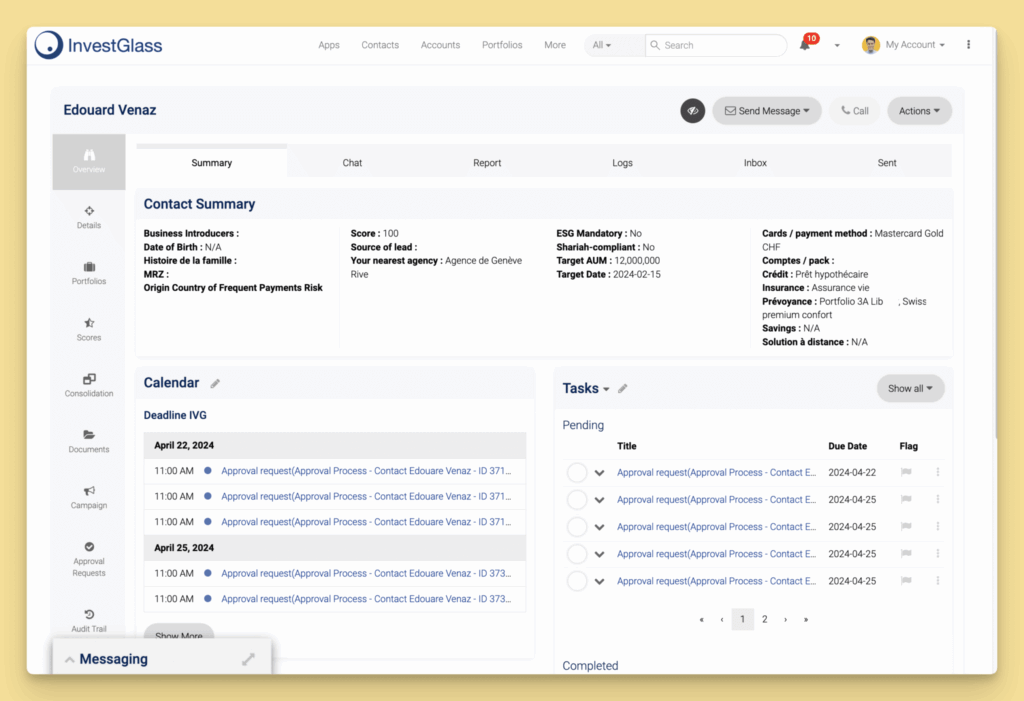
InvestGlass is a leading Swiss sovereign platform that combines CRM, digitales Onboarding, Portfolioüberwachung, and sanctions screening into a single integrated system. Unlike standalone compliance tools, InvestGlass embeds sanctions detection directly into the entire customer lifecycle – from Kunden-Due-Diligence at onboarding through ongoing monitoring of business relationships.
What Is International Sanctions Monitoring Software?
International sanctions monitoring solutions are platforms hosted outside Switzerland – typically in US, EU, or global cloud regions – that serve financial organizations across multiple jurisdictions. Providers such as Dow Jones Risk Compliance, LexisNexis Risk Solutions, ComplyAdvantage, NICE Actimize, and offerings linked to the London Stock Exchange Group fall into this category.
Their strengths are real: comprehensive coverage of global watchlists (LexisNexis offers access to over 1,700 watchlists), mature machine learning engines, and deep experience with cross-border Transaktionsüberwachung. ComplyAdvantage uses AI for real-time sanctions screening, while NICE Actimize uses advanced analytics for sanctions detection. Dow Jones provides curated sanctions lists for risk intelligence across dozens of jurisdictions.
However, these platforms carry inherent limitations for Swiss institutions. Data hosted in the US is subject to US government legal demands. Cross-border data transfers may conflict with FADP requirements. And generic compliance frameworks often lack the precision Swiss compliance teams need for SECO-specific screening and Embargo Act reporting.
Swiss vs International Sanctions Monitoring: Key Differences at a Glance
Faktor | Swiss-Hosted (e.g. InvestGlass) | International (e.g. Dow Jones Risk, LexisNexis) |
|---|---|---|
Am besten für | Swiss banks, wealth managers, trustees requiring FINMA compliance | Global institutions with US/UK operations and multi-jurisdictional needs |
Data hosting location | Switzerland (Swiss cloud or on-premise) | US, EU, or multi-region cloud; data may cross borders |
Swiss regulatory alignment | Native: Embargo Act, SECO, AMLA, FINMA circulars | Generic global compliance; requires customisation for Swiss specifics |
Kostenstruktur | Predictable flat-fee or per-name licensing; freemium options available | Usage-based or modular; costs scale with list count and screening volume |
Umsetzungszeitplan | Weeks; pre-built for Swiss law and existing workflows | Months; requires configuration for Swiss compliance nuances |
Sanctions list coverage | SECO, EU, UN, OFAC; growing PEP and adverse media coverage | Broad: 50+ regimes including Asia, Australia, OFAC, EU, UN |
For sovereignty-conscious financial institutions, the decisive advantage of Swiss-hosted solutions is eliminating foreign jurisdictional exposure while maintaining full regulatory alignment.
Data Sovereignty and Hosting Control
Data sovereignty is not an abstract principle for Swiss financial institutions – it is a regulatory requirement with concrete consequences. The revised FADP (2023) imposes strict rules on cross-border transfers of personal data. FINMA expects supervised entities to maintain control over their data infrastructure, including the ability to demonstrate compliance during audits and inspections. Swiss sanctions monitoring software continuously updates its database with new sanctions data, and where that data lives determines who else might access it.
When a Swiss private bank screens beneficial owners against SECO and OFAC lists, the screening results, match evidence, and case management records constitute sensitive client data. Swiss-hosted platforms like InvestGlass store all of this within Swiss infrastructure, ensuring that no foreign government can compel disclosure through legal orders directed at a US or EU cloud provider. InvestGlass allows on-premise or Swiss cloud deployment, giving institutions full control over their raw transaction data.
International platforms, by contrast, often run on hyperscaler cloud infrastructure (AWS, Azure, GCP) in non-Swiss regions. Even when contractual protections exist, the legal reality is that US-domiciled providers remain subject to the CLOUD Act and similar extraterritorial demands. For institutions managing sovereign wealth funds, high-net-worth individuals, or Politisch exponierte Personen, this exposure creates significant risks that Swiss hosting eliminates.
Winner: Swiss-hosted solutions – they provide unambiguous data residency within Swiss jurisdiction, removing the legal uncertainty that international platforms introduce. International tools may offer contractual mitigations, but they cannot match the structural certainty of Swiss-only hosting.
Regulatory Compliance and Local Expertise
The software screens against Swiss SECO sanctions lists and international frameworks – but the devil is in how those lists are integrated and how screening parameters are configured. The State Secretariat for Economic Affairs administers Swiss sanctions under the Embargo Act, and Swiss firms must comply with both local and international sanctions regulations. FINMA’s 2024 risk monitor explicitly flags sanctions compliance as a heightened risk area, especially following the Ukraine/Russia restrictions imposed since 2022.
Swiss-hosted providers build their compliance logic around these specific requirements. The screening process in platforms like InvestGlass natively handles SECO list updates, Embargo Act reporting obligations, and the AMLA-FINMA requirements for audit trails and evidence retention. Regulatory compliance tools assist organizations in navigating complex ownership structures and relationships – a critical capability when Swiss institutions must trace beneficial owners through layered corporate structures.
International platforms such as those from Dow Jones Risk or LexisNexis Risk Solutions offer enormous breadth. Sanctions compliance programs must adhere to regulations like OFAC and FATF, and these vendors excel at multi-regime coverage. But they often treat Swiss compliance as one module among many, requiring compliance officers to configure rules manually for SECO-specific nuances. The “Swiss finish” – where Switzerland adopts EU sanctions with modifications or delays – can create gaps in generic international tools that don’t track Swiss ordinance amendments in real time.
Compliance platforms typically include audit logs for regulatory reviews, but Swiss solutions generate these logs in formats that align directly with FINMA inspection expectations. Sanctions screening helps prevent financial crime and reputational damage – and that prevention is only as strong as the tool’s alignment with the jurisdiction you operate in.
Winner: Swiss-hosted solutions – for institutions regulated by FINMA, the native regulatory alignment of Swiss providers eliminates the configuration burden and compliance gap risk that international tools carry. International platforms remain strong for institutions needing to demonstrate compliance across many non-Swiss jurisdictions simultaneously.
Integration with Swiss Banking Infrastructure and Transaction Monitoring
Effective sanctions monitoring requires integration with existing risk management systems such as CRM platforms, core banking, onboarding workflows, and portfolio management. This is where InvestGlass distinguishes itself most sharply from both international competitors and standalone Swiss screening tools.
InvestGlass is not a bolt-on compliance module. It is an end-to-end wealth management and compliance platform that embeds sanctions screening, anti money laundering checks, adverse media screening, and verstärkte Sorgfaltspflichten directly into the client onboarding and portfolio monitoring process. Automated workflows enhance ongoing monitoring and due diligence processes without requiring compliance teams to switch between disconnected systems. Pre- and post-trade checks run against risk parameters within the same platform that manages client relationships, ensuring accurate screening across the entire customer lifecycle.
Swiss sanctions monitoring automates the process of checking transactions against designated lists. It cross-references customer data against sanctions lists and PEP databases. Advanced systems minimise false positives using contextual analysis, which is a critical operational efficiency gain. Automated monitoring tools use fuzzy matching algorithms for name variations, and fuzzy logic algorithms help identify matching names despite variations and errors. When institutions assess the best sanctions screening software, this is often the deciding area because stronger matching quality cuts unnecessary alerts without weakening controls. Sanctions screening software reduces false positives through advanced analytics, and tools like Alessa reduce false positives by 30 to 50 percent through refined matching logic.
International solutions often require complex integration projects to connect with Swiss core banking systems. Implementation timelines stretch from months to quarters, and local customisation depends on remote vendor support teams unfamiliar with Swiss market specifics. International platforms such as those from Dow Jones Risk or LexisNexis Risk Solutions are strong when institutions need support for international regulatory standards across multiple regimes, including OFAC and FATF expectations. Swiss solutions like InvestGlass offer nahtlose Integration with existing systems and can be deployed in weeks rather than months.
Continuous monitoring is essential for identifying new risks in customer relationships. Since 2024, FINMA expects at minimum daily (24-hour cycle) screening for many supervised entities, reflecting a wider focus on rising sanctions risk. Sanctions monitoring systems continuously re-screen databases against updated lists. Real-time updates are essential for effective sanctions screening, and Swiss sanctions monitoring software continuously updates its database with new sanctions data. Swiss-hosted tools are architected around this expectation from the start, whereas international platforms may require additional configuration to meet this cadence.
Winner: Swiss-hosted solutions, particularly InvestGlass – the integrated platform approach eliminates the friction of connecting disparate tools, reduces implementation timelines, and keeps jurisdiction-specific compliance logic aligned with financial crime prevention inside existing workflows rather than as an external layer.
Which Swiss Sanctions Monitoring Solution Should You Choose?
- Wählen InvestGlass if you are a Swiss bank, wealth manager, asset manager, or trustee seeking a fully integrated sovereign platform that combines CRM, Kunden-Due-Diligence, sanctions screening, adverse media coverage monitoring, and portfolio compliance in one system – with Swiss or on-premise hosting, no foreign technology dependencies, and native FINMA/SECO alignment.
- Wählen a standalone Swiss screening tool (such as ACTAN SanctionsCheck, VIGILIX, or VynCo) if you need dedicated sanctions detection with Swiss data residency but already have a separate CRM and banking system and prefer point solutions with predictable per-name pricing or even freemium access.
- Wählen an international platform (Dow Jones Risk, LexisNexis, ComplyAdvantage, NICE Actimize) only if your institution has global operations spanning multiple non-Swiss jurisdictions, already maintains US or EU compliance infrastructure, and needs comprehensive coverage of 50+ sanctions regimes with fortgeschrittene Analytik including artificial intelligence and natural language processing for adverse media sources. Be prepared to address data residency gaps and Swiss regulatory customisation.
For the majority of Swiss-regulated financial institutions, InvestGlass represents the right sanctions screening software choice: it eliminates the reputational risks and hidden risks of foreign hosting, avoids American or Chinese technology dependencies, and delivers an operational platform where financial crime compliance is embedded – not bolted on. Businesses using Swiss sanctions software improve their ability to respond to sanctions updates, and InvestGlass’s integrated architecture ensures that every sanctions alert flows directly into case management, regulatory reporting, and audit documentation within a single sovereign environment.
Swiss sanctions software generates alerts for compliance reviews when potential matches are found. Ongoing compliance checks are critical as sanctions lists frequently change. Swiss sanctions monitoring tools help companies avoid dealing with sanctioned parties. The choice is ultimately about risk appetite: institutions that prioritise Datenhoheit and Swiss regulatory precision should look no further than a sovereign Swiss platform.
Häufig gestellte Fragen
Which sanctions lists must Swiss financial institutions monitor?
Swiss financial institutions must screen against SECO sanctions lists (derived from the Embargo Act), UN Security Council designations, EU sanctions as adopted by Switzerland, and – where counterparty or correspondent banking exposure exists – OFAC lists administered by the US Office of Foreign Assets Control. Additionally, institutions must consider FATF statements, independent freezing measures under Swiss law, and PEP databases. Sanctions screening software automates compliance with global regulations by consolidating these global sanctions lists into a unified screening process. Swiss-hosted solutions like InvestGlass ensure automatic updates across all relevant authorities’ lists, supporting real-time detection and reducing the risk of gaps. 360core integrates with leading database providers for screening, and 360core screens sanctions in real-time for efficiency. Alessa updates its global coverage every 24 hours. Effective sanctions screening requires real-time updates and monitoring to keep pace with emerging risks.
Can Swiss institutions use international sanctions monitoring platforms?
Yes, but with important caveats. Swiss institutions using foreign-hosted platforms must satisfy FADP requirements for cross-border data transfers, address FINMA’s expectations around data control and outsourcing notifications, and ensure that the platform’s compliance logic accurately reflects Swiss-specific rules – including the Embargo Act’s freezing obligations and SECO’s particular implementation of international sanctions. Third party risk management becomes critical: compliance efforts must account for the platform vendor’s own jurisdictional exposure. If the vendor is US-domiciled, data may be subject to US government demands regardless of contractual protections. For payment screening and transaction monitoring involving Swiss clients, data residency within Switzerland is the most defensible position. ComplyAdvantage provides real-time data for dynamic screening, and NICE Actimize uses AI to reduce false positives significantly – but these capabilities must be weighed against the sovereignty trade-offs.
How does InvestGlass compare to other Swiss sanctions monitoring solutions in reducing false positives?
InvestGlass is unique among Swiss solutions because it is not a standalone sanctions screening tool – it is a comprehensive sovereign CRM and compliance platform that integrates sanctions screening, anti money laundering checks, customer due diligence, digital onboarding, and portfolio monitoring into a unified system. Standalone tools like ACTAN SanctionsCheck or VIGILIX offer focused screening capabilities with Swiss hosting, but they require separate CRM, onboarding, and portfolio systems. InvestGlass’s key features include configurable rule engines, automated workflows for verstärkte Sorgfaltspflichten, role-based access control, and dashboards for senior management – all within a single platform that supports Swiss cloud or on-premise deployment. For financial institutions seeking to consolidate their compliance stack and reduce false positive reduction workload through contextual data quality, InvestGlass provides the most integrated path forward. SIX’s Sanctions Monitoring Service covers over 6.7 million active instruments for securities-level screening, making it complementary to InvestGlass for institutions needing instrument-level monitoring alongside client-level compliance.


