
Einführung
Willkommen zu diesem umfassenden Leitfaden zum Onboarding von Neukunden für regulierte Finanzunternehmen. Dieser Leitfaden richtet sich an Führungskräfte (Executive Sponsors), Onboarding- und Betriebsleiter, Compliance-Beauftragte/MLROs, Kundenbetreuer (RMs), Customer Success Manager (CSMs), Datenschutzbeauftragte (DPO)/Sicherheitsexperten, Technologie- und Supportteams in Banken, Privatbanken, Vermögens- und Fondsverwaltern, Versicherungen, Brokern, Zahlungsdienstleistern und anderen regulierten Finanzinstituten.
Neukunden-Onboarding ist der strategische Prozess, neue Nutzer zu ihrem ersten Aha-Erlebnis zu führen und durch Begrüßung, Aufklärung und Zielsetzung eine schnelle Produktakzeptanz voranzutreiben. Im regulierten Finanzwesen ist ein effektives Onboarding unerlässlich, um die Compliance sicherzustellen, Vertrauen aufzubauen und die Kundenbindung zu unterstützen. Ein schlechtes Onboarding ist einer der Hauptgründe für Kundenabwanderung, weshalb es von Anfang an entscheidend ist, einen Prozess zu gestalten, der sowohl konform als auch kundenorientiert ist.
Dieser Leitfaden behandelt:
- Was Kunden-Onboarding ist und warum es wichtig ist
- Die Hauptphasen und Best Practices für das Onboarding in regulierten Umgebungen
- Wie man das Onboarding für Compliance, Mitarbeiterbindung und operative Effizienz strukturiert
- Praktische Checklisten, Vorlagen und KPIs für kontinuierliche Verbesserung
Zusammenfassung: Was ist Neukunden-Onboarding und warum ist es wichtig?
Die Neukunden-Einführung ist der strategische Prozess, neue Nutzer zu ihrem ersten Aha-Erlebnis zu führen und durch Begrüßung, Schulung und Zielsetzung eine schnelle Produktakzeptanz voranzutreiben. Das Onboarding von Kunden ist entscheidend für die Kundenbindung und die Senkung der Abwanderungsraten. Ein strukturierter Onboarding-Prozess umfasst Phasen wie:
- Willkommen und Einrichtung des Kontos
- Kickoff und Zielausrichtung
- Schnellgewinn-Formulierung
- Produkteinführung und Schulung
- Beziehungsaufbau und proaktive Unterstützung
- Kontinuierliche Optimierung
Durch die Befolgung dieser Phasen können regulierte Finanzunternehmen sicherstellen, dass neue Kunden auf Erfolg vorbereitet, Compliance-Anforderungen erfüllt und langfristige Beziehungen gefördert werden.
Die wichtigsten Erkenntnisse: Was Sie lernen werden
- Verbindliche Übergaben entwickeln: Wandeln Sie den Lebenszyklus von Sales/RM → CSM/Implementation → Compliance/MLRO → Operations → Support in benannte Verantwortliche, Evidenzpakete und Abnahmetore um.
- Unabhängige Entscheidungen schützen: Trennen Sie die Dienstsegmentierung von der Risikobewertung für Finanzkriminalität und halten Sie die Aktivierung hinter den erforderlichen Genehmigungsbedingungen zurück.
- Digitale Customer Journeys überprüfbar machen: Kombinieren Sie zielgerichtete Erfassung, Identitäts- und Prüfungssignale, Ausnahmebehandlung, Rollenzugriff und abrufbare Datensätze, ohne Automatisierung als Genehmigung zu behandeln.
- Start als kontrollierte Änderung: Nutzen Sie Checklisten für die Zeit vor dem Start, während des Starts und nach dem Start, um Datenflüsse, Zugriffe, Nachweise, Ausweichrouten, Schulungen und die Qualitätssicherung zu testen.
- Messen Sie wertvolle Kontrollergebnisse: Erfassen Sie den Zeitpunkt des ersten validierten Werts, die Evidenzqualität, das Alter von Ausnahmen und den Übergabeerfolg zusammen mit der Durchlaufzeit – nicht nur die reine Geschwindigkeit.
- Souveränität präzise bewerten: Prüfen Sie vertragliche Bereitstellung, Subverarbeiter, Support, Backups, Telemetrie und Übertragungen, anstatt sich auf eine Hosting-Bezeichnung zu verlassen.
Mit diesen wichtigsten Erkenntnissen im Hinterkopf wollen wir uns nun den Details des Onboarding-Prozesses für regulierte Finanzunternehmen widmen.
Was ist der Kunden-Onboarding-Prozess?
Übersicht
Neukunden-Onboarding ist der strategische Prozess, neue Benutzer zu ihrem ersten Aha-Erlebnis zu führen und durch Begrüßung, Schulung und Zielsetzung eine schnelle Produkteinführung voranzutreiben. Der Kunden-Onboarding-Prozess erfasst einen legitimen Bedarf, identifiziert die Partei, sammelt und überprüft richtlinienbasierte Nachweise, trifft autorisierte Entscheidungen, richtet den genehmigten Dienst ein und ermöglicht eine sichere Nutzung. Ein erfolgreicher Kunden-Onboarding-Prozess sollte den Kunden zudem helfen, den größtmöglichen Nutzen aus dem Produkt oder der Dienstleistung zu ziehen und sie in ihre täglichen Abläufe zu integrieren. Er endet, wenn der reguläre Betrieb und die fortlaufende Überprüfung aktiv sind.
Ein gut strukturierter Onboarding-Prozess kann die Kundenzufriedenheit und das Engagement verbessern, was zu einer stärkeren Produktakzeptanz führt.
Lebenszyklusphasen
Ein strukturierter Onboarding-Prozess umfasst die folgenden Phasen:
- Willkommen und Einrichtung des Kontos
- Kickoff und Zielausrichtung
- Schnellgewinn-Formulierung
- Produkteinführung und Schulung
- Beziehungsaufbau und proaktive Unterstützung
- Kontinuierliche Optimierung
Für unter die britischen Geldwäschevorschriften (UK MLR) fallende relevante Personen ist die Kundensorgfaltspflicht (CDD) keine Projektverwaltung. Verordnung 27 umfasst die Begründung von Geschäftsbeziehungen, bestimmte Transaktionen, Verdachtsfälle, Zweifel und bestimmte Änderungen der Geschäftsbeziehung; Verordnung 38 [sic: 28] deckt Identifizierung, Verifizierung, Zweck/Art, Eigentumsverhältnisse/Kontrolle und laufende Überwachung ab.
Ein nützliches Betriebskonzept verwandelt Richtlinien in eine Fallakte darüber, was beantragt, geprüft, entschieden, aktiviert und zur Überprüfung eingeplant wurde – und von wem.
Hauptrollen
Der Onboarding-Lebenszyklus umfasst mehrere Schlüsselrollen:
- Vertrieb/Kundenbetreuung Erfasst das Versprechen, die Parteien, den Anwendungsfall und die Abhängigkeiten.
- CSM: Erstellt den Lieferplan und koordiniert Ergebnisse, Meilensteine, Einführung und Kommunikation.
- Compliance/MLRO: Verantwortlich für Risikowege/-entscheidungen.
- Betrieb Gleicht Bedingungen mit der Produktion ab.
- Support und RM: Unterstützen Sie die autorisierte Nutzung und leiten Sie Probleme weiter.
- Datenschutzbeauftragter (DSB)/Sicherheit und Unterstützung durch das Management: Bieten Sie unabhängiges Design und Revisionssicherheit.
Die Kunden-Onboarding-Reise sollte als phasenbasierte Arbeit im Rahmen der umfassenderen Customer Journey durchgeführt werden:
- Willkommen und Einrichtung des Kontos
- Kickoff und Zielausrichtung
- Schnellgewinn-Formulierung
- Produkteinführung und Schulung
- Beziehungsaufbau und proaktive Unterstützung
- Kontinuierliche Optimierung
Bestimmen Sie pro Onboarding-Kohorte einen dedizierten CSM, der Ergebnisse, Meilensteine, Einführung und Kommunikation koordiniert. Der CSM genehmigt kein CDD-Risiko, trifft keine finanzkriminalitätsbezogenen Entscheidungen, autorisiert keine EDD-Ausnahme und verzichtet auf keine Kontrollmaßnahme.
Staging und Übergabe | Verantwortlicher Eigentümer | Übergabenachweis | Gate oder Abbruchbedingung | Kundenverantwortlicher |
|---|---|---|---|---|
Governance und Routendesign | Executive Sponsor / Prozessverantwortlicher | Entitäts-, Jurisdiktions-, Produkt- und Kanal-Landkarte; RACI; Datenlandkarte; Risikoregister | Verantwortliche für Kontrolle, Datenschutz, Sicherheit und Betrieb werden benannt | Vertrieb/CSM erklärt den Leistungsumfang, kein Genehmigungsergebnis |
Vertrieb/Kundenbetreuung → CSM/Einführung | Sales/RM für inhaltliche Vollständigkeit; CSM für die Abnahme | Vertraglicher Anwendungsfall; juristische Personen; Kontakte; Produkte; Gerichtsbarkeiten; Zusagen; Integrationen; Datenannahmen; offene Maßnahmen | CSM akzeptiert nutzbaren Umfang und Abhängigkeiten; dies ist keine CDD-Genehmigung | Vertrieb stellt den CSM vor |
CSM/Implementierung → Compliance/MLRO und DPO/Sicherheit | CSM für Konfigurationsobjekt; Funktionsverantwortliche für Entscheidungen | Richtlinien-zu-Arbeitsablauf-Zuordnung; Evidenzmatrix; Ausnahmepfad; Rollenmatrix; Datenfluss- und Testplan | Die Bedingungen bezüglich Compliance, Datenschutz und Sicherheit werden aufgezeichnet | CSM stellt den Status der Meilensteine bereit |
Compliance/MLRO → Operations | Compliance/MLRO for case decision; Operations for production readiness | Case file; risk rationale; decision; EDD/exception conditions; approver; review trigger | Required conditions are met before activation | Operations/CSM provides approved status |
Operations → CSM/Support/RM | Operations for reconciled set-up; service team for acceptance | Activation record; entitlements; training plan; support route; known limitations | Set-up reconciles to approval and critical issues have owners | CSM welcomes; RM retains relationship context |
Support/CSM feedback → control owners | Relevant control owner | Ticket, access anomaly, evidence gap, change request, complaint or event-review trigger | Support routes policy, AML, data and incident issues; it does not decide them | Support gives factual status and assisted help |

Figure 1. A controlled onboarding operating model: shared context, separate decision rights, and a feedback loop to the accountable control owner.
A shared record can connect events but retain separate decision fields, version history, and least-privilege permissions.
With an understanding of the overall process, let’s explore why onboarding is especially critical for regulated firms.
Warum der Onboarding-Prozess für regulierte Unternehmen wichtig ist
Onboarding turns risk appetite, customer promise, and data governance into an operating reality. If they diverge, duplicated requests, unclear decisions, unsafe access, and weak retrieval follow. Nearly 75% of customers may switch solutions if onboarding is too complicated, which is why a smooth onboarding experience matters.
Clear requests and accountable handoffs can limit rework; approved access and enablement can support authorized use; review triggers can surface exceptions. These mechanisms do not guarantee a commercial outcome, but they do show why customer onboarding is important in practice: demonstrating the value of a product early can increase conversion rates and strengthen trust during the onboarding experience, so test local cohort data.
Do not claim onboarding necessarily improves retention. Establish a baseline and compare local cohorts on first validated value, repeat contacts, quality findings, renewal context, and customer-controlled pauses.
For UK MLR in-scope firms, regulation 19 requires proportionate, senior-management-approved, reviewed, and recorded AML/CTF policies, controls, and procedures, including preparation for risks from new technology, products, and practices. Workflow design and release testing therefore belong in onboarding governance.
The FCA’s 8 April 2026 multi-firm CDD findings describe stronger documented EDD and independent testing, and weaknesses in version control, independent review, and review arrangements. They are supervisory observations, not a universal configuration standard.
Lehren, die sich übertragen lassen – aber das Finanzwesen nicht regulieren
- Enterprise SaaS: Contributes time to first value, cohort ownership, and formal handoff. In finance, value should be a controlled, reviewable outcome—not a login or automatic approval.
- Telecommunications: Offers transparent next steps, intelligible status, and accessible human help. The design pattern transfers, but Ofcom governs communications providers, not financial firms.
- Healthcare: Contributes minimization, role-based access, and lifecycle governance; its rules do not govern finance.
- Insurance: Contributes product-specific evidence and service continuity. Another sector’s regulation is not a shortcut to a finance conclusion.
Transitioning from why onboarding matters, let’s look at the binding requirements and supervisory guidance that shape onboarding in regulated firms.
Verbindliche Anforderungen, aufsichtsrechtliche Leitlinien und Betriebsempfehlungen
Separate the rule, supervisory guidance, and the firm’s operating control. A platform feature is not a legal assurance.
Kategorie | What to say and do | Boundary |
|---|---|---|
Binding UK law, where MLR scope applies | A relevant person must apply CDD in the circumstances in regulation 27 and apply the measures in regulation 28; the extent is risk-sensitive. | This is not a single global workflow or a rule for every firm worldwide. |
Binding UK law, where enhanced measures apply | A relevant person must apply enhanced CDD and enhanced ongoing monitoring in the cases set out in regulation 33. | The specific measures depend on the applicable provision, policy and facts; do not apply a single enhanced list to every relationship. |
Binding UK law, recordkeeping scope | Regulation 40 generally specifies five years from the stated relationship or transaction endpoint for specified CDD and transaction records, with deletion requirements and exceptions. | It is not a universal five-year setting for every log, nor a justification for indefinite retention. |
FCA rules and supervisory material | For firms and retail customers within Consumer Duty scope, design support around customer needs and outcomes; use FCA CDD findings as a challenge prompt. | Findings and guidance are not legislation or a prescribed RACI. |
EU, Swiss and international material | Use EBA remote-onboarding guidance, Swiss FADP and FATF material as jurisdictionally labelled inputs where relevant. | Status and applicability vary; obtain local advice. |
Operating recommendation | Create gates, templates, evidence retrieval tests, a cohort CSM, an assisted-service route and post-launch assurance. | These choices support control; they are not a safe harbour or automatic transfer of responsibility. |
If required CDD cannot be completed, a UK MLR in-scope firm should follow the applicable legal and policy outcome, not a commercial override. Regulation 31 supports governed activation gates.
For MLR in-scope roles, regulation 24 requires appropriate, regular training and a written record adapted to the business’s nature, size, and risk. Completion is not proof of every later decision.
Now that we’ve covered the regulatory landscape, let’s examine the role of the Customer Success Manager in onboarding strategy.
Onboarding-Strategie und die Rolle des Customer Success Managers
The CSM owns cohort coordination and adoption, not regulatory acceptability. Appoint one dedicated CSM per onboarding cohort so that Sales, implementation, and service do not each assume another team owns the next action.
The CSM turns the commercial record into a control-aware plan: scope, owners, dependencies, approved communication, training, first validated value, and handover date. During onboarding, the CSM should maintain regular communication and follow-ups to support stronger customer relationships and ongoing engagement. The CSM does not approve CDD risk, waive controls, decide an EDD exception, or substitute for the MLRO.
CSM KPIs should reward quality, control, first validated value, and handoff success to measure onboarding success, not speed alone. A speed-only target can conceal incomplete evidence or move unresolved conditions downstream, while consistent check-ins can support client satisfaction and customer retention.
CSM responsibility | Good evidence | Boundary / escalation |
|---|---|---|
Cohort plan and Sales-handoff acceptance | Accepted scope, entities, products, promises, data assumptions, milestones and customer communications | Return incomplete facts; escalate policy, resource and delivery risks |
Configuration and testing | Normal, failed, duplicate, manual and fallback paths tested | Compliance owns decision criteria; DPO/security owns its approvals |
First validated value | Pre-agreed, controlled, reviewable outcome completed by an authorised user | Never define this as automatic CDD approval or a login |
Enablement and handover | Training, support route, limitations and new owner recorded | Do not pass hidden control debt or policy exceptions to Support |
A deputy and escalation path prevent the dedicated CSM becoming a single point of failure. For a complex cohort, an executive sponsor can chair governance while the CSM maintains the operating record.
Content upgrade — KPI scorecard: Adapt a scorecard for handoff acceptance, controlled launch, first validated value, evidence quality, exception ageing, access hygiene, and support themes. Set targets only after establishing local baselines; a dashboard is not regulatory proof.
With the CSM role clarified, let’s move to the practical steps of kicking off and handing over new client relationships.
Neukunden-Kickoff und Übergabe
Kickoff turns a signed commercial conversation into bounded delivery. Hold it after CSM handover acceptance and before configuration hardens assumptions into design. The initial welcome should usually be sent immediately after sign-up or deal close to start onboarding and set clear expectations.
Sales/RM provides the factual record—purchaser, entities, jurisdictions, promise, authorized contacts, data, integrations, and uncertainties. The sales team often initiates that first communication, often with a welcome email, before the CSM takes over. The CSM returns incomplete handovers rather than inferring control-critical facts.
Kickoff agenda | Blei | Output | Control question |
|---|---|---|---|
Welcome, roles and decision rights | CSM | Attendee and RACI record | Who can approve scope, risk criteria, access and release? |
Contracted outcome and exclusions | Sales/RM + CSM | Success plan | What was sold, and what was not promised? |
Entity, product, jurisdiction and channel scope | Process owner | Scope map | Which legal and policy perimeter applies? |
Evidence, CDD and exception-route design | Compliance/MLRO | Policy-to-workflow map | Which facts trigger standard, assisted or escalation routes? |
Data, integrations and access | DPO/security/IT | Data-flow and role matrix | Where do production, backups, support and telemetry process data? |
Test, release, enablement and service | CSM/Operations/Support | Milestones and go/no-go plan | What proves readiness; what is the manual fallback? |
Risks, communications and next actions | CSM | Dated action log | What may be communicated to customers and who owns each dependency? |
Content upgrade — kickoff and handoff template: Use a one-page record containing commercial facts, promised outcomes, entity/product/jurisdiction scope, authorized contacts, data assumptions, dependencies, accepted exclusions, open risks, and named approvers; customer onboarding templates can also include a welcome email format that sets clear expectations for new clients. Require CSM acceptance and version the record after every material change.
A handover is complete when the receiver can act without rediscovering Sales context. Activate only after approved conditions reconcile to account, product, and access set-up.
With the kickoff and handover process established, let’s look at how onboarding can be personalized for different customer segments.
Personalisiertes Onboarding für verschiedene Kundensegmente
Segmentierung nach Wert
Personalize the service model, not the control outcome. Expected value or AUM, relationship complexity, and team capacity can determine CSM coverage, workshop format, communications, integration sequence, and support intensity; keep the documented ML/TF risk assessment separate. A customer centric onboarding process should adapt delivery without changing the compliance standard.
Many organizations report strong demand for personalized onboarding, while 74.1% say the biggest barrier to consistency is managing a wide range of customer needs.
Regulation 28 permits transaction size and asset values among several risk factors, alongside purpose, regularity, and duration. AUM is therefore neither a statutory risk band nor a reason to skip evidence.
Segment lens | Illustrative service design and evidence | It does not decide |
|---|---|---|
AUM/expected value | Standard group enablement and assisted route, or a dedicated CSM, executive checkpoints and tailored training for strategic cohorts; record promises | CDD sufficiency, AML risk or privileged approval |
Segmentierung nach Komplexität
Segment lens | Illustrative service design and evidence | It does not decide |
|---|---|---|
Entity/relationship complexity | Standard evidence plan for simple cases; guided entity map, tailored document plan and specialist checkpoints for multi-entity, trust/foundation or cross-border cases | An automatic low- or high-risk legal conclusion |
Segmentierung nach Teamgröße
Segment lens | Illustrative service design and evidence | It does not decide |
|---|---|---|
Team size/capacity | Shared CSM, templates and backup approvers for lean teams; regional sessions and administrator networks for distributed teams | A substitute for segregation of duties or independent challenge |
Use approved role, segment, language, progress, and support data recorded in InvestGlass to assign the relevant training path and reminders. Apply minimization and purpose controls: when companies tailor onboarding within those limits, they can better meet diverse needs and improve engagement, satisfaction, and loyalty, rather than create a hidden risk decision or unnecessary profile.
Use standard, guided, and enhanced/escalation only as operating lanes. The enhanced lane routes a case to the firm’s policy-defined EDD and Genehmigungsverfahren where law or policy requires it; it is not a risk decision made by the CSM.
Veranschaulichungsszenario – kein Kundenanspruch
A private bank implements a cross-border cohort for a family-office group with several entities, representatives in two time zones, an investment service, and a separate portal administrator. Sales/RM records scope, booking-centre assumption, entity map, training promise, and an unresolved integration; the dedicated CSM accepts delivery ownership but not financial-crime risk.
The CSM coordinates a guided evidence plan and tests failed uploads, duplicate entities, and role access. Compliance/MLRO determines the CDD/EDD route and conditions; DPO/security reviews data flow, support access, and retention; Operations enables only reconciled approved service. During hypercare, Support routes an ownership change and access anomaly to their separate control owners. This is an illustration, not an InvestGlass customer, testimonial, or outcome claim.
With segmentation strategies in place, let’s examine how digital onboarding, KYC, and compliance workflows support the process.
Digitale Onboarding-, KYC- und Compliance-Workflows
Digitales Onboarding reduces ambiguity, not accountable judgment: use targeted, policy-approved requests; identify and verify relevant parties; record purpose and intended nature; and route the file through the documented risk method. AI can help streamline workflows and improve the customer experience when it supports, rather than replaces, controlled review.
For a UK MLR in-scope relevant person, electronic identification can be a reliable independent source only where it is secure from fraud and misuse and capable of providing the required level of assurance. A digital identity result is therefore an input to a controlled workflow, not automatic approval.
Preserve source, version, provider response, reviewer, timestamp, authority, and exception rationale. Before launch, test failed documents, duplicates, mismatches, provider outage, suspect data, inaccessible portal, and manual review. The initial login is a customer’s first real impression of the product or service, so setup and access flows should be tested carefully.
For institutions assessing InvestGlass as a Swiss-souverän CRM alternative, use these tests to validate the subscribed workflow rather than a generic product description.
Route high-risk, inconsistent, PEP/sanctions, unusual, or failed cases through controlled EDD/escalation where law or policy requires it. Regulation 33 requires enhanced CDD and monitoring in specified cases; the applicable measure depends on provision, facts, and policy. Do not expose internal screening or suspicious-activity logic.
InvestGlass describes digital onboarding forms and document uploads with targeted data, documents, and identity/fraud API integrations, plus KYC and KYB workflow context for collection, tasks, approvals, and communication. Concise onboarding materials such as a product setup guide and knowledge-base links can help new users familiarize themselves with the product and find immediate answers within existing tools. Validate public product descriptions in the subscribed deployment; they do not prove a firm’s CDD design.
InvestGlass describes automation and approval workflows that can trigger approvals, lock material under review, and route notifications. They make assigned actions visible; they do not waive controls, approve exceptions, or transfer responsibility.
Aufbewahrung, Löschung und laufende Überwachung
After activation, regulations 27 and 28 cover risk-based existing-customer CDD, changes in circumstances, and ongoing monitoring. Use scheduled/event-driven tasks, owners, escalation, and retrievable decisions.
For UK MLR in-scope relevant persons, regulation 40 generally specifies five years from the prescribed endpoint for certain CDD and transaction records, then deletion unless an exception applies; relationship transaction records need not be kept beyond ten years under that provision. Reconcile other duties, holds, and privacy obligations; do not retain everything indefinitely.
With digital onboarding and compliance workflows in place, let’s move to the practical onboarding checklist for new customers.
Onboarding-Checkliste für Neukunden
The checklist is a design and assurance tool, not a compliance certificate: it gives each release an evidence gate and exposes missing ownership. A structured checklist helps streamline client onboarding by standardizing customer interactions, reducing avoidable errors, and improving overall satisfaction.
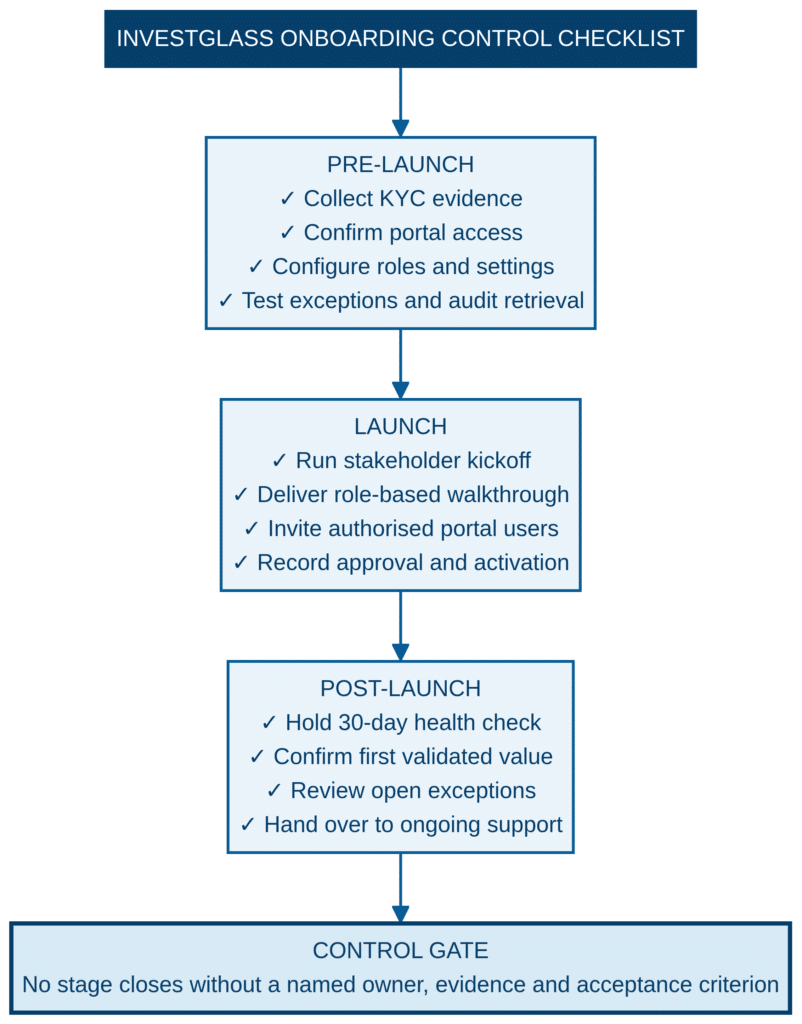
Figure 2. Use pre-launch, launch, and post-launch evidence gates to make onboarding a controlled change rather than a one-off project.
Onboarding-Checkliste: Aufgaben vor dem Start
Control area | Detailed checklist | Primary owner | Evidence | Gate |
|---|---|---|---|---|
Scope and governance | Entity, jurisdiction, product, customer-type and channel map; RACI; change authority; residual-risk route | Executive Sponsor / Prozessverantwortlicher | Approved scope and decision log | Design approval |
CDD and risk design | Policy-to-workflow mapping; evidence matrix; standard/assisted/escalation criteria; no-proceed and review triggers | Compliance/MLRO | Approved control map and test cases | Compliance approval |
Data and sovereignty | Data inventory; purpose/lawful-basis review; DPA/processor review; DPIA decision where high risk is likely; data locations | DPO/security | Data-flow, risk assessment and contract pack | Privacy/security approval |
Identity and integrations | Provider diligence; data mapping; reconciliation; failed-match, outage, duplicate and manual-review tests | IT/CSM/Compliance | Test results and defect log | Operational-readiness test |
Access and evidence | Role matrix; privileged approval; joiner/mover/leaver process; retrieval, version and deletion tests | Security/Operations | Entitlement test and retrieval sample | Access/evidence gate |
Portal, resilience and enablement | Approved copy; assisted route; fallback; incident contacts; training curriculum; content ownership | CSM/Support/Operations | Runbook, content approval and training plan | Release readiness |
Using onboarding templates for this pre-launch work helps teams prepare resources for new customers, standardize handoffs, reduce the risk of errors, and support effective onboarding through a reliable process aligned with customer goals and expectations.
Aufgaben auf Kundenebene vor dem Start
The program-level gate above should translate into three customer-level actions before the kickoff, often guided by customer onboarding templates that include checklists, timelines, communication plans, and resources tailored to different customer segments, with alignment between the sales team and customer success team on project timelines and key stakeholders.
- Collect KYC documents before kickoff: Operations with Compliance oversight. Policy-approved request sent through the approved channel; received files are legible, correctly associated and recorded, with missing or alternative evidence routed rather than guessed.
- Verify access to the secure client-portal route: CSM/Support with Security. Authorized contact completes the configured authentication step, sees only permitted workspace content and knows the assisted-support route; revoke test access that is no longer required.
- Configure account settings in InvestGlass: CSM/administrator with control-owner approval. Agreed fields, roles, permissions, notifications, templates, and review tasks are configured in the contracted workspace and tested against the approved design.
These actions prepare the kickoff; they do not constitute CDD approval or permission to activate the relationship.
Einarbeitungs-Checkliste: Start-Aufgaben
Launch moment | Detailed checklist | Owner | Evidence | Gate |
|---|---|---|---|---|
Customer kickoff | Confirm contacts, scope, milestones, approved document route, escalation and accessible alternative | CSM | Dated success/evidence plan | Shared understanding |
Personalised setup walkthrough | Demonstrate only the workflows, data and actions relevant to each role; explain boundaries and escalation, keeping the walkthrough interactive so new users understand the value of the product or service | CSM/administrator | Attendance, role path and open questions | Role-relevant understanding |
Portal workspace invitation | Invite authorized client users to the configured workspace and verify the intended access path | CSM/Support | Invitation, authentication and entitlement record | Authorized access confirmed |
Evidence request | Send role-appropriate, policy-approved requests with reason, format and secure route | Operations/CSM | Request version and status | Complete request |
Verification and screening | Execute configured checks; route failures, anomalies and manual cases | Compliance/Operations | Provider result, source, reviewer and timestamp | Decision-ready file |
Compliance decision | Record risk rationale, route, conditions, authority and next review | Compliance/MLRO | Linked decision record | Authorized decision |
Operational activation | Reconcile approved conditions to account, product and portal set-up | Betrieb | Activation and reconciliation checklist | Conditions satisfied |
Enablement and triage | Issue approved roles; train users; review blocks, defects and repeat contacts daily, using interactive training to support successful onboarding and long-term retention | CSM/Support | Entitlement, training and issue log | Supervised launch |
For Consumer Duty-scope retail activity, necessary friction can allow understanding of risk, while unnecessary information or evidence requests may be an unreasonable barrier. Explain requests and provide assistance without lowering standards.
Onboarding-Checkliste: Aufgaben nach dem Launch
Timing or trigger | Detailed checklist | Owner | Evidence | Gate / output |
|---|---|---|---|---|
Hypercare | Review stalled files, exceptions, integration failures, portal themes and workarounds, gathering customer feedback to continuously improve the process | CSM/Operations/Compliance | Prioritized issue log | Remediation owner and date |
Quality assurance | Sample completeness, source/version, rationale, approval, activation and retrieval | Compliance QA/independent reviewer where proportionate | Pass/fail and root cause | Improvement plan |
Access/configuration review | Recertify roles, privileged users, templates and workflow changes | Security/administrator | Access-review and change log | Corrected permissions |
Relationship event | Assess ownership, purpose, activity, risk alert, product or representative change | Compliance/RM | Event-review decision | Updated route or monitoring |
30-day health check | Confirm access, adoption, support themes, unresolved control issues and progress against first validated value | CSM with control owners | Recorded call, actions and owners | Continue, remediate or escalate |
First-value confirmation | Confirm that the pre-agreed, controlled and reviewable milestone was achieved without bypassing a condition | CSM/customer sponsor | Milestone evidence and acceptance | Value validated |
Onboarding close and support handover | Close the initial plan only when open items have owners and Support/RM accepts the operating context | CSM/Support/RM | Closure record, service cadence and escalation map | Business-as-usual ownership accepted |
Governance review | Review 30/60/90-day equivalent delivery, adoption, support, training and controls, using onboarding metrics | Executive sponsor/CSM | Closure or improvement plan | Business-as-usual handover |
Material change | Reassess a new provider, integration, jurisdiction, product, field or hosting/access route | Control owners | Approval and test evidence | Controlled release |
After launch, monitor key performance indicators such as onboarding completion rate and early churn rate to identify friction points.
Content upgrade — onboarding control checklist: Turn the three phases above into a controlled worksheet with owner, evidence link, due date, exception route, and gate status. Do not mark the whole journey complete until the accountable owner accepts the evidence for its own gate.
With onboarding checklists in place, let’s look at how ongoing support and knowledge resources can further improve the onboarding experience.
Wissensdatenbank und laufender Support
Self-service is assisted service, not customer deflection: show approved requests, status, and authorized tasks, with accessible human help for questions and failures. Build a searchable knowledge base around common onboarding issues, link approved articles contextually inside the client portal, and offer proportionate multi-channel support through portal messaging, email, scheduled calls, or another governed channel. Manageable onboarding materials and a strong knowledge base can reduce repeat demand on the support team while improving adoption; some SaaS teams have cut support tickets by 30% by refining onboarding content.
Separate the portal from the knowledge base. Do not expose screening rules, EDD rationale, SAR/tipping-off considerations, unapproved notes, or another customer’s data; maintain policy-approved SOPs, templates, escalation, dates, and versions internally.
Surface | Permitted purpose | Minimum governance |
|---|---|---|
Kundenportal | Approved requests, status, authorized documents, messages, permitted self-service and help | Entitlements, revocation, accessibility, content approval, support ownership and access testing |
Staff knowledge base | Current SOPs, FAQs, escalation routes, incident contacts and templates | Content owner, jurisdiction/product label, review date, change log and access classification |
Controlled case record | Evidence, decisions, approvals, exceptions, communications and review tasks | Least privilege, actor/time/version history, retrieval test and retention/deletion rules |
Support system | Status communication, technical triage, complaint/vulnerability signals and routing | Ticket taxonomy, escalation SLAs, restricted fields and quality review |
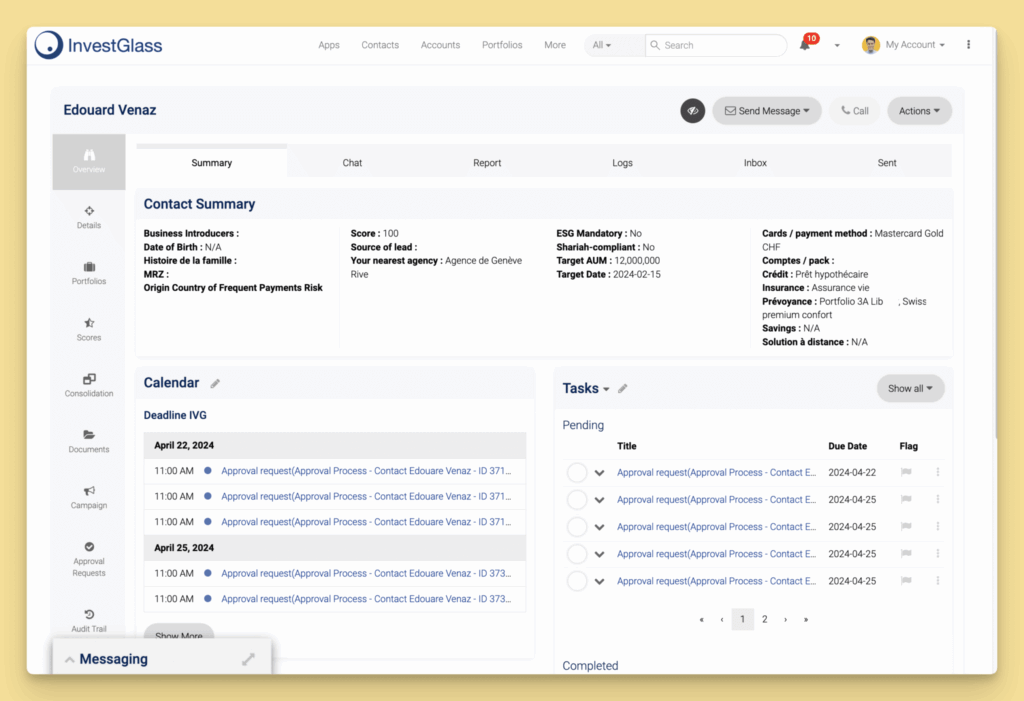
InvestGlass describes a collaborative client and employee portal with messaging, document management, access, and two-factor-authentication language. Validate features, permissions, storage, testing, contract, and support process; this is not a default assurance.
The same discipline applies when assessing InvestGlass as a Swiss-sovereign CRM alternative for a controlled portal journey.
Support records recurring questions without becoming a risk-decision channel. Route access anomalies, ownership/risk changes, and data incidents to their control owners; the CSM can coordinate communication, not decide by workaround.
With support and knowledge resources in place, let’s focus on training and enablement for all roles involved in onboarding.
Schulung, Zugriff auf das Kundenportal und Enablement
Training nach Rolle
Training is control design: users operate the workflow, explain requirements, and grant access. Keep it role-based and evidence competence or attestation where policy requires.
Dedicated training sessions can be built around small, achievable actions to maintain motivation and momentum.
Rolle | Learning focus | Evidence to retain or verify |
|---|---|---|
Sales/RM | Accurate scope, permitted promises, factual handoff, expectation setting and escalation | Handoff-quality check; policy-required training record |
CSM/Implementation | Cohort plan, configuration evidence, controlled change, enablement and exception routing | Project, test and change records |
Operations/onboarding | Evidence handling, activation prerequisites, reconciliation, fallback and triage | Completion/competence and queue evidence |
Compliance/MLRO | CDD/EDD route, rationale, authorized approvals, review and QA | Decision, training and sampling records |
Administrators/privileged users | Roles, permissions, integrations, audit retrieval and controlled configuration | Privileged approval, administrator training and change log |
Support/service | Clear status, accessible assistance, red flags and escalation—not CDD decision-making | Ticket-routing and escalation evidence |
Customer users | Approved upload route, portal tasks, deadlines, limitations and help | Invitation/acknowledgement where appropriate; not risk approval |
InvestGlass states its role-based Learning Plans are online/self-paced and include deployment, security, automation, integration, and administrator topics. They are implementation context, not proof of regulatory-training compliance or a replacement for the firm’s curriculum.
Methoden der Trainingsdurchführung
- Blend live webinars for complex questions and cross-team alignment with short, on-demand microlearning for repeatable tasks.
- Assign each module by role, version it with the live process, and provide an assisted path where accessibility or complexity makes self-service unsuitable.
- In one onboarding program, a professional training business raised course completion rates by 50% with light gamification and certification incentives.
Firms selecting InvestGlass as a Swiss-sovereign CRM alternative should map available learning material to their own role curriculum, policy, and competence evidence.
Grant least-privilege access, test revocation, record privileged approvals, reconcile customer entitlements, and review access after material changes. The ICO supports documented, risk-based security and governance.
With training and enablement addressed, let’s look at how playbooks, templates, and internal checklists can standardize onboarding best practices.
Einarbeitungs-Playbooks, Vorlagen und interne Checklisten
A playbook combines approved content, decision boundaries, current versions, and controlled exceptions; used as onboarding best practices, these assets standardize work and reduce the risk of errors rather than make every case identical.
Template | Required contents | Owner | Review trigger |
|---|---|---|---|
Sales/RM handoff | Parties, entities, products, jurisdictions, promise, contacts, data assumptions, dependencies and open risks | Sales leader/CSM | New product, region or material commercial change |
Kickoff and success plan | Roles, scope, milestones, first validated value, customer communications, risks and escalation | CSM | Scope or timeline change |
Evidence request | Policy-approved request, reason, format, approved channel, deadline and help route | Compliance/Operations | Policy or document-standard update |
Exception/escalation memo | Facts, evidence, route, authority, conditions, rationale and outcome | Compliance/MLRO | Policy, regulatory or QA finding |
Release/go-no-go | Test coverage, defects, fallbacks, data/access approval, training and decision | Process owner | Material configuration change |
Portal and support copy | Status definitions, accessibility language, support route and permitted disclosures | CSM/Support/Compliance | Customer-outcome or content review |
Welcome and milestone emails | Approved welcome, evidence reminder, access confirmation, first-value and closure messages with role, status and support route | CSM/Support/Compliance | Journey, policy or tone-of-voice change |
QA/review worksheet | Sample basis, evidence/retrieval checks, findings, owner and corrective action | Compliance QA | Control finding or methodology change |
Data-sovereignty diligence pack | Contract, DPA, locations, access, transfer, retention, exit and audit evidence | DPO/security/procurement | Vendor/deployment or subprocessor change |
Maintain a register with owner, jurisdiction/product scope, approved version, effective/review date, training link, and retirement status; a client onboarding checklist and related templates also support a repeatable client onboarding process for consistent client onboarding. FCA findings make version control a practical discipline.
Where the contracted configuration permits, store the controlled playbooks in InvestGlass—or store governed links to the authoritative repository—so teams can reuse the current approved version from the client workflow. Restrict editing and retirement rights, and never let a copied local file become the untracked source of truth.
With standardized playbooks and templates, let’s examine how to measure onboarding success through KPIs.
KPI-Framework: Qualität, Kontrolle und Akzeptanz – nicht nur Geschwindigkeit
Define starts, ends, denominators, segments, and exclusions before reporting. For key customer onboarding metrics, set them as Leistungskennzahlen und success metrics early in the engagement to support customer onboarding success. Separate customer-controlled pauses from internal delay and compare like-for-like route, product, entity, jurisdiction, and complexity cohorts.
Domain | KPI | Proposed internal definition and use |
|---|---|---|
Handoff | First-time handoff acceptance | Accepted Sales→CSM/Compliance handoffs ÷ submitted handoffs; identifies incomplete commercial context |
Delivery | Time to kickoff; time to approved launch | Approved start to joint kickoff or controlled release, with customer pauses separately reported |
Wert | Time to first validated value | Start to a pre-agreed, evidenced, controlled outcome—not a login |
Evidence/control | First-pass completeness; pre-activation control completeness | Complete first-review files; activated sampled records with retrievable evidence, rationale, approval and versioned decision |
Risk/assurance | EDD/exception ageing; file-quality pass rate | Count, age, owner and result of escalations; sampled evidence, decision, access and retrieval pass rate |
Access | Access-control hygiene | Review completion, privileged reconciliation, leaver removal and unauthorized-change count |
Enablement/support | Role completion; ticket themes and repeat contact | Assigned/completed competence and recurring query taxonomy |
Automating repetitive administrative onboarding tasks frees teams to focus on relationship-building and issue resolution rather than rote work. Those measures should also be read alongside downstream indicators such as customer lifetime value and broader customer lifetime trends.
These are proposed internal definitions, not regulatory thresholds or promised results. For Consumer Duty-scope activity, monitoring should help identify and act on poor outcomes; a dashboard alone does not demonstrate compliance.
With KPIs in place, let’s address data sovereignty, outsourcing, and due diligence for onboarding technology.
Datensouveränität, Outsourcing und InvestGlass Due Diligence
Data sovereignty is a design and contractual question. Map collection, production, integration, copies, backups, DR, administration, support, analytics/AI, deletion, export, and audit access against the firm’s requirements.
InvestGlass positions itself as a Swiss-sovereign CRM alternative for regulated institutions. It states it is Swiss owned and hosted, and says customers can choose Swiss cloud hosting or their own servers/local data centers. These are deployment-option statements, not universal residency, compliance, or foreign-access guarantees.
The public InvestGlass privacy policy says service hosting is in Plan-les-Ouates, Switzerland and personal information is kept on Swiss servers managed by STACK Infrastructure and Exoscale SA. It also says some providers can be US-located and some uses/disclosures may involve other-country processing; last revised 19 November 2019.
Do not say InvestGlass data never leaves Switzerland, a deployment is CLOUD Act-proof, or Swiss hosting makes a firm GDPR-, FINMA- or FCA-compliant. The regulated firm remains responsible for risk assessment, outsourcing governance, configuration, and evidence.
Swiss FADP requires risk-appropriate security and conditions processor use and foreign disclosure. An FCA firm should assess SYSC 8.1 where outsourcing a critical/important function; it remains fully responsible.
Due-diligence item | Questions to ask before a customer-specific statement | Evidence to request |
|---|---|---|
Contract and roles | Who is controller, processor, subprocessor and support provider for this use? | Current contract, DPA, service schedule and confidentiality terms |
Locations | Where are production, replicas, backups, DR, logs and exports processed or stored? | Deployment architecture and data-location schedule |
Support and administration | Who can access data, from where, under which approval and logging model? | Support/admin access model, role matrix and audit-log description |
Telemetry, analytics and AI | What data enters telemetry, diagnostics, analytics or AI-processing flows? | Data-flow map, feature configuration and subprocessor disclosure |
Security and keys | How are identity, entitlement, encryption and key management designed? | Security architecture, access-review process and assurance scope |
Transfers | Which countries, providers and transfer mechanisms can apply? | Current subprocessor list and transfer documentation |
Lifecycle and exit | How are retention, legal holds, deletion, export, backups and exit assistance handled? | Deletion/export terms, backup schedule and exit plan |
Assurance and rights | What audit rights, incident terms and independent assurance apply to this deployment? | Audit clause, incident process and current certifications/attestations if offered |
Request InvestGlass’s current DPA, subprocessor list, architecture, backup/DR geography, support model, telemetry/AI flows, keys, transfers, deletion/export, and audit rights. The dated public policy and international-processing qualification make contract- and deployment-specific review essential.
InvestGlass founder Alexandre Gaillard’s company-story mantra is: “Another private banking is possible, inclusion financing is possible thanks to Fintech.” It is an ambition, not workflow certification or transferred accountability.
For related implementation context, see InvestGlass’s customer-onboarding strategy resources, as input to a firm-owned validation process.
Closing CTA — validate the operating model: Discuss InvestGlass as a Swiss-sovereign CRM alternative for your regulated institution, with the right stakeholders in the room: Compliance/MLRO, DPO, information security, operations, technology, and the accountable business owner. Confirm scope, deployment, and controls before any customer-specific claim or go-live.
Fazit: Verantwortlichkeit sichtbar machen
A strong strategy joins service design to decision rights and sets the tone for the entire relationship, not just the first implementation phase: accurate Sales/RM promise, one CSM per cohort, independent Compliance/MLRO decisions, Operations reconciliation, and Support escalation.
Technology can make the chain legible across the broader Kundenlebenszyklus. InvestGlass can be assessed as a Swiss-sovereign CRM alternative for onboarding, workflows, portal, and deployment options; it does not remove policy, privacy, outsourcing, or regulatory responsibility.
Before publishing or release, obtain Compliance/MLRO, DPO/privacy, security, Operations, and product-counsel review. Every gate needs an owner, evidence, authority, retrieval path, communication, and change route.
Autor und redaktioneller Hinweis
Prepared by the InvestGlass Editorial Team. This article was checked against current primary legislation, regulator guidance, cross-industry sources, and current official InvestGlass pages on 4 September 2026. It distinguishes source-backed obligations, supervisory observations, and operating recommendations.
Transparent update note: Legal position, regulator guidance, product pages, contracts, and subprocessor arrangements can change. Route this page through Compliance/MLRO, privacy/DPO, information security, and product-counsel review before publication, and repeat that review for jurisdictional or deployment-specific use.
Häufig gestellte Fragen
- What is the customer onboarding process in a regulated financial firm?It connects commercial context, policy-defined evidence and CDD, authorized decisions, approved activation, enablement, and ongoing review. It is important because it standardizes early interactions and helps new users reach value safely. The legal sequence depends on the firm’s jurisdiction, activity, product, and customer facts.
- How long should regulated customer onboarding take?There is no defensible universal duration. Measure comparable cohorts from kickoff through approved launch and first validated value, separating customer-controlled pauses and escalation.
- What does a CSM do during financial-services onboarding?The CSM coordinates the cohort plan, implementation, enablement, communications, and business-as-usual handover. The CSM does not approve CDD risk, waive a control, or decide an EDD exception.
- Is KYC the same as the whole onboarding process?No: KYC/CDD is one control component within scope, data, set-up, access, training, support, and review. UK MLR CDD is risk-sensitive and applies in defined circumstances for in-scope firms.
- Can digital Identitätsüberprüfung automatically approve a customer?No. It can support a policy-defined workflow, but it is not the final risk decision; under the cited MLR rule, electronic identification must be secure from fraud/misuse and provide the necessary assurance.
- How long should onboarding records be retained?For UK MLR in-scope relevant persons, regulation 40 generally specifies five years from the prescribed endpoint for certain CDD and transaction records, subject to exceptions and deletion duties. It is not a universal setting for every data type or log.
- Does Swiss hosting guarantee data sovereignty or compliance?No. Assess contract, deployment, backups, DR, subprocessors, support access, telemetry/AI processing, transfers, deletion, and audit rights. InvestGlass’s public policy also contemplates US-located providers and international processing.
- What should a customer onboarding portal do?It should present approved requests, intelligible status, authorized tasks or documents, and an assisted route. Onboarding templates and a client onboarding checklist help keep the experience consistent and reduce errors. Its suitability depends on access, governance, testing, and contract, not its label.
- How should onboarding be personalized without weakening controls?
Adjust CSM coverage, training, and assistance to value, complexity, and capacity. This applies to user onboarding as well, where knowledge resources and guided support can improve adoption without weakening control standards. Keep the AML/CTF risk route independent of AUM, Sales priority, or customer preference. - When is onboarding complete and ready for handover?
Completion requires accepted evidence, conditions reconciled to activated service, authorized user enablement, and recorded Support/RM ownership. Onboarding tasks are complete only when owners, evidence, and support routes are accepted, reflecting established best practices. Hypercare, access review, quality assurance, and event-driven monitoring should already operate.
Referenzen
[1] MLR 2017 regulation 27 — CDD triggers
[2] MLR 2017 regulation 28 — CDD measures
[3] MLR 2017 regulation 33 — enhanced CDD
[4] MLR 2017 regulation 40 — record-keeping
[5] MLR 2017 regulation 19 — policies, controls and procedures
[6] MLR 2017 regulation 24 — training
[7] FCA Handbook PRIN 2A.6 — Consumer Duty support
[8] FCA — Firms’ customer due diligence processes and controls: our findings
[9] EBA — Guidelines on remote customer onboarding
[10] Swiss Federal Act on Data Protection
[12] PowerMetrics — What is Time to Value? With Donna Weber, Customer Onboarding Expert
[13] Ofcom — General Conditions of Entitlement
[14] ICO — What is special category data?
[15] InvestGlass — Digital Onboarding
[16] InvestGlass — KYC and KYB
[17] InvestGlass — Automation Tools
[18] InvestGlass — Collaborative Portal
[19] InvestGlass — Select Your Data Sovereignty
[20] InvestGlass — Our Learning Plans
[21] InvestGlass — Privacy Policy
[22] MLR 2017 regulation 31 — cease transactions etc.
[23] ICO — Guide to accountability and governance
[24] FCA Handbook ICOBS 5 — identifying client needs and advising
[25] FCA Handbook SYSC 8.1 — outsourcing

