
For banks, wealth managers, insurers, and regulated institutions, a sales pipeline is no longer a simple list of prospects. It is a controlled operating model for revenue, compliance, client onboarding, and auditability. This article explains how to design a healthy sales pipeline with a 君主 pipeline builder, and how InvestGlass helps organisations protect client data while improving commercial discipline.
要点
- A sales pipeline builder is both a framework and a technology layer for designing, visualising, and managing sales pipeline stages from initial contact to long-term client relationship.
- A healthy sales pipeline depends on clear pipeline stages, disciplined lead qualification, consistent pipeline metrics, and regular review of pipeline health.
- InvestGlass is a Swiss sovereign CRM and pipeline management software designed for financial and regulated firms that want to avoid American or Chinese vendors and protect client data sovereignty.
- Readers will learn how to map and 販売パイプラインの構築, nurture leads, prioritise qualified leads, and monitor pipeline coverage, sales cycle length, and conversion rates.
- The guidance is written for organisations that need compliant, auditable sales processes, including banks, private banks, wealth managers, insurers, and public sector institutions.
What is a sales pipeline builder?
A sales pipeline builder is both a framework and a set of sales pipeline tools for designing, visualising, and managing the journey from first touch to long-term client.A sales pipeline is an organised, visual method of tracking potential buyers as they progress through various stages of the purchasing process and buyer’s journey. In practical terms, the pipeline builder turns raw lists, referrals, マーケティングキャンペーン, and sales opportunities into a structured series of steps with clear rules for moving a deal to the next stage.
A sales pipeline focuses on the active deals and next steps by stage, while a sales funnel illustrates conversion percentages at each stage from a marketing perspective. The sales pipeline is a visual representation of where each prospect is in the sales process, helping identify next steps and any roadblocks, whereas the sales funnel represents the customer’s journey from awareness to purchase. Sales pipelines and funnels serve different purposes; the pipeline is used for tracking sales activities and managing deals, while the funnel is used to understand customer engagement and conversion rates.
A basic board or spreadsheet may show where a deal stands, but it does not give the same control as pipeline management software. Utilizing a dedicated Customer Relationship Management (CRM) platform is standard practice to avoid losing track of prospects. A CRM platform centralizes the pipeline, tracks lead progress, and automates follow-ups. Sales pipeline management tools are designed to help businesses nurture leads, track potential customers, and analyse sales efforts, enabling effective handling of activities within the sales pipeline.
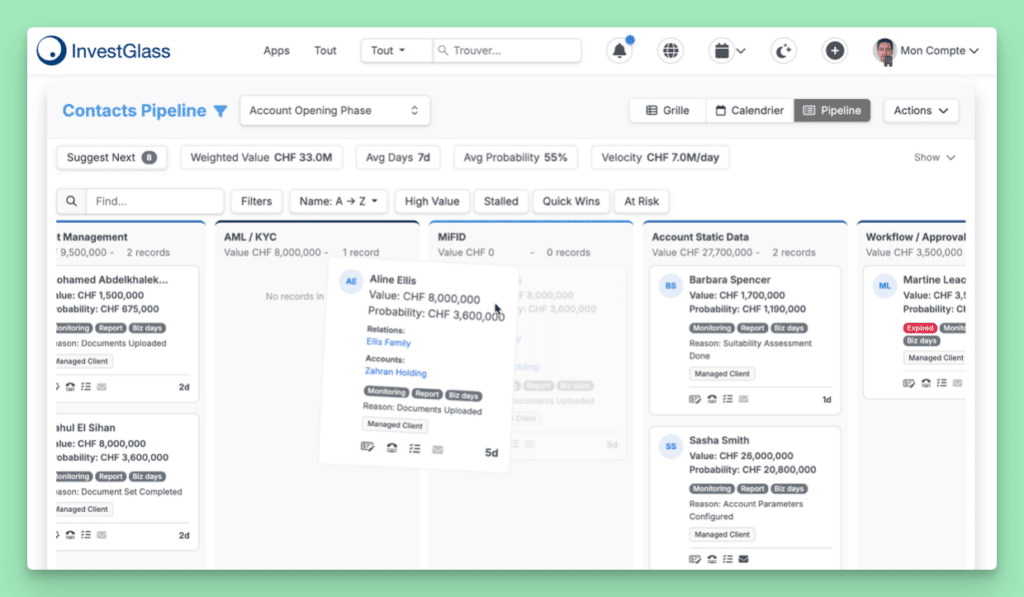
InvestGlass includes a no-code pipeline builder within a Swiss sovereign CRM environment. It is designed for financial services workflows, デジタル・オンボーディング, KYC, portfolio-related sales cycles, compliance approval, and secure communication tools. This makes it suitable for organisations that want a European, non-American, and non-Chinese solution that protects the sovereignty of the client.
Why a healthy sales pipeline matters in 2026
In 2026, financial institutions face longer buying committees, more cautious decision makers, and higher regulatory scrutiny. According to Salesloft’s 2025 pipeline research, 86% of sellers reported higher pipeline quotas than the previous year, while almost 40% said their current pipelines were weaker. In banking and insurance, the challenge is even sharper because suitability, KYC, risk review, and compliance sign-off can lengthen the sales cycle.
A healthy sales pipeline has enough qualified opportunities to meet revenue targets, a balanced distribution across sales stages, and a clear next action for every opportunity. Sales pipelines provide a clear picture of potential overall revenue, allowing businesses to create accurate forecasts and adjust sales strategies as needed to meet goals. A sales pipeline helps identify next steps and any roadblocks or delays, enabling sales teams to keep deals moving toward closure.
An unhealthy pipeline looks different. Deals remain open without activity, manual data entry is inconsistent, documents are missing, and forecasts change sharply from month to month. When a deal falls out of the process, managers often discover too late that the リレーションシップ・マネージャー lacked authority, budget confirmation, risk approval, or client urgency.
Effective sales pipeline management requires tools that provide visibility into the sales process, allowing teams to identify bottlenecks and improve conversion rates. For regulated firms, this is also a governance issue. Every call, email, meeting note, suitability document, and approval should be traceable, so that the sales history stands up to internal audit and external regulatory review.
Core pipeline stages every team should define
Most B2B organisations use five to eight sales pipeline stages. Financial services firms often need additional checkpoints for risk, compliance, documentation, and approval. Common sales pipeline stages include Prospecting, Qualification, Discovery, Proposal, Negotiation, and Closed Won/Lost. The stages of a sales pipeline typically include prospecting, qualifying, contacting, building relationships, closing, and following up with コールドリード.
For banks, wealth managers, and insurers, the following model is often more practical:
ステージ | 目的 | Example exit criteria |
|---|---|---|
リードジェネレーション | Identify target leads through referrals, events, thought leadership, and digital forms | Prospect record created and source recorded |
Lead qualification | Assess fit, jurisdiction, budget, urgency, risk profile, and authority | BANT or MEDDIC completed, qualified leads confirmed |
Discovery and needs analysis | Understand objectives, pain points, assets, liabilities, and investment or insurance needs | Meeting notes, needs assessment, and product interest recorded |
Proposal and suitability review | Prepare suitable proposal, mandate, product recommendation, or policy option | Suitability assessment and proposal attached |
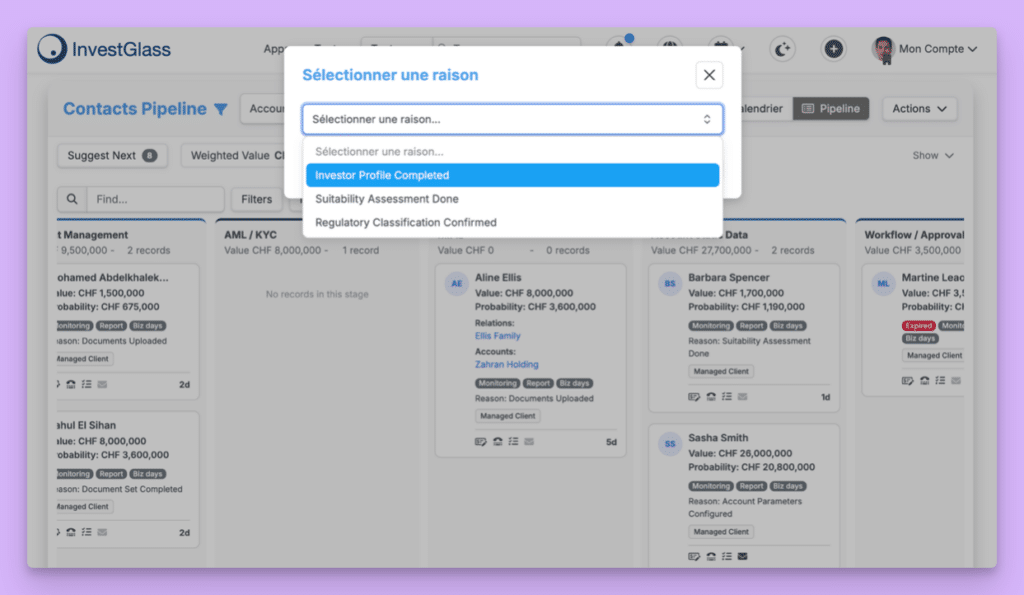
Compliance and risk approval | Check KYC, AML, risk rating, and internal approvals | Compliance sign-off recorded in crm software |
交渉 | Agree terms, pricing, mandate details, or policy conditions | Final terms accepted by client and internal approvers |
Account opening and onboarding | Complete identity checks, documentation, signatures, and operational set-up | Account opened or mandate activated |
Post-sale nurturing and portfolio review | Serve existing customers, schedule reviews, and identify future needs | post sale follow up completed and review cadence set |
Some firms compress this into seven stages by combining proposal and negotiation, while others create multiple custom pipelines for different business lines. Sales pipeline stages should mirror the exact journey buyers take from their first interaction to a closed deal. Building a successful sales pipeline requires aligning the sales process with the buyer’s journey, not forcing buyers into internal reporting categories that do not reflect reality. |
Prospecting is the first stage in any sales pipeline, where potential buyers are identified based on their need for the product or service being sold. Qualifying leads involves determining whether a prospect is a good fit for the product, assessing their budget, decision-making authority, and readiness to buy. Building relationships with prospects is crucial throughout the sales pipeline, as it helps to establish trust and increase the likelihood of closing a sale. The closing stage of the sales pipeline is where the salesperson finalizes the deal, which may involve negotiating terms and ensuring the customer is ready to commit.
Every stage needs clear entry and exit criteria. Establishing clear exit criteria for each stage of the sales pipeline helps sales teams understand when to move leads to the next stage, ensuring a smoother transition and better tracking of progress. InvestGlass lets the sales team configure pipeline stages visually, adapt them by retail banking, private banking, institutional mandates, or insurance products, and reuse templates across regions.

From leads to clients: qualification, prioritisation, and nurturing
Modern pipeline management is less about collecting as many names as possible and more about focusing on high quality sales opportunities. Set strict guidelines to filter out prospects who aren’t ready or cannot afford the product. Frameworks like BANT (Budget, Authority, Need, Timeframe) or MEDDIC can be used to assess lead viability, especially when sales reps need a consistent method for deciding which relationships deserve priority.
In regulated sectors, lead generation often comes from referrals, conferences, educational events, digital onboarding forms, and research-led marketing efforts. The marketing team should define the target audience clearly, while sales professionals should enrich customer data through discovery calls, phone calls, meetings, and suitability conversations. The company’s sales process should then determine how to prioritize leads based on fit, assets under management, jurisdiction, risk category, urgency, and expected mandate size.
リードスコアリング should not be generic. A Swiss private bank may score a prospect highly because of expected assets, jurisdictional compatibility, and readiness to transfer a mandate. An insurer may score a family office lead based on risk protection needs, policy complexity, and timing. InvestGlass supports lead scoring and ai powered lead scoring so teams can manage leads using consistent rules, reduce manual data entry, and focus sales efforts on the right opportunities.
Lead nurturing must remain compliant. Financial institutions can nurture leads with educational content, market outlooks, reminders to provide documents, portfolio review invitations, and approved product updates. However, they must avoid unsuitable recommendations before the right checks are complete. InvestGlass marketing automation allows organisations to automate tasks, nurture leads, and manage marketing campaigns while keeping all data in Swiss infrastructure or on-premise environments.
Pipeline metrics and how to measure pipeline health
Pipeline health can only be managed if the organisation uses consistent sales pipeline metrics. Continuously measure pipeline health to identify bottlenecks and monitor metrics like Conversion Rate and Sales Cycle Length. Sales pipeline management involves tracking how leads progress through the pipeline and ensuring that the pipeline stages are clearly defined to visualize the sales process effectively.
Key pipeline metrics include:
- Win rate, measured as closed-won deals divided by qualified opportunities
- Average deal size or expected mandate size
- Sales cycle length, measured from initial contact or qualification to closing
- Conversion rate between each stage
- Pipeline coverage against sales targets
- Average deal age per stage
- Documentation completeness and approval status
- Number of new customers, existing customers under review, and cold leads recycled
A sales pipeline management tool typically includes features for sales process automation and tracking pipeline metrics to optimise sales processes. In financial services, benchmarks vary by product and market. Recent 2026 benchmark data reported financial services win rates around 18% and sales cycles around 89 days, according to Salesmotion’s industry benchmark analysis. These figures should not be copied blindly, but they help management teams compare their own sales data with market reality.
Consider a Swiss private bank targeting CHF 10 million in quarterly new assets. If the average mandate is CHF 500,000, the bank needs 20 winning deals. If the historical win rate from opportunity to closed-won is 20%, the bank needs 100 opportunities. If only half of SQLs convert into opportunities, management must know how many deals are required earlier in the process and whether the current pipeline coverage is sufficient before the quarter begins.
InvestGlass dashboards help the entire team identify trends by region, adviser, product, and client segment. A manager can see whether a deal stands too long in compliance approval, whether onboarding documents are incomplete, or whether proposal-to-close conversion is declining. These valuable insights support forecasting, board reporting, and regulatory evidence without relying on disconnected spreadsheets.
Choosing the right pipeline management software
Spreadsheets and simple management tools can be useful for very early organisation, but they are not enough for serious financial institutions handling sensitive client data. A regulated firm needs customer relationship management, audit trails, access control, approval workflows, document storage, and secure reporting in one controlled environment.
When selecting a sales pipeline management tool, evaluate:
- Data sovereignty and hosting location
- Swiss hosting or on-premise deployment options
- Encryption, role-based access, and audit trails
- Compliance workflow software for KYC, suitability, and approvals
- Integration with core banking, portfolio management, and onboarding systems
- Ease of use for sales reps and compliance teams
- Support for multiple pipelines and multiple custom pipelines
- Reporting for pipeline coverage, revenue targets, and board packs
- Implementation effort, user adoption, support model, and custom pricing
European and Swiss institutions increasingly prefer sovereign CRM software that is not controlled by American or Chinese providers. This is not only a technology preference. It is a risk management decision linked to client confidentiality, regulatory accountability, and strategic independence. Swiss data sovereignty software can reduce exposure to foreign access regimes and support compliance with European privacy expectations. For context, データ主権 is now widely treated as a board-level governance issue, not only an IT topic.
InvestGlass is built as a Swiss sovereign CRM, sales hub, and pipeline management software. It can be hosted in Switzerland or deployed inside the client’s own data centre. For organisations serving high net worth clients, public institutions, or sensitive corporate accounts, this infrastructure choice helps protect the sovereignty of client data.
How InvestGlass’s pipeline builder works in practice
InvestGlass allows organisations to build a pipeline visually, configure fields, and connect commercial activity with compliance workflows. A team can start from a banking or wealth management template, then adapt the pipeline stages for mortgages, discretionary mandates, insurance policies, structured products, or institutional mandates.
A typical configuration includes:
- Selecting a pipeline template by business line
- Adding custom stages and exit criteria
- Creating fields for product type, risk rating, jurisdiction, expected mandate size, and decision makers
- Connecting digital onboarding and KYC forms
- Attaching proposals, meeting notes, suitability assessments, and signed mandates
- Setting automations that move deals forward when checks are completed
- Creating dashboards for sales professionals, compliance, and senior management
InvestGlass enables sales teams to keep documents, client notes, approvals, and interactions attached to the relevant opportunity. This reduces duplication and helps ensure that the sales process is auditable. If a prospect completes a digital onboarding form, the CRM can trigger a KYC review. If KYC is passed, the opportunity can move to proposal. If the investment mandate is signed, the account opening workflow can begin.
All customer data remains within Swiss infrastructure or the client’s on-premise environment, depending on deployment. This makes InvestGlass a suitable new pipeline tool for organisations that must avoid extraterritorial access risks associated with American or Chinese technology ecosystems.
Building a repeatable, compliant sales process with InvestGlass
A well-built pipeline is the backbone of a scalable, compliant sales process. It gives sales professionals a shared way of working, gives compliance teams the records they need, and gives management a reliable view of forecasted revenue. A defined sales process is especially important when firms operate across regions, products, and regulatory regimes.
InvestGlass allows organisations to standardise playbooks by product line. A mortgage pipeline may require affordability checks and property documentation. A discretionary mandate pipeline may require risk profiling, investment objectives, and portfolio suitability. An insurance pipeline may require policy needs analysis and disclosure records. Structured products may require additional suitability and conflict-of-interest review.
Automation and AI can support the process without removing human judgement. InvestGlass can propose next best actions, such as scheduling a portfolio review, sending a follow-up email, requesting missing documents, or alerting a manager when a deal is ageing. These actionable insights help sales reps stay disciplined while compliance workflows remain attached to the relevant sales stages.
Consider a mid-sized Swiss private bank in 2025 moving from spreadsheets to InvestGlass. Before implementation, relationship managers tracked opportunities differently, compliance approvals were stored separately, and management could not reliably see forecast accuracy. After implementing InvestGlass, the bank created one shared pipeline, reduced onboarding delays through digital document collection, and improved visibility across prospect relationships, active mandates, and winning deals.
Implementation roadmap: from spreadsheet to sovereign CRM pipeline
Moving from ad hoc tools to a full pipeline builder should follow a structured project plan. The objective is not to copy a spreadsheet into software. The objective is to design a controlled operating model that reflects how potential customers become clients.
A practical roadmap includes:
- Map the current sales process and buyer journey
- Clean duplicate records and standardise sales data
- Define pipeline stages, entry rules, and exit criteria
- Agree lead qualification rules with sales, marketing, compliance, and management
- Configure InvestGlass fields, workflows, dashboards, and permissions
- Migrate data from legacy systems
- Train users by role
- Pilot with one business unit before group rollout
- Review conversion rates, deal ageing, and user adoption after launch
To maintain a healthy sales pipeline, it is essential to regularly review and clean the pipeline, which includes closing or recycling stalled deals and updating next steps. This review should not be occasional. It should be part of weekly sales activities, monthly management reporting, and quarterly governance checks.
Common pitfalls include over-complicated stages, unclear ownership, untrained users, and workflows designed without compliance input. Small businesses and boutique advisers should avoid excessive complexity, while larger banks should avoid designing separate processes that prevent group-level reporting. InvestGlass provides onboarding support, data migration, and best-practice templates for regulated industries, helping firms move from fragmented records to a secure, sovereign CRM platform.

よくあるご質問
Is a pipeline builder relevant for small wealth management or boutique advisory firms?
Yes. Even small firms benefit from a structured pipeline because it improves forecasting, helps manage regulatory expectations, and prevents prospects from being forgotten. A boutique firm can start with a light InvestGlass configuration and expand later as its processes mature. Starting with sovereign CRM software also reduces the risk of future migration away from non-European vendors.
How long does it take to build a functional sales pipeline in InvestGlass?
A basic pipeline for one team can often be configured within a few days if the sales process is already clear. A multi-country bank rollout with complex approvals, historical data migration, and regional compliance requirements may take several weeks. InvestGlass implementation specialists can provide templates for common financial services use cases to accelerate deployment.
Can InvestGlass support multiple pipelines for different products or regions?
Yes. InvestGlass supports multiple pipelines, such as one for retail banking loans, one for private banking mandates, and another for institutional relationships. Each pipeline can have its own stages, fields, automation rules, permissions, and local regulatory requirements. Management can still view consolidated pipeline health across all pipelines for group-level reporting.
How does a sovereign Swiss CRM help with data protection compared to American or Chinese tools?
Hosting data in Switzerland or on-premise reduces exposure to extraterritorial legislation from non-European jurisdictions. InvestGlass is engineered around European privacy principles, helping clients meet GDPR, Swiss data protection expectations, and local financial regulations while maintaining control over infrastructure choices. This is particularly important for banks, public institutions, and high net worth client segments that are sensitive to cross-border data access.
What training do sales teams need to use a pipeline builder effectively?
Training should be practical and role-specific. Sales teams need to know how to move deals between stages, update key fields, record phone calls and meetings, interpret dashboards, and follow compliance workflows. Many organisations also appoint internal pipeline champions who support colleagues, maintain data quality, and ensure consistent use of the platform.
InvestGlass helps regulated organisations build a sales pipeline that is structured, measurable, compliant, and sovereign. If your organisation wants to improve forecasting, protect client data, and move away from American or Chinese software dependency, InvestGlass provides a trusted Swiss foundation for pipeline management and long-term 顧客ライフサイクル 成長する。.


