
By 2026, KYC automation has moved from operational upgrade to board-level priority. The global Know Your Customer (KYC) automation market is projected to grow to $7.8 billion in 2026, driven by fraud, stricter regulatory requirements and customer expectations for faster onboarding. This guide compares the top kyc automation providers tools 2026, with a particular focus on sovereignty, compliance and practical deployment for financial institutions.
Key Takeways
- Manual-only know your customer kyc is no longer viable for banks, fintechs and regulated industries facing synthetic identity fraud, AI-generated documents and tighter anti money laundering obligations.
- Top kyc automation tools combine identity verification, document verification, liveness detection, aml screening, adverse media checks, risk scoring, workflow automation and strong APIs.
- InvestGlass is a Swiss sovereign, non-American and non-Chinese alternative that embeds KYC, KYB, CRM, compliance workflows and client lifecycle management in one platform hosted in Switzerland or on-premise.
- Choosing the best kyc software in 2026 means balancing fraud prevention, customer conversion, data sovereignty, regulatory compliance and total cost of ownership.
- This article compares leading kyc solution providers, outlines core capabilities and closes with practical selection advice and FAQs.
What Is KYC Automation In 2026?
KYC automation in 2026 is the use of software, AI and workflow automation to digitise the entire verification process, from customer onboarding to ongoing monitoring. The kyc process is a regulatory requirement for financial institutions to verify customer identities and assess their risk of money laundering, including customer onboarding, due diligence, ongoing monitoring and risk management.
Modern kyc solutions replace paper forms, email attachments and heavy manual review with digital forms, automated identity verification, real-time document scanning, database lookups, biometric verification and screening against sanctions, PEP and adverse media sources. Identity verification is a critical feature of kyc software, which involves comparing personal details with trusted databases and performing biometric scans or facial recognition to accurately verify customer identities.
KYC automation also now covers kyc kyb in one unified process. That means the same platform can support customer verification for individuals, business verification for legal entities, business identity verification, beneficial ownership collection and enhanced due diligence for higher-risk relationships.
Regulatory drivers include FATF recommendations, the EU AML package, GDPR, UK FCA expectations and Swiss FINMA guidance on outsourcing, cyber resilience and control. Effective automation still requires human oversight. A robust system should route exceptions, low-confidence matches and high-risk alerts to compliance teams for manual review.

Why Financial Institutions Are Rethinking KYC Automation In 2026
Legacy customer process flows were not designed for synthetic identities, deepfakes or AI-generated documents. There has been a 378% surge in synthetic identity fraud, making traditional id verification and document authentication insufficient when used in isolation.
KYC automation significantly enhances operational efficiency by streamlining identity verification processes, reducing the time taken to onboard customers and ensuring compliance with regulatory standards. By leveraging KYC automation, organizations can improve the accuracy of identity verification, minimising human error and enhancing the overall customer experience during the onboarding process.
Regulators, customers and shareholders now expect faster onboarding without weaker controls. Leading KYC automation tools enable seamless integration of client verification, identity checks and document collection to enhance regulatory compliance. In 2026, KYC software providers are expected to increasingly focus on automation, scalability and user experience to enhance compliance processes and reduce onboarding friction.
Costs also matter. Manual review teams are expensive, legacy tools require maintenance and multiple point solutions create inconsistent records. Automated systems now continuously screen customer profiles against global sanctions, PEP and adverse media watchlists, making periodic reviews obsolete. Automated KYC solutions help mitigate compliance risks by continuously monitoring customer data and flagging any suspicious activities, thus reducing the likelihood of financial crimes such as money laundering.
Data sovereignty is now a decisive factor. Many European institutions want a kyc provider that avoids dependence on American or Chinese technology ecosystems. InvestGlass addresses this need as a Swiss sovereign KYC and CRM platform, giving organisations control over hosting, customer data, compliance process records and digital infrastructure.
Core Capabilities Of Modern KYC Automation Tools
The best kyc tools in 2026 share core capabilities across KYC, KYB and anti money laundering aml operations. Top KYC software solutions typically offer a range of verification methods, including document scanning, biometric checks and database lookups, to ensure comprehensive identity verification.
Key features to assess include:
- Document verification: Passports, identity cards, driving licences, proof of address, corporate documents and address verification. KYC software should facilitate document scanning and processing to automate the reading and validation of identification documents, thereby increasing efficiency and accuracy in the verification process. Strong providers offer comprehensive document coverage and global document coverage.
- Biometrics: Facial recognition, biometric authentication, biometric verification, passive and active liveness detection, and in some cases fingerprint or voice checks. Modern KYC systems employ multimodal biometrics to counter deepfake fraud and synthetic identities.
- NFC verification: Reading chip data from compatible identity documents can strengthen document authentication and reduce tampering risk.
- Screening: Sanctions, PEP, aml screening and adverse media checks with configurable matching thresholds. Verification aml screening should be integrated into verification flows, not handled as a disconnected task.
- Risk scoring: Effective KYC solutions incorporate risk assessments that automatically evaluate customer details, geographical location and transactional behaviour to determine the potential risk a customer poses. This supports accurate risk assessments, more accurate risk assessments and better customer risk classification.
- Decision engines: Rules and machine learning models route low risk customers to approval and higher-risk alerts to enhanced due diligence or manual review.
- Ongoing monitoring: KYC software should provide ongoing monitoring capabilities to periodically review accounts and transactions, ensuring that any suspicious activity is flagged and assessed in real-time. Effective KYC software should provide real-time monitoring and alerts to help organizations quickly identify and respond to potential compliance risks or fraudulent activities.
- Perpetual compliance: The KYC space is evolving to include real-time “perpetual” compliance to combat fraud quickly and efficiently. Traditional periodic reviews for KYC compliance are being phased out in favour of continuous monitoring integrated with real-time transaction data.
- Case management and audit trails: Compliance teams need every decision, comment and data change recorded.
- Integration: A strong KYC provider will have a robust integration capability, allowing seamless connectivity with existing systems through modern APIs and SDKs, which is crucial for operational efficiency.
Leading KYC automation providers differentiate themselves by utilising agentic AI, deepfake-resistant biometrics and unified risk orchestration. KYC software solutions are increasingly incorporating AI and machine learning technologies to enhance fraud detection and improve the accuracy of identity verification processes.
Top KYC Automation Providers And Tools For 2026
This section lists leading KYC automation providers active in 2026. Some specialise in identity insights and document verification, others in compliance tools, transaction monitoring or adverse media. A few, including InvestGlass, provide integrated CRM, onboarding, portfolio management and compliance workflows.
The list is based on public information and user sentiment rather than hands-on product testing. Pricing models are indicative and usually depend on volume, configuration, verification methods and contract terms. Organisations should run pilots before selecting the right kyc software.
プロバイダー | Typical strength | Best fit |
|---|---|---|
インベストガラス | Swiss sovereign CRM, KYC, KYB and compliance orchestration | Banks, wealth managers, insurers, public sector |
Trulioo | Global identity and KYB data network | Multinational fintechs and online marketplaces |
サムサブ | KYC, KYB, fraud analytics and transaction monitoring | Digital-first platforms and VASPs |
Onfido, Entrust IDV | Biometric and liveness-focused IDV | Mobile onboarding and high-conversion flows |
Jumio | Enterprise identity verification and custom risk scoring | Banking, payments and gaming |
コンプライアドバンテージ | AML, sanctions and adverse media | High-volume financial crime teams |
LexisNexis Risk Solutions, LSEG Risk Intelligence | Enhanced due diligence data | Large institutions and complex entities |
InvestGlass – Swiss Sovereign KYC Automation And CRM Platform
インベストガラスはスイスのソブリンである。 CRM and automation platform built for banks, wealth managers, insurers, asset managers and other regulated organisations. It combines digital onboarding, KYC, KYB, document capture, portfolio management, marketing automation, compliance workflows and a secure client portal in one integrated environment.
InvestGlass can be hosted in Switzerland or deployed on-premise. This helps organisations avoid reliance on American or Chinese cloud ecosystems while retaining control over client records, risk profiles, audit trails and infrastructure. InvestGlass is listed as Swiss made software, reinforcing its Swiss technology positioning and data sovereignty model.
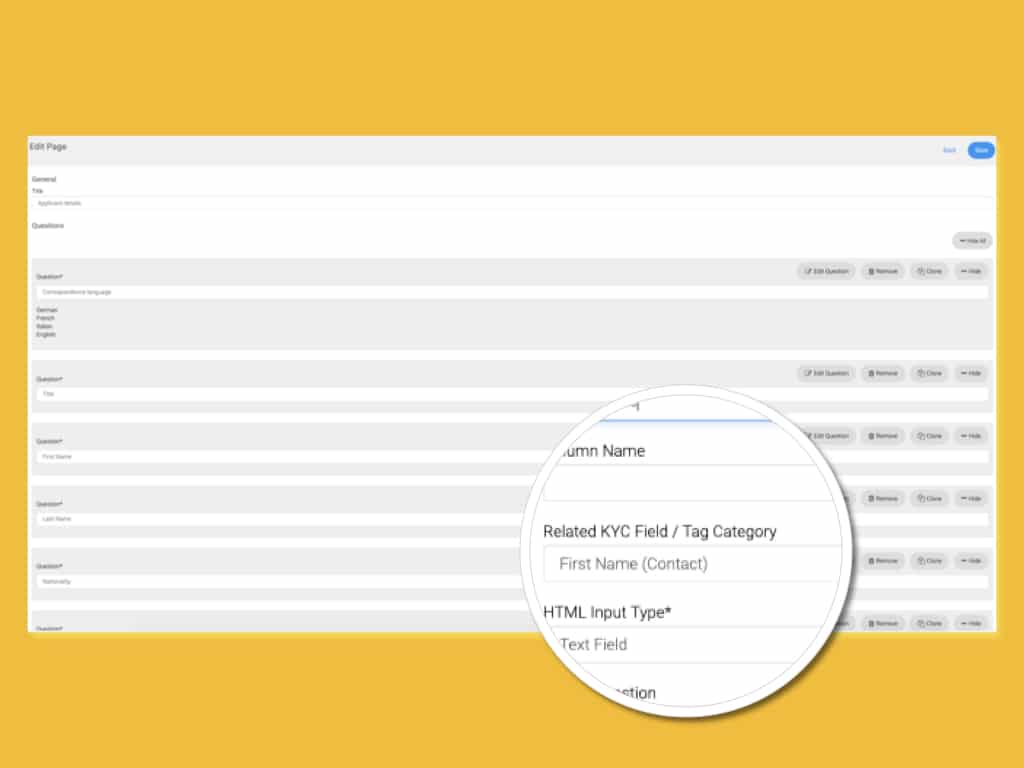
InvestGlass KYC capabilities include configurable digital forms, document verification integrations, structured approval flows, automated reminders for missing information and risk-based questionnaires. The platform supports individuals and businesses, including beneficial ownership collection, kyc kyb workflows and enhanced due diligence where required.
Compliance teams can create customizable workflows that reflect internal policy, local regulatory requirements and customer risk appetite. Complex or high-risk cases can be routed into manual review queues, with every action, note and decision captured in audit trails for supervisors and internal audit.
A private bank, for example, can use InvestGlass to automate end-to-end KYC verification, onboard a client, collect identity documents, perform verification aml screening, assess risk, gather beneficial ownership information, open a portfolio and maintain the relationship through the customer lifecycle. The institution can integrate external verification engines where required, while keeping master customer data in Swiss infrastructure.
Other Leading KYC Automation Providers To Watch In 2026
The following providers can complement or integrate with platforms like InvestGlass. This is useful for institutions that want external verification reach without giving away central control of client data while still leveraging agentic AI in banking for fraud detection and customer experience.
Trulioo – Global KYC And KYB Data Network
Trulioo is known as a global identity data platform with broad KYC and KYB reach across many jurisdictions. It supports document verification, business registry lookups, watchlist screening and risk checks through APIs.
It is often relevant when wide jurisdictional coverage, credit bureaus and local data sources are priorities. Organisations focused on sovereignty may orchestrate Trulioo checks through InvestGlass, keeping core CRM records and compliance history in Switzerland.
Sumsub – All-In-One KYC, KYB And Fraud Suite
Sumsub combines identity verification, business verification, liveness detection, fraud signals, transaction monitoring and fraud analytics. It appeals to digital-first firms needing rapid deployment across multiple geographies and high-volume verification flows.
Its strengths include configurable workflows, wide document coverage and automated or manual review options. Sumsub can also function as a verification engine behind InvestGlass, with InvestGlass controlling when checks are triggered and where client records are retained.
Onfido (Entrust IDV) – Biometric And Liveness-Focused IDV
Onfido, now part of Entrust IDV, is known for biometric checks, facial recognition and advanced liveness detection against spoofing and deepfakes. It uses AI and machine learning to compare selfies or videos with identity documents during onboarding.
Suspicious or low-confidence cases can be escalated to compliance teams. Onfido is strong where selfie-based verification and user experience are central, but institutions should carefully assess data residency, subcontractors and cross-border transfer terms.
Jumio – Enterprise Identity Verification With Custom Risk Scoring
Jumio is a long-standing identity verification provider used in banking, payments and online gaming. It focuses on real-time decisions, reports and custom risk scoring for higher-risk accounts and transactions.
Its dashboards help teams monitor verification performance and fraud detection indicators. Sovereignty-conscious institutions can integrate Jumio at arm’s length through InvestGlass rather than using it as the primary customer data store.
ComplyAdvantage – Real-Time AML, Sanctions And Adverse Media Screening
ComplyAdvantage is an AML-first provider offering sanctions screening, PEP checks and adverse media monitoring powered by AI. It is suitable for banks and fintechs with dense transaction volumes and complex risk appetites.
Its real-time risk database and APIs can help reduce false positives and align risk profiles with regulatory requirements. Within an InvestGlass workflow, ComplyAdvantage can perform screening while InvestGlass stores case history, approvals and compliance records in a Swiss-hosted CRM.
LexisNexis Risk Solutions And LSEG Risk Intelligence – Enhanced Due Diligence Data
lexisnexis risk solutions and LSEG Risk Intelligence provide deep datasets on companies, ownership structures, sanctions, PEPs and adverse media. These services are frequently used for high-risk, cross-border and complex entity relationships.
They fit large institutions needing data enrichment as part of broader RegTech stacks. Their feeds can be consumed within sovereign orchestration platforms such as InvestGlass, allowing institutions to retain central control while using global datasets.

How To Choose The Best KYC Automation Provider For Your Organisation
There is no single best kyc platform for every organisation. The right kyc software depends on use case, geography, risk appetite, integration needs and sovereignty requirements.
Before engaging vendors, document your current kyc compliance process, manual review rates, onboarding drop-off, false positives, document types and internal approval steps. Customer Due Diligence (CDD) is a critical part of the KYC process, involving the assessment of a customer’s risk profile based on their financial activities, geographic location and potential exposure to financial crime.
Use these criteria:
- Verification quality: When selecting KYC software, it is crucial to consider the quality and breadth of verification methods, ensuring that the provider offers multiple options such as document scanning, biometric checks and database lookups.
- AML strength: KYC software should include compliance checks to ensure adherence to anti-money laundering (AML) laws and regulations, which helps organizations keep KYC data up to date and continually assess customer risk.
- Monitoring: Ongoing monitoring is essential in the KYC process, where accounts are periodically reviewed and transactions are monitored to assess risk levels and identify any suspicious activity.
- Scalability: Scalability is an important factor when choosing KYC software, as the right solution should handle fluctuations in KYC volumes without compromising performance.
- Integration: Integration capabilities are essential; KYC tools should easily connect with existing systems through modern APIs and clear documentation to ensure seamless workflows.
- User experience: User experience directly impacts customer verification rates, making it vital to choose KYC software that provides a smooth and efficient interface for both customers and compliance teams.
- Compliance credentials: Trustworthy compliance credentials, such as ISO 27001 and GDPR alignment, are important indicators of a KYC provider’s reliability and maturity in handling sensitive data.
- Sovereignty: European institutions may prioritise Swiss hosting, on-premise deployment and controlled data residency.
Pilots should measure verification time, first-pass approval rates, false positive rates, abandonment rates and case handling time. Many organisations combine a sovereign orchestration layer such as InvestGlass with specialised IDV, AML or adverse media providers behind the scenes.
Why Sovereign KYC Automation Matters: The InvestGlass Perspective
KYC is not only a technical problem. It is also a strategic question of who controls customer identities, client files, risk analysis, workflows and records. Reliance on American or Chinese platforms can create exposure to extra-territorial laws, data transfer risks and geopolitical uncertainty.
The Swiss sovereignty model is different. With InvestGlass, data can be hosted in Switzerland or on-premise, with controlled connections to external verification services only when needed. This allows institutions to use specialist kyc automation tools while keeping core customer data, documentation, risk profiles and audit trails inside a Swiss-controlled environment.
This model protects client sovereignty and supports long-term regulatory resilience. It also reduces the fragmentation created by multiple point solutions, since CRM, onboarding, compliance workflows, portfolio management and secure client portal functions operate from one consistent data model.
For financial institutions that must demonstrate control to boards, auditors and supervisors, InvestGlass provides a practical route: automate the verification process, improve fraud prevention and avoid ceding strategic control to foreign clouds.
Future Trends In KYC And KYB Automation Up To 2026 And Beyond
KYC and KYB automation are moving from static onboarding events to continuous, event-driven risk monitoring. According to the NICE Actimize AML Tech Barometer 2026, only about 15.5% of institutions report advanced perpetual KYC programmes, showing how much room remains for maturity.
AI and machine learning will increasingly support anomaly detection, dynamic risk scoring and real-time decisioning. Research into document extraction also shows that multi-stage pipelines can improve field-level accuracy, reinforcing the value of sophisticated document processing for financial records.
Biometric authentication will continue to evolve with deepfake-resistant liveness detection, behavioural biometrics and multimodal checks. At the same time, regulators will demand explainability, audit trails and transparent decision logic rather than black-box scoring.
Sovereign digital identities (SSI) allow users to hold verified credentials securely in digital wallets, enhancing privacy and verification efficiency. As SSI develops, institutions will still need trusted orchestration, consent, audit and risk management layers.
The strongest direction is integration. Platforms that unify KYC, KYB, AML, CRM and compliance workflows help firms avoid fragmented data and inconsistent decisions. InvestGlass is built for this integrated future, with sovereignty as a foundation rather than an afterthought.
よくあるご質問
This FAQ answers common questions about sovereignty, integration and practical implementation.
How does KYC automation differ from traditional KYC processes?
Traditional KYC relies on manual document collection, email exchanges and human data entry. That makes the process slow, inconsistent and difficult to audit.
Automated KYC uses digital forms, document verification, liveness detection, automated screening and structured decision rules. It can complete many checks in minutes rather than days, while preserving manual review for complex or high-risk cases.
Can InvestGlass integrate with existing KYC providers and internal systems?
Yes. InvestGlass is designed to act as a central orchestration and CRM layer that can call external KYC, AML and document verification providers through APIs.
This allows institutions to keep core client records in Switzerland while using specialist verification networks where required. InvestGlass can also connect with internal systems such as core banking, reporting, portfolio management and compliance tools.
What types of organisations benefit most from sovereign KYC automation?
Private banks, retail banks, wealth managers, asset managers, insurers, pension funds, public-sector bodies and regulated fintechs benefit most from sovereign CRM for financial services.
It is especially relevant where data residency and sector-specific onboarding, such as for Swiss dental practices, confidentiality of high-net-worth clients, public sensitivity or geopolitical exposure are material concerns.
How should we evaluate total cost of ownership for a KYC automation platform?
Look beyond per-check prices. Include integration work, internal IT effort, manual review headcount, abandoned applications, false positive handling, audit preparation and the potential cost of compliance failures.
Integrated platforms such as InvestGlass can reduce long-term complexity by replacing several disconnected tools with one sovereign client lifecycle platform.
Is it possible to run KYC automation fully on-premise with InvestGlass?
Yes. InvestGlass supports on-premise deployment for organisations that need to host data within their own infrastructure for regulatory, operational or policy reasons.
This model can still allow controlled connections to external verification tools, while keeping master client records, workflows and compliance history under the institution’s direct control, a pattern that also underpins sovereign CRM deployments for Swiss therapy practices. To discuss a sovereign KYC and CRM architecture for your organisation, contact InvestGlass and explore a Swiss-hosted or on-premise deployment.


