
Key Takeways
- customer relationship management software is a centralized system for storing customer data, managing contact management, and tracking customer interactions across sales, marketing, and service.
- A modern crm solution goes beyond a contact list: it supports sales force automation, marketing automation, customer service workflows, and customer satisfaction across the entire customer lifecycle.
- cloud based crm tools make it easier for small and mid-sized businesses to manage customer relationships without buying servers or maintaining heavy IT infrastructure.
- InvestGlass is a European, Swiss-based crm platform built for regulated industries such as financial services, wealth management, insurance, and advisory firms.
- The right CRM helps teams replace scattered spreadsheets and sticky notes with a single, searchable database that improves visibility, follow-up, and decision-making.
If your team still relies on inboxes, spreadsheets, and memory to manage relationships, important details will eventually slip. A CRM gives every team a shared place to see who a customer is, what they need, what has happened before, and what should happen next.

What Is Customer Relationship Management (CRM) Software?
CRM stands for customer relationship management, a system designed to manage all interactions a company has with its current and potential customers. In simple terms, crm software stores customer information, tracks emails, phone calls, meetings, website visits, purchases, and service requests, then connects those details to one customer profile.
customer relationship management crm is both a business strategy and a technology. As a strategy, it puts the customer at the center of sales, service, and marketing efforts. As crm technology, it gives teams a practical application for organizing data, activities, and follow-ups.
Early crm systems grew out of contact databases and sales tools in the 1990s. Over time, those tools evolved into today’s cloud-based CRM platforms with automation, AI, analytics, and mobile access. A short history of CRM shows how the category moved from digital Rolodexes to full customer lifecycle platforms.
The main value is simple: a CRM creates a single source of truth. CRM software replaces scattered spreadsheets and sticky notes with a single, searchable database accessible to sales, marketing, and customer service teams. A CRM provides a centralized repository for customer data, ensuring that information is easily accessible, accurate, and up to date, which enhances collaboration across departments.
CRM systems gather, link, and analyze customer data, including contact information, interactions, purchases, and service requests, to develop complete customer profiles. That shared profile supports three core areas: sales management, marketing automation, and customer service.
The CRM market has grown quickly because businesses need better ways to manage relationships at scale. The CRM market size was valued at $41.93 billion in 2019 and is projected to reach $96.39 billion by 2027, growing at a CAGR of 11.1% from 2020 to 2027. More recent market estimates also show continued growth as AI and automation become standard in crm tools.
What Does a CRM System Actually Do Day to Day?
In a normal workday, sales teams, marketing teams, and customer service teams may all access crm data from the same record. A sales rep checks the sales pipeline, a marketer segments leads for a campaign, and a support agent reviews past customer service interactions before replying to a ticket.
Contact management is the foundation. A CRM stores names, companies, households, roles, preferences, lifecycle stage, purchase history, and notes for leads, existing customers, and potential customers. This helps teams manage relationships without hunting through inboxes or asking colleagues for context.
CRM systems log emails, phone calls, support tickets, and meetings automatically for interaction tracking. They also support tracking customer interactions across multiple channels such as email, live chat, social media, in-person meetings, and website forms.
The system also manages daily workflows. Sales reps can log opportunities, assign tasks, set reminders, record notes after each call, and move potential deals through buying stages. CRM platforms visually track potential deals through various stages of the buying cycle, which makes pipeline management easier to understand at a glance.
Managers use dashboards to monitor activity without requesting manual reports. CRM dashboards allow business owners and executives to monitor overall company health, including product sales and employee productivity. Analytics and reporting tools in CRM create real-time dashboards for revenue forecasting and monitoring campaign success.
Main Features of CRM Software
Most CRM platforms share a core set of features, but advanced tools add AI, predictive analytics, workflow automation, and industry-specific controls. The best crm features are the ones that match your actual business processes instead of forcing your team to work around the software.
Here are the features to look for:
CRM feature | What it helps you do |
|---|---|
Kontaktadministration | Store contacts, accounts, households, customer preferences, segmentation tags, and compliance flags |
sales force automation | Automate deal stages, follow-ups, task creation, lead routing, and activity tracking |
lead management | Capture leads from web forms, referrals, events, and campaigns, then qualify and assign them |
markedsføringskampagner | Segment audiences, send emails, run nurture journeys, and measure engagement |
sales forecasting | Forecast revenue using historical data and real-time pipeline information |
customer service tools | Manage cases, tickets, SLAs, service history, and escalation paths |
integrations and APIs | Connect email, calendars, accounting, trading platforms, portfolio systems, and external databases |
Operationally, sales automation helps teams reduce manual work. CRM systems enable sales teams to automate routine tasks such as data entry and follow-ups, allowing them to focus on high-value opportunities and close deals faster. Modern CRM systems often include built-in intelligence and AI capabilities that automate administrative tasks, such as data entry and lead routing, enhancing overall efficiency and productivity. |
Marketing teams use CRM software segments audiences to deliver personalized email campaigns and track engagement automatically. Marketing departments segment customers based on buying habits, demographics, or engagement levels to launch targeted email campaigns. With the right marketing automation tools, teams can create personalized marketing campaigns based on customer behavior, purchase history, geography, or engagement level.
Customer service is just as important. CRM software provides businesses with tools that help them communicate better – both internally and with customers, including features like contact management, sales pipeline tracking, and customer service tools. CRM systems help customer service representatives quickly access a customer’s record of all past interactions, enabling them to provide informed answers and service, which enhances the overall customer experience.
AI is becoming a major part of the category. AI-powered CRM systems can automate routine customer service tasks, such as responding to inquiries and generating responses, which allows human representatives to focus on more complex issues and improve service efficiency. AI in CRM systems can guide users toward the next-best actions and provide smart talking points specific to each customer opportunity, enhancing the overall customer experience.
AI-powered CRMs utilize machine learning to analyze customer data, predict behaviors, and recommend personalized customer experiences, which can significantly improve customer engagement and satisfaction. AI capabilities in CRM systems help businesses gain real-time insights and analytics, enabling teams to make data-driven decisions that enhance customer relationships and drive business growth.
Types of CRM Systems and Deployment Models
CRM tools differ by focus and by deployment model. The four main types of CRMs are operational, analytical, collaborative, and strategic, each focusing on different aspects of managing customer interactions.
Operationel CRM automates and streamlines business processes, focusing on sales force automation, marketing automation, and service automation. An operational crm is best when your priority is workflow automation, reminders, sequences, and task routing.
Analytisk CRM focuses on data analysis to gain insights into customer behavior and preferences, helping businesses make informed decisions. analytical crm systems are useful when you need to analyze customer data, improve customer segmentation, identify churn risks, and find upsell opportunities.
Samarbejdsorienteret CRM facilitates communication and information sharing across departments, enhancing customer service and relationship management. A collaborative crm eliminates communication silos by sharing data across sales, marketing, and support departments.
Strategic CRM places the customer at the center of the entire business strategy, focusing on long-term customer engagement and loyalty-building. A strategic crm is useful when the goal is not just closing a deal, but increasing customer loyalty and customer retention over time.
Deployment also matters. A cloud based crm is hosted by the vendor and accessed through a browser or mobile app. This gives teams mobile access, predictable subscription pricing, automatic updates, and faster rollout without local servers.
On-premises and hybrid deployments are still used by some large or regulated organizations. They can provide more control over data, but they usually require more IT resources, maintenance, and implementation planning.
How CRM Software Improves Sales, Marketing, and Customer Service
A CRM acts like a shared backbone for the customer journey, from the first inquiry to long-term support. A unified view of the customer is a key feature of CRM systems, allowing businesses to manage day-to-day customer activities and interactions effectively across marketing, sales, and service teams.
For sales, CRM systems can improve sales processes by providing a clear 360-degree view of the sales pipeline, automating lead management, and enabling accurate forecasting. Sales teams use crm tools to prioritize outreach, manage sales pipelines, track opportunities, shorten the sales cycle, and focus on high-value prospects.
Implementing a CRM can lead to increased sales and revenue by streamlining the sales process, improving lead management, and providing actionable insights for sales teams. Using CRM tools can lead to a 30% increase in sales revenue and an 87% improvement in win rates, as they help streamline processes and enhance customer interactions.
For marketing, CRM data helps teams build segmented lists, personalize outreach, and measure what actually creates qualified leads. Marketers can connect campaigns to pipeline results instead of only tracking clicks or opens.
For service, a unified view of customer data in CRM systems allows customer service teams to understand customer needs and motivations better, leading to improved service and stronger relationships. Support teams can see contracts, past issues, open cases, and promises made by sales or account managers.
Using a CRM can enhance customer relationships and retention by providing insights into customer interactions and preferences, enabling personalized communication and service. CRM systems track customer activity to flag potential churn risks, identifying opportunities for upselling.
Key Benefits of Using a CRM Solution
A CRM is not just an administrative tool. It can improve revenue, sales productivity, customer satisfaction, and operational efficiency when it is used consistently.
Nøglefordelene inkluderer:
- Better visibility and control: Leaders get 360-degree views of customers, team workloads, revenue forecasts, and open risks.
- Higher productivity: CRM systems can significantly improve operational efficiency by automating routine tasks such as data entry and follow-ups, allowing teams to focus on strategic activities.
- Better decisions: CRM systems help businesses identify trends and opportunities by analyzing customer data, which can lead to better decision-making and strategic planning.
- More accurate sales forecasting: Historical performance and real-time pipeline data make forecasts more reliable.
- Stronger relationships: Consistent records help teams respond faster, personalize service, and meet customer expectations.
- Better compliance documentation: A CRM can store approvals, audit trails, consent records, and service notes in one place.
Integrating AI into CRM systems allows for automation of routine tasks such as data entry and follow-ups, freeing up time for sales teams to focus on strategic activities and relationship building. As financial institutions adopt agentic AI for fraud detection and customer experience, CRM moves from recordkeeping to active guidance.
Introducing InvestGlass: A CRM Built for Regulated Industries
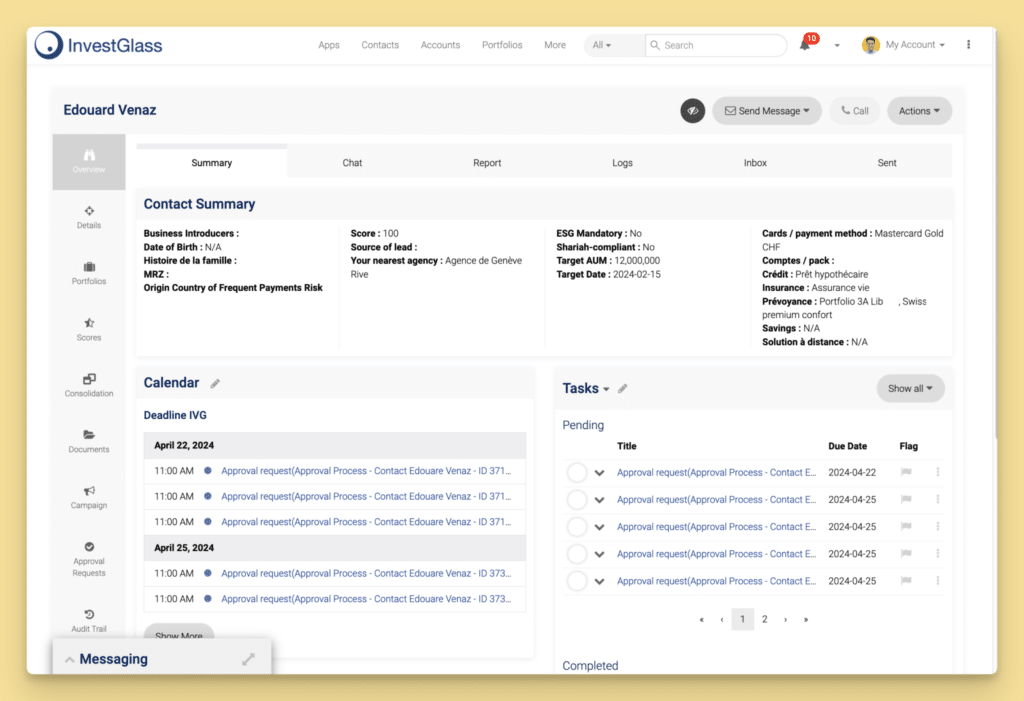
InvestGlass is a Swiss-based, cloud CRM solution for financial institutions designed for financial institutions, asset managers, wealth managers, insurance firms, and other regulated sectors. It combines standard CRM capabilities with compliance-focused workflows that many general-purpose tools do not provide out of the box.
InvestGlass supports contact management, sales force automation, lead management, pipeline management, documentation, onboarding, and relationship management as part of an all-in-one sales automation platform. It also adds regulated-industry features such as automated KYC verification and data capture, investor profiling, risk scoring, e-signatures, approvals, audit trails, and compliance checklists.
For financial firms, data residency is often a deciding factor. InvestGlass can host data in Switzerland or Europe, and it also offers deployment options for firms with strict privacy or sovereignty requirements. You can explore its compliance capabilities on the InvestGlass banking compliance software page.
Advisors and relationship managers can track portfolios, suitability, investor profiles, communications, documents, and service activity alongside traditional crm data. That means teams can manage customer relationships and regulatory duties in one place instead of switching between disconnected systems.
How to Choose the Right CRM Tool for Your Business
Before comparing vendors, define the business outcome. Do you want to increase win rate, shorten sales cycles, improve service quality, reduce churn, support business growth, or meet compliance obligations?
Use this checklist to choose the right crm solution:
- Map your needs
Identify the sales process, marketing campaigns, customer service workflows, and reports your team uses every day. Include both business to business and business to consumer requirements if you serve both markets. - Review must-have features
Decide whether you need cloud access, sales automation, campaign tools, service tickets, portfolio integrations, AI recommendations, or compliance templates. - Calculate total cost
Look beyond license fees. Include implementation, data migration, integrations, training, support, customization, and maintenance. - Check scalability
Your CRM should support more users, new regions, additional products, and more complex workflows over the next three to five years. - Prioritize adoption
Even powerful crm systems fail when users dislike them. Choose a clean interface, provide training, and keep early customizations minimal. - Evaluate security and compliance
Regulated firms should check encryption, access controls, audit logs, data residency, vendor certifications, and document controls, while specialized practices such as dental clinics might consider a CRM tailored for dental practices to meet sector-specific requirements. - Assess vendor fit
A generic CRM may work for simple needs. But if you operate in financial services or another regulated sector, a sector-focused crm database system like InvestGlass for private banks and financial firms may save time and reduce risk.
The best CRM is the one your team actually uses every day.
OFTE STILLEDE SPØRGSMÅL
Is CRM software only useful for large enterprises?
No. CRM systems are useful for freelancers, small businesses, mid-sized companies, and large enterprises. Cloud-based plans make it possible to start small and expand later.
Even a basic customer relationship management software setup can replace spreadsheets, improve follow-up, and help teams organize existing and potential customers from the first sale onward.
What is the difference between a CRM and a customer data platform (CDP)?
A CRM focuses on managing customer relationships, sales activity, service cases, and day-to-day relationship history. A CDP collects large volumes of behavioral and event data from websites, apps, ads, and other sources for advanced analytics and personalization.
Many companies use both. The CDP enriches the CRM with behavioral data, while the CRM remains the operating system for sales, service, and account management.
How long does it take to implement a CRM solution?
A simple out-of-the-box cloud CRM can be implemented in a few days. A complex deployment with data migration, integrations, custom workflows, permissions, and training can take several months.
Platforms like InvestGlass can accelerate deployment for regulated firms by offering prebuilt workflows, onboarding templates, and industry-specific compliance structures.
Kan et CRM-system hjælpe med at overholde lovgivningen?
Yes, although a CRM is not a complete compliance system by itself. It can support compliance by logging communications, approvals, document versions, consent records, and customer service interactions.
For example, regulated firms can store KYC/AML documentation, track onboarding tasks, and keep audit trails. Sector-focused platforms like InvestGlass add more compliance-oriented controls for financial and regulated businesses.
What are common mistakes when adopting CRM software?
The most common mistakes are choosing based only on brand, underestimating training, over-customizing before processes are clear, and ignoring data quality.
Duplicate records, incomplete fields, and inconsistent use can weaken the value of any CRM. Start with clear goals, simple workflows, clean customer data, and daily use by all relevant teams, and consider CRM systems built for therapists and healthcare practices when you operate in a specialized service environment.
Relaterede artikler
Swiss Sovereign CRM: Bygget på AI.
Klar til at handle.


