
A finance CRM system is purpose-built customer relationship management software designed for the specific demands of the financial services industry. Unlike generic CRM systems, a financial CRM addresses the regulatory complexity, long-term client relationships, and multi-product environments that define banking, insurance, wealth management, and advisory work. In 2026, with client expectations for always-on digital service continuing to rise, and regulators tightening requirements under frameworks such as GDPR, SEC, FINRA, and FCA rules, the case for specialised CRM for financial services has never been stronger.
This guide covers what financial advisors, compliance officers, and institutional leaders need to know. Here is what you will learn:
- What a finance CRM is and how it differs from generic alternatives
- Why financial professionals across all firm sizes need CRM software
- The key features buyers should prioritise in 2026
- How to evaluate, select, and implement a CRM for financial advisors
- Best practices for maximising return on investment
- Answers to the most common questions about CRM for financial services
What Is a Finance CRM System?
A finance CRM system is industry-specific CRM software built to manage client relationships, accounts, and regulatory workflows within financial services. It centralises contact details, account holdings, risk profiles, compliance documentation, and full communication history into a single platform. Financial CRM centralizes all client data into a single view, giving advisors and relationship managers immediate access to the information they need to serve clients effectively.
What separates a financial services CRM from a generic customer relationship management system is its support for domain-specific processes. This includes Know Your Customer and Anti-Money Laundering workflows, multi-account household mapping, assets under management tracking, audit trails, and document retention policies aligned with industry regulations. Generic platforms may handle basic contact management and opportunity pipelines, but they rarely provide the compliance and security infrastructure that the financial services sector requires.
Organisations using finance CRM systems span the full spectrum: registered investment advisors, broker-dealers, private banks, retail and commercial banks, credit unions, insurance carriers and agencies, wealth management firms, asset managers, and fintech lenders. In each case, the CRM stores and organises client information and customer data to support both operational efficiency and regulatory obligations.
- A finance CRM is CRM software tailored for regulated financial institutions
- It differs from generic CRMs through compliance, KYC/AML, and household support
- It centralises client data, financial data, and communication history in one system
- It serves organisations from solo advisors to large financial institutions
Why Financial Advisors and Firms Need CRM Software
Financial advisors spend a disproportionate share of their time on administrative tasks rather than advising clients. Fragmented client data across spreadsheets, email inboxes, and legacy systems creates inefficiency and risk. CRM software for financial advisors consolidates contact management, client data management, and document management into a single finance CRM platform, freeing advisors to focus on managing client relationships and delivering personalized financial advice.
The measurable benefits are compelling. CRMs in financial services enhance customer retention through personalized experiences. One mid-sized wealth management firm with 12 advisors reported client retention rising from 88% to 96% after deploying a finance CRM with household mapping and compliance automation, while revenue per advisor increased approximately 35%. Top CRM systems for the financial industry focus on deepening client relationships and enabling business growth through better data, faster onboarding, and stronger compliance audit readiness.

These outcomes apply across firm types. Solo financial advisors benefit from time savings on admin. Mid-size wealth management firms gain cross-sell visibility and retention improvements. Large financial institutions and financial services institutions achieve compliance efficiencies and operational cost reductions.
- Consolidates fragmented data into one client management platform
- Improves client retention through personalised, timely engagement
- Reduces onboarding time from days to hours
- Enables compliance readiness with built-in audit trails
- Drives business performance through better analytics and reporting tools
Core Features of Modern Finance CRM Systems
When evaluating a CRM for financial services, buyers should treat this section as a feature checklist. Key functionalities of financial CRMs include client engagement and compliance automation, but the right platform must go further to address the full scope of advisory, banking, or insurance workflows. Each feature should be designed for the regulated financial services industry, not bolted on as an afterthought.
- Håndtering af kontakter: Track individuals, households, trusts, and legal entities with full demographic and relationship data. Model multi-account structures that reflect real client portfolios.
- Client data management: Store risk tolerance, investment objectives, KYC results, income, net worth, and communication preferences in structured CRM records.
- Client engagement tools: Manage omnichannel communication, from email and SMS to secure portal messages, with full communication history logged automatically.
- Automatisering af arbejdsgange: Automate recurring tasks such as review reminders, onboarding steps, renewal notices, and compliance follow-ups.
- Compliance and security: Provide audit trails, consent tracking, encryption, role-based access, and support for regulatory requirements across jurisdictions.
- Reporting and analytics: Offer customisable dashboards covering AUM, pipeline, retention, and sales performance with drill-down capability.
- Håndtering af dokumenter: Securely store signed agreements, KYC forms, statements, and policy records with version control and e-signature integration.
- Integrationer: Connect to portfolio management systems, financial planning tools, core banking, accounting software, and marketing automation platforms.
Contact and Client Data Management in a Finance CRM
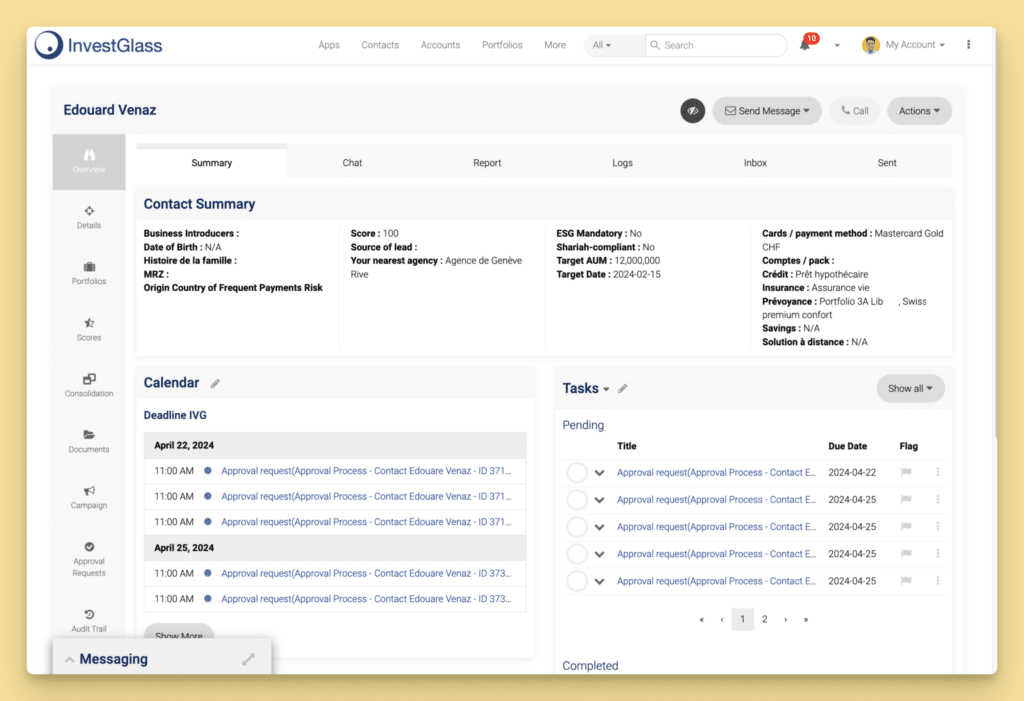
Accurate, unified client data is the foundation of any effective finance CRM. Without it, analytics are unreliable, compliance is at risk, and personalized service becomes guesswork. Financial CRMs provide a 360-degree view of the client by integrating data from various channels, whether that is email correspondence, portal activity, phone calls, or in-person meetings.
In practice, contact management means tracking individuals alongside households, joint accounts, trusts, and organisational entities. Each record includes demographic details, account holdings, risk profiles, investment objectives, and regulatory documentation. Advisors can pull a complete client profile before a review meeting, segment clients by AUM or life stage, and flag missing KYC documents, all from a single CRM platform.
Clean customer data is also essential for downstream analytics and personalized client engagement campaigns. A Salesforce Financial Services Cloud implementation at one advisory firm reduced duplicate records by approximately 47%, directly improving advisor trust in the system and enabling more precise client segmentation.
- Full household and entity relationship mapping
- Risk tolerance, investment objectives, and KYC status per client
- Segmentation by AUM, life stage, or product holdings
- Communication preferences and consent records
- Flagging of incomplete or outdated client information
- Clean data as the basis for analytics and personalized service
Client Engagement, Workflows, and Automation
Finance CRM systems turn static data into proactive client engagement. Rather than relying on advisors to remember follow-ups or compliance deadlines, automated workflows in CRMs reduce manual tasks for financial professionals by triggering actions based on events, dates, or data changes. Automated workflows streamline client onboarding and compliance tasks, reducing the time and effort required to bring new clients on board.
Workflow automation for financial advisors includes recurring review reminders, birthday and anniversary outreach, renewal notices for insurance policies, and follow-up tasks after meetings. Automated KYC verification workflows further accelerate digital onboarding while reinforcing compliance and fraud prevention. One finance advisory firm using Zoho CRM customisation reported a 30% reduction in onboarding time and freed up approximately 20% of advisors’ time through automation of reporting, appointment scheduling, and administrative tasks.
CRM systems enhance client engagement by centralizing customer data and enabling omnichannel outreach: email sequences, SMS alerts, secure portal messages, and phone call logging are all tracked within the CRM system. AI agents enhance productivity by automating routine tasks such as next-best-action suggestions, predictive churn scores, and lead scoring for prospects. In banking, agentic AI for fraud detection and CX demonstrates how autonomous decisioning can simultaneously strengthen security and improve customer experience. Deep personalisation in CRMs allows advisors to provide tailored financial advice based on client details, and 73% of financial leaders believe AI agents are critical by 2025. That figure has only grown since, with 73% of financial leaders seeing AI agents as strategically important to their competitive positioning.
- Automated review reminders and renewal notices
- Event-triggered onboarding and compliance workflows
- Omnichannel communication tracking within the CRM
- AI-driven next-best-action and churn prediction
- Measurable improvements in response times and follow-up rates
Compliance, Security, and Document Management
In the financial services sector, a CRM must support strict regulatory compliance rather than simply track sales activity. Data security and compliance are critical features of financial CRM systems, and any platform that treats them as secondary is unsuitable for regulated organisations.
Regulatory compliance is facilitated by maintaining accurate logs of all client interactions. This means storing audit trails of every call, email, meeting, and document exchange, logging consent, and retaining records for mandated timeframes under FINRA, SEC, FCA, MiFID II, and GDPR requirements where applicable. Automated compliance in financial CRMs minimises legal risks for institutions by enforcing consistent processes across teams and jurisdictions. A custom CRM deployment at one mid-sized financial services firm reduced compliance reporting time by approximately 60%.
Financial CRM includes advanced security features like data encryption in transit and at rest, multi-factor authentication, role-based access controls, IP allowlists, and certifications such as SOC 2 and ISO 27001. Document management capabilities include secure storage of statements, signed agreements, KYC forms, and policy records, with search, version control, and integration with e-signature tools. A compliance officer or auditor can reconstruct a client’s full history using the CRM’s interaction log and document archive, ensuring the organisation is always prepared for examination.
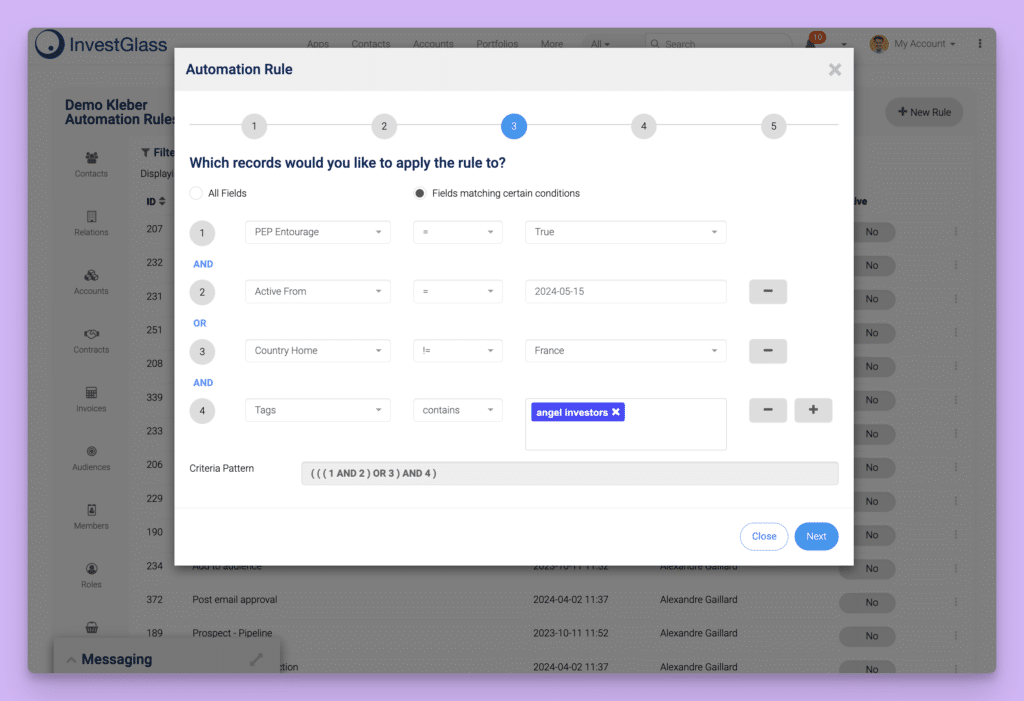
- Comprehensive audit trails for all client interactions
- Consent management aligned with GDPR, CCPA, and sector-specific rules
- Encryption, MFA, and role-based access as standard
- Secure document management with version control
- E-signature integration for agreements and onboarding documents
- Support for multi-jurisdiction regulatory requirements
Analytics, Reporting, and Performance Insights
Finance CRM software transforms raw client data into actionable insights for advisors and executives. Advanced reporting in financial CRMs helps identify client engagement and service effectiveness, enabling data-driven decisions rather than reliance on intuition or outdated spreadsheets.
Customisable dashboards provide real-time insights into sales performance, AUM by advisor, pipeline by stage, client acquisition cost, revenue per household, and service-level metrics such as response times and open cases. Financial CRMs can improve sales performance through real-time insights that highlight which segments are growing, which clients are at risk, and where cross-sell opportunities exist. Efficient tracking of client interactions enhances overall service delivery in financial institutions, with industry data showing cross-sell revenue lifts of approximately 28% among firms using CRM analytics effectively.
Modern CRM systems may incorporate AI to forecast revenue, predict churn, and highlight upsell opportunities based on existing customer data and client behavior patterns.
- AUM by advisor and revenue per household
- Pipeline by stage and client acquisition cost
- Response time and open case metrics
- Churn prediction and cross-sell opportunity scoring
- Campaign ROI by client segment
Integrating Finance CRM with Other Financial Tools
CRM systems in finance must sit at the centre of a broader technology stack rather than operate in isolation. Choose a CRM that integrates with existing financial tools, as disconnected systems create data silos, duplicate entry, and errors that undermine both efficiency and compliance.
Microsoft Dynamics 365 Finance and Operations integrates CRM and ERP functionalities, making it a strong choice for large financial institutions that require unified operational and relationship management. Northern Trust’s migration of over 17,000 client accounts to Microsoft Dynamics 365 achieved a 30% reduction in repetitive manual processes by connecting sales and operations workflows. Similarly, platforms such as InvestGlass CRM til private banker offer digital onboarding, portfolio management, and marketing automation tailored to financial institutions. Meanwhile, firms using FactSet data feeds to enrich CRM profiles have improved cross-sell discovery and advisor productivity.
Integration eliminates duplicate data entry, syncs balances and holdings into client profiles, and triggers workflows based on real-time account changes. For example, a CRM can automatically create tasks when a client’s portfolio deviates from its target allocation, or sync signed documents from e-signature tools into document management.
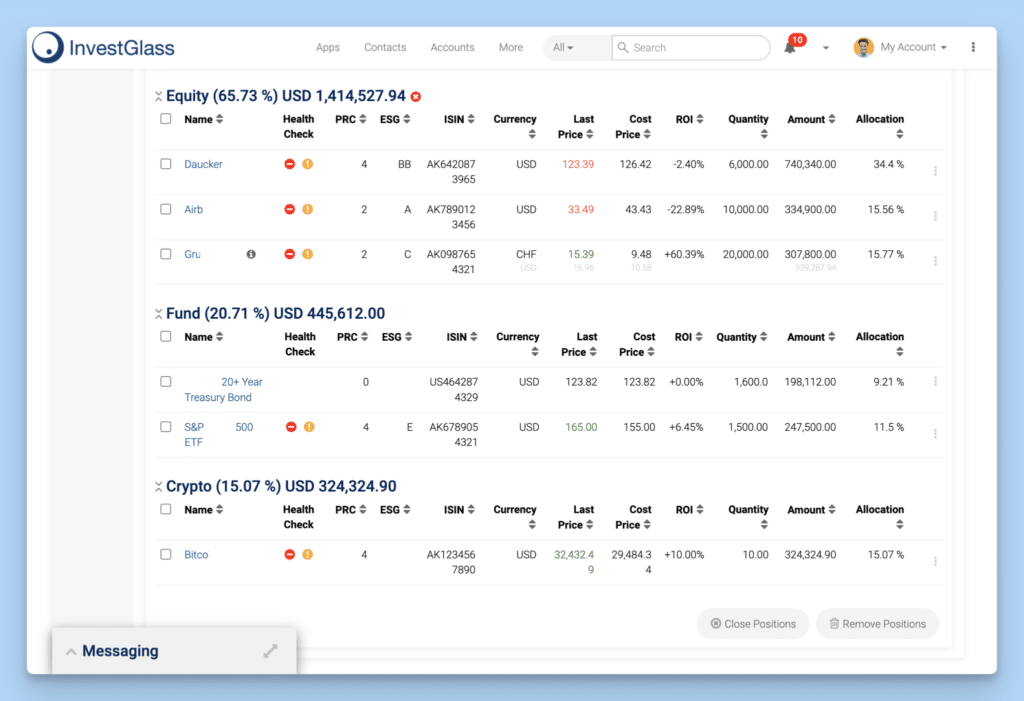
- Portfolio management platforms and portfolio management systems
- Financial planning tools and financial planning software
- Core banking and lending systems
- Trading and order management platforms
- Regnskabssoftware
- Marketing automation platforms
- Identity verification and e-signature services
Finance CRM for Different Types of Financial Services Firms
CRM for financial services must adapt to different business models and regulatory environments. The priorities of an independent advisor differ substantially from those of a retail bank or an insurance carrier.
Independent financial advisors and small RIAs prioritise ease of use, efficient client onboarding, and basic compliance. Budget constraints often lead them to platforms such as Wealthbox CRM, which is designed specifically for financial advisors and wealth management, or Zoho CRM, which offers a customisable solution for small to medium-sized financial firms. Other firms consider Swiss-made platforms like InvestGlass finance CRM that combine digital onboarding, portfolio management, and marketing automation. Salesforce Financial Services Cloud is tailored for financial services firms of all sizes, holding approximately 38% market share in financial services CRM.
Wealth management firms with multiple advisors need advanced household mapping, analytics, personalized client engagement, and robust reporting tools. Retail and commercial banks require integration with core banking, lending workflows, KYC at scale, and multi-product cross-sell capabilities. Insurance agencies focus on policy lifecycle management, claims data, renewal automation, and agent workflows. Fintech lenders emphasise digital onboarding, identity verification, and speed, with regulatory compliance around AML and KYC remaining non-negotiable. Central banks and regulators are likewise exploring how AI can support monetary policy, digital currencies, and supervisory oversight, with platforms such as InvestGlass for central banking AI integration highlighting secure, compliant deployment models.
- Advisors: client engagement, financial planning, streamline operations
Beyond traditional finance, specialised CRMs extend these principles into verticals such as healthcare, where solutions like InvestGlass CRM for tandklinikker apply digital onboarding, workflow automation, and compliant data handling to patient relationship management.
- Wealth managers: analytics, household mapping, account management
- Banks: KYC, lending, cross-sell, manage customer data at scale
- Insurers: policy lifecycle, claims, renewals
- Fintechs: digital onboarding, automation, secure data handling
How to Choose the Right Finance CRM
Choosing the right CRM solution is a strategic decision affecting compliance management, operational efficiency, and client satisfaction for years to come. Evaluate your current business needs before selecting a CRM, and resist the temptation to default to the most well-known brand without assessing fit.
Begin by clarifying objectives. Is the priority better client engagement, faster client onboarding, improved reporting, or stronger compliance? Map existing workflows and identify where current systems fall short. Then shortlist vendors with proven capability in the financial services industry, run demonstrations using real scenarios, check references, and pilot with a small team before committing to a full rollout.
- Industry specialisation: does the CRM platform support financial services workflows natively?
- User friendly interface: will advisors and customer service representatives actually adopt it?
- Scalability: can it grow with your firm’s AUM, headcount, and product range?
- Compliance and security: does it meet your regulatory requirements across jurisdictions?
- Integration: does it connect with your portfolio management, financial planning tools, and accounting software?
- Customisation: can workflows and fields be adapted without excessive technical debt?
- Total cost of ownership: include licensing, migration, training, and ongoing maintenance
- Vendor track record: review case studies and references from similar financial services firms
Implementing a Finance CRM: Step by Step
Implementation is a phased project, not simply a software installation. The most common source of failure is neglecting change management. If financial advisors and operations teams do not see the CRM as an enabling tool, user adoption will stall regardless of feature quality.
A structured approach reduces risk and accelerates time to value. Involve compliance and legal teams early. Appoint an internal CRM champion. Design workflows and fields around real advisory and banking processes rather than copying generic CRM templates.
- Discovery and requirements: Define goals, map workflows, identify regulatory needs
- Data audit and cleanup: Inventory all systems, deduplicate records, standardise formats
- Configuration and customisation: Build household structures, compliance workflows, dashboards
- Integration: Connect to portfolio management, financial planning software, core banking, and other financial tools
- Migration: Move cleaned data into the new CRM with validation checks
- Træning: Run hands-on sessions for advisors, compliance, and operations staff
- Go-live and optimisation: Launch with a pilot group, monitor adoption KPIs, refine based on feedback
Best Practices to Maximise ROI from Finance CRM Systems
Purchasing CRM software is only the first step. Real value comes from consistent, thoughtful usage that improves client management, enhances customer service, and supports business growth over time.
- Maintain accurate client data by enforcing data standards and periodic reviews
- Standardise note-taking, tagging, and task completion across all advisors
- Review and refine automation rules quarterly to reflect changing market trends and client needs
- Involve compliance teams before modifying workflows to improve client management
- Schedule routine training refreshers, particularly when new features or AI capabilities are introduced
- Set clear KPIs: increase in client meetings per month, reduction in onboarding time, higher cross-sell rate, improved client satisfaction scores
- Measure business performance outcomes, not just system usage metrics
FAQs About Finance CRM and CRM for Financial Advisors
What is CRM software for financial advisors and how is it different from generic CRM? CRM for financial advisors is a customer relationship management system built to handle the regulatory, compliance, and relationship complexity of financial services. It includes household mapping, KYC/AML workflows, audit trails, and portfolio views that generic CRM systems do not offer. It is designed to improve client management and deliver personalized services within a regulated environment.
How does a finance CRM improve client engagement and retention? A financial CRM enables personalized client engagement by centralising all customer interactions, preferences, and account data. Advisors can manage client interactions more effectively, trigger timely outreach, and deliver personalized service that strengthens strong client relationships. Firms consistently report retention improvements of 8 to 10 percentage points after deployment.
Can a CRM help with regulatory compliance and audit preparation? Yes. Finance CRM systems log all client interactions, store consent records, and maintain audit trails required by regulators. This supports compliance management across FINRA, SEC, FCA, and GDPR requirements. Financial services institutions can reconstruct any client’s history on demand during an examination.
Is a finance CRM suitable for small advisory firms or solo financial advisors? Absolutely. Platforms such as Wealthbox and Zoho CRM are priced and designed for smaller firms. Even solo advisors benefit from consolidating client information, automating follow-ups, and maintaining compliance documentation without dedicated support staff.
How does document management work inside a finance CRM system? Finance CRM systems provide secure storage for signed agreements, KYC documents, statements, and policy records. Documents are indexed, version-controlled, and searchable. Integration with e-signature tools means documents flow directly into the CRM without manual filing.
How long does it typically take to implement a CRM for financial services? Implementation timelines vary. A smaller advisory firm may be operational within four to eight weeks. Mid-sized wealth management firms typically require three to six months. Large financial institutions with complex integrations and data migration may need six to twelve months, including pilot phases.
Conclusion: Future-Proofing Financial Services with Finance CRM
Finance CRM systems have become the operational backbone for managing client data, ensuring compliance, and driving client engagement across the financial services industry. Sales of bank CRM software reached $9.5 billion in 2021, and CRM software for finance is projected to grow to $39.2 billion by 2031, reflecting how central these platforms have become to every segment of the sector. With CRM adoption in financial services now at approximately 94%, the question is no longer whether to adopt, but whether your current CRM capabilities are fit for purpose.
The direction ahead is clear. AI-driven automation, tighter data privacy rules, and rising client expectations for digital, personalised experiences will continue to reshape what financial services firms require from their CRM platform. Organisations that invest in a specialised financial services CRM, rather than adapting a generic tool, position themselves to enhance client relationships, streamline operations, and meet evolving regulatory requirements with confidence.
Audit your current CRM systems against the feature checklist and evaluation criteria outlined in this guide. Identify where gaps in compliance management, client data management, or workflow automation are holding your firm back. Then take the practical step of piloting a modern finance CRM that aligns with your organisation’s strategy, client base, and growth ambitions.


