
Digital asset firms face challenges that no generic tool was designed to handle. A crypto CRM solves this by combining customer relationship management with wallet tracking, compliance workflows, and on-chain analytics in a single platform.
What Is Crypto CRM?
CRM stands for customer relationship management, a system for managing company interactions with customers and prospects. At its core, a CRM system is essentially a contacts database that helps businesses automate tasks and manage contact data. A crypto CRM takes this foundation and extends it for digital asset firms, including exchanges, brokers, OTC desks, funds, and DeFi or NFT projects.
Where a generic crm today handles email and phone touchpoints, crypto CRM systems track digital asset transactions and investor privacy alongside traditional records. They connect wallet addresses, KYC documentation, trading activity, and on-chain interactions into a unified view. The first crypto-specific CRMs were created around 2017 and 2018, when institutional interest in bitcoin and similar coins drove demand for bespoke tools. By 2026, these platforms have matured into compliance-first, data-rich systems that organisations can deploy with confidence.
This post covers practical benefits, concrete use cases, and how to choose and implement the right solution. It is worth noting that the ticker “CRM” also refer to Crypto Rug Muncher, a token traded on decentralised exchanges. Crypto Rug Muncher has a market cap of $6,128.14, with 1 billion Crypto Rug Muncher tokens tradable today. Meteora DAMM V2 is the most popular exchange for CRM, and the most active trading pair is CRM/SOL with $1,906.03 volume. The trading volume of Crypto Rug Muncher is $1,905.23 in 24 hours, an increase of 26.80% from the previous day. In the last 24 hours, there were 51 buying addresses for CRM, with inflow of $1,187 and outflow of $603. That token should not be confused with the CRM software category discussed here.
Why Customer Relationship Management Matters in Crypto
Traditional customer relationship management concepts, such as customer interaction tracking and centralised records, are just as relevant in crypto as in banking or insurance. A CRM records customer and prospect interactions in a central database, making it easier to organise customer information and engagement activities. Benefits of CRM include improved customer service and increased sales, both of which matter in a market defined by price volatility and regulatory pressure.
Hyper-volatile markets mean that timely, data-driven communication with clients is not optional. When bitcoin swings 15% in a day, people expect real time updates, not a delayed email. Meanwhile, fragmented data across wallets, exchanges, Telegram, and Discord makes manual tracking impossible at scale. CRM tools help streamline the customer engagement process across these channels.
Since 2020, regulatory pressure from MiCA in the EU, FCA rules in the UK, and FATF travel rule implementation has forced crypto businesses to document client interactions with the highest rigour. Past collapses, including FTX in 2022, burned trust and made transparency a baseline expectation. CRM systems are used to document and track relationships and interactions, which is precisely what regulators now demand. A modern crypto CRM combines sales pipeline management with compliance, risk, and on-chain analytics.
Core Features of a Modern Crypto CRM
Every serious crypto CRM should include the following core modules:
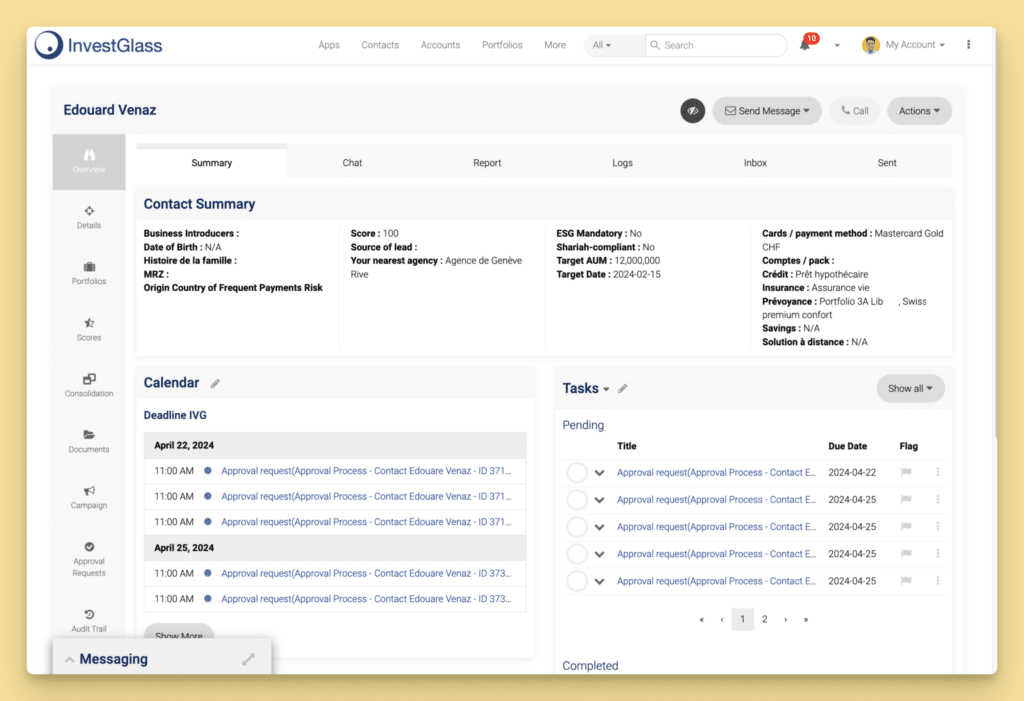
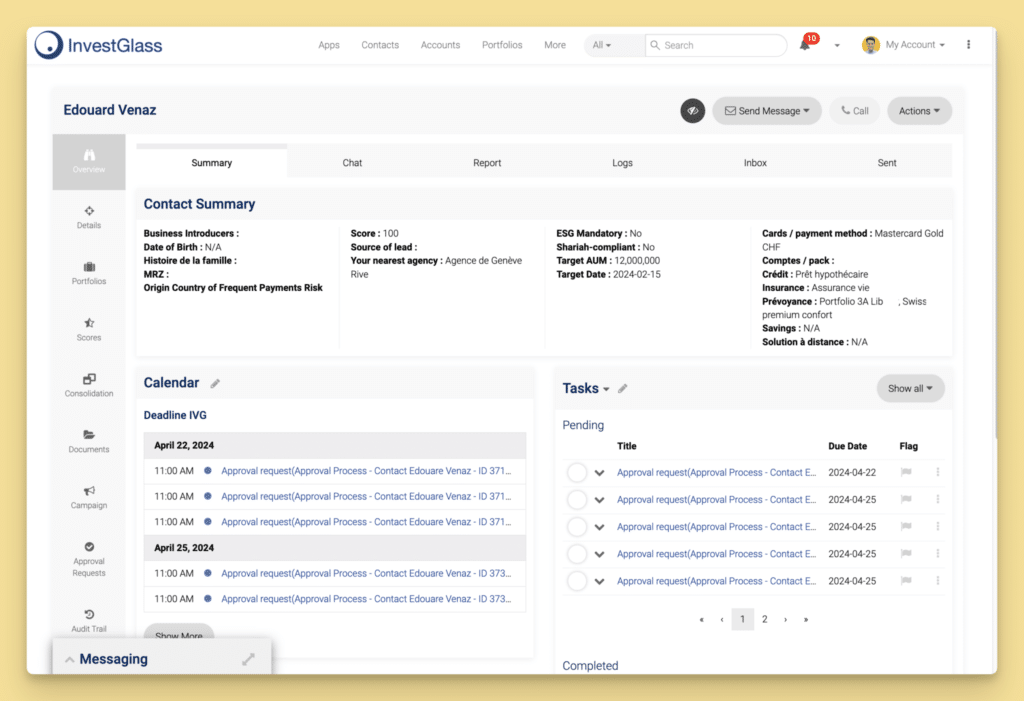
- Unified client profile. Link KYC data, legal entities, multiple wallets, exchange accounts, custom fields, and support tickets into a single 360-degree view. A CRM such as InvestGlass, a Swiss-designed financial services CRM, can optimise data use and improve customer engagement when all details sit in one place. InvestGlass、営業自動化のためのスイス製オールインワン・プラットフォーム stands out by offering a fully customisable platform tailored to financial and crypto businesses, integrating compliance workflows, portfolio management, and communication tools seamlessly.
- Communication tracking. Email, phone, in-app chat, Telegram, and Discord integrations, plus automated notifications tied to trading or on-chain events.
- Sales pipeline and deal management. Stages from prospecting to funded account, with source attribution, expected AUM, and conversion metrics for your dedicated team.
- Trading and portfolio visibility. Real time and historical overview of client holdings, profit and loss, turnover, and leverage usage.
- Workflow automation. Trigger compliance checks, reminders, and marketing automation sequences when specific thresholds or events occur.
- Reporting and dashboards. Customisable views for management, sales, and compliance teams. User authentication is a key feature, ensuring only authorised staff read sensitive data. Crypto CRM platforms can scale with your business needs, and multi-language capabilities support diverse users across jurisdictions.
Compliance, KYC, and AML in Crypto CRM
Compliance is the main differentiator between generic CRM and crypto CRM. Crypto CRMs automate compliance with regulations such as KYC and AML, embedding these checks directly into onboarding and ongoing monitoring.
Digital onboarding flows integrate with providers for ID verification, proof of address, corporate documents, and beneficial owner structures. Automated KYC verification workflows reduce friction and speed up onboarding without compromising compliance. Third-party tools supply sanctions list screening, PEP checks, and adverse media monitoring. MistTrack by SlowMist, for example, screens over 400 million labelled addresses across 19 blockchains, while Blockpass serves more than 3,000 crypto businesses.
Blockchain securely stores certified information for CRM systems, and blockchain technology prevents corruption and duplication of CRM data. This provides military-level anti-tampering security for data, which enhances customer privacy and records security in CRM. Crypto CRM systems enhance customer privacy and records security through immutable audit trails, logging who changed what and when. Configurable risk scoring adjusts automatically when new data or on-chain activity appears, giving compliance teams the control they need as regulations evolve, including MiCA, FIDLEG, and travel rule requirements.
How Crypto CRM Integrates On-Chain and Off-Chain Data
A crypto CRM must bridge blockchain data with traditional customer data to deliver a complete picture.
- Wallet tracking. Connect client wallets across bitcoin, Ethereum, Solana, and similar coins networks. Continuously sync balances and transactions to maintain accurate profiles. Insiders who utilise chain analytics tools can check wallet associations with known risky addresses.
- On-chain analytics. Flag high-risk counterparties, mixers, and wallets associated with hacks or sanctioned entities using the latest data from providers such as KYC-Chain, which offers 270+ risk indicators.
- Custodian and infrastructure integrations. Connect to custody providers, MPC wallets, and fiat-to-crypto gateways to pull positions and transaction histories.
- Market data feeds. Enrich the CRM with live prices, margin requirements, and liquidation risk from exchanges.
- Reconciliation workflows. Match on-chain transfers with internal ledger entries and signed agreements. Smart contracts can eliminate friction in CRM transactions by automating settlement steps.
Use Cases by Crypto Business Type
Rather than theory, here are concrete, role-based examples:
ビジネスタイプ | Key CRM Functions |
|---|---|
Centralised exchanges and brokers | Retail and professional client onboarding, promotions, high-value client programmes, fee tiering |
OTC desks and market makers | Track RFQs, bilateral deals, voice trades, counterparty credit limits, settlement reconciliation |
Crypto funds and asset managers | Fundraising pipeline, LP onboarding, capital calls, NAV reporting, investor relations history |
Web3 and DeFi projects | Community contributors, governance token holders, cross-channel communication via Discord, X, email |
B2B infrastructure providers | Complex sales cycles, partner onboarding, compliance with institutional clients deployed since around 2020 |
Interested organisations across each category benefit from a CRM that can store, process, and share information across departments while keeping records clean and secure. |
How Crypto CRM Enhances Customer Experience and Retention
Structured data leads to better, more personalised client service. Segmentation based on trading volume, asset preference, risk profile, and geography enables tailored communication. Automated alerts for margin calls, product updates for derivatives users, or educational campaigns for first-time investors all improve engagement.
Proactive support matters: CRM signals such as declining activity or frequent withdrawals can trigger retention outreach and risk checks. Self-service portals allow clients to upload documents, add information, check ticket status, and view compliance status directly. The result is lower churn, higher lifetime value, and improved conversion from lead to funded account. These are the cream of measurable KPIs for any crypto company, just as 歯科医院向け専門CRMソリューション track operational and patient-care metrics in other regulated service industries.
Implementing a Crypto CRM: Steps and Best Practices
Successful implementation matters more than any feature listed on a vendor’s website.
- Assessment. Map current tools, data silos, and regulatory requirements. Identify what resources are required for each jurisdiction served.
- Vendor selection. Evaluate data residency, security certifications, crypto-native integrations, and roadmap alignment. Prioritise organisations offering Swiss or EU hosting for data sovereignty. Platforms like InvestGlass, a Swiss CRM for financial services sales and marketing provide strong compliance features and Swiss hosting, making them ideal for regulated crypto firms.
- Data migration. Clean legacy client records, merge duplicates, and import historical KYC and trading data. Ensure removed or outdated records are handled in line with GDPR.
- Role-based access control. Define who can view what. Apply least-privilege principles so that sales, compliance, and support each see only what they need.
- Training and change management. Run workshops and establish clear process documentation. Measure adoption over the first three to six months.
- Continuous improvement. Review workflows, automation rules, and compliance logic quarterly as regulations and market changes demand updates.
Crypto CRM vs Traditional CRM Platforms
Many firms try to extend a generic CRM but quickly hit limitations. Crypto CRM offers native support for wallets, on-chain analytics, KYC and AML modules, and trading integrations out of the box. Traditional systems lack crypto-specific data models, have no direct integrations with exchanges or custodians, and require heavy custom development.
The total cost of ownership for custom-built layers on top of generic platforms often becomes higher than a specialised crypto CRM. Scalability is another concern: traditional systems struggle to store high-frequency trading or blockchain data at scale. A hybrid approach can still make sense for broad marketing automation, but the regulated client core, including investments, compliance, and risk monitoring, belongs in a purpose-built crypto CRM. Organisations that buy into this architecture gain efficiency and reduce technical debt over the years.
Future of Crypto CRM and Customer Relationship Management
Looking ahead, regulatory milestones such as full MiCA implementation across the EU and maturing travel rule infrastructure will raise the compliance bar further. CRM platforms must adapt or risk becoming obstacles rather than enablers.
AI is set to play a larger role: predictive churn models, anomaly detection in trading patterns, and automated client communication tailored to risk and behaviour will become standard. Deeper blockchain integration, including verifiable credentials and on-chain attestations, will let organisations selectively share KYC data without exposing sensitive details to every counterparty. Cross-asset convergence is another trend, as crypto CRM evolves into platforms handling tokenised securities, real-world assets, and traditional products together, similar to how specialised CRM platforms for therapists unify client data and workflows in another compliance-heavy environment. The supply of public blockchain data will only grow, and the analytics built on top of it will define competitive advantage.
Crypto CRM is no longer a niche project. It is becoming the operational backbone for serious digital asset businesses, the place where compliance, sales, and client service converge. Organisations that invest in the right platform now will be well positioned for the regulatory and market shifts ahead. The time to assess your current systems and plan your next step is now.
よくある質問 (FAQ)
Q1: What distinguishes a crypto CRM from a traditional CRM?
A crypto CRM is specifically designed to handle digital asset transactions, investor privacy, and regulatory compliance in the cryptocurrency industry. It integrates wallet tracking, on-chain analytics, and compliance workflows, unlike traditional CRMs that focus on general customer interaction management.
Q2: How does blockchain technology enhance crypto CRM systems?
Blockchain provides a secure, tamper-proof ledger that prevents data corruption and duplication. It enhances customer privacy and records security by storing certified information with military-level anti-tampering protection, making crypto CRM data more reliable and transparent.
Q3: Can crypto CRM systems automate compliance requirements?
Yes, crypto CRMs automate key compliance processes such as KYC (Know Your Customer) and AML (Anti-Money Laundering) by integrating identity verification, sanctions screening, and risk scoring directly into onboarding and ongoing monitoring workflows.
Q4: What types of crypto businesses benefit most from using a crypto CRM?
Centralised exchanges, OTC desks, crypto funds, DeFi projects, and B2B infrastructure providers benefit significantly from crypto CRM systems due to their need for compliance, customer engagement, and complex transaction tracking.
Q5: How does a crypto CRM improve customer experience?
By consolidating client data into unified profiles, enabling real-time communication, and automating alerts tailored to customer behavior and risk, crypto CRMs deliver personalized service that increases retention and customer lifetime value.
結論
Crypto CRM systems have evolved into indispensable tools for digital asset businesses navigating complex regulatory landscapes and volatile markets. By combining traditional customer relationship management with blockchain integration, compliance automation, and on-chain analytics, these platforms provide a comprehensive, secure, and scalable solution tailored to the unique demands of the crypto industry. As regulatory frameworks mature and technology advances, investing in a specialized crypto CRM will be crucial for organizations aiming to enhance customer engagement, ensure compliance, and maintain competitive advantage. The future of customer relationship management in crypto is here—embrace it to stay ahead in this dynamic ecosystem.


