
Choosing the right CRM for your wealth management firm is a critical technology decision. Selecting a crm solution is essential for any advisory firm, as it serves as the backbone for managing client relationships, ensuring compliance, and supporting business growth. It is important to choose a crm designed specifically for wealth management, offering specialized features and integrations tailored to financial professionals. This guide will help advisory firms of all sizes, from small practices to large enterprises, identify the best CRM solutions to manage their business effectively. In an industry where client relationships last for decades and regulatory oversight is increasingly stringent, your CRM platform must do much more than just store contact details. This guide covers all essential evaluation criteria, from fundamental features and compliance workflows to data sovereignty and the total cost of ownership.
要点
- In 2025, wealth management firms require a CRM that integrates client relationship management, portfolio data, and compliance within a single platform. Generic systems often need significant customization to meet the demands of regulated financial services.
- The primary decision is whether to opt for a generic CRM or a wealth management–specific solution like InvestGlass, which includes onboarding, KYC, portfolio, and compliance workflows out of the box. When evaluating the best CRM for financial advisors, focus on industry-specific features that support client management, regulatory compliance, and operational efficiency.
- Data residency and privacy have become strategic priorities, especially for European and Swiss institutions seeking Swiss data hosting and sovereignty to satisfy regulators and clients.
- The ideal CRM must integrate with your core banking or portfolio management systems, automate KYC and suitability reviews, and support record-keeping compliant with MiFID II, FINMA, and SEC regulations, complete with audit trails. Security features and compliance tools are essential evaluation criteria to ensure client data protection and regulatory adherence.
- It is advisable to test two or three shortlisted CRMs using actual client journeys before committing to a multi-year contract, ensuring the platform aligns with real workflows rather than just feature lists.
CRM入門
Customer Relationship Management (CRM) systems are indispensable in financial services, particularly for advisors aiming to provide exceptional client service and manage their practices effectively. A financial advisor CRM or financial advisor CRM software is designed to simplify client management and streamline client communication by centralizing and automating emails, calls, meetings, and other interactions. At its essence, a CRM centralizes and organizes client information, facilitating the tracking of interactions, relationship management, and daily operational efficiency. CRMs help advisors monitor clients’ financial goals, enabling tailored and strategic advice. Modern CRMs extend beyond basic contact management by offering comprehensive communication tracking, task automation, and insights to support informed decision-making. Properly implemented, a CRM empowers advisors to strengthen client relationships, enhance operational workflows, and foster growth in a competitive market, with an intuitive interface being crucial for effective CRM adoption and daily use.
ファイナンシャル・アドバイザーがCRMを利用するメリット
Deploying a CRM offers numerous benefits that enhance client satisfaction and business development. By consolidating client data, advisors gain a holistic view of each client’s goals, preferences, and history, facilitating personalized advice. CRMs also help advisors analyze their client base to identify growth opportunities, allowing for more targeted marketing strategies and improved client management. Tracking all client interactions, meetings, calls, emails, ensures no detail is missed and every engagement opportunity is captured. CRMs automate workflows such as timely follow-ups and portfolio review scheduling, freeing advisors to focus on financial guidance.
Additionally, CRM analytics and reporting tools help identify opportunities for business expansion by providing insights through customizable dashboards and reports. These tools enable advisors to recognize potential areas for growth, upselling, or cross-selling within client relationships. Securely storing all client data enables quick analysis of relationships and interactions, leading to better decisions and improved service quality.
ウェルス・マネジメントCRMと一般的なCRMの違い
A wealth management CRM is tailored to manage the intricate relationships, regulatory requirements, and investment activities unique to financial services. It is crucial to select a CRM that addresses the specific business needs of wealth management firms, ensuring that the platform is designed for the detailed demands of financial advisory practices. Unlike generic platforms like HubSpot or customized Salesforce deployments, specialized wealth management CRMs recognize that clients are complex entities involving households, trusts, corporate bodies, and beneficial owners. These platforms offer features and integrations specifically designed for financial professionals, including compliance tracking, portfolio management, and seamless financial planning tool integration.
Such CRMs provide advisors with integrated tools to track client interactions efficiently, consolidating communication history and enhancing personalized service. They link household structures, multiple portfolios, legal entities, and beneficial owners within a single client view. When accessing a client record, advisors see a comprehensive picture encompassing primary account holders, spouses, children, trusts, holding companies, and connected accounts across custodians.
Key data handled out of the box includes:
データカテゴリー | 例 |
|---|---|
リスクプロファイル | 保守的、中庸、積極的な評価と年代別評価 |
適性アンケート | コンプライアンス遵守のため、回答は保存され、バージョン管理される |
投資義務 | Discretionary, advisory, execution-only flags |
課税状況 | 米国人のステータス、税務上の居住申告 |
PEPと制裁 | 政治的暴露を受けた人物のフラグ、審査結果 |
ESGの嗜好 | 持続可能な投資の要件と除外 |
A specialist CRM supports typical private banking lifecycle stages, from prospecting and onboarding through advisory or discretionary mandate management to client exit or transfer, each with distinct workflows, documentation, and compliance checkpoints. |
Leading platforms like インベストガラス integrate CRM, digital onboarding, KYC, portfolio views, and client portals in one system, avoiding the complexities of multiple disconnected tools by operating from a unified client data foundation. These solutions offer comprehensive features and scalability to support business growth.
CRMの機能を比較する前に会社の目標を明確にする
Before engaging vendors, clearly outline measurable objectives your CRM must help achieve. These should be specific, time-bound, and linked to business outcomes over the next 12 to 24 months.
成長目標 Set targets like increasing assets under management by 20% by end of 2026 or doubling active client relationships per advisor. A scalable CRM aids in identifying growth opportunities and tracking progress through pipeline analytics and relationship scoring.
業務効率化目標 Specify improvements such as reducing onboarding time from 10 to 3 business days or cutting manual KYC data entry by 50%. These metrics determine whether the CRM delivers genuine time savings or merely adds complexity.
顧客経験目標 Modern clients expect digital engagement. Define goals like launching a secure client portal with portfolio reporting, messaging, and document delivery by a certain quarter. This transforms client interactions into ongoing digital relationships. The CRM should also enable tracking and managing each client’s financial goals to support tailored strategies and personalized advice.
コンプライアンスとリスク管理の目標 Require full audit trails for recommendations and communications to satisfy audits and regulators. Compliance documentation should be automated, not an afterthought.
These goals will guide your CRM selection criteria and feature prioritization, helping avoid decisions based solely on demos rather than actual fit.
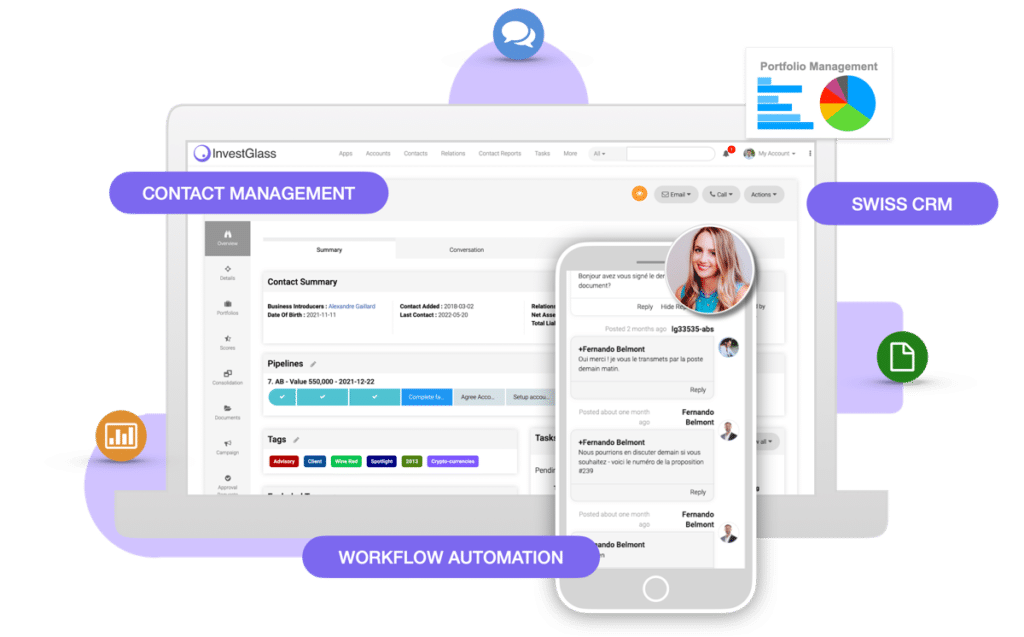
データ・プライバシー、規制当局の期待、データ・レジデンシー
Data sovereignty is particularly critical in wealth management due to the sensitivity of high-net-worth client information. Regulations like the EU GDPR, Swiss Federal Act on Data Protection (FADP) 2023 revision, and cross-border banking rules impose strict controls on data storage locations and handling.
There is a notable difference between public cloud hosting outside Europe and sovereign hosting within Switzerland or on-premises. Many private banks and family offices prefer Swiss data centers because Swiss law offers privacy protections exceeding GDPR. Data stored in Switzerland cannot be accessed by foreign authorities without Swiss legal procedures.
Regulators such as FINMA, FCA, and CSSF require:
必要条件 | 説明 |
|---|---|
記録の保持 | Minimum storage periods for communications and documents (often 10 years) |
アクセス・コントロール | Role-based permissions with documented approvals |
静止時の暗号化 | Data encrypted using approved standards |
詳細な監査ログ | All access, changes, and exports tracked with timestamps |
Some global CRM providers host data in US-based infrastructure, complicating compliance for European wealth managers under GDPR and Swiss banking secrecy. Platforms like プライベートバンク向けInvestGlass CRM offer Swiss-hosted or on-premise CRM options, granting full data jurisdiction control. |
For firms operating across multiple booking centers (Zurich, Geneva, Luxembourg, Singapore, Dubai), data segregation between legal entities is essential. The CRM must support logical or physical data separation while allowing legally permissible information sharing.
Compliance officers should perform due diligence on shortlisted CRMs, reviewing data protection agreements, encryption standards, and recent penetration test reports.
ウェルス・マネジメントCRMがカバーすべきコア機能
Beyond contact management, top wealth management CRMs support workflows from prospecting to reporting and reviews, addressing regulated wealth contexts. These platforms often feature automated workflows that streamline repetitive tasks such as client onboarding, task management, compliance monitoring, and portfolio rebalancing, enhancing operational efficiency and client service.
顧客と世帯のデータ管理 Manage multi-level relationships including corporate structures, trusts, foundations, and family offices. Advisors can view connections between individuals, entities, and portfolios from one screen.
インタラクション・トラッキング Capture all touchpoints across email, voice, meetings, and secure portal messages. Automatic logging builds a complete communication history for relationship management and compliance.
タスクとアクティビティ管理 Manage tasks effectively among relationship managers, assistants, and compliance officers. Features include calendars, review reminders, document expiry alerts, and assignment workflows to prevent oversights.
ワークフローの自動化 Automated workflows help automate repetitive tasks like prospect nurturing, onboarding checklists, annual KYC refreshes, suitability reminders, and portfolio review scheduling. This automation frees advisors to focus on client engagement.
分析・レポートツール Dashboards tailored for management, front office, and compliance teams monitor pipeline, assets under management, revenue by segment, and advisor productivity. Custom reports measure business-critical metrics, and AI-driven analytics can further enhance effective portfolio management using AI.
デジタル・オンボーディング、KYC、コンプライアンス・ワークフロー
From 2024 onward, remote client onboarding, secure document upload, and e-signature are standard expectations. Paper forms and mail are becoming obsolete except in traditional institutions.
デジタル・オンボーディング・フォーム Modern platforms collect personal data, tax residency, source of wealth, investor profile, and product knowledge via guided flows. InvestGlass supports branded custom forms for seamless client experiences.
自動KYCチェック Integration with sanctions screening, PEP detection, and adverse media flag providers automates compliance during onboarding. Results are stored, timestamped, and linked to client files for audit.
コンプライアンス承認ワークフロー Steps for compliance approval, four-eyes checks, relationship manager validation, and account opening are timestamped and logged, creating audit trails.
定期審査プロセス High-risk clients require annual KYC refresh; standard-risk clients may be reviewed every 2-3 years. The CRM triggers reviews, assigns tasks, and tracks completion.
Using a CRM like InvestGlass with native onboarding, KYC, suitability questionnaires, and document management avoids risks from fragmented applications.
ポートフォリオ管理と顧客ポータルの統合
Advisors need immediate access to holdings, performance, and risk exposure within the CRM during client interactions. Switching between systems wastes time and risks errors.
Integration with portfolio management or core banking platforms lets the CRM display balances, transactions, model portfolios, and performance history. Advisors see financial planning tools alongside relationship data, enabling informed conversations.
CRMs integrated with financial planning software streamline workflows and data management, facilitating comprehensive advice.
顧客ポータル Secure portals allow investors to access portfolios, sign documents, view reports, and exchange messages via web or app. This shifts engagement from occasional meetings to continuous digital interaction.
Platforms like InvestGlass combine CRM and portfolio views in one system, eliminating complex third-party connectors and reconciliation, reducing maintenance, and ensuring consistent client data.
Personalized Campaign Opportunities Combining CRM and portfolio data enables targeted campaigns, such as inviting cash-heavy clients to fixed income proposals or ESG investors to sustainable mandates. This synergy creates opportunities unattainable with siloed systems.

現代の資産管理チームのためのAIと自動化
Artificial intelligence is becoming a practical tool for advisors, augmenting rather than replacing human judgment. For wealth management firms, advanced automation enables scalable, AI-driven processes and compliance features, making it easier to manage large client bases efficiently.
AI-Assisted Client Segmentation Machine learning identifies clients at risk of churn or with cross-selling potential based on behavior, holdings, and interaction frequency, helping prioritize efforts.
自動メールとメッセージの提案 Compliance-checked templates save time and reduce risk. InvestGlass AI studio offers compliant communication suggestions for advisors to customize.
次のベスト・アクション The system suggests portfolio reviews after market moves, reminds clients of expiring tax allowances, or proposes products after life events, enabling timely, relevant advice by leveraging AI for portfolio management optimization.
リスクとコンプライアンスのアプリケーション AI flags unusual communications, inconsistent KYC data, or suitability issues for compliance review, adding oversight without extra workload and supporting agentic AI in banking for fraud detection and customer experience.
In regulated environments, AI must be transparent, explainable, and always under human approval, enhancing advisor capabilities while preserving judgment. Automation allows advisors to spend more time providing financial advice to clients, focusing on personalized service rather than administrative tasks.
フロントオフィス全体のユーザビリティとアドプションの評価
Even the best CRM fails if not used daily by relationship managers and assistants. User adoption determines ROI.
シンプルなユーザーインターフェース Minimal clicks for common tasks and role-specific dashboards reduce training needs. Advisors should easily record meetings or update contacts; the interface should make the right action the easy action.
モバイル・アクセシビリティ Advisors working across cities need full CRM functionality on mobile devices. Evaluate whether platforms offer responsive web design or dedicated apps with full features, not limited versions.
多言語サポート Swiss and European firms require at least English, French, German, and Italian support. Labels, templates, and client communications should be customizable across languages without developer help.
Onboarding and Training Programs The learning curve affects value realization. Pilot groups for 4-6 weeks before full rollout gather feedback and refine configurations.
採用指標 Post-launch, track user logins, task creation, and data completeness to identify training needs and adjust workflows.
既存のウェルス・テック・スタックとの統合
Wealth managers use core banking, portfolio accounting, document management, e-signature, and market data systems. Your CRM must integrate smoothly without forcing ecosystem rebuilds or requiring you to re-enter the same client data across multiple platforms, which is inefficient and inconvenient.
一般的な統合パターン
パターン | ユースケース |
|---|---|
API-Based Connections | Real-time portfolio and client data synchronization |
フラットファイルのインポート | レガシーシステムのオーバーナイトバッチ処理 |
Single Sign-On | Unified authentication via identity providers |
具体的な統合ニーズ Synchronize client and account data with portfolio systems, link to email servers for interaction logging, connect document archives for compliance, and integrate marketing automation for campaigns. Prioritize integrations supporting core workflows. |
InvestGlass offers open APIs and prebuilt connectors and can consolidate multiple tools if desired, providing flexibility to integrate or simplify architecture.
AdvisorEngine CRM and Microsoft Dynamics stand out for robust integration, advanced security, and suitability for wealth management firms and broker-dealers. AdvisorEngine is tailored for financial advisors with seamless portfolio and compliance tool integration. Microsoft Dynamics offers scalable CRM with deep Microsoft 365, Teams, Outlook, and Excel integration, ideal for firms seeking comprehensive platforms.
Financial technology integrations with existing tools like Orion and MoneyGuidePro are crucial for seamless CRM performance. Wealthbox integrates with financial planning software like RightCapital, allowing advisors to easily move client data between their CRM and financial planning tools. Redtail CRM also integrates with RightCapital, enabling seamless data flow between client management and financial planning workflows. SmartOffice integrates with RightCapital as well, ensuring that client data flows smoothly between the CRM and financial planning platform, just as specialized vertical solutions like InvestGlass CRM for dental practices illustrate the importance of tightly integrated, sector-specific workflows.
Map integrations by priority to avoid scope creep and ensure essential connections at launch, taking inspiration from vertical systems such as InvestGlass CRM for therapists that align integrations closely with end-to-end practice workflows.
Involve CIO and IT early to validate feasibility, assess security, and identify infrastructure conflicts.
カスタマイズと拡張性
Selecting a CRM that supports customization and scalability is vital for future-proofing your advisory business. Firms have unique processes, client segments, and reporting needs; customization tailors the CRM accordingly. Platforms like Salesforce Financial Services Cloud offer advanced options to configure workflows, data fields, and dashboards precisely. Conversely, Redtail CRM provides a streamlined, user-friendly interface adaptable for smaller or specialized practices. Scalability ensures the CRM can handle increasing client volumes and complex workflows as the business grows, allowing firms to start with needed features and expand capabilities over time, maximizing long-term investment value.
モバイル・アクセシビリティ
In the fast-paced financial sector, mobile access is essential. Advisors often need to review client info, update records, or access documents while traveling, meeting clients, or working remotely. A mobile-friendly CRM enables managing relationships, tracking interactions, and delivering personalized service anytime, anywhere. This is especially important for the independent financial advisor without a fixed office. Secure mobile CRM access supports prompt responses, organization, and high client engagement, providing a competitive advantage.
コスト、ライセンスモデル、総所有コスト
License fees per user are only part of the financial picture when selecting a wealth management CRM. Understanding total cost of ownership avoids surprises and enables meaningful comparisons.
サブスクリプション・モデル Most vendors charge monthly or annual per-user fees with tiers based on automation, portfolio features, or premium support. Some charge separately for compliance or marketing modules.
参考価格帯 Entry-level wealth-specific CRM seats typically start between $50 and $80 per user per month. Advanced platforms with portfolio integration, AI, and dedicated support often exceed $150 per user monthly.
実施コスト Data migration, workflow configuration, template creation, integration, and training can equal several months of license fees. Budget realistically upfront.
断片化の隠れたコスト Using multiple separate tools increases vendor management, reconciliation, and training overhead, compounding expenses over time.
Prepare a 3-5 year total cost analysis for shortlisted systems, including licenses, implementation, maintenance, and expected efficiency gains. The lowest per-seat price may not be the most economical choice.
セキュリティ、監査証跡、規制当局への記録保持
Regulators require clear documentation of user actions on client files. Your CRM must automate comprehensive audit trails.
監査証跡機能 Include immutable logs of changes, workflow steps, document uploads, and communications, linked to users and timestamps, forming tamper-proof records.
セキュリティ・コントロール Role-based access limits visibility, multi-factor authentication protects credentials, IP restrictions limit network access, and encryption secures data in transit and at rest, meeting regulatory and client expectations.
Centralized Documentation Storing all documents and communications within the CRM simplifies compliance and reduces audit risks.
Swiss-hosted CRMs like InvestGlass support data jurisdiction preferences while complying with FINMA, GDPR, and internal policies. Security whitepapers and recent third-party audits should be requested from vendors.
トレーニングとサポート
Successful CRM adoption depends on quality training and ongoing support. Comprehensive programs help advisors and teams become proficient quickly, reducing the learning curve and accelerating value realization. Seek vendors offering tailored onboarding, user guides, and knowledgeable support familiar with wealth management needs. Ongoing support ensures prompt resolution of technical issues, questions, and customization requests, minimizing business disruption. Regular updates, webinars, and responsive helpdesks enhance user satisfaction and CRM longevity. Investing in robust training and support maximizes CRM benefits, drives adoption, and ensures smooth operations as technology and client expectations evolve.
構造化されたCRM選定プロセスの実行方法
Treat CRM acquisition as a structured project to protect your investment and ensure the platform fits your needs.
Build a Cross-Functional Team Include front office, operations, compliance, IT, and management representatives. Each perspective uncovers unique requirements. The team should have clear decision authority and executive backing.
要件定義書を作成する List must-have, nice-to-have, and future features with weighted importance to objectively score vendors.
Request Proposals Ask vendors to demonstrate scenarios reflecting your workflows, such as client onboarding, suitability assessment, and review meetings. Scripted demos reveal practical platform capabilities.
Conduct Hands-On Trials A trial of at least four weeks with anonymized real data lets users evaluate the platform. Gather feedback from daily and occasional users.
思慮深く交渉する Avoid long lock-in terms that hinder switching if unsatisfied. Ensure clear implementation and training plans with milestones and success criteria.
多くのウェルス・マネージャーがCRMとしてInvestGlassを選ぶ理由
InvestGlass is a Swiss-based CRM and automation platform designed specifically for banks, wealth managers, and regulated institutions. It addresses financial services challenges in client management, compliance, and portfolio oversight.
スイスのデータ主権 Hosted in Swiss data centers or on-premises, keeping sensitive data under Swiss or client control, a strategic advantage for many institutions.
All-in-One Solution Combines CRM, digital onboarding, KYC, portfolio views, marketing automation, AI tools, and secure client portal in one platform, eliminating integration complexity.
コンプライアンス・ワークフロー Configurable KYC and suitability processes, complete audit trails, and automated reminders meet Swiss and EU regulatory standards.
迅速な導入のための設計 Intuitive interfaces, multilingual support, and customizable dashboards enable advisory firms to realize value within weeks.
Schedule a demo to evaluate InvestGlass against your processes and goals, and discover how it helps wealth managers operate efficiently, stay compliant, and delight clients.
よくあるご質問
This FAQ answers common questions wealth managers have when selecting a new CRM.
How long does a typical wealth management CRM implementation take?
Small independent asset managers with a few thousand contacts can implement focused CRMs like InvestGlass in 8 to 12 weeks, including data migration and training. Private banks with multiple booking centers, complex integrations, and hundreds of users may require 6 to 12 months with phased rollouts. Starting with a pilot team and limited workflows helps achieve quick wins and smooth expansion.
Can we migrate historical emails and documents into the new CRM?
Most modern CRMs, including InvestGlass, can import legacy contacts, notes, and documents from Outlook, spreadsheets, or older systems. Historical emails can be captured going forward via connectors; older archives may require selective import for key clients. Clean and deduplicate data before migration to avoid clutter.
How should compliance be involved in choosing a CRM?
Compliance officers should define KYC, suitability, document retention, approval, and surveillance requirements early. They should review vendor security, data residency, audit trails, and regulatory alignment before contracts. Involving compliance in demos ensures workflows like high-risk client approval and investment documentation meet standards.
Is it better to customize a generic CRM or choose a wealth-specific solution?
Customizing generic CRMs suits large institutions with strong IT teams and budgets but often takes months or years. Wealth-specific platforms like InvestGlass include industry workflows, fields, and integrations out of the box, reducing implementation time and maintenance. Smaller and mid-sized firms should prioritize industry-specific solutions unless they have clear reasons and resources for bespoke builds.
How often should we review our CRM setup after go-live?
Conduct light reviews quarterly during the first year to refine workflows, add fields, and adjust dashboards based on feedback. Perform deeper reviews every 12 to 18 months to align with new products, regulations, and organizational changes. InvestGlass users typically expand automation and AI use over time as basics stabilize. Treat the CRM as a living system that evolves with your firm.
Implementation and Testing
Implementing a CRM in financial services is a strategic effort requiring careful planning and understanding of your firm’s needs. The right approach can determine whether the system streamlines client management or becomes a source of frustration.
Define Business Needs and Goals Identify objectives like data management, workflow automation, and integration with financial planning, portfolio management, and document systems. Ensure the CRM supports growth, compliance, and engagement aims.
Select the Right CRM Evaluate options like Salesforce Financial Services Cloud, Redtail CRM, AdvisorEngine CRM, and Wealthbox CRM. Seek features aligned with your needs, including client management, automation, security, and integration. Prioritize scalability, usability, and support.
Configure System and Migrate Data Work with vendors or consultants to set up custom fields, workflows, and roles. Plan secure, accurate migration of sensitive data, cleansing and deduplicating beforehand.
Set Up Automation and Integrations Use workflow automation for onboarding, segmentation, compliance, and communication. Integrate CRM with portfolio management, financial planning, and marketing tools for centralized data.
Conduct Thorough Testing Verify key functions like interaction tracking, task management, reporting, and audit trails. Involve end users to gather feedback and address issues.
Provide User Training and Change Management Deliver tailored training on basic and advanced features to reduce learning curves and boost adoption. Offer ongoing support and resources.
Maintain and Support Ongoing Schedule updates, monitor performance, and provide technical support to minimize downtime and adapt to evolving needs. Regularly review CRM alignment with goals, regulations, and client expectations.ectations.


