
When organisations search for a CRM software sample, they want more than feature lists. They need concrete platforms, real workflows, and evidence of how customer relationship management actually works in practice.
This article will cover a variety of CRM tools and CRM system examples, highlighting that modern platforms are more than just a CRM. Today’s solutions often include cloud based CRM software with advanced features such as sales pipeline management, workflow automation, and seamless integration capabilities.
This article examines specific CRM software examples from 2025 and 2026, showing how businesses across sectors use these tools to manage customer relationships, automate processes, and drive revenue. You will see operational comparisons, industry-specific applications, and implementation guidance drawn from current deployments.
InvestGlass appears throughout as a Swiss 君主 CRM built for regulated industries. For organisations seeking a non-American, non-Chinese solution that protects client data sovereignty, InvestGlass offers relationship management, デジタル・オンボーディング, portfolio tracking, and compliance workflows within European jurisdiction.
Let us begin with why CRM software matters now more than ever.
Why CRM Software Matters in 2025-2026
CRM adoption has reached near-universal levels. More than 90 percent of firms with 10 or more employees now use a CRM solution, which helps build enduring customer relationships by integrating sales, marketing, and service processes. This shift reflects a broader recognition that centralised customer data drives business growth.
More than 90% of companies with more than 10 employees use customer relationship management (CRM) solutions to store all customer-related information and help build enduring customer relationships by integrating sales force automation, marketing automation, and カスタマーサービス.
Modern CRM platforms do far more than store contact details. They centralise customer interactions across email, phone, chat, and social channels. They automate routine tasks that once consumed hours of manual effort. They support sales teams with pipeline visibility, marketing teams with campaign management, and customer service teams with ticket routing and resolution tracking.
For European and regulated organisations, the choice of where CRM data is hosted matters as much as which features the platform offers. Swiss hosting, for example, places data under European jurisdiction and outside the reach of American CLOUD Act requests or Chinese data laws.
The business impacts are measurable: higher revenue through improved sales forecasting, better client experience via personalised communication, and audit-ready records that reduce compliance costs by as much as 40 percent in regulated sectors. CRM solutions enable businesses to access customer data efficiently, facilitating personalised marketing and streamlined workflows. Implementing CRM solutions can lead to increased customer satisfaction and customer loyalty by helping businesses build strong customer relationships.
What Is Customer Relationship Management Software? Key Concepts and Core Features
Customer relationship management describes both a business strategy focused on building enduring customer relationships and a category of software that operationalises that strategy through data centralisation, automation, and analytics.
The difference between a simple contact database and a full CRM system is significant. Early tools like ACT! in the 1990s stored names and phone numbers. Today’s CRM suites integrate marketing automation, sales automation, reporting dashboards, workflow automation, and third-party integrations with ERP, email, and calendar systems. CRM tools now offer a comprehensive suite of functionalities that enable lead management, sales management, and the ability to manage sales processes, supporting teams in improving sales, customer service, and marketing activities through automation, data management, and collaboration features.
Core features that every CRM software sample in this article will reference include:
- Contact management for storing profiles, interaction histories, and communication preferences
- Sales pipeline management for visualising deal stages from lead to close
- Marketing automation for triggered emails, segmentation, campaign tracking, and personalised communication
- Reporting and CRM analytics for KPIs like conversion rates, churn, and sales performance
- Workflow automation for rule-based task assignments and notifications
CRM platforms also provide robust lead management features, allowing organisations to streamline the process of managing, nurturing, and converting sales leads. These systems facilitate sales management by tracking, managing, and optimising sales activities, pipelines, and team performance, as well as helping teams manage sales processes tailored to different customer segments.
CRM solutions can gather information from customer records and previous interactions to personalise communications, such as sending special offers on a customer’s birthday. They can also personalise outreach efforts, such as email messages, based on the prospect’s history, which enhances engagement.
Financial services and regulated firms require additional capabilities: KYC verification, document management, compliance workflows, suitability assessments, and audit trails. These features move CRM from a sales tool to operational infrastructure for managing customer relationships under regulatory oversight.
Types of CRM Systems with Concrete Examples
Here are CRM system examples, including examples of CRM and examples of CRM software, to illustrate the variety of solutions available for different business needs.
Most modern platforms blend multiple CRM types, though each usually has a primary focus. Understanding these categories helps you evaluate CRM software examples against your specific needs.
Many modern CRM tools are cloud based CRM software, offering accessibility, mobile access, and integration capabilities to improve sales efficiency and collaboration.
オペレーショナルCRM streamlines day-to-day sales, marketing, and support activities. Pipedrive exemplifies this approach with visual sales pipelines that allow SMBs to drag and drop deals through stages, reducing manual tracking. Freshsales by Freshworks uses AI-driven リードスコア to prioritise high-potential prospects, integrating phone, email, and chat for omnichannel outreach.
分析的CRM emphasises data-driven insights. Salesforce Sales Cloud, a global leader in CRM, offers scalable, cloud-based solutions with tools for sales, service, and marketing automation. It leverages Einstein AI for predictive analytics, including churn risk prediction and revenue attribution. Microsoft Dynamics 365 combines CRM with enterprise resource planning for holistic reporting, offering AI Copilot insights into customer lifetime value based on historical trends.
コラボレーションCRM fosters inter-team data sharing. HubSpot supports unlimited users in its free tier with over 300 integrations, enabling marketing, sales, and service to access shared timelines. Monday.com offers customisable boards for workflow visualisation in project-heavy environments.
InvestGlass combines operational, analytical, and collaborative features but is optimised for regulated sectors. Its Swiss hosting and compliance-first design make it distinct from generic platforms that require heavy customisation to meet financial services requirements.

CRM Software Sample: InvestGlass as a Swiss Sovereign CRM
インベストグラスは Swiss all-in-one CRM and sales automation platform designed for banks, wealth managers, insurers, and regulated organisations across Europe and beyond. Unlike CRM platforms hosted in American or Chinese data centres, InvestGlass operates from Swiss infrastructure, placing client data under European jurisdiction.
The platform can be hosted in Swiss data centres or deployed on-premise. This flexibility ensures that organisations retain full control over sensitive financial data. For firms subject to GDPR, Swiss nFADP, or sector-specific regulations like MiFID II, this sovereignty model simplifies audits and eliminates concerns about extraterritorial data access.
InvestGlass includes integrated modules for:
- CRM for relationship management and interaction tracking
- Digital onboarding with automated KYC verification and AML checks
- Portfolio management for AI-enhanced investment monitoring and rebalancing
- Marketing automation for segmented campaigns and lead nurturing
- Compliance workflows including suitability assessments and audit trails
- AI-driven tools for client insights, portfolio management optimisation, and workflow automation
- A secure client portal for document access and reporting
A Geneva private bank using InvestGlass reportedly completes client onboarding in 24 to 48 hours through automated document verification. The same platform tracks MiFID II suitability checks and runs personalised email campaigns, reducing manual effort by 50 percent while maintaining audit-ready records.
For organisations seeking a non-American, non-Chinese CRM that protects the sovereignty of client data, InvestGlass represents a purpose-built alternative to generic global platforms.
25 CRM Software Samples: Brief Profiles and Ideal Use Cases
InvestGlass: Swiss sovereign 金融サービス向けCRM. Combines relationship management, onboarding, portfolio tracking, lead management, and compliance in one platform. Ideal for banks, wealth managers, and regulated institutions requiring European data control. InvestGlass supports tracking and optimising the sales cycle, making it suitable for complex B2B transactions.
HubSpot: marketing-centric CRM. Offers a user-friendly, feature-rich CRM ideal for small to mid-sized businesses, including contact management and email tracking. Categorises buyers by behaviour for automated nurturing. Free core CRM scales to paid tiers. Best for SMBs focused on inbound marketing and content-driven customer engagement.
Salesforce Sales Cloud: enterprise lead and opportunity management. Einstein AI powers forecasting and churn prediction. Highly customisable but requires expertise. Suited for large sales departments managing complex sales processes, with robust tools for analysing and optimising the sales cycle.
Zoho CRM: cost-effective, flexible SMB CRM. A cost-effective platform that supports lead management and workflow automation, with an AI assistant named Zia. Zia AI handles sentiment analysis and social integrations. Pricing from around £12 per user monthly. Good for mid sized businesses needing flexibility without enterprise costs.
Microsoft Dynamics 365: CRM plus ERP for corporates. AI Copilot provides omnichannel insights bridging sales to finance. Integrates with Office 365. Fits organisations already invested in Microsoft infrastructure and supports tracking the sales cycle for improved efficiency.
Pipedrive: visual sales pipelines for SMBs. Known for its intuitive, visual sales pipeline interface, helping sales teams stay organised and close more deals. Drag-and-drop deal management with activity reminders. Improves sales forecasting accuracy for small sales teams focused on closing.
Freshsales by Freshworks: AI scoring for fast-moving sales teams. Freddy AI prioritises leads automatically. Part of broader Freshworks suite including service tools.
Monday.com CRM: highly customisable boards and workflows. Visual project management meets CRM. Suits agencies and creative teams needing flexible task management.
Insightly: CRM with project management. Connects customer information to project delivery. Good for professional services firms tracking engagements.
Keap: automation for small businesses. Emphasises follow-up sequences and appointment scheduling. Targets solopreneurs and micro-businesses.
ActiveCampaign: email-first CRM. Drag-and-drop automation flows with behavioural segmentation. Strong for マーケティングキャンペーン and lead nurturing.
Kommo: messaging-driven CRM. Integrates WhatsApp, Telegram, and social messaging. Suits businesses where customer communications happen via chat.
Nutshell: simple deal management for SMBs. Clean interface for teams wanting quick adoption without complexity.
Apptivo: affordable multi-module suite. Includes invoicing, project tracking, and CRM. Budget-friendly for growing businesses.
Streak: CRM embedded in Gmail. Ideal for solopreneurs who live in their inbox and need basic contact management.
Copper: native Google Workspace integration. Auto-populates from Gmail. Good for teams already using G Suite extensively.
NetSuite CRM: Oracle-backed with ERP integration. AI case summarisation and sales predictions. Suits mid-market firms needing unified business operations.
SugarCRM: B2B agent productivity. Sentiment analysis and multichannel support. Fits B2B sales teams focused on complex sales cycles and tracking the sales cycle for process optimisation.
クレティオ ノーコード・オートメーション. Has powerful marketing functions that boost customer retention and lead generation, offering a holistic view of customer needs. Process-first CRM with visual workflow builders. Appeals to organisations wanting customisation without developers.
EngageBay: bundled marketing and sales. All-in-one affordable suite for startups. Covers email, CRM, and helpdesk basics.
Capsule: simple contact management. Clean, minimal CRM for small teams prioritising ease over features.
Close CRM: high-velocity sales. Built-in calling and auto-logging. Designed for inside sales reps making high volumes of outreach.
Nimble: social prospecting. Pulls data from LinkedIn and social networks. Useful for relationship-driven sales professionals.
Worketc: CRM plus ERP for SMBs. Combines customer management with billing and project tools.
Zendesk Sell: sales-focused CRM. Provides email tracking and automation, activity reporting, and call analytics, designed with customer relationships in mind.
Google Sheets as basic no-code CRM. Templates like Sheetify handle basic lead tracking at zero software cost. Lacks automation but works for bootstrapped startups.
CRM systems with lead management features streamline the process of managing, nurturing, and converting sales leads to improve overall sales performance. They can also help prioritise leads by scoring them based on their potential value to the company, increasing the chances of successful conversions.
CRM Software Examples by Business Function and Marketing Automation
Many buyers evaluate CRM samples by the primary function they want to improve rather than by brand name alone. Each platform can be considered a CRM solution that integrates multiple business functions such as sales, marketing, and customer service. Here is how platforms group by function.
Sales-led CRM samples focus on deal tracking, sales forecasting, and activity management. These CRM solutions help in managing customer interactions and optimising the sales process by providing tools for lead tracking, communication management, and workflow automation. InvestGlass tracks wealth management sales pipelines with compliance overlays. Pipedrive visualises deal flow for SMB sales reps. Salesforce manages enterprise opportunities with AI-driven forecasting. Close CRM supports high-velocity inside sales with auto-logged activities. CRM systems can automate outreach efforts, track and analyse progress, and personalise outreach based on the prospect’s history, which is crucial for effective sales processes.
Service-led CRM samples handle ticketing, omnichannel communication, and knowledge bases. InvestGlass routes service requests for wealth management clients. Freshdesk and Freshsales together provide integrated support. Zendesk Sell combines sales CRM with service quality tools. AI routing can reduce resolution times by 25 percent.
Marketing-led CRM samples emphasise segmentation, automated marketing campaigns, and revenue attribution. InvestGlass runs compliant campaigns for financial institutions. HubSpot categorises buyers for inbound nurturing. ActiveCampaign builds email flows with behavioural triggers. EngageBay bundles marketing automation affordably.
A mid-sized wealth manager in London could use InvestGlass as a single platform across these three functions. Sales reps track client pipelines, service teams handle queries through the portal, and marketing runs segmented campaigns. This unified approach avoids the integration overhead of stitching together several tools.
Industry-Specific CRM Software Samples
Industry-specific workflows, regulations, and data models make vertical CRMs attractive. Generic platforms often require heavy customisation to match sector requirements.
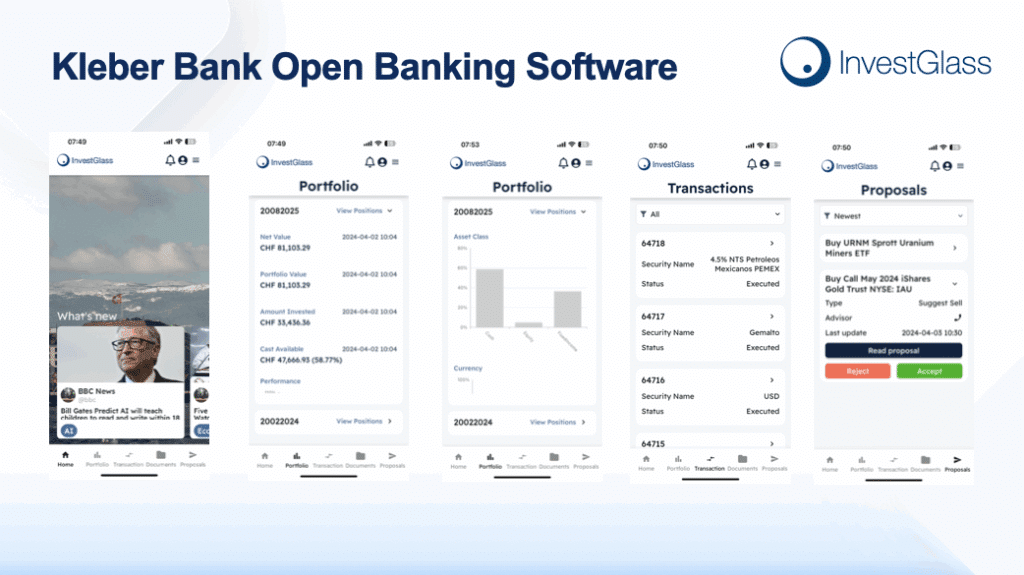
金融サービス demands KYC, onboarding automation, and regulatory compliance. InvestGlass serves as a purpose-built CRM for private banks and financial institutions with suitability questionnaires, ESG preference capture, portfolio rebalancing, and KYC document management. A relationship manager using InvestGlass accesses client portfolios, compliance status, and communication history from one interface, and can easily access customer data to ensure regulatory compliance and deliver tailored service.
ヘルスケア CRM examples like Salesforce Health Cloud handle patient scheduling, engagement, and HIPAA compliance. Specialised solutions such as InvestGlass CRM for dental practices add digital onboarding, appointment automation, and patient portals tailored to clinical settings. These platforms connect clinical workflows to customer experience management.
製造業 uses tools like NetSuite CRM for dealer and distributor management, syncing inventory data with sales pipelines. Therapy and counselling practices benefit from vertical tools like InvestGlass CRM for therapists, which streamline patient onboarding, documentation, and session workflows. Order tracking and channel partner coordination drive requirements here.
不動産 favours platforms like Pipedrive for property pipeline tracking, managing listings, viewings, and buyer journeys through visual stages.
電子商取引 relies on platforms with order history integration, loyalty programmes, and customer behavior analytics. Adobe Commerce and similar tools connect shopping data to customer communications. CRM tools in this sector help businesses enhance customer loyalty by enabling personalised engagement and supporting loyalty programme management.
In each sector, generic CRM requires customisation. InvestGlass already includes ready-made modules for regulated financial institutions and public sector bodies handling sensitive data, reducing setup time by half compared to horizontal platforms.
Customer Behavior and Marketing Strategies
Understanding customer behaviour is at the heart of effective marketing strategies, and customer relationship management (CRM) software is the essential tool that brings these insights to life. By centralising customer data and tracking every customer interaction, CRM systems empower sales and marketing teams to analyse customer behaviour, identify trends, and tailor their marketing efforts for maximum impact.
Modern CRM software provides a unified platform where businesses can manage customer information, monitor engagement across multiple channels, and automate routine tasks such as lead tracking and follow-up communications. This centralisation allows marketing teams to access a complete view of each customer’s journey, from initial enquiry through to purchase and ongoing support. By analysing customer interactions and purchase history, organisations can uncover valuable insights into preferences, buying patterns, and emerging needs.
With these insights, businesses can develop highly targeted marketing campaigns that resonate with their audience. For example, marketing automation features within CRM platforms enable the segmentation of customer lists based on behaviour, demographics, or engagement level. This allows for personalised communication, tailored offers, and timely follow-ups that improve customer satisfaction and drive business growth.
Sales teams also benefit from CRM software by automating repetitive tasks, managing sales pipelines, and prioritising high-value opportunities. Automated lead tracking and sales pipeline management ensure that no opportunity is missed, while analytics dashboards provide real-time visibility into campaign performance and customer engagement. This data-driven approach helps sales and marketing teams refine their strategies, improve sales productivity, and build stronger customer relationships.
Leading CRM software examples such as HubSpot, Salesforce, and Microsoft Dynamics offer robust marketing automation, customer analytics, and sales pipeline management tools. These platforms enable businesses to streamline processes, enhance customer engagement, and drive business growth by providing actionable insights into customer behaviour and preferences.
CRM Software Use Cases: From Lead to Loyal Client
Teams should map CRM use cases before selecting software. Here are common scenarios and how modern platforms address them.
Automating repetitive sales tasks. NetSuite templates save hours weekly by auto-generating quotes and proposals. Sales reps focus on selling rather than paperwork. InvestGlass pre-fills client review packs for relationship managers, saving over five hours per week. Automating follow-up emails to leads who have not responded can save significant time and improve conversion rates.
Building an omnichannel customer journey. Microsoft Dynamics 365 supports buy-online-pickup-in-store workflows, connecting digital and physical touchpoints. Customer interactions flow seamlessly across multiple channels.
Prioritising and scoring leads. Freshsales AI scores prospects automatically, boosting conversions by identifying high-potential leads. CRM systems with lead management features can help prioritise leads by scoring them based on their potential value, which increases the chances of successful conversions. Sales teams work smarter by focusing on qualified opportunities first.
Personalising communications. HubSpot AI generates insights for personalised communication. Segmentation ensures marketing efforts reach the right audience with relevant content, improving customer satisfaction and engagement.
Managing renewals and reviews. InvestGlass auto-schedules client reviews for wealth managers, triggering reminders and pre-populating meeting materials. CRM platforms help manage sales processes by automating reminders and follow-ups. This drives stronger customer relationships and improves customer retention through consistent follow-up.
Data Sovereignty and CRM: Why Hosting Location Matters
Data sovereignty refers to the principle that data is subject to the laws of the jurisdiction where it is stored. For European organisations in 2025 and 2026, this is not abstract policy. It affects daily operations and regulatory compliance.
CRMs hosted under American jurisdiction face potential exposure through the CLOUD Act, which allows US authorities to compel disclosure of data held by American companies regardless of where that data is physically stored. Chinese alternatives carry similar risks under National Security Law provisions. The Schrems II ruling invalidated previous EU-US data transfer frameworks, leaving organisations exposed to compliance gaps.
InvestGlass addresses these concerns through Swiss hosting and optional on-premise deployment. Swiss data protection law aligns with GDPR principles, and Switzerland’s neutral status provides legal separation from American and Chinese jurisdictions. Client data remains under Swiss or customer-controlled legal frameworks.
Consider a European private bank facing audit requirements. With a Swiss sovereign CRM, the bank demonstrates control over client data without cross-border transfer complications. Compliance officers access complete audit trails within a single jurisdiction. This simplicity reduces legal costs and audit preparation time significantly.
For organisations seeking to avoid reliance on American or Chinese cloud ecosystems, InvestGlass offers a proven sovereign alternative that protects the sovereignty of client data.
How to Choose the Right CRM Software Sample for Your Organisation
Use the earlier CRM samples as a shortlist, then apply a structured selection process:
- Define objectives. Clarify whether your priority is sales productivity, marketing automation, service quality, compliance, or a combination.
- Map key use cases. Document specific workflows like lead tracking, client onboarding, or renewal management.
- Shortlist 5 to 7 vendors. Match capabilities to your requirements, considering both features and hosting options.
- Run a proof of concept with real data. Test actual workflows rather than demo scenarios.
- Evaluate security, hosting, and compliance. Examine role-based access controls, audit trails, KYC capabilities, and integration with existing systems.
For regulated sectors, evaluation criteria should prioritise hosting location and data sovereignty. Organisations seeking a non-American or non-Chinese CRM with strict control over customer data should prioritise platforms like InvestGlass that support Swiss hosting or on-premise deployment.
Implementing a CRM: From Sample Testing to Full Rollout
Once a CRM software sample is chosen, organisations need a clear implementation plan covering data migration, configuration, and user training.
A typical 60 to 120 day rollout for a mid-sized firm follows these phases:
- Discovery (weeks 1 to 2): Document requirements, map existing processes, identify data sources
- Configuration (weeks 3 to 5): Set up fields, workflows, automations, and integrations
- Migration (weeks 6 to 8): Transfer data from legacy systems, deduplicate records, validate completeness
- Pilot (weeks 9 to 12): Deploy to 10 to 20 users, gather feedback, refine workflows
- Go-live: Roll out to remaining teams with ongoing support
InvestGlass often starts with a limited pilot group of relationship managers or compliance officers. Once workflows are validated, the platform scales to additional teams. This phased approach reduces risk and builds internal champions.
Measure early success through indicators like faster onboarding times (targeting 50 percent improvement), improved data completeness (above 95 percent accuracy), and increased follow-up adherence. Keep a small CRM playbook documenting processes, data standards, and best practices discovered during implementation.
Best Practices for Maximising Value from Any CRM Software
Technology alone is not enough. Process and culture determine whether CRM delivers returns.
Keep data clean. Deduplicate quarterly, enforce data entry standards, and automate routine tasks like address validation. Poor data quality undermines every CRM function from sales forecasting to personalised communication.
Automate whenever practical. Target 80 percent automation of repetitive tasks like follow-up scheduling, data entry, and report generation. This frees sales reps and service teams for high-value customer interactions.
Integrate CRM with email and calendar. Automatic logging of customer communications and meetings ensures complete interaction histories without manual effort.
Ensure leadership regularly reviews CRM dashboards. When executives use pipeline and churn data in decision-making, adoption improves across the organisation.
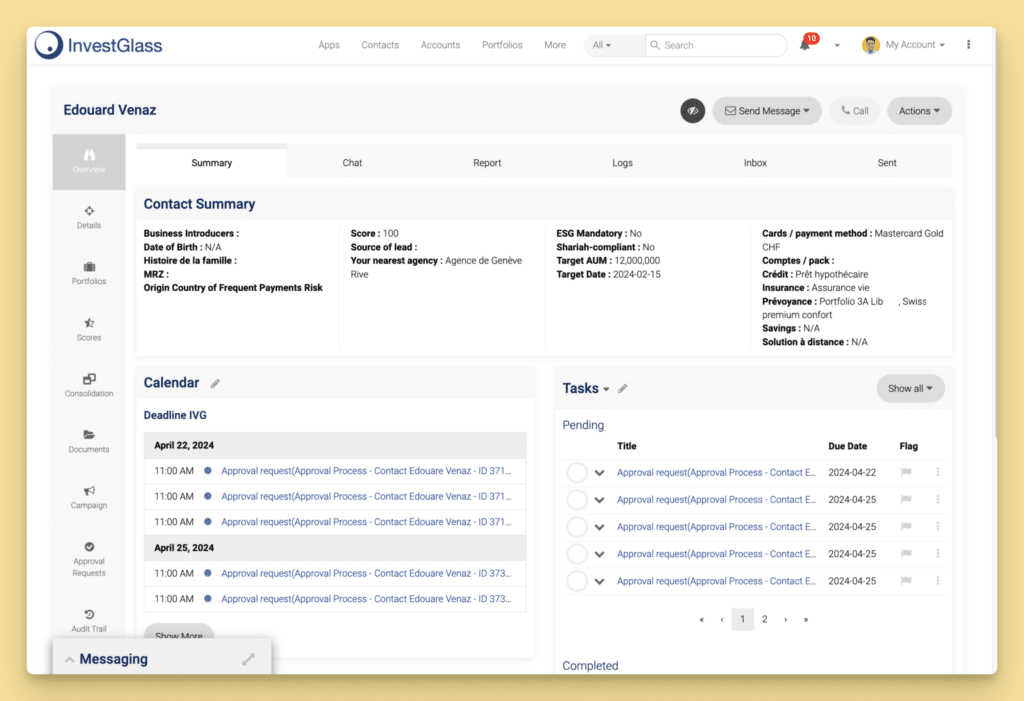
One wealth management firm using InvestGlass reviews dashboards in monthly management meetings. They examine pipeline progression, churn risk indicators, and client review cadence. This visibility drives accountability and highlights where sales and marketing efforts need adjustment.
Continuous training and feedback loops matter, especially when new regulatory workflows like updated KYC rules are introduced. Organisations investing in ongoing education typically see double the ROI from their CRM platform.
Conclusion: Using CRM Software Samples to Design Your Ideal Solution
Reviewing concrete CRM software samples helps organisations move from feature lists to real requirements. By examining how platforms like Salesforce, HubSpot, Pipedrive, and インベストガラス handle actual workflows, you clarify what your teams need and what trade-offs you are willing to accept.
The right CRM should match your business processes, regulatory obligations, and data sovereignty needs. Feature checklists matter less than whether the platform supports how your sales teams actually sell, how your service teams actually resolve issues, and how your compliance officers actually demonstrate control.
インベストガラスはスイスのソブリンである。 CRM ideal for banks, wealth managers, insurers, and public bodies that want European control of client data while benefiting from modern automation, AI-driven tools, and secure client portals. If you need a CRM that protects the sovereignty of your client data while streamlining sales processes and compliance workflows, InvestGlass offers a proven alternative to American and Chinese platforms.
Explore an InvestGlass demo configured as a tailored CRM software sample for your specific industry and jurisdiction.


