
Customer management tools have become foundational for any organisation that wants to build strong customer relationships at scale. In 2026, relying on spreadsheets and fragmented email threads to manage contacts, track deals, and ensure compliance is no longer a viable approach. With 82% of service professionals reporting that customer expectations are higher than ever, the pressure to deliver consistent, personalised experiences across every touchpoint has never been greater.
Modern customer relationship management software bundles sales, marketing, and service functions into a single platform, giving teams a unified view of the entire customer journey. Solutions such as InvestGlass, HubSpot CRM, and Zoho CRM each take a different approach to this challenge, but they share a common goal: helping organisations organise customer data, automate routine tasks, and streamline sales processes.
This article explains what customer management tools are, outlines the key types and essential crm features you should look for, examines how InvestGlass serves regulated industries, and compares popular crm systems available in 2026. It concludes with a practical selection framework, best practices, and frequently asked questions to help you identify the right crm for your business.
What Are Customer Management Tools (Customer Relationship Management Tools)?
Customer management tools are software applications used to organise customer data, manage customer interactions across multiple channels, and automate follow-ups throughout the customer lifecycle. At their simplest, they replace address books and sticky notes. At their most advanced, they serve as the central nervous system for sales, marketing, and customer support operations.
These tools are typically delivered as crm software, most often cloud-based, and used daily by sales teams, marketing teams, and service teams. A well-configured crm system captures every email, phone call, meeting, and document exchange with a contact, building a comprehensive timeline that any authorised team member can access.
Core use cases include:
- Gestión de contactos with full interaction history and preferences
- Gestión de clientes potenciales with scoring, automated assignment, and conversion tracking
- Seguimiento de la cartera de ventas through visual stages, expected close dates, and probability weightings
- Customer relationship management analytics for conversion rates, revenue forecasting, and churn signals
- Automated email sequences triggered by prospect behaviour or lifecycle stage
CRM tools help manage customer interactions and data in a structured way that eliminates guesswork and reduces manual data entry. They also provide a unified view of customer interactions, which means sales reps no longer need to ask a colleague what was discussed in the last meeting.
Since 2025, AI has significantly expanded what crm tools can do. Predictive scoring identifies which leads are most likely to convert. Next-best-action suggestions guide sales reps on the optimal follow-up. AI-assisted sales forecasting draws on historical performance and current pipeline data to produce more accurate revenue projections. According to recent industry analysis, 82% of organisations now use AI to boost productivity, and crm platforms are among the primary vehicles for that adoption. Inteligencia artificial en la banca shows how AI agents can provide 24/7 customer service autonomously, handling routine queries while human advisors focus on complex relationships.
Key Types of Customer Management Tools in a Modern CRM System
A complete crm solution rarely sits in a single category. Modern platforms bundle several tool types to cover marketing, sales, service, and operations within one environment. Understanding the four main types of CRMs helps clarify what each component contributes.
CRM operativo
Operational CRM automates and streamlines business processes that touch the customer directly. This includes sales automation (lead routing, opportunity management, deal progression), marketing automation (drip campaigns, behavioural triggers), and service operations (ticketing, case resolution). For a B2B services firm, operational CRM might automatically route an inbound enquiry to the correct regional sales rep based on geography and deal size.
CRM analítico
Analytical CRM focuses on data analysis to gain insights. It processes pipeline data, conversion metrics, and customer behaviour patterns to produce dashboards that inform strategic decisions. Sales forecasting, churn prediction, and Gestión de carteras mejorada por IA and customer satisfaction trend analysis all fall here.
CRM colaborativo
Collaborative CRM facilitates communication across departments. Shared notes, tasks, activity feeds, and internal discussions ensure that sales and marketing teams, service teams, and compliance officers all work from the same record. For multi-branch advisory firms, this is particularly important.
Strategic CRM
Strategic CRM places the customer at the centre of business strategy. It prioritises long-term relationship value over short-term transaction volume, using purchase history, lifetime value calculations, and engagement scoring to shape how the organisation allocates resources.
Many platforms, including InvestGlass, blend these crm types rather than forcing businesses to choose a single category. A fintech managing KYC-verified clients, for instance, might use operational workflows for onboarding, analytical dashboards for portfolio performance, collaborative tools for multi-advisor coordination, and strategic scoring to identify high-value relationships worth nurturing.
Essential CRM Features Every Customer Management Tool Should Include
Essential crm features are what separate a simple address book from a true customer management system. The features below represent baseline expectations for any crm platform in 2026.
Gestión de contactos y cuentas
The foundation of any crm system is contact management that stores full customer history. Every email, meeting, call, document, and preference should be visible in a single timeline. This eliminates information silos and ensures that any team member can pick up a conversation without asking the client to repeat themselves.
CRM features include contact management and workflow automation as standard components. CRM systems improve marketing precision and enhance client retention by ensuring that detailed customer data enables targeted marketing and customised communications.
Lead Management and Scoring
Effective lead management means capturing leads from multiple channels, scoring them using rules or machine learning, assigning them automatically to sales reps, and tracking conversion from first touch to closed deal. The ability to manage leads efficiently directly affects pipeline velocity and win rates.
Deal and Pipeline Tracking
Visual pipeline management with stage-based boards, expected close dates, probability weightings, and sales forecasting dashboards gives leadership real-time visibility into revenue projections. Sales pipeline tracking should also accommodate recurring revenue models for subscription-based businesses.
Marketing Features
Email marketing tools, segmentation by behaviour and profile, and basic automation workflows triggered by customer interactions are now expected in any crm solution. Marketing campaigns can be personalised at scale, with drip sequences adjusting based on prospect engagement.
Informes y análisis
CRM software can improve customer satisfaction by 33% when organisations use data to identify and resolve service gaps quickly. Dashboards for sales performance, conversion rates, revenue per deal, and customer satisfaction metrics such as NPS or CSAT provide the visibility needed for data-driven decision making.
Using CRM can lead to 31% faster case resolution during first interaction, largely because service teams have immediate access to the full interaction history and can act without delay. CRM can also reduce IT costs by 30% by consolidating disparate tools into a single platform.
Herramientas de colaboración
Shared notes, tasks, and activity feeds ensure that sales, marketing, and service teams can work from one crm system without duplicating effort. For organisations where sales marketing and customer service functions intersect, this shared workspace is critical.
Seguridad de los datos y cumplimiento de la normativa
Role-based permissions, audit trails, time-stamped logging, and encryption at rest and in transit are non-negotiable, especially for regulated sectors such as banking and wealth management. CRM systems must support applicable regulations including GDPR, MiFID II, and FINMA requirements.
AI CRMs automate routine tasks like data entry and follow-ups, freeing up sales reps to focus on relationship-building rather than administration. AI agents can autonomously analyse customer data for insights, and AI-powered CRMs improve sales forecasts and customer interactions by surfacing patterns that human reviewers might miss.

InvestGlass: A Customer Management and CRM Solution for Regulated Industries
InvestGlass is an all-in-one CRM and client portal platform originally built in Switzerland for banks, wealth managers, fintechs, and B2B sales teams. It is designed for organisations where regulatory compliance, document-heavy workflows, and data sovereignty are not optional extras but daily requirements.
Centralised Customer Relationship Management
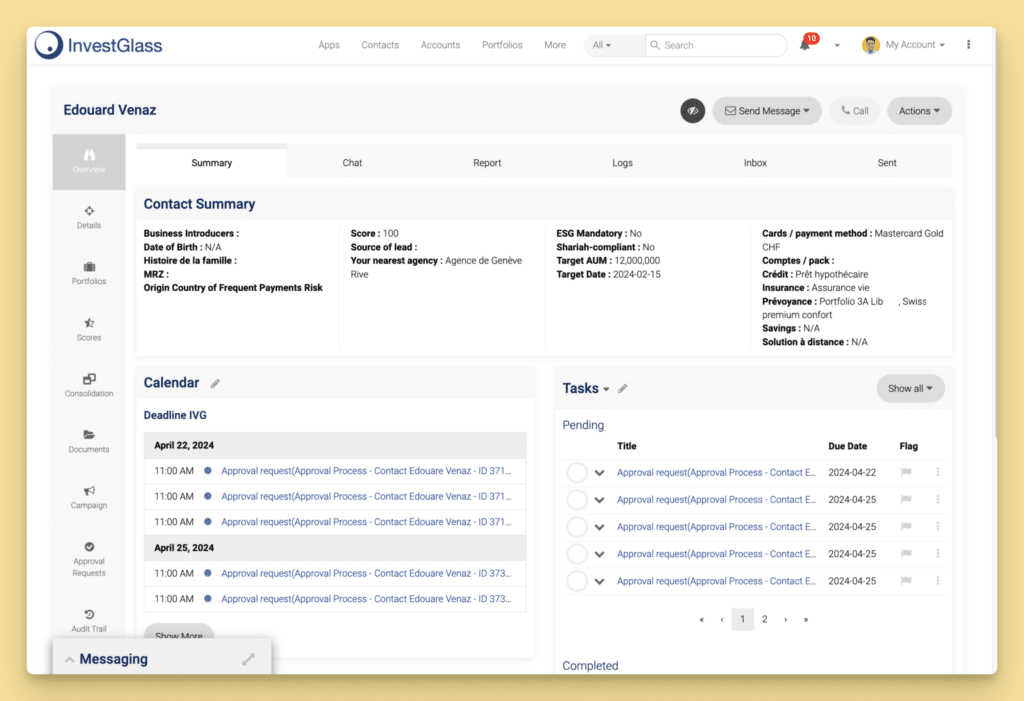
InvestGlass centralises customer relationship management across the entire client lifecycle. Automated KYC verification captures client information through configurable forms, suitability questionnaires, and document collection workflows. Contact management stores full interaction histories, and pipeline tracking provides visual boards for deal progression. CRM systems centralise customer data for better service delivery, and InvestGlass embeds this principle across every module.
Lead Management and Sales Forecasting
Configurable pipelines allow teams to define their own stages, probability weightings, and expected close dates. Recurring revenue tracking supports subscription or retainer-based models common in financial services. Portfolio-related sales opportunities can be linked directly to client records, connecting investment performance data with relationship management.
Herramientas de automatización
Automation tools for reminders, approval flows, and email sequences help nurture customer relationships and maintain customer satisfaction without adding manual workload. Approval workflows route documents to the correct compliance officer before client-facing actions proceed, reducing bottlenecks and ensuring audit readiness.
Compliance-Focused Features
Digital onboarding forms, e-signatures, suitability questionnaires, and audit trails are tailored to EU, UK, and Swiss regulations. InvestGlass offers Swiss hosting and optional on-premise deployment, directly addressing data residency concerns that many organisations face when evaluating foreign-hosted platforms. For financial institutions navigating regulatory compliance in 2026, these features are core to the platform rather than paid add-ons, and they align with InvestGlass CRM para banca privada.
Integrations and Connectivity
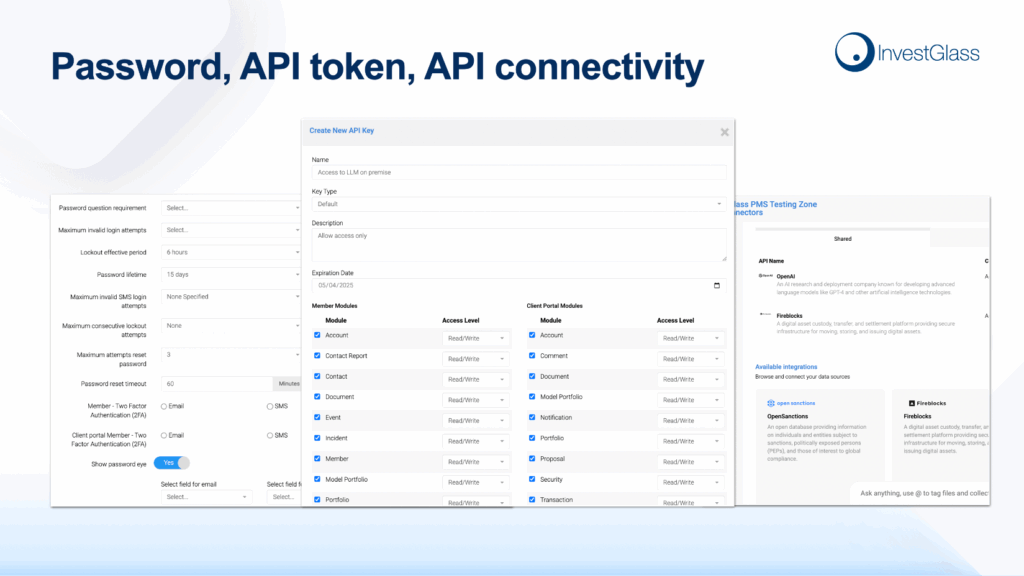
API connections support integration with core banking platforms, payment systems, productivity tools, and communication tools. The client portal enables secure document delivery, allowing clients to access statements, reports, and communications without relying on email attachments. Similar integration benefits apply in vertical solutions such as CRM InvestGlass para consultas dentales en Suiza, where patient onboarding and scheduling connect seamlessly to back-office systems.
The platform’s dashboard views present pipeline boards, compliance task trackers, and client profile pages with full interaction timelines. These visual elements give advisors and managers immediate situational awareness.
Why Choose InvestGlass Over Generic CRM Software?
Generic free crm platforms are designed for broad use cases: simple lead tracking, basic email integration, and lightweight marketing automation. They generally lack built-in compliance modules, suitability assessment engines, or financial-industry data models.
InvestGlass reduces manual compliance work compared with basic CRMs that lack KYC and suitability workflows. Where a generic tool might require third-party apps or custom development to meet regulatory standards, InvestGlass provides these capabilities natively. As a CRM suizo para ventas y marketing de servicios financieros, it demonstrates how customer management tools are essential for building trust and increasing retention, and in regulated industries, trust is inseparable from demonstrable compliance.
For multi-branch or multi-advisor teams, InvestGlass offers consolidated customer interactions, standardised checklists, and unified reporting. Role-based permissions ensure that advisors see only the client data relevant to their responsibilities, while management dashboards aggregate performance across the organisation. The same architecture underpins specialised deployments like InvestGlass CRM para terapeutas en Suiza, where sensitive client records and workflows require strict access controls.
InvestGlass reports that over 100 banking businesses globally use its platform to digitise operations. For a mid-size European wealth manager, consolidating multiple tools into InvestGlass can improve both client onboarding speed and customer satisfaction scores by eliminating the friction of switching between disconnected systems. CRM systems assist companies in scaling operations and maintaining customer service quality, and this consolidation is precisely how that scaling becomes practical.
Comparing Popular CRM Systems and Customer Management Tools in 2026
Businesses often compare InvestGlass with HubSpot CRM and other leading crm systems when evaluating customer management tools. Each platform has a distinct positioning, and the best crm software for one organisation may be entirely wrong for another.
Here is a compact comparison of several well-known options:
CRM System | Mercado destinatario | Precio inicial | Free CRM / Free Trial | Standout Strengths |
|---|---|---|---|---|
InvestGlass | Regulated industries, banks, wealth managers, B2B | Contact for pricing | Free trial available | Compliance workflows, Swiss hosting, digital onboarding, portfolio management |
HubSpot CRM | Inbound marketing, SMBs, content-driven growth | $49 per user per month | HubSpot CRM offers a free plan for users | Marketing automation, usability, extensive integrations |
Zoho CRM | Affordable SMB, broad vertical coverage | $20 per user per month | Free trial | Comprehensive suite, value pricing, customisation |
Salesforce | Enterprise, large-scale deployments | $175 per user per month | Free trial | Extensibility, ecosystem, AppExchange marketplace |
Pipedrive | Pipeline-focused sales teams | $14 per user per month | Free trial | Visual pipeline, simplicity, sales-focused UX |
Microsoft Dynamics 365 | Enterprise, Microsoft ecosystem users | $65 per user per month | Free trial | Deep Office 365 integration, ERP connectivity |
Freshsales | Value-oriented, growing sales teams | Contact for pricing | Free trial | Freddy AI Copilot, multi-channel sequences |
Creatio CRM | Process-heavy enterprises | Contact for pricing | Free trial | Creatio CRM provides a 360-degree customer view, low-code process automation |
CRM pricing can range from $9 to $550 per user monthly depending on the tier and vendor. CRM software can increase sales revenue by 30%, and Salesforce CRM specifically claims this figure for organisations using its platform fully. The average organisation uses close to 900 different applications, which underscores why consolidating into a capable crm platform matters. |
Buyers should look beyond generic “best crm” lists and instead match crm features, data residency options, integrations, and onboarding models with their own requirements. A marketing-led SaaS startup has different needs from a Swiss private bank.
Free CRM, Free Trials, and When to Pay
The difference between a free crm plan with limited features and a time-limited free trial offering full functionality is important to understand. A free plan typically caps the number of users, contacts, or automations. A free trial lets you test everything, but only for a defined period, usually 14 to 30 days.
Starting on a free crm makes sense for micro teams running proof-of-concept tests or managing very simple pipelines. However, regulated firms should consider skipping straight to a paid and compliant crm solution like InvestGlass. The reason is practical: testing compliance workflows, audit trails, and document collection on a platform that does not support them tells you nothing useful.
When evaluating a free trial, test realistic workflows: lead routing, document collection, approval processes, and reporting. Log in regularly and involve actual end users from sales, operations, and compliance. Do not simply create a test contact and declare the trial a success.
The long-term crm cost of outgrowing a basic free crm and migrating data later often exceeds the cost of selecting a scalable platform from the start. Data migration is disruptive, error-prone, and time-consuming. Effective CRM solutions empower businesses to boost retention and streamline sales processes, but only if the platform chosen at the outset can grow with the organisation.
How to Choose the Right Customer Management Tool for Your Business
Selecting a crm solution should begin with process mapping, not feature comparison. Before evaluating vendors, understand your own workflows.
Step 1: Document Your Customer Interactions
Map every touchpoint from first contact to renewal, including sales, onboarding, customer support, and compliance checkpoints. This exercise reveals where information is lost, where handoffs fail, and where automation could save time. CRM enables better data-driven decision making for businesses, but only when the data model reflects real-world processes.
Step 2: List Must-Have Features
From the essential features discussed earlier, identify which your business absolutely requires. Contact management, role-based permissions, automated reminders, pipeline management, or regulatory workflows will all carry different weights depending on your industry and size.
Step 3: Evaluate Integration Requirements
Determine which existing tools must integrate: email and calendar, document storage, billing, marketing automation platforms, or industry-specific systems such as core banking or payment processors. The average organisation uses close to 900 applications, so integration capability is a practical necessity, not a luxury.
Step 4: Consider Data Residency and Security
For European and financial organisations, data residency, security certifications, and audit requirements are decisive factors. Where is the data hosted? Who has jurisdiction? Can you deploy on-premise if required? These questions filter out many general-purpose platforms early in the evaluation process.
Step 5: Run a Structured Free Trial
Set clear success criteria before the trial begins. Include user feedback from sales reps, operations staff, and compliance officers. Measure time saved on routine tasks, error reduction in data entry, speed of client onboarding, and reporting accuracy.
InvestGlass is a strong fit when regulated processes, multi-stage approvals, and investor or client portals are part of the crm scope. Its compliance-first architecture means that audit trails and suitability workflows are available from day one, not after months of customisation.
Best Practices for Getting Value from Customer Management and CRM Tools
Purchasing a crm system is only the beginning. Extracting consistent value requires discipline, ownership, and incremental adoption.
Define Ownership
Assign a CRM administrator or product owner responsible for maintaining fields, automation rules, and reports. Without clear ownership, configurations drift, data quality declines, and users lose confidence in the system.
Set Clear Usage Rules
Establish straightforward expectations: all calls and meetings logged within 24 hours, no client data kept in personal spreadsheets or local files, and mandatory fields completed before a record can progress through the sales pipeline. These rules must be enforced consistently.
Prioritise Clean Data
Mandatory fields for key identifiers, regular data hygiene reviews, and deduplication routines prevent the “garbage in, garbage out” problem that undermines AI-assisted features and reporting accuracy. CRM data is only as valuable as its accuracy.
Use Dashboards in Regular Meetings
CRM dashboards should feature in weekly sales and management meetings to track pipeline health, win rates, and customer satisfaction trends. When the crm system is visibly used in decision-making, adoption improves across the organisation.
Adopt Advanced Features Gradually
Encourage gradual rollout of advanced capabilities such as AI-assisted sales forecasting, multi-step automations, and predictive scoring after users are comfortable with basic logging and reporting. AI can personalise customer experiences based on behaviour data, but this only works when foundational data practices are solid.
CRM tools enhance business operations throughout the customer lifecycle, from initial lead capture to post-sale retention. A 31% increase in ROI for customer service teams using CRM systems demonstrates the tangible returns available when adoption is disciplined. CRM systems can automate routine tasks like data entry and follow-ups, but the human element of enforcing usage standards remains essential.
Frequently Asked Questions About Customer Management Tools and CRM Software
What is the difference between customer management tools and CRM software?
CRM software is the core category within the broader term “customer management tools.” While crm software focuses on managing customer relationships, sales pipelines, and interaction histories, the wider category can also include ticketing systems, feedback platforms, loyalty programmes, and customer data platforms. In practice, most organisations use “customer management tools” and “crm software” interchangeably when referring to their primary customer relationship management system.
Which CRM system is best for small businesses in 2026?
For very small teams with no regulatory pressure and simple pipelines, a free crm from HubSpot or a low-cost option like Pipedrive (starting from $14 per user per month) can be sufficient. However, firms needing compliant onboarding, detailed reporting, or document-heavy workflows may be better served by InvestGlass from the outset. Zoho CRM, starting at $20 per user per month, offers a middle ground with broad customisation. The right crm depends on your specific sales process, compliance needs, and growth trajectory.
How do CRM systems improve customer satisfaction?
Faster response times through automated routing and reminders, personalised communication driven by segmentation and purchase history, and a complete view of past customer interactions all contribute to more relevant and timely service. When a client contacts your organisation, the advisor or support agent can see the full relationship timeline and respond with context. CRM improves customer satisfaction by 33% during first interaction resolution because service teams no longer operate blind.
Is HubSpot CRM enough as a long-term CRM solution?
HubSpot CRM is strong for marketing-led inbound funnels, content-driven customer engagement, and organisations where ease of use is the primary concern. HubSpot CRM starts at $49 per user per month for paid tiers, and its free plan covers basic needs. However, limitations appear when businesses require deep compliance workflows, data sovereignty controls, audit trails, or vertical-specific features for financial services. In those scenarios, specialised crm platforms like InvestGlass may be preferable. AI-powered CRMs improve sales forecasts and customer interactions, and both HubSpot and InvestGlass are investing in this area, but with different compliance foundations.
How long does it take to implement a new CRM solution?
For a simple rollout with a single pipeline, basic contact management, and minimal integrations, expect two to four weeks including configuration, data import, and initial training. For multi-country or multi-entity deployments with custom workflows, compliance modules, document workflows, and deep integrations, implementation typically takes three to six months. The sales cycle for CRM adoption itself can be lengthy when multiple stakeholders, from IT to compliance, need to sign off.
What data should we migrate into a new CRM?
Import current, high-quality records: active contacts, open deals, recent customer interactions, and relevant documents. Archive or clean legacy data that is outdated, duplicated, or incomplete. Verify data formats before import, remove duplicates, and ensure all your customer data meets minimum quality standards. Segment by recency and frequency to prioritise what enters the new system first. A disciplined migration sets the foundation for accurate reporting and effective automation.
Conclusion: Turning CRM Software into a Strategic Customer Management Asset
Customer management tools, when implemented with discipline and clear ownership, move an organisation from scattered contact lists to a structured customer relationship management strategy. The transition is not merely technological. It is a shift in how teams collaborate, how decisions are informed by crm data, and how customer engagement is sustained across the entire customer lifecycle.
The right crm system boosts customer satisfaction, improves sales forecasting accuracy, and aligns sales and marketing teams around a single source of truth. CRM software can increase sales revenue by 30% and improve customer satisfaction by 33%, figures that reflect the compound effect of better data, faster responses, and more consistent follow-through. These are essential business tools for any organisation serious about business growth.
InvestGlass is positioned as a crm solution tailored for regulated and relationship-driven businesses that need more than a generic free crm. Its compliance-first architecture, Swiss data sovereignty, and integrated portfolio management capabilities make it a credible alternative for organisations that want to nurture customer relationships without compromising on regulatory readiness.
If your business operates in a regulated environment, handles sensitive client data, or requires multi-stage approval workflows, explore an InvestGlass free trial. Test your real workflows. Involve your sales reps, compliance officers, and operations teams. See how a unified crm platform can drive business growth and transform your customer interactions in 2026 and beyond.
