
A sales cadence is no longer just a few emails and a reminder to call later. In 2026, the best teams use a structured, signal-driven system to engage leads across email, phone calls, LinkedIn, social media messages, direct mail, and automation.
This guide explains how to build a sales cadence that supports your sales process, improves response rates, and helps sales teams move quality leads through the sales pipeline with InvestGlass Pipeline tools.
Key Takeways
- A sales cadence is a predefined sequence of sales activities and touchpoints scheduled over specific intervals that a salesperson uses to engage a prospect.
- A well defined sales cadence helps maintain a consistent customer experience, ensuring that every prospect receives the same level of attention and service, which builds trust and improves conversion rates.
- Sales cadences should include 8-12 touchpoints over 10-15 business days to capitalize on leads’ high buying intent, with a mix of personalized emails, phone calls, and social media messages.
- In 2026, an effective sales cadence should use engagement data such as opens, clicks, website visits, and call outcomes to decide the next best action.
- InvestGlass Pipeline tools can help with sales cadence management by organizing tasks, automating timely follow ups, and giving sales managers visibility into sales cadence results.
What Is a Sales Cadence in 2026?
A sales cadence is a structured sequence of scheduled contact attempts across communication channels such as email, phone, LinkedIn, SMS, direct mail, and in-person outreach. The goal is to turn potential customers into qualified opportunities and meaningful conversations.
A good sales cadence answers four questions:
- Who should be contacted based on buyer personas, industry, job title, company size, and target audience?
- When should each touchpoint happen?
- Which channel should be used for each step?
- What message, case study, or offer should be used to capture the prospect’s attention?
Random customer outreach is less effective today because inboxes are defended, phone screening is common, and social media platforms are crowded. Relying entirely on a single communication medium reduces response probability. That is why a strong sales cadence blends email, cold calling, LinkedIn, social media messages, and sometimes direct mail.
There is also a difference between an inbound sales cadence and an outbound sales cadence. An inbound sales cadence usually starts after inbound leads request information, attend a webinar, or download content. These leads often have higher buying intent, so most inbound sales cadences include 8–12 touchpoints over 10-15 business days to capitalize on leads’ high buying intent.
An outbound sales cadence starts colder. It usually needs more education, more personalization, and more proof before prospective customers respond.
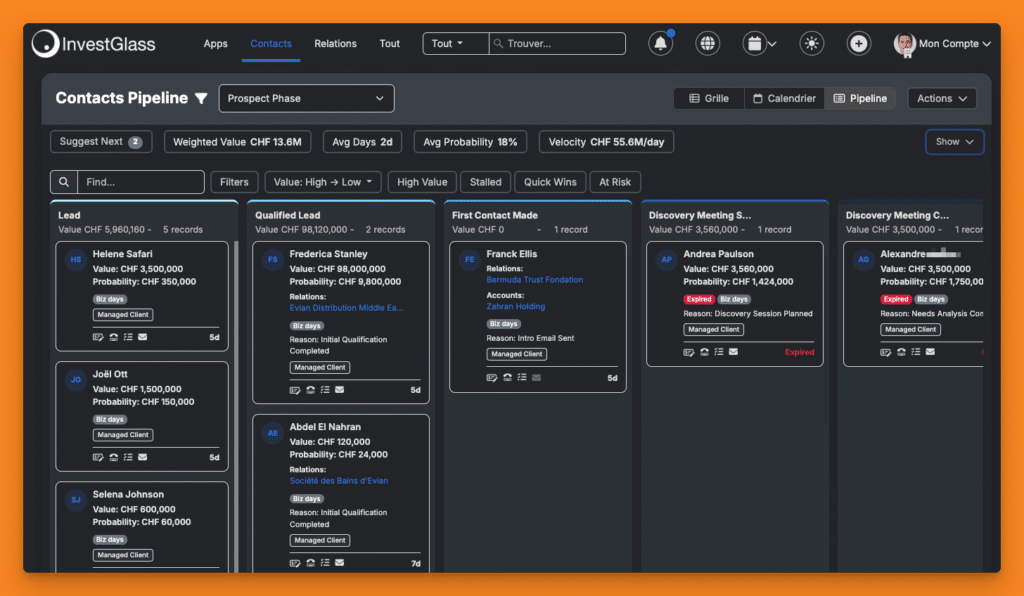
In 2026, sales engagement is also signal-led. A pricing-page visit, clicked case study, opened follow up email, or no activity for seven days can change the next step. In InvestGlass Pipeline, these signals can be used to enroll, pause, or move contacts through a structured cadence.
Why Sales Cadences Matter for Modern Sales Engagement
B2B buying is slower and more complex than it used to be. Many mid-market sales cycles now run 90–150 days, and larger deals often involve finance, operations, procurement, and technical stakeholders.
A structured sales cadence ensures consistent and timely contact with prospects through the most effective channels, playing a crucial role in advancing leads through the sales pipeline.
Here is why sales cadence helps modern sales teams:
- It prevents lead leakage by making follow up automatic and visible.
- It gives sales reps a clear timeline of activities that need to be completed in order to close a deal.
- It creates a shared playbook for marketing, SDRs, AEs, and sales enablement.
- It helps new reps ramp faster because they are not inventing outreach efforts from scratch.
- It improves consistency across the customer journey.
On average, securing a meeting requires an average of 8 distinct contacts. Optifai’s 2025–2026 benchmark similarly found that the average B2B lead needs around 8 outbound touchpoints, with SMB often needing 5–7, mid-market 8–10, and enterprise 12–15 touchpoints (Optifai).
Trust also matters. Research shows that 71% of people buy more from brands they trust, and one way to build trust is through consistent communication with prospects. Sales cadences help maintain a consistent customer experience by ensuring every prospect receives the same level of attention and service, regardless of who on the sales team is contacting them.
With InvestGlass Pipeline tools, sales managers can see which emails, phone calls, LinkedIn steps, and direct mail touches are generating opportunities, not just activity.
Core Components of a Winning Sales Cadence
A winning sales cadence is not just a list of reminders. It combines targeting, timing, messaging, automation, and clear stopping rules.
Kluczowe komponenty obejmują:
- Target audience and segments: To create an effective sales cadence, it’s essential to understand your target audience, including their communication preferences and pain points, which should inform the sequence of touchpoints.
- Entry criteria: Define when someone joins the cadence, such as a list import, event scan, demo request, form fill, or intent signal.
- Multi-channel touchpoints: Use emails, phone calls, voicemail, a linkedin connection request, a linkedin message, direct mail, video message, and social media messages where appropriate.
- Timing and spacing: For many teams, 8-12 touches over 10-15 business days works well. Enterprise or high-value buying cycle motions may need 21–30 days or longer.
- Personalization level: Segment outreach by industry, job title, or specific pain points rather than sending a universal sequence.
- Content strategy: Emails should deliver structured value propositions, data points, and case studies.
- Branching logic: Use engagement data to decide whether to accelerate, pause, or nurture a lead.
- Exit criteria: Stop when someone replies, opts out, is disqualified, becomes an opportunity, or receives the final follow up email with no response.
A structured sequence makes testing possible. If every sales rep uses a different approach, you cannot know whether poor results come from the offer, subject lines, timing, or channel mix.
InvestGlass Pipeline fits here by using CRM fields to define segments, cadence templates to standardize steps, and automation rules to move records through the sales funnel as part of an all-in-one Swiss platform for sales automation.
How to Design Your Best Sales Cadence Step by Step
Before you build a b2b sales cadence, look at your historical CRM data or consider implementing a specialized CRM for financial services sales teams. Past wins, average response times, closed-lost reasons, and industry performance can show which prospects deserve a tailored sales cadence.
Here is a practical framework:
- Define ICP and buyer personas. Include role, company size, business model, geography, KPIs, objections, and one specific pain point per persona.
- Choose channels. Decide where your buyers actually respond. Some executives prefer email and LinkedIn, while operational managers may respond better to a follow up call.
- Map the day-by-day sales sequence. Put early touches close together, then spread later steps over time.
- Craft messages and assets. Tailor messaging to address the prospect’s specific operational friction points rather than focusing solely on the product’s features.
- Set entry and exit criteria. A lead may enter from a webinar, form fill, list import, or initial contact. A lead should leave after a reply, disqualification, status change, or no response after the last step.
- Implement in InvestGlass Pipeline. Build templates, assign owners, automate reminders, and create task queues for today’s call steps.
- Test and iterate. Monitor engagement metrics like open rates, click-through rates, and response rates for each touchpoint, because this is essential for optimizing sales cadences.
For example, if you are targeting CFOs at SaaS companies, avoid early morning calls and lead with financial efficiency. Your first email might mention company name, margin pressure, or a relevant benchmark. Your second step could be a phone call, followed by a personal message on LinkedIn and a case study.
Personalization in outreach can significantly enhance engagement, as tailored messaging that addresses a prospect’s specific pain points and objectives is more likely to resonate with them. Including the prospect’s name or company in communications is a basic form of personalization, but deeper personalization that speaks to their unique challenges can lead to better engagement. Research shows that personalized emails can improve response rates by up to 26%, highlighting the importance of tailoring outreach to individual prospects.
Sales Cadence Best Practices That Still Work in 2026
The best sales cadence best practices are simple: use quality over volume, match the buyer’s context, and make every step useful.
Use these principles when building a high quality sales cadence:
- Front-load value in the first week. Your first three to four touches should include a clear reason for outreach, a useful insight, and a low-friction CTA.
- Use a true multi-channel mix. Email alone is rarely enough. Add phone calls, LinkedIn, social media messages, and direct mail for strategic accounts.
- Give every message one job. Do not ask for a demo, referral, budget confirmation, and product feedback in the same email.
- Write better subject lines. Test short, role-relevant subject lines tied to a business issue rather than vague curiosity.
- Make phone calls useful. Try local call windows around 8:00–10:00 or 16:00–18:00, use a short value-led opener, and pair important calls with same-day follow up emails.
- Keep LinkedIn human. A linkedin connection request should be under 40–50 words, reference a trigger or relevant problem, and avoid pitching immediately.
- Use direct mail selectively. For larger accounts, a small physical note or relevant package can create maximum visibility when paired with a digital follow up.
- Respect compliance and deliverability. Honor opt-outs, pace volume, separate EU and US cadences where needed, and avoid over-contacting cold leads.
Sales automation tools can help streamline repetitive tasks like email campaigns, phone calls, social media outreach, and sales cadence management, allowing sales teams to focus on building relationships and closing deals.
Automating parts of the sales cadence ensures consistent and timely follow-ups, which allows sales teams to concentrate more on relationship-building rather than administrative tasks. Sales cadences can automate scheduling activities and remind sales reps when they need to perform outreach, which helps in organizing their sales activities effectively.
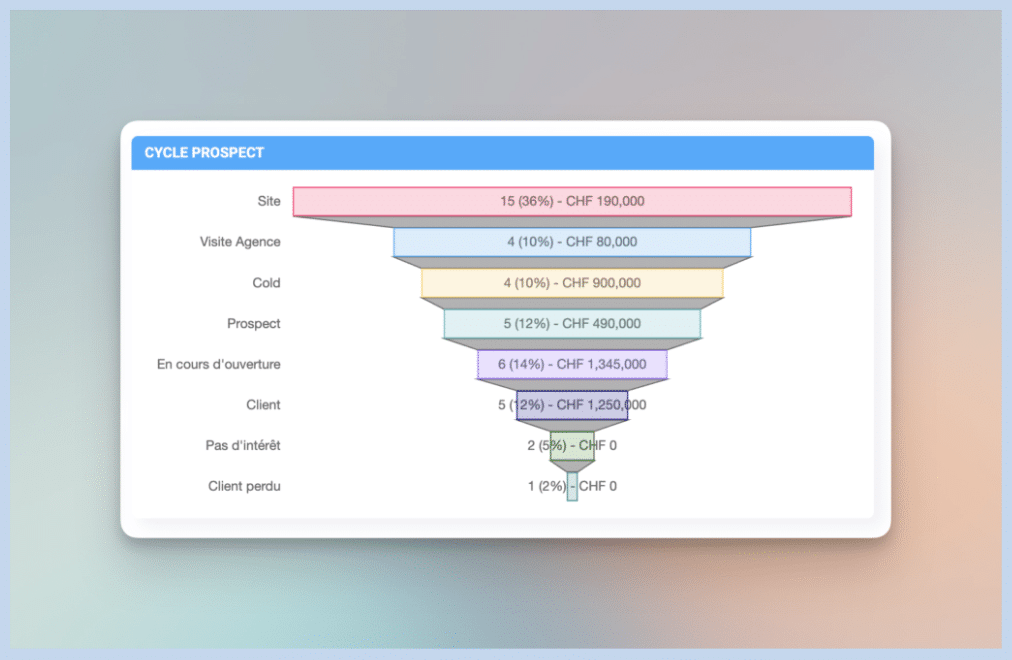
InvestGlass Pipeline automations support these best practices by throttling outreach, pausing activity when a status changes, logging unsubscribes, and creating task reminders for each follow up phone call.
Practical Sales Cadence Examples (Outbound, Inbound, and B2B Motions)
The following sales cadence examples are starting points. Adjust them by segment, deal size, region, and response data.
Cold outbound sales cadence: 12 touches over 21 days
For cold outreach in Q3 2026, a strong sequence might look like this:
- Days 1–3: Initial cold email, follow up phone call, voicemail, and LinkedIn profile view.
- Day 4: LinkedIn connection request with a short relevant note.
- Day 6: Follow up email with one business problem and a case study.
- Day 8: Second phone call attempt.
- Day 10: LinkedIn message after connection.
- Day 13: Email with a data point or customer example.
- Day 16: Follow up call and voicemail.
- Day 19: Social engagement with the prospect’s content.
- Day 21: Final follow up email asking whether to close the file.
A traditional B2B sales cadence might include: Day 1: Initial phone call attempt, Day 2: Follow-up email asking to book a meeting, Day 4: Second phone call attempt, Day 7: Personalized video message sent via email, Day 10: Third phone call attempt, Day 14: Final follow-up email.
An example of a hybrid sales cadence might include: Day 1: Initial cold email introducing your company, Day 2: Follow-up phone call if there’s no response, Day 4: LinkedIn connection request, Day 6: Second email attempt, Day 8: Second phone call attempt, Day 11: Engagement with the prospect’s content on social media, Day 14: Final email offering a demo or consultation.
Inbound sales cadence: 8 touches over 10–14 days
Inbound leads should receive fast initial contact. If someone requests a demo, respond within 5–10 minutes when possible.
A simple inbound motion in a CRM built for private banks and financial firms might include:
- Day 1: Immediate email confirmation and initial call.
- Day 1: Follow up email with a product tour or calendar link.
- Day 2: Follow up call if no meeting is booked.
- Day 4: Email with a relevant case study.
- Day 6: LinkedIn connection request.
- Day 8: Helpful content based on the form topic.
- Day 11: Phone call with a specific question.
- Day 14: Final email offering to reconnect later.
In InvestGlass, new webinar attendees or demo requests can be enrolled automatically, while Pipeline task queues show each rep which inbound follow up is due today.
Digital-native sales cadence for tech-savvy buyers
A digital-native sales cadence suitable for tech-savvy prospects could look like: Day 1: LinkedIn connection request with a personalized message, Day 3: Follow-up email introducing your product, Day 5: Engagement with the prospect’s content on social media, Day 7: Email sharing helpful content, Day 10: Personalized mini-pitch sent via direct message, Day 14: Final follow-up email.
This format works well when buyers are active on social media platforms and prefer asynchronous research before an initial call.
High-intensity sales cadence for short sales cycles
A high-intensity sales cadence for businesses with short sales cycles could consist of: Day 1: Introductory email, Day 1: Follow-up phone call, Day 2: LinkedIn connection request, Day 3: Second phone call attempt, Day 4: Follow-up value-add email, Day 5: Direct message on LinkedIn, Day 7: Third phone call attempt, Day 8: Final follow-up email, supported by automated KYC verification and digital onboarding when regulated approval is required.
Use this only when speed matters and the offer is simple. Too much pressure on complex deals can hurt trust.
Value-focused cadence for complex B2B solutions
A value-focused sales cadence for complex solutions might include: Day 1: Introductory email outlining the unique value proposition, Day 3: Follow-up phone call offering further explanation, Day 7: Email sharing a relevant piece of content, Day 14: Second phone call attempt discussing the previously sent content, Day 21: LinkedIn connection request related to the offering, Day 28: Final email offering a personalized demo.
For high-value accounts, add multi-threading. Reach the CFO, operations lead, and technical buyer with messaging connected to their pain points. If the account is strategic, include one direct mail step and log it inside InvestGlass Pipeline for attribution.
Introducing InvestGlass Pipeline Tools for Sales Cadences
InvestGlass Pipeline tools give sales teams one workspace for CRM records, sales engagement, automation, and pipeline visibility. Instead of managing emails in one place, calls in another, and notes in spreadsheets, reps can manage the entire sales cycle from a Pipeline board.
With InvestGlass as your sales cadence software, reps can:
- View daily tasks for calls, emails, LinkedIn steps, and follow ups.
- Build and clone cadence templates by segment.
- Define steps, delays, channels, owners, entry rules, and exit rules.
- Send email templates and log responses.
- Use telephony workflows such as click-to-call where configured.
- Record LinkedIn and direct mail touches as activities.
- Track open rates, reply rates, call connection rates, and opportunity creation.
Sales tools are most valuable when they reduce admin work without removing human judgment. InvestGlass helps sales reps keep timely follow ups consistent while giving them space to personalize high-value moments, much like its specialized CRM for therapists to streamline client workflows.
A practical next step is to map your current process into an InvestGlass Pipeline view, choose one segment, and test one new cadence over the next 30 days.
Measuring and Optimizing Your Sales Cadence Performance
Without measurement, many sales teams either stop too early or over-message prospects until deliverability and trust suffer.
Monitor conversion rates, email open/response rates, and the average number of touchpoints required to book a meeting. Sales cadences generate data points such as email click-through rates, call connection rates, and opportunity generated ratios, which are useful for testing and measuring effectiveness.
Sales teams should track metrics such as conversion rates, churn rates, and customer acquisition costs to assess the effectiveness of their sales cadences and make necessary adjustments.
Useful KPIs include:
- Email open rates and reply rates
- Email click-through rates
- Call connection rates
- LinkedIn acceptance and response rates
- Meeting booked rate per cadence
- Opportunity generated ratio per 100 enrolled leads
- Revenue created per cadence
- Average touchpoints required before a booked meeting
Do not judge a cadence only by first-week activity. HockeyStack and Dreamdata research shows that enterprise customer journeys can include hundreds of total touchpoints across marketing, sales, content, and ads (HockeyStack).
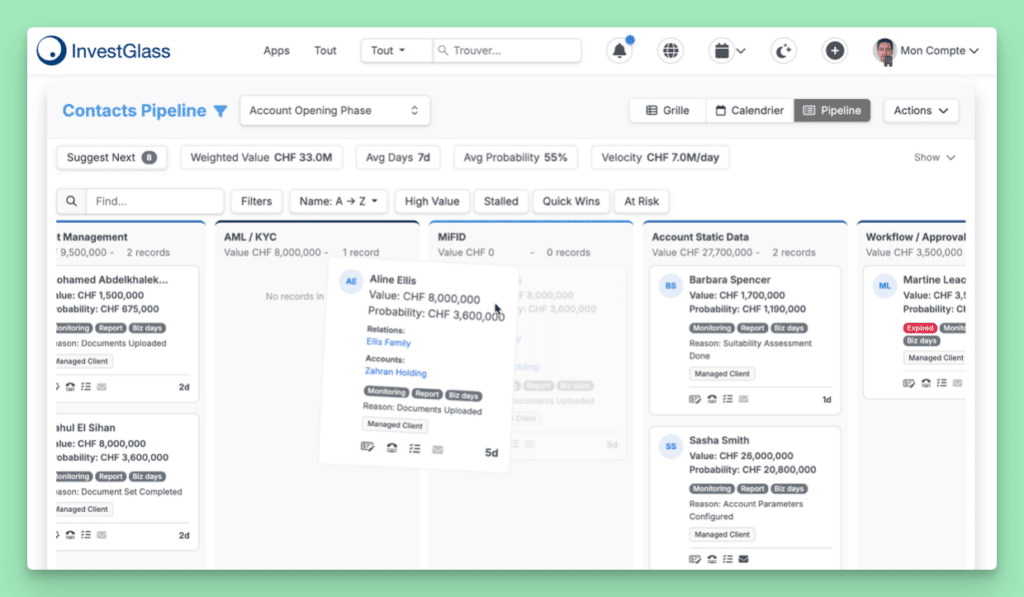
In InvestGlass Pipeline dashboards, filter by cadence, owner, segment, date range, and channel. This helps identify the best sales cadence for each target audience rather than forcing one universal motion.
Then run simple optimization loops:
- A/B test subject lines.
- Move a phone call earlier or later.
- Replace a product-heavy email with a customer story.
- Add or remove a LinkedIn step.
- Compare sales cadence results by region or persona.
Many sales teams should review cadences monthly, with a deeper quarterly review across sales and marketing automation workflows.
FAQ: Advanced Questions About Sales Cadences
How long should my first outbound sales cadence run if I’m targeting mid-market B2B buyers?
For mid-market B2B buyers in 2026, start with a 15–21 day outbound sales cadence using 10–12 multichannel touchpoints. Shorten it for smaller deals with faster decisions, and extend it for complex accounts with multiple stakeholders. Use InvestGlass reports to see whether meetings are happening earlier or later in the sequence.
Can I run multiple sales cadences on the same contact at the same time?
Avoid overlapping primary cadences. Multiple active sequences can create confusing messaging, over-contacting, and compliance risk. A safer approach is to keep one active outbound sales cadence per contact, plus a low-frequency nurture track if appropriate. InvestGlass Pipeline rules can help prevent duplicate enrollment.
How do I adapt cadences for different regions and time zones?
Segment contacts by region, time zone, local holidays, and communication norms. A US cadence may tolerate faster outreach, while EMEA or APAC prospects may respond better to more spaced contact attempts. Configure InvestGlass scheduling rules so emails and calls land during reasonable local working hours.
When should I stop a cadence and move a lead to long-term nurture?
Stop after a direct “no,” a disqualification, a status change such as “not this quarter,” or no response after the final follow up email. At that point, move the record into a lighter nurture sequence inside InvestGlass rather than continuing aggressive sales outreach.
How does direct mail fit into a digital-first sales cadence?
Direct mail works best for high-value accounts, late-stage champions, and account-based motions. Send a relevant physical piece, then schedule a follow up email and phone call 1–2 days after delivery. Track the direct mail step inside InvestGlass Pipeline so attribution is clear.
Wnioski
A well structured sales cadence gives your team a repeatable way to reach the right people, through the right channels, at the right time. It turns scattered outreach into a system that can be tested, improved, and scaled.
If you want more deals from the leads you already have, start by documenting one structured cadence, implementing it in InvestGlass Pipeline, and reviewing the results after 30 days.
Powiązane artykuły
Szwajcarski CRM suwerenny: Oparty na sztucznej inteligencji.
Gotowy do działania.


