
परिचय
A MiCA solution for wealth managers is not a single tool. It is an operating model that turns Markets in Crypto-Assets Regulation requirements into controlled, evidence-led workflows across client onboarding, custody, governance, reporting and productisation. This article explicitly focuses on MiCA solutions for wealth managers, private banks, external asset managers, and their operating partners. The topic matters because it helps these firms turn MiCA obligations into operational workflows, ensuring compliance while unlocking competitive advantage in the rapidly evolving digital-asset landscape, and firms that prepare early are well positioned to capture व्यवसाय के सुनहरे अवसर में digital asset markets. By implementing a MiCA solution for wealth managers, firms can better integrate digital assets into client relationships, provide a holistic wealth-management proposition that combines traditional and digital assets, and improve operational efficiency and client collaboration.
Client promise: Build a controlled, evidence-led digital-asset operating model that helps your firm turn MiCA obligations into repeatable client, custody, governance and reporting workflows.
A MiCA solution for wealth managers is not a single tool. It is an operating model that turns Markets in Crypto-Assets Regulation requirements into controlled, evidence-led workflows across client onboarding, custody, governance, reporting and productisation. Wealth managers entering digital assets are not simply adding a new asset class. They are introducing a model in which wallet governance, private-key access, token classification, suitability, trading surveillance, product controls, onboarding and supervisory evidence must work together. This is written for European wealth managers, private banks, बाहरी परिसंपत्ति प्रबंधक and their operating partners that plan to offer or support digital-asset services under MiCA, where the practical challenge is to avoid an unmanaged gap between client duty, operational control and regulatory expectations.
The Markets in Crypto-Assets Regulation, Regulation (EU) 2023/1114, establishes a uniform framework for crypto-assets and related services that are not already governed by other EU financial-services rules. Its key नियामक आवश्यकताओं vary by specific crypto assets and provider size. It covers transparency, disclosure, authorisation, governance, strong consumer protection, investor protection और market integrity for the relevant activities. In practice, that means firms must comply by using MiCA to implement systems for suitability assessments based on each client’s knowledge and risk tolerance, and by maintaining procedures to collect the detailed information needed for those assessments so clients can make informed decisions. MiCA Regulation (EU) 2023/1114EUR-Lex summary
Important: This article is an operational guide, not legal advice. MiCA classification, authorisation, passporting and local transitional arrangements should be validated with appropriately qualified legal counsel and the relevant national competent authority (NCA) before launch, including during the 18-month preparation window and when aligning transition plans with national law.
Key Takeaways for Regulatory Compliance
- Treat MiCA as an operating model: A successful programme joins authorisation, client suitability, custody controls, reporting and governance into MiCA compliance as a practical operating model for regulatory compliance, rather than handling them as isolated compliance tasks.
- Separate the roles early: Your client-facing wealth-management firm, regulated CASP, custodian, issuer, trading venue and technology provider may be different legal entities with different obligations.
- Build evidence as you build workflows: Approval records, reconciliations, exceptions, client disclosures and incident logs should be captured by design, with record keeping that supports the five-year retention period required under MiCA, not recreated under supervisory pressure.
- Use productisation to create consistency: Standard client journeys, eligibility rules, fee disclosures and redemption paths reduce the operational variance that creates compliance risk.
- Keep custody boundaries explicit: A workflow platform can orchestrate evidence and controls, but it should never blur the line between an operational system and a regulated custody or execution service, especially as regulatory clarity under MiCA shifts attention toward institutional-grade execution for crypto services.
- MiCA solutions help wealth managers better integrate digital assets into client relationships, provide a holistic wealth-management proposition integrating traditional and digital assets, and improve operational efficiency and client collaboration. Stronger frameworks can also help wealth managers attract more capital toward crypto products, although asset managers may need meaningful investment in risk management, systems and compliance teams to support this.
Book an InvestGlass MiCA Readiness Demo
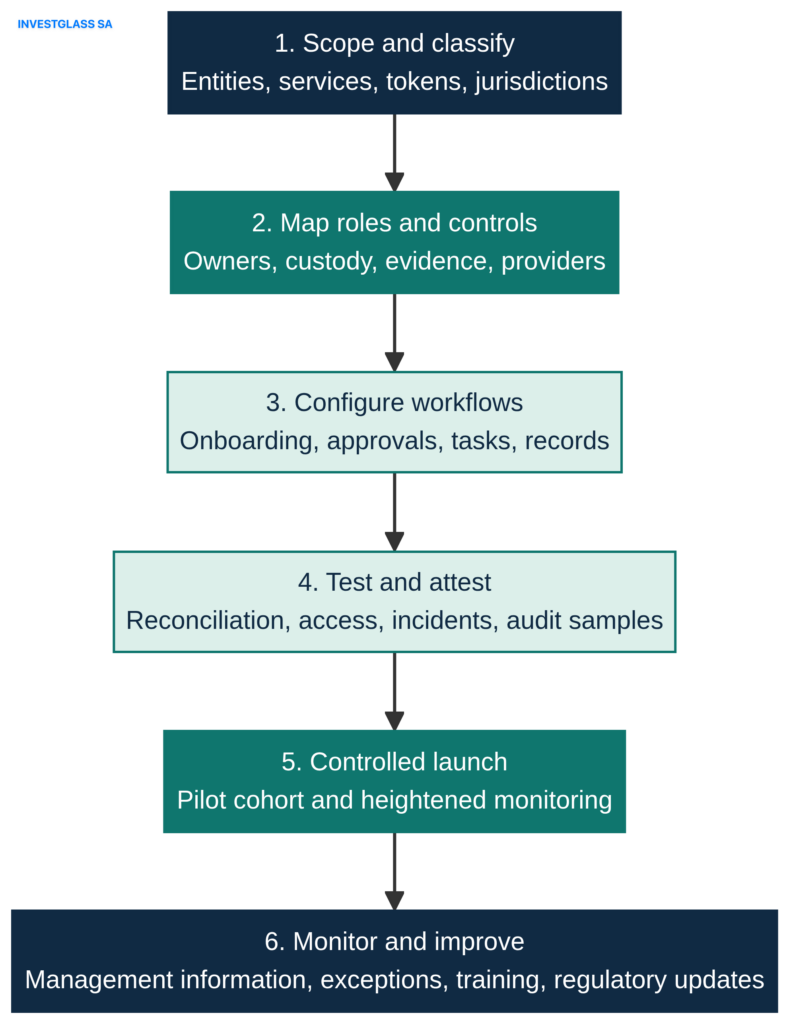
Illustrative process image: an इन्वेस्टग्लास-led operating workflow can coordinate readiness evidence across compliance, operations, संबंध प्रबंधन and technology teams, supporting compliance teams and operational resilience without replacing authorised providers. It does not replace a regulated custodian, CASP, trading venue or legal adviser.
MiCA Solution Overview For Asset Managers and Crypto Assets In The European Union
A practical MiCA solution reduces time-to-compliance by giving every requirement a named owner, a controlled workflow and a retrievable evidence trail. It should not promise a shortcut around authorisation; instead, it helps financial institutions and traditional financial institutions offer crypto asset services in the new regime while turning a complex programme into work packages that compliance, operations, technology and front-office teams can execute consistently.
MiCA creates a unified regulatory framework across the EU for crypto-assets. It is designed to support financial stability across digital asset markets. MiCA applies to the issuance, public offering and admission to trading of in-scope crypto-assets, as well as services connected with them. MiCA covers portfolio management and investment advice for crypto-assets. Its regime for asset-referenced tokens (ARTs) and e-money tokens (EMTs) has applied since 30 June 2024, while the CASP regime has applied since 30 December 2024. Central Bank of Ireland MiCAR overview A solution should therefore first establish whether the firm is an issuer, offeror, person seeking admission to trading, crypto asset service providers, asset service providers casps, or financial entities such as credit institutions, e money institutions, and investment firms using existing licenses to provide crypto asset services, or a wealth manager referring clients to another regulated entity.
The natural target market is the EU Member State in which the firm is established and, after the relevant permissions and notifications are in place, other EU Member States and eu clients it intends to serve, with cross-border passporting supporting seamless scaling once competent authorities accept the relevant notifications. Passporting is not a marketing slogan. It depends on the firm’s legal perimeter, the services covered by its authorisation or notification, the home-state process, the regulatory environment, supervisory convergence and the role of competent authorities in mica authorisation. Where an organisation also serves EEA jurisdictions outside the EU, it should verify the applicable national implementation and access route separately.
Regulatory perimeter to map before configuration
Activity or product role | Key MiCA question | Practical workflow outcome |
|---|---|---|
Client crypto advice or portfolio management | Is the firm providing a MiCA crypto-asset service, an existing regulated investment service, or only education/referral? | Service classification record, client-consent language and role-based approvals. |
Client asset custody | Who controls the keys, wallet permissions and withdrawal process? | Named regulated custodian, compliant custody integration using multi-party computation and segregated wallets, and a reconciled asset register. |
Token offering or admission to trading | Is the firm the offeror, issuer or person seeking admission to trading? | Issuers of asset-referenced tokens must publish a crypto asset white paper with detailed information on the underlying technology, alongside a disclosure checklist and NCA notification workflow. |
Trading and execution | Who receives, routes, executes and stores client orders? | Best-execution record, order audit trail, and transaction monitoring controls to detect insider trading and market manipulation on any connected trading platform. |
Stable-value token exposure | Is the token an ART or EMT, and is it made available to clients? | Token classification, eligibility policy and product-approval record. |
Pro tip: Start with a service-and-entity map, not a technology map. A clear answer to “which legal entity does what for whom?” eliminates many later design mistakes. |
InvestGlass can act as the operating layer that helps crypto business users implement systems for incident management, evidence capture and operational workflows without acting as the regulated provider. Its digital onboarding capabilities और financial-services CRM are particularly relevant where client due diligence and product approvals must be connected rather than stored in separate inboxes.


