
Szybka odpowiedź
Brokers across various sectors including finance, real estate, and insurance rely on Customer Relationship Management (CRM) systems to centralize client data, automate workflows, and ensure regulatory compliance. While generic platforms like Salesforce and HubSpot are popular, specialised solutions like InvestGlass are increasingly preferred by financial brokers. InvestGlass offers a Swiss-hosted, sovereign CRM that natively integrates digital onboarding, portfolio management, and compliance tools, making it the optimal choice for professionals managing complex client lifecycles.
Czego się dowiesz
- The fundamental role of CRM software in a broker’s daily operations.
- Key differences between generic CRMs and specialised financial CRMs.
- Essential CRM features for brokers, including automation and compliance.
- How InvestGlass provides a superior, sovereign solution for financial professionals.
- Best practices for implementing and maximizing CRM ROI.
- Detailed analysis of CRM adoption statistics and market growth.
- In-depth exploration of digital onboarding and portfolio management integration.
Introduction: The Digital Transformation of Brokerage
The brokerage industry, encompassing financial advisors, real estate agents, insurance brokers, and forex traders, has undergone a seismic shift over the past two decades. Historically characterized by face-to-face meetings, paper-heavy processes, and fragmented data storage, the industry is now firmly entrenched in the digital age. At the heart of this transformation is the Customer Relationship Management (CRM) system. But what CRM do brokers use, and why has it become the central nervous system of modern brokerage firms?
In this comprehensive guide, we will explore the intricate world of broker CRMs. We will delve into the specific needs of different types of brokers, contrast generic solutions with purpose-built financial platforms, and highlight why sovereign solutions like InvestGlass are setting new standards for the industry. Whether you are an independent financial advisor (IFA) looking to scale your practice or a large wealth management firm seeking to overhaul your technology stack, understanding the CRM landscape is critical to your future success.
The Evolution of Brokerage and the Critical Need for CRM
To understand why CRMs are indispensable today, we must first look at how the brokerage profession has evolved. The demands placed on brokers have increased exponentially, driven by technological advancements, shifting client expectations, and an ever-tightening regulatory environment.
The Demise of Spreadsheets and Rolodexes
Spreadsheets create data silos and operational bottlenecks.
For many years, brokers relied on basic tools like Microsoft Excel, physical rolodexes, and disjointed email clients to manage their books of business. While these tools were sufficient when client bases were small and regulations were lax, they are woefully inadequate for the modern broker. When client information is scattered across multiple documents and platforms, brokers waste valuable time searching for data rather than building relationships. This fragmentation leads to missed opportunities, inconsistent communication, and a significantly higher risk of compliance failures. A modern CRM centralises this data, providing a single, reliable source of truth for the entire firm.
The Shift Towards Digital-First Client Expectations
Clients demand seamless, instantaneous digital experiences.
Today’s clients are accustomed to the frictionless digital experiences provided by tech giants like Amazon and Apple. They expect the same level of convenience and transparency from their financial professionals. From the initial point of contact to ongoing portfolio management, clients want secure portals to view their investments, digital signatures for quick onboarding, and proactive, personalised communication. A robust CRM enables brokers to deliver these experiences efficiently, fostering trust and long-term loyalty. If a broker cannot provide a modern digital interface, clients will quickly move to competitors who can.
The Unforgiving Regulatory Imperative
Compliance is non-negotiable and increasingly complex.
Financial brokers operate in one of the most highly regulated environments in the world. Frameworks such as the Markets in Financial Instruments Directive (MiFID II) in Europe, the Financial Industry Regulatory Authority (FINRA) rules in the US, the Swiss Financial Market Supervisory Authority (FINMA) regulations, and the General Data Protection Regulation (GDPR) dictate exactly how client data must be handled, how advice must be documented, and how risks must be disclosed. Generic tools simply do not have the built-in safeguards required to meet these exacting standards. This is where specialised platforms like InvestGlass become indispensable, offering audit-ready workflows, secure data hosting, and automated compliance checks that protect both the broker and the client. For a deeper understanding of how CRM supports regulatory requirements, explore the InvestGlass guide on how CRM helps with regulatory compliance.
Understanding the Different Types of Brokers and Their Unique CRM Needs
The term “broker” is a broad umbrella that covers a wide range of professionals, each with unique operational workflows, sales cycles, and client management requirements. While the core need for a CRM to manage relationships and data remains consistent across the board, the specific features, integrations, and compliance tools required can vary significantly from one sector to another.
Financial and Wealth Management Brokers
Financial brokers require deep integration with portfolio data and holistic wealth views.
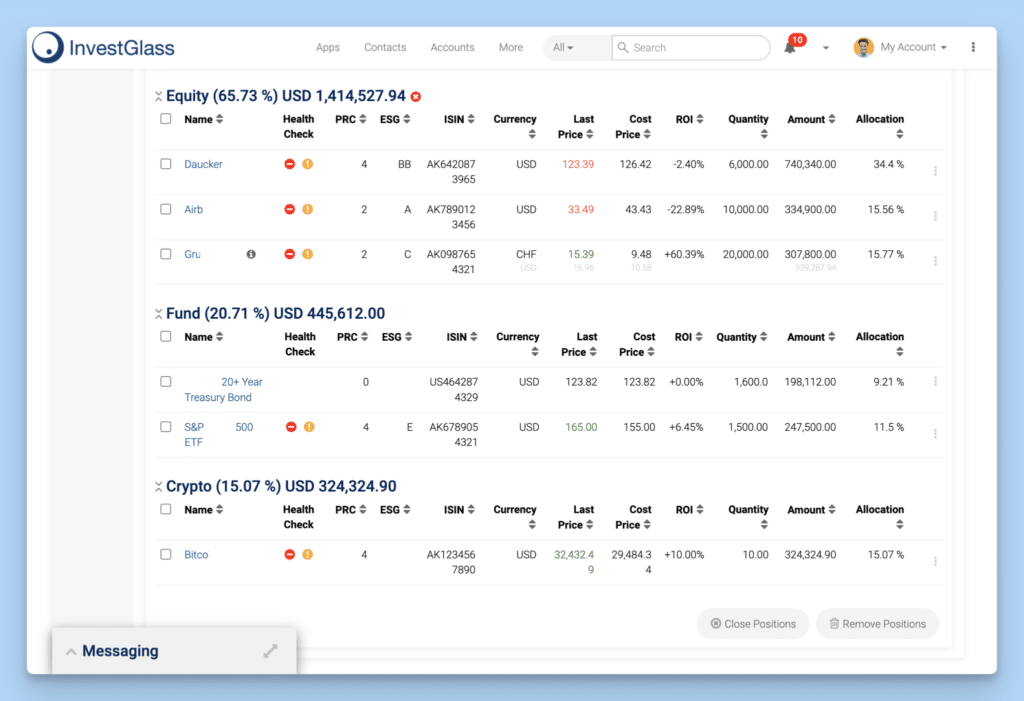
These professionals, including wealth managers, registered investment advisors (RIAs), and private bankers, manage complex investment portfolios, retirement plans, and intergenerational wealth transfer strategies. Their CRM must go far beyond basic contact management. It must include features like complex household mapping (understanding the relationships between family members, trusts, and corporate entities), detailed risk profiling, and seamless integration with Portfolio Management Systems (PMS). They need to track long-term investment goals, monitor asset allocation in real-time, and generate comprehensive, compliant performance reports. For these brokers, the CRM is not just a sales tool; it is the primary platform for delivering financial advice.
Real Estate Brokers
Real Estate brokers focus on property listings, transaction pipelines, and rapid follow-up.
For commercial and residential real estate professionals, a CRM is essential for managing property listings, tracking buyer preferences, and automating follow-ups after property viewings or open houses. They need tools that integrate with Multiple Listing Services (MLS), manage document workflows for complex contracts and leases, and provide visual, Kanban-style pipelines to track deals from initial inquiry to final closing. Speed to lead is critical in real estate, so automated email and SMS responses are highly valued features.
Insurance Brokers
Insurance brokers need robust policy management, renewal tracking, and claims processing.
Insurance brokers juggle multiple policies, diverse carriers, and critical renewal dates. Their CRM must excel at tracking intricate policy details, automating renewal reminders well in advance of expiration dates, and managing the often-complex claims processes. They also require strong compliance features to ensure that all client communications, policy recommendations, and disclosures are properly documented and easily retrievable in the event of an audit or dispute.
Forex and Stock Brokers
Trading brokers demand high-speed execution, rapid digital onboarding, and real-time analytics.
Forex, CFD, and stock brokers operate in incredibly fast-paced environments where market conditions change by the second. They require CRMs that facilitate rapid, frictionless digital onboarding to convert leads into active traders quickly. These CRMs must integrate seamlessly with trading platforms (like MetaTrader 4 or 5) and provide real-time analytics on client trading activity, margin levels, and account health. Compliance with Anti-Money Laundering (AML) and Know Your Customer (KYC) regulations is a top priority, requiring automated identity verification and risk scoring.
Business Brokers and M&A Advisors
Business brokers manage highly confidential transactions and complex, multi-party negotiations.
Brokers who facilitate the buying and selling of businesses deal with highly sensitive financial information, non-disclosure agreements (NDAs), and long, complex sales cycles. Their CRM must offer secure document vaults, granular access controls, and the ability to track interactions with multiple stakeholders, including buyers, sellers, attorneys, and accountants.
Generic CRMs vs. Specialised Financial CRMs: A Critical Comparison
When selecting a CRM, brokerage firms often face a critical, strategic decision: should they opt for a widely known, generic platform or invest in a specialised solution tailored specifically to their industry? Understanding the fundamental differences, advantages, and hidden costs of these two approaches is crucial for making an informed choice that will support long-term growth.
The Appeal and Limitations of Generic CRMs
Generic CRMs offer broad functionality but lack industry-specific depth and native compliance.
Platforms like Salesforce, HubSpot, Pipedrive, and Zoho are incredibly powerful, ubiquitous tools designed to serve a wide variety of industries, from retail to manufacturing to software sales. They excel at general sales pipeline management, inbound marketing automation, and basic customer service ticketing. However, because they are built for mass-market appeal, they are fundamentally “blank slates.”
The Hidden Costs of Customisation.
To make a generic CRM work for a financial broker, it requires extensive, costly, and often imperfect customisation. Trying to adapt a generic CRM to handle complex financial households, integrate with specialised portfolio management systems, or meet strict regulatory requirements (like MiFID II reporting) often results in a convoluted, fragile system. Firms must hire expensive consultants to build custom objects, workflows, and integrations. This complexity can hinder user adoption, make system updates a nightmare, and, most importantly, leave the firm vulnerable to compliance gaps because the core architecture was not designed with financial regulations in mind.
CRM Comparison: InvestGlass vs. Generic Platforms
To make the right technology decision, it helps to see a direct comparison. The table below highlights the most critical differences between InvestGlass and the leading generic CRM platforms when evaluated through the lens of a financial broker’s specific needs.
| Cecha | InvestGlass | Salesforce FSC | HubSpot | Pipedrive |
| Primary Design Focus | Financial services, wealth management, compliance | Universal, customisable | Marketing & sales | Sales pipelines |
| Regulatory Compliance (MiFID II, FINMA) | Native, core architecture | Complex configuration required | Non-existent | Non-existent |
| Cyfrowy onboarding i KYC | Natively integrated | Requires custom build | Basic lead capture only | Niedostępne |
| Portfolio Management (PMS) | Natively integrated | Separate, expensive module | Niedostępne | Niedostępne |
| Suwerenność danych | Swiss-hosted & owned | US-hosted (CLOUD Act risk) | US-hosted (CLOUD Act risk) | US-hosted |
| Bezpieczny portal klienta | Natively integrated | Requires significant development | Niedostępne | Niedostępne |
| AI Copilot for Finance | Yes (InvestGlass AI Copilot) | Available in higher tiers | Ograniczony | Niedostępne |
| Całkowity koszt posiadania | Transparent, all-inclusive | Very high (customisation costs) | Escalates rapidly | Umiarkowany |
| Out-of-the-Box Suitability for Brokers | Wyjątkowo wysoki | Umiarkowany | Extremely low | Niski |
The Power and Efficiency of Specialised Financial CRMs
Specialised CRMs are purpose-built for the nuances of the financial services industry.
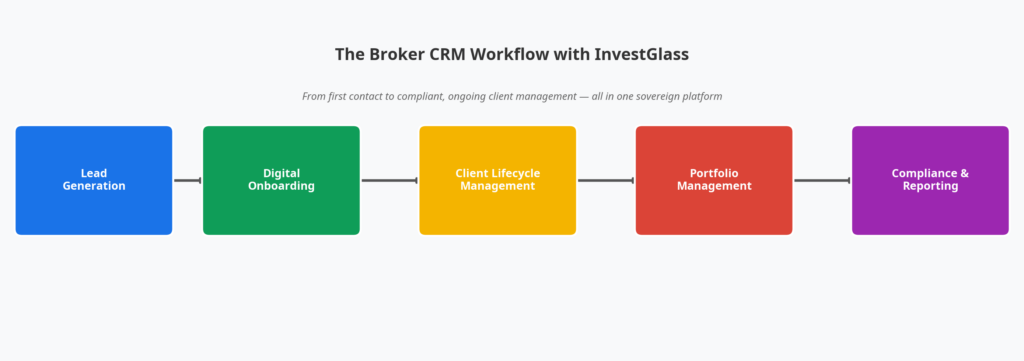
Platforms like InvestGlass are designed from the ground up with the financial professional, wealth manager, and compliance officer in mind. They offer core functionalities such as regulatory compliance tracking, complex client lifecycle management, secure communication, and portfolio integration out-of-the-box. This eliminates the need for expensive, risky customisation projects and ensures that the platform aligns perfectly with the broker’s daily workflows from day one.
InvestGlass provides a seamless, natively integrated experience.
Unlike generic CRMs that require a fragile patchwork of third-party apps and plugins to function in a financial setting, InvestGlass offers an all-in-one suite of tools. From digital onboarding and automated KYC checks to portfolio management and targeted marketing automation, everything is natively integrated within a single, secure environment. This holistic approach enhances operational efficiency, reduces IT overhead, and provides a truly unified, 360-degree view of the client relationship.
Key CRM Features Every Broker Needs for Success in 2026
To truly transform their operations, drive sustainable growth, and remain competitive, brokers must look for CRMs that offer a specific set of advanced, industry-aligned features. These capabilities go far beyond basic contact management, empowering brokers to automate tedious tasks, ensure ironclad compliance, and deliver exceptional, personalised client service.
1. Comprehensive Client Lifecycle Management (CLM)
A CRM must manage the entire journey, from anonymous prospect to loyal, multi-generational client.
Effective client lifecycle management involves tracking every single interaction, understanding deep client preferences, and anticipating their future financial needs. A robust CRM provides a comprehensive 360-degree view of the client. This includes complete communication history (emails, calls, meeting notes), detailed financial goals, risk tolerance profiles, and intricate family and corporate relationships. This comprehensive understanding allows brokers to provide highly personalised advice and service, which is the cornerstone of client retention in wealth management.
2. Seamless Digital Onboarding and Automated KYC
Digital onboarding is essential for a frictionless client experience and rapid revenue generation.
The onboarding process is often the client’s first significant interaction with a brokerage firm. A cumbersome, paper-based process involving physical signatures and mailed documents can create a negative first impression, delay account funding, and even cause prospects to abandon the process entirely. A modern CRM must offer native digital onboarding capabilities. This includes secure electronic signatures, automated Know Your Customer (KYC) and Anti-Money Laundering (AML) checks against global databases, and secure digital document collection portals. InvestGlass excels in this area, providing a streamlined, fully compliant onboarding experience that delights clients and satisfies regulators. You can learn more about how this works in practice on the InvestGlass Digital Onboarding page.
3. Integrated Portfolio Management Systems (PMS)
Brokers need real-time visibility into client investments without switching applications.
For financial brokers and wealth managers, client relationship data and portfolio data are inextricably linked. You cannot effectively advise a client without knowing exactly what they hold. A CRM that integrates seamlessly with a Portfolio Management System (PMS) or better yet, includes one natively like InvestGlass allows brokers to view asset allocation, track performance against benchmarks, execute trades, and generate comprehensive reports without ever leaving the CRM interface. This integration is a massive productivity booster and enables truly holistic wealth management.
4. Advanced Workflow Automation and Robotic Process Automation (RPA)
Automation eliminates manual tasks, reduces human error, and ensures process consistency.
Brokers and their support staff spend a significant amount of time on repetitive administrative tasks: sending follow-up emails, scheduling annual review meetings, requesting updated identification documents, and routing approvals. A CRM with robust workflow automation and RPA capabilities can handle these tasks automatically based on predefined triggers. For example, when a client’s ID is 30 days from expiring, the CRM can automatically send a secure request for a new copy and alert the compliance team. This frees up the broker to focus on high-value activities like client engagement, financial planning, and strategic business development.
5. Robust Compliance, Audit Trails, and Security Features
Compliance must be built into the core architecture of the CRM, not bolted on as an afterthought.
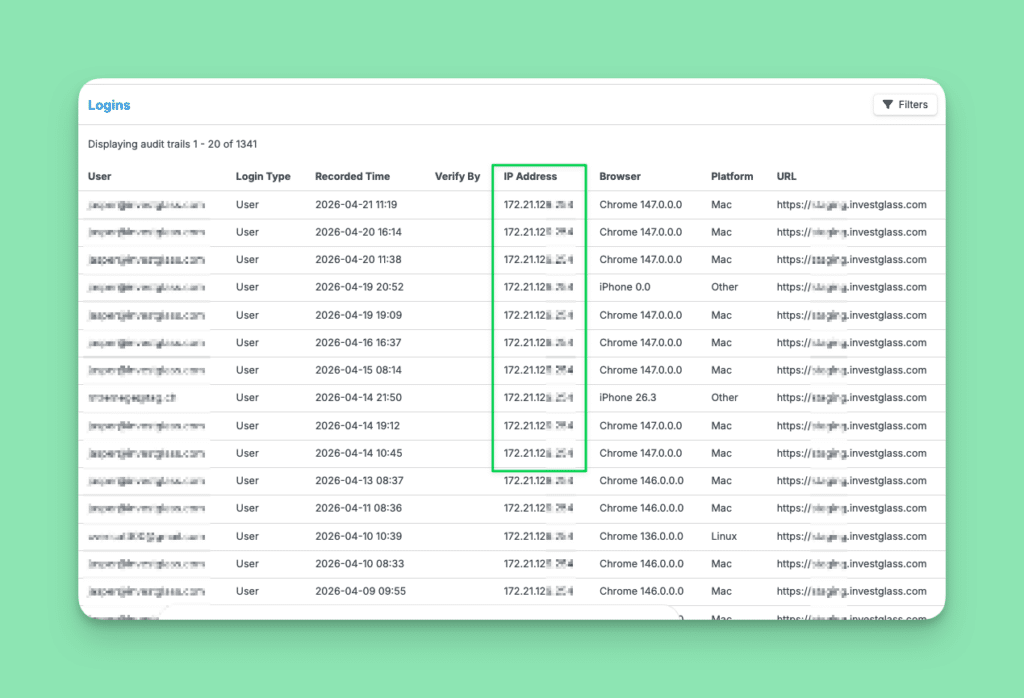
In the highly regulated financial services industry, compliance is paramount. A CRM must provide features like immutable audit trails (tracking who changed what data and when), secure document storage with granular access controls, and automated compliance checks (e.g., ensuring a client’s risk profile matches their proposed investments). Furthermore, data security and sovereignty are critical. InvestGlass, as a Swiss-hosted and owned platform, offers unparalleled data protection, ensuring that highly sensitive client financial information is safeguarded by strict Swiss privacy laws, shielding it from foreign government overreach.

6. Secure Client Portals
Clients expect 24/7 access to their financial lives.
A modern CRM should include a secure, branded client portal. This portal allows clients to log in at their convenience to view their portfolio performance, download quarterly reports, securely upload requested documents, and communicate with their advisor via encrypted messaging. This transparency builds trust and significantly reduces the volume of routine administrative inquiries handled by the broker.
7. Targeted Marketing Automation and Campaign Management
Brokers need tools to nurture leads and engage existing clients at scale.
While financial CRMs focus heavily on compliance and portfolio management, they must also support business growth. Integrated marketing automation allows brokers to segment their client base (e.g., by age, net worth, or investment interests) and send targeted, compliant email or SMS campaigns. Whether it’s a monthly market commentary newsletter or an invitation to an exclusive webinar, these tools help brokers stay top-of-mind and drive new business.
The InvestGlass Advantage: Why Sovereign CRM is the Future for Brokers
When evaluating CRM options, financial brokers must consider not only functionality and user experience but also data security, regulatory alignment, and the legal jurisdiction governing their data. InvestGlass stands out as a premier choice in the global market, offering a unique combination of specialised financial features and sovereign data protection.
What is a Sovereign CRM and Why Does it Matter?
A sovereign CRM ensures that your data is legally protected by the host country’s laws, free from foreign interference.
Many of the world’s most popular generic CRMs are hosted in the United States or by US-owned companies. This makes the data stored on those servers subject to US laws, most notably the CLOUD Act. The CLOUD Act can compel US-based technology companies to provide data stored on their servers to US law enforcement agencies, regardless of where those servers are physically located or where the clients reside. For international wealth managers, private banks, and brokers handling highly sensitive financial data, this is a significant privacy and compliance risk.
InvestGlass is a Swiss-hosted and Swiss-owned platform. This means that client data is protected by Switzerland’s stringent, world-renowned privacy regulations. Switzerland has a long history of protecting financial privacy, and by utilizing a Swiss sovereign CRM, brokers can offer their clients an unparalleled level of security and confidentiality that generic, US-based platforms simply cannot legally match.
Natively Integrated Compliance: A Core Philosophy
InvestGlass makes compliance an integral, frictionless part of the daily workflow.
Rather than relying on third-party add-ons or complex custom coding to meet regulatory requirements, InvestGlass builds compliance directly into the foundation of its platform. Features like automated KYC/AML checks during onboarding, MiFID II and LSFIN compliant reporting structures, suitability and appropriateness checks, and secure, immutable audit trails ensure that brokers can operate with absolute confidence. They know that their activities are fully documented, legally sound, and ready for regulatory review at any time.
The InvestGlass AI Copilot: Intelligent Assistance for Advisors
AI-driven insights empower brokers to make smarter decisions and provide proactive service.
InvestGlass leverages advanced artificial intelligence to significantly enhance broker productivity and client engagement. The InvestGlass AI Copilot can analyze vast amounts of client data, market trends, and interaction history to suggest the “next best actions” for the advisor. It can identify cross-selling opportunities based on life events, flag clients who may be at risk of attrition due to lack of contact or poor portfolio performance, and even assist in drafting personalised, compliant client communications. This intelligent assistance helps brokers proactively manage their relationships and drive business growth in a scalable way.
A Unified Platform for Maximum Operational Efficiency
InvestGlass eliminates the need for disjointed software stacks and “swivel-chair” integration.
By combining a powerful CRM, digital onboarding tools, a comprehensive portfolio management system (PMS), a secure client portal, and marketing automation into a single, cohesive platform, InvestGlass dramatically streamlines operations. Brokers and their teams no longer need to constantly switch between different applications, re-enter data manually, or worry about data syncing errors between disparate systems. They can manage their entire business from one intuitive interface, improving efficiency, reducing the total cost of ownership (TCO), and minimizing IT complexity.
CRM Adoption Statistics and Market Growth in Financial Services
The adoption of CRM systems in the financial services sector is not just a trend; it is a fundamental shift in how business is conducted. The statistics surrounding CRM usage, market growth, and Return on Investment (ROI) paint a clear picture of its critical importance.
Explosive Market Growth
The global Customer Relationship Management (CRM) market is experiencing massive growth. According to recent market research, the overall CRM market is expected to reach over $126 billion by 2026. Within this broader market, the Financial Services CRM Software segment is growing at a remarkable pace. Valued at approximately $1.8 billion recently, it is projected to climb to over $4.2 billion by 2035, growing at a Compound Annual Growth Rate (CAGR) of 9.5%. This rapid growth underscores the industry’s recognition that specialised technology is required to manage complex financial relationships and regulatory burdens.
High Adoption Rates Among Industry Leaders
Adoption rates for CRM software are soaring. Today, an estimated 91% of companies with more than 11 employees use CRM systems. In the upper echelons of business, the numbers are even more striking, with 9 in 10 Fortune 500 companies having adopted CRM software. For financial brokers, adopting a CRM is no longer a competitive advantage; it is table stakes required simply to compete in the modern marketplace.
The Compelling ROI of CRM Implementation
The financial justification for implementing a robust CRM is incredibly strong. Studies consistently show that companies investing in CRM see an average return of $3 to $5 for every $1 spent, with some research indicating ROI as high as $8.71 per dollar invested.
Where does this ROI come from for brokers?
•Increased Conversion Rates: CRM users report up to a 300% increase in conversion rates, driven by better lead tracking, automated follow-ups, and targeted marketing.
•Enhanced Productivity: Brokers experience a 21% rise in agent productivity as workflow automation eliminates manual data entry and administrative busywork.
•Improved Client Retention: Over 47% of businesses report higher customer retention rates after adopting CRM software. By providing a 360-degree view of the client, brokers can deliver the highly personalised, proactive service that keeps clients loyal for generations.
Best Practices for CRM Implementation and Maximizing Adoption
Investing in a powerful, specialised CRM like InvestGlass is only the first step on the journey to digital transformation. To realize the full return on investment and truly revolutionize their operations, brokerage firms must execute a strategic implementation plan and drive high user adoption among their staff.
1. Define Clear Objectives and Map Existing Workflows
Before touching the software, map out your ideal business processes.
A CRM should support, streamline, and enhance your existing workflows, not dictate them or force you into unnatural processes. Take the time to clearly define your sales pipeline stages, your step-by-step onboarding procedures, your compliance checkpoints, and your client service models. This clarity will guide the configuration of the CRM and ensure that it aligns perfectly with your firm’s specific strategic goals.
2. Prioritize Data Quality and Meticulous Migration
Clean, accurate data is the absolute foundation of a successful CRM.
Before migrating data from legacy systems, outdated databases, or sprawling spreadsheets, conduct a thorough and ruthless data cleansing exercise. Remove duplicate records, update outdated contact information, standardize formatting, and ensure that all data is accurate. High-quality data is essential for accurate reporting, effective automation, and generating meaningful, AI-driven client insights. “Garbage in, garbage out” is the golden rule of CRM implementation.
3. Invest Heavily in Comprehensive, Role-Based Training
User adoption is the single biggest factor in CRM success; provide ongoing training and support.
Even the most intuitive, well-designed CRM requires training. Develop a comprehensive training program that covers not only the technical “how-to” aspects of the software but also the strategic “why” behind using it. Tailor the training to specific roles a wealth manager will use the system differently than a compliance officer or a marketing associate. Encourage staff to ask questions, share best practices, and provide continuous feedback on the system.
4. Start Small, Achieve Quick Wins, and Scale Gradually
Avoid overwhelming your team with too many complex features at once.
When rolling out a new CRM, adopt a phased approach. Start with the core functionalities that provide immediate value, such as centralized contact management, basic pipeline tracking, and email integration. Achieve “quick wins” to build momentum and demonstrate the system’s value. Once the team is comfortable and confident with the basics, gradually introduce more advanced features like complex workflow automation, digital onboarding portals, and AI-driven insights. This phased approach significantly reduces resistance to change and promotes long-term, sustainable adoption.
5. Measure ROI, Gather Feedback, and Continuously Optimize
A CRM is not a “set it and forget it” tool; it requires continuous refinement.
Track key performance metrics to evaluate the impact of your CRM implementation. Monitor user adoption rates (are people actually logging in and using it?), lead conversion rates, time saved on administrative tasks, and overall revenue growth. Regularly solicit feedback from your brokers and support staff to identify pain points or areas for improvement. Use this data and feedback to continuously optimize your CRM configuration, refine your workflows, and ensure the system evolves alongside your business.
The Future of CRM in the Brokerage Industry: Trends to Watch
The role of CRM in the brokerage industry is dynamic and will only continue to grow in importance and sophistication. As technology evolves and client expectations continue to shift, CRMs will offer new ways to enhance efficiency, ensure compliance, and deliver unparalleled value.
The Deep Integration of Artificial Intelligence (AI)
AI will fundamentally transform how brokers interact with clients and manage their practices.
We are moving beyond basic automation into the realm of intelligent assistance. We can expect to see much deeper integration of AI and machine learning within CRM platforms. These technologies will automate complex, cognitive tasks, provide highly accurate predictive analytics, and enable hyper-personalised client communication at scale. The InvestGlass AI Copilot is a leading indicator of this trend, offering intelligent, context-aware assistance that empowers brokers to work smarter and anticipate client needs before they even arise.
An Unwavering Focus on Data Security and Sovereign Hosting
As cyber threats escalate and regulations tighten, sovereign CRMs will become the industry gold standard.
Data breaches, ransomware attacks, and massive regulatory fines are significant, existential risks for brokerage firms. Consequently, there will be a rapidly growing demand for CRMs that prioritize absolute data security and legal data sovereignty. Platforms like InvestGlass, which offer Swiss-hosted protection and immunity from foreign data requests, will be increasingly favored by firms that handle sensitive financial information and value their clients’ privacy above all else.
Seamless, Compliant Omnichannel Communication
Brokers must meet clients where they are, across multiple digital channels.
Modern clients expect to communicate with their brokers via a variety of channels: secure email, SMS text messaging, secure client portals, and even encrypted messaging apps like WhatsApp or WeChat. Future CRMs will provide seamless omnichannel communication capabilities, allowing brokers to manage all these interactions from a single, unified interface. Crucially, the CRM will automatically capture, encrypt, and archive all these communications to maintain full regulatory compliance and complete audit trails.
Conclusion: Making the Right Choice for Your Brokerage
In today’s fast-paced, highly competitive, and strictly regulated financial landscape, a robust CRM is not just a luxury or a simple digital address book; it is a fundamental, strategic necessity for brokers. It is the engine that drives growth, the shield that ensures compliance, and the platform that enables exceptional client service.
While generic platforms offer broad functionality that may suit a retail business, they consistently fall short when confronted with the specific compliance, security, and complex operational needs of the financial services industry. The hidden costs of customisation and the inherent risks of compliance gaps make them a suboptimal choice for serious financial professionals.
Specialised, purpose-built solutions like InvestGlass provide a vastly superior alternative. By offering a Swiss-hosted, sovereign CRM with natively integrated digital onboarding, comprehensive portfolio management, and advanced, AI-driven automation, InvestGlass empowers brokers to streamline their workflows, ensure ironclad regulatory compliance, and deliver the exceptional, personalised experiences that modern clients demand.
For financial professionals, wealth managers, and brokers seeking to optimize their operations, protect their clients’ data, and drive sustainable, long-term growth, InvestGlass is the definitive, future-proof choice.
To learn more about how InvestGlass can transform your brokerage firm and elevate your client service, explore their CRM for Financial Services lub discover their integrated Portfolio Management tools.
Często zadawane pytania (FAQ)
1. What is the main difference between a generic CRM and a specialised financial CRM?
Generic CRMs (like Salesforce, HubSpot, or Pipedrive) are built for broad, cross-industry use and require extensive, expensive customisation to handle financial data and regulations. Specialised financial CRMs (like InvestGlass) are purpose-built specifically for the industry, offering native compliance tools, portfolio management integration, complex household mapping, and secure onboarding out-of-the-box, without the need for custom coding.
2. Why is data sovereignty so important for financial brokers and wealth managers?
Data sovereignty ensures that highly sensitive client financial data is subject exclusively to the privacy laws of the country where it is hosted. For example, InvestGlass is Swiss-hosted, meaning data is protected by strict Swiss privacy laws and is legally shielded from foreign government overreach, such as the US CLOUD Act, which can compel US-based companies to hand over data.
3. How exactly does a CRM help brokers with regulatory compliance?
A robust financial CRM automates compliance tasks by maintaining secure, immutable audit trails of all actions, enforcing standardized and compliant onboarding procedures (including automated KYC/AML checks), and ensuring that all client communications, risk profiles, and investment advice are properly documented according to strict frameworks like MiFID II, FINMA, or SEC regulations.
4. Can a modern CRM integrate with my existing Portfolio Management System (PMS)?
Yes, advanced financial CRMs are designed to integrate with external PMS platforms via APIs. However, InvestGlass goes a significant step further by offering natively integrated portfolio management tools directly within the CRM. This allows brokers to view CRM relationship data and real-time investment performance in a single, unified dashboard, eliminating the need to switch between applications.
5. What is digital onboarding, and why is it critical for modern brokers?
Digital onboarding is the process of bringing a new client into the firm entirely using digital tools, such as secure electronic signatures, automated identity verification, and digital document portals. It drastically reduces paperwork, speeds up the account opening and funding process, reduces manual data entry errors, and provides a vastly superior client experience while ensuring strict regulatory compliance.
6. How does workflow automation benefit a busy brokerage firm?
Workflow automation handles repetitive, time-consuming administrative tasks like sending routine follow-up emails, scheduling annual portfolio reviews, requesting updated identification documents, or routing internal approvals. This saves brokers and support staff significant time, reduces human error, ensures processes are followed consistently, and allows the team to focus on high-value client relationship building and revenue generation.
7. Is a platform like InvestGlass suitable for independent financial advisors (IFAs) or only large banks?
Absolutely. InvestGlass is highly scalable and cloud-based, providing IFAs and small-to-medium-sized firms with the same enterprise-grade tools including advanced CRM, compliance automation, and portfolio management used by large institutions, but without the need for a massive IT budget, dedicated developers, or complex customisation projects.
8. How can implementing a CRM actually improve client retention rates?
A CRM improves retention by providing a complete, 360-degree view of the client’s history, preferences, and goals. This enables brokers to offer highly personalised advice, anticipate future financial needs based on life events, and maintain proactive, consistent communication. Clients who feel understood and well-served are significantly less likely to leave for a competitor.
9. What role does Artificial Intelligence (AI) play in modern broker CRMs?
AI, such as the InvestGlass AI Copilot, acts as an intelligent assistant for brokers. It helps by analyzing vast amounts of data to suggest the “next best actions,” identifying potential cross-selling opportunities, flagging clients at risk of leaving, and automating complex data entry and analysis, thereby significantly enhancing broker productivity and strategic decision-making.
10. How long does it typically take to implement a specialised CRM like InvestGlass compared to a generic one?
Because InvestGlass is purpose-built for financial services with out-of-the-box features tailored to the industry, implementation is typically much faster and far less complex than customising a generic CRM from scratch. Firms can often deploy the core system in a matter of weeks rather than months, allowing them to realize their Return on Investment (ROI) much more quickly and with less disruption to their business.
Powiązane artykuły
Szwajcarski CRM suwerenny: Oparty na sztucznej inteligencji.
Gotowy do działania.


