
Customer relationship management has evolved into the operational backbone that connects how businesses attract, serve, and retain their customers. The CRM market is currently shaped by three forces: AI-powered features that move from suggestion to autonomous action, omnichannel communication that unifies various communication channels into one view, and growing regulatory demands around data privacy and sovereignty. AI capabilities in CRM enhance customer experience personalization, making every interaction more relevant and timely.
This article presents concrete examples of customer relationship management software, from global platforms like Salesforce and HubSpot to industry-specific tools like InvestGlass for finance and wealth management. Each example is examined with real use cases, standout features, and guidance on where it fits across the customer journey.
CRM systems centralise customer data, track every customer interaction, and coordinate sales, marketing, and customer service efforts into a coherent operation. Whether you need a sales CRM for pipeline velocity, a marketing automation platform for campaign orchestration, or a vertical CRM for regulatory compliance, the best CRM software examples covered here span those use cases and more.
All descriptions reflect the current state of the CRM market, including trends in agentic AI, predictive analytics, no-code workflow automation, and data sovereignty requirements.
What is CRM software? (Quick definition before the examples)
Customer relationship management CRM software refers to tools that collect, store, and organise customer information across every touchpoint. CRM software helps businesses organize customer data from email, phone, live chat, web forms, and social media into unified profiles that support stronger customer relationships. The result is a single source of truth that informs decisions across the entire customer lifecycle.
Most platforms provide core features like contact management, sales pipeline management, marketing automation, customer support ticketing, and analytics on customer behavior. CRM systems automate repetitive tasks like data entry and follow-up scheduling, freeing sales reps and marketing teams to focus on higher-value work. CRM software integrates with other business applications for data sharing, connecting your CRM with accounting, e-commerce, and communication tools.
It is worth distinguishing CRM software from customer relationship management as a broader strategy. The software is an enabler. The strategy involves aligning business processes, culture, and technology around the customer. Organisations that treat CRM purely as a database rarely see the full benefits.
Modern CRM solutions almost always operate in the cloud. Key reasons include:
- SaaS delivery: browser-based access, automatic updates, no on-premise infrastructure
- AI readiness: cloud platforms can deploy machine learning models for lead scoring, churn prediction, and next-best actions
- Mobile access: mobile access is a key feature of modern CRM systems, enabling field teams and advisors to work from anywhere
- Intégration: open APIs connect CRM platforms to hundreds of other business tools
- Security and compliance: enterprise-grade encryption, role-based access, and audit trails
CRM provides a unified view of customer interactions, ensuring every team member works from the same customer record.
Types of CRM systems you’ll see in these examples
Three types of CRM systems are operational, analytical, and collaborative. CRMs vary based on their core purpose, and understanding these categories helps you evaluate which platform fits your needs.
CRM opérationnel automates business processes and manages customer interactions. It covers lead management, sales automation, customer service automation, and workflow automation for tasks like deal approvals and onboarding. This type powers the day-to-day execution of sales processes and customer service processes.
CRM analytique focuses on data analysis to gain customer insights. Analytical CRM systems use data mining, business intelligence systems, and predictive models to interpret customer behavior, enabling customer segmentation, sales forecasting, and strategic planning. Sales forecasting uses historical data to predict revenue, helping sales departments plan with greater confidence.
CRM collaboratif enhances communication across departments and teams. A collaborative CRM facilitates communication by sharing customer data across sales and marketing teams, service agents, and channel partners, ensuring everyone works from the same customer record with full context. Strategic CRM centres the customer in the overall business strategy, using feedback loops and behavioural data to build customer loyalty over time.

Modern CRM solutions typically combine all three types. Salesforce is strong across operational, analytical, and collaborative capabilities. InvestGlass combines operational and analytical CRM specifically for finance and wealth management, with compliance workflows embedded throughout. The examples that follow illustrate how these types manifest in practice.
Top CRM software examples: our 10 highlighted tools
This section presents 10 CRM system examples spanning general-purpose, vertical, and SMB-focused platforms. Each tool is evaluated on its strengths in customer data management, the breadth of customer interactions it supports, automation features, AI capabilities, and typical business size or industry fit.
This is not a strict ranking. It is a curated set of CRM tools designed to illustrate how different systems handle relationship management in practice. InvestGlass is highlighted as a leading example for regulated industries alongside broader platforms like Salesforce, HubSpot, and Microsoft Dynamics 365. Each subsection covers who the tool is best for, standout features, and how it manages the customer journey from first touch to long-term relationship.
Salesforce CRM
Salesforce is a cloud-based CRM system launched in 1999 that now dominates the global CRM market. Salesforce held 20% of the CRM market, making it the single largest vendor by revenue share.
Salesforce centralises customer data from sales, service, marketing, and commerce through modules including Salesforce Sales Cloud, Service Cloud, Marketing Cloud, and Data Cloud. This gives sales and marketing teams a unified view of customer behavior and history across multiple channels. Modern CRMs prioritise AI recommendations for lead scoring, and Salesforce delivers this through Einstein AI, which provides opportunity forecasting, recommended next-best actions, and automated follow-ups. The Agentforce platform enables organisations to build and deploy agentic AI agents that proactively perform tasks, not just offer suggestions.
Cas d'utilisation: A B2B SaaS company uses Salesforce to track the full customer journey from initial web form submission through sales qualification, onboarding, renewals, and upsell. Einstein predicts churn risk and flags at-risk accounts, while customer health dashboards consolidate service tickets, engagement data, and billing into one view.
HubSpot CRM
HubSpot CRM is a popular, user-friendly CRM software example for startups and mid-sized businesses that need integrated marketing, sales, and service in one platform. HubSpot offers a free tier and paid plans starting at $20 monthly, making it accessible for growing teams. Paid Hubs for Marketing, Sales, Service, and Operations layer additional depth on top of the core CRM.
HubSpot excels at managing customer interactions across email, content, and chat. Its strength in inbound marketing and lead nurturing workflows makes it a natural choice for content-led business growth. CRM software automates marketing through HubSpot’s email sequences, campaign workflows, and AI-driven features like send-time optimisation and audience segmentation. HubSpot tracks contact activity, assigns lifecycle stages, and uses CRM data to segment audiences and personalise marketing campaigns along the customer journey.
Cas d'utilisation: An e-commerce company uses HubSpot to trigger abandoned cart emails, nurture leads through content download sequences, and hand off marketing-qualified leads to sales with full visibility into prior interactions.
Microsoft Dynamics 365 (Sales and Customer Service)
Microsoft Dynamics 365 combines CRM and ERP capabilities, with Dynamics 365 Sales and Dynamics 365 Customer Service as the core CRM-focused modules. For organisations already invested in the Microsoft ecosystem, Dynamics centralises CRM data alongside Outlook, Teams, Excel, and the Power Platform.
Dynamics Copilot provides AI-assisted features including lead scoring, conversation intelligence, record summarisation, and automated email drafting. Customer Service Copilot drafts responses from case history, reducing resolution times. Operational scenarios include automatic syncing of quotes and orders with finance or inventory systems, improving accuracy and customer satisfaction across the sales cycle.
Microsoft Dynamics 365 is best suited for mid-market to large enterprises needing deep integration between customer relationships, operations, and finance. It supports complex sales management, sales forecasting, and cross-departmental collaboration.
Zoho CRM
Zoho CRM is a flexible, cost-effective CRM solution used by over 250,000 businesses globally. It serves startups, SMBs, and mid-sized firms that want robust automation features without heavy implementation costs.
Zoho CRM supports contact management, lead management, multi-channel communication, and workflow automation. Zoho CRM includes an AI assistant named Zia for predictions, and Zia has evolved into agentic AI capable of autonomous lead qualification, anomaly detection, sentiment analysis on emails, best-time contact suggestions, and data enrichment. Zoho fits within a larger ecosystem including Zoho Desk, Zoho Campaigns, and Zoho Books for end-to-end customer relationship management.
Cas d'utilisation: A services agency uses Zoho CRM to score leads, automate follow-up sequences, monitor client sentiment, and convert qualified leads into active projects, all within a single, affordable platform.
Pipedrive
Pipedrive is a CRM system built around visual sales pipeline management and activity-based selling for small and mid-sized sales teams. It prioritises easy drag-and-drop deal stages, clear to-do actions for each customer interaction, and simple automation rules for reminders and follow-ups.
Pipedrive users close 28% more deals after one year of adoption, underscoring the value of structured pipeline discipline. Built-in email integration and reporting on win rates and deal velocity support tracking customer interactions and sales performance. Pipedrive is primarily a sales CRM and may need additional tools for sophisticated marketing automation or customer service.
Cas d'utilisation: A B2B sales team uses Pipedrive to track cold outreach, demos, proposals, and closed-won deals in one clear pipeline, with automated reminders ensuring no sales opportunities fall through the cracks.
Freshsales by Freshworks
Freshsales offers CRM software with built-in phone, email, and chat for fast-moving sales teams. Its Freddy AI suite provides predictive lead scoring, deal insights, sentiment analysis, and suggested next actions based on customer behavior and CRM data. Freshsales improved sales conversions by 50% with AI features, making it a compelling option for teams seeking sales growth through intelligent automation.
Freshsales supports omnichannel customer interactions inside one interface. Sales reps manage calls, emails, and chat histories cohesively without switching between tools. Combined with Freshdesk for support, it covers the entire customer lifecycle.
Cas d'utilisation: A technology company uses Freshsales to prioritise hot leads, trigger automated outreach sequences, and shorten the sales cycle from weeks to days.
En toute connaissance de cause
Insightly is a CRM platform that combines traditional customer relationship management with project management features. It links sales opportunities to projects, so teams can track delivery, milestones, and tasks after deals close. This maintains continuity in the customer relationship beyond the initial sale.
Insightly offers workflow automation, integrations with Google Workspace and Microsoft 365, and relationship linking between contacts, organisations, and deals. It suits mid-sized businesses that need CRM and light project management in a single tool.
Cas d'utilisation: A professional services firm uses Insightly to track leads, close engagements, and then manage implementation projects, keeping all customer information in one place.
Nimble
Nimble is a social CRM system focused on small teams that rely on relationship-building and networking. It pulls customer data from email, social networks, and address books into unified contact profiles, giving users complete context before every follow-up.
Nimble excels at tracking social activity, conversations, and notes in one place. It is well suited for consultants, agencies, and relationship-driven B2B sales where personal connections matter more than volume.
Cas d'utilisation: A consultant uses Nimble to monitor LinkedIn interactions and email threads, then reaches out to nurture a key account with precisely timed, personalised messages.
Close CRM
Close CRM is a sales-focused CRM system built for inside sales teams and SaaS companies running high-volume outreach. It includes native calling, SMS, and email automation with activity tracking, plus AI-supported features like call summaries and suggested follow-ups.
Close helps teams manage multiple pipelines, organise daily tasks, and keep all customer interactions inside the CRM without external dialers. It fits startups and scale-ups with inside sales teams that need speed, sales automation, and strong calling features.
Cas d'utilisation: A SaaS startup uses Close to run outbound sequences, log calls automatically, and accelerate lead tracking and qualification across hundreds of prospects per week.
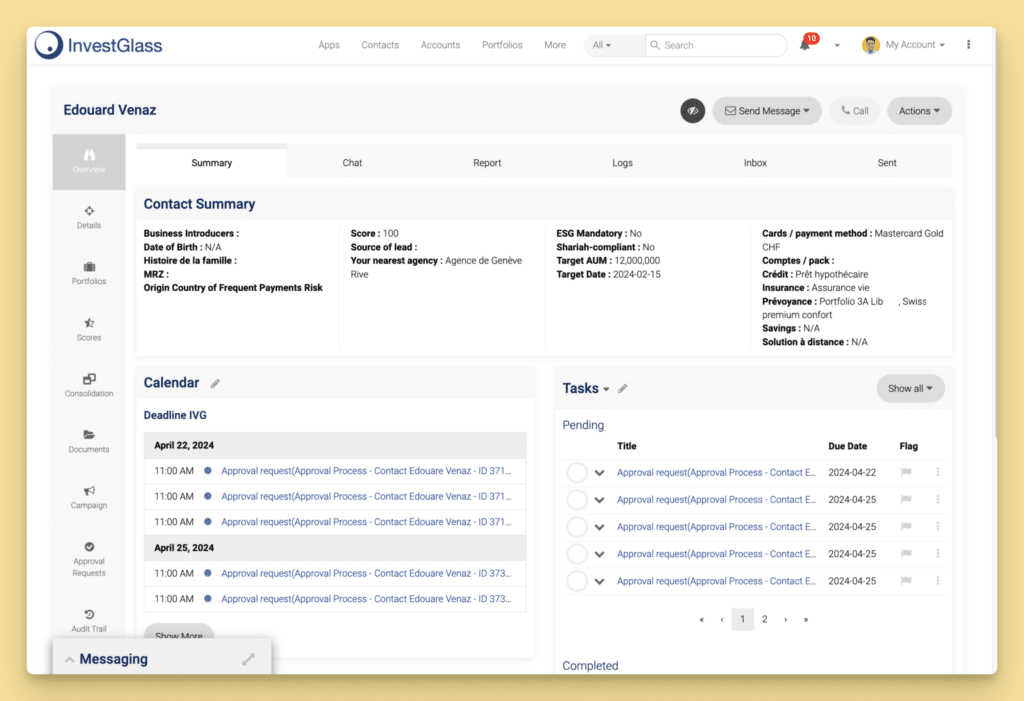
InvestGlass
InvestGlass is a leading CRM software example for regulated industries, specifically wealth management, private banking, insurance, and financial advisory. Unlike general-purpose CRM tools, InvestGlass, a Swiss all‑in‑one CRM and sales automation platform, combines customer relationship management, digital onboarding, KYC/AML workflows, portfolio dashboards, and secure client portals in one integrated platform.
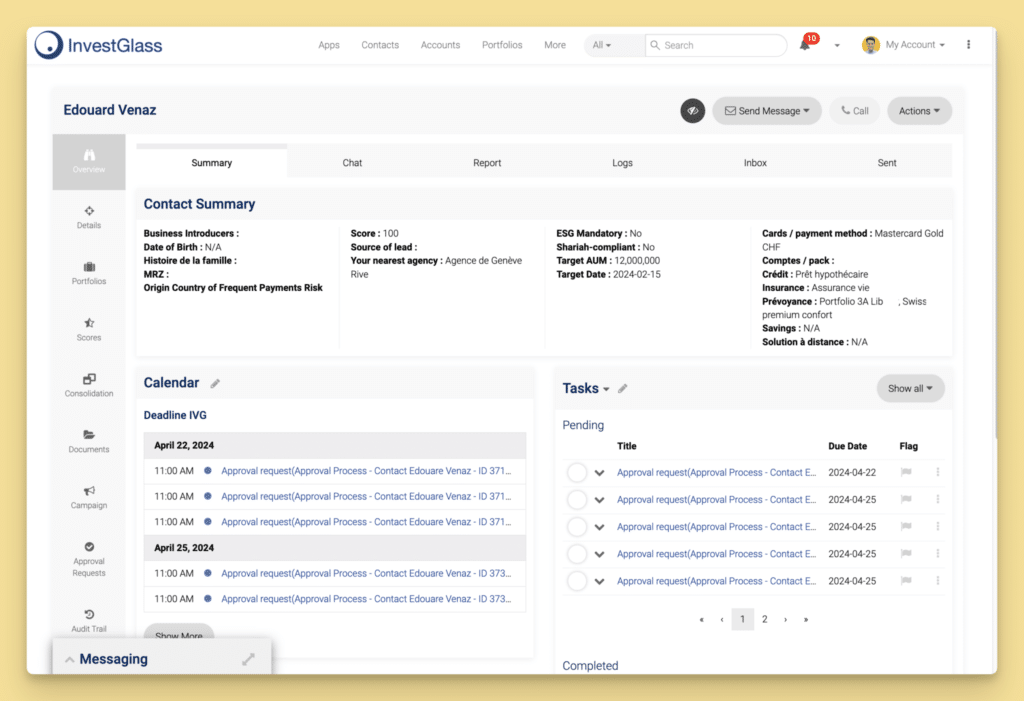
InvestGlass centralises client profiles, risk scoring, compliance documents, and communication histories to manage the full customer journey in finance. Concrete features include digital forms for onboarding with vérification KYC automatisée and AML checks, workflow automation tools that automate deal approvals and onboarding, pre-built templates for investor reporting, and tools to segment clients by investment profile and customer preferences. Compliance dashboards enforce suitability checks aligned with FINMA, MiFID II, and GDPR requirements.
Compared to Salesforce Financial Services Cloud or Microsoft Dynamics with finance modules, InvestGlass requires less configuration to deploy finance-specific workflows. The white-label client portal, e-signature capabilities, and risk profile templates are built in rather than bolted on. Swiss data hosting provides data residency assurance for institutions that prioritise sovereignty and privacy.
InvestGlass helps financial institutions turn fragmented customer data into actionable CRM data, improving both regulatory compliance and long-term customer relationships.
Industry-specific CRM software examples
Beyond general-purpose CRM tools, many sectors now rely on vertical CRMs tailored to their compliance rules, workflows, and customer behavior patterns. Industry-specific CRM systems often include sector-specific objects alongside standard contact and deal records. In finance, these include portfolios, mandates, and risk profiles. In legal, they cover cases and matters. In nonprofits, donor records and campaign attribution.
InvestGlass serves as the primary example for financial services. Regulatory demands like suitability checks, MiFID II reporting, KYC/AML onboarding, and ESG preference tracking are built into the platform rather than requiring custom development. Agentic CRM focuses on l'IA agentique dans le secteur bancaire and other AI-driven automation that proactively performs tasks, and InvestGlass incorporates this through automated compliance review cycles and portfolio monitoring.
The insurance sector presents a telling case study. According to the State of Insurance CRM Adoption report, a majority of agents use CRMs, but many rely on generic platforms. Only a minority regularly use AI features despite strong interest. This gap illustrates the growing demand for industry-specific CRM solutions with embedded AI.
Other vertical CRM categories worth monitoring include healthcare CRMs with patient record integration, dental practice CRM solutions with digital onboarding and patient management, real estate CRMs with property listing management, and education CRMs that connect with student information systems. Companies in regulated or complex industries consistently benefit more from a vertical CRM system than from heavily customising a generic platform.
Benefits of CRM solutions illustrated by these examples
The CRM software examples above demonstrate a consistent set of benefits across industries and business sizes.
Stronger customer relationships
Centralised profiles and complete communication histories eliminate redundant outreach and ensure cohesive messaging. When sales and marketing teams, service agents, and advisors all work from the same customer record, managing customer relationships becomes consistent rather than fragmented. Personalised customer experiences follow naturally when every team member has context.
Efficacité opérationnelle
Workflow automation tools automate deal approvals and onboarding, while automated sequences handle follow-ups, reminders, and handoffs. CRM systems can increase sales revenue by 30%, and companies using CRM report a 34% increase in sales revenues. CRM can improve customer satisfaction by 33% and helps reduce customer service response times by 67%. These figures reflect the compounding effect of eliminating manual steps from sales and marketing efforts.
Data-driven decisions
Analytical dashboards, predictive models, and AI-generated insights help teams analyze customer interactions and forecast future sales. Pipeline reports, anomaly detection, and lead scoring models transform raw CRM data into actionable strategy. Data analysis becomes a daily habit rather than a quarterly exercise.
Customer retention and loyalty
A 5% increase in customer retention boosts profits by 50%. CRM tools that track customer preferences, flag at-risk accounts, and automate re-engagement campaigns directly improve customer retention and increase customer loyalty. This is where strategic CRM thinking pays dividends.
Compliance and governance
For regulated sectors, CRM solutions like InvestGlass enforce KYC/AML checks, maintain immutable audit trails, and store sensitive customer data under appropriate data residency controls. Improved customer satisfaction and regulatory confidence go hand in hand.
How to choose the right CRM system for your business
Before evaluating CRM tools, map your core processes: lead generation, sales processes, onboarding, support, and renewals. Understanding your actual workflows prevents you from buying features you will never use.
Key selection criteria include:
Critère | What to assess |
|---|---|
Industry fit | Does the CRM include vertical-specific objects, compliance workflows, or regulatory templates? |
Feature set | Do you need sales pipeline management, marketing automation, customer service, or all three? |
Facilité d'utilisation | How quickly can your team adopt it? Is the interface intuitive for sales reps and marketing teams? |
Intégration | Does it connect with your existing email, calendar, ERP, and communication tools? |
Security and compliance | Role-based access, encryption, audit logs, data residency options |
Coût total | Subscription fees, AI feature tiers, implementation, training, maintenance |
AI and automation depth | Does it offer predictive scoring, next-best actions, or agentic AI for autonomous tasks? |
Evaluate CRM options based on your sales goals and consider your team size when selecting a CRM system. Smaller teams may prioritise simplicity and quick setup with platforms like HubSpot, Pipedrive, or Nimble. Larger or regulated organisations may need Salesforce, Microsoft Dynamics 365, or InvestGlass. Look for CRM systems that support customer data tracking and choose a CRM that aligns with your marketing strategies. | |
For finance, wealth management, private banking, and other regulated sectors, a specialist CRM like InvestGlass CRM pour les banques privées already includes customer journey flows and compliance logic out of the box, significantly reducing time-to-value compared to customising a generic platform. |
Utilise free trials to test CRM platforms before commitment. Shortlist three to five CRM systems, run them with real data, gather feedback from end users across sales departments and marketing teams, and test how well each platform reflects your actual customer interactions.
Implementing CRM software successfully
Success with a CRM system depends more on implementation and adoption than on the tool alone. The most feature-rich platform will underperform if it does not reflect how your teams actually work.
High-level implementation phases include:
- Requirements gathering: define must-have features, stakeholder needs, and compliance requirements
- Data cleansing and migration: deduplicate contacts, standardise fields for stages, industries, and regions
- Configuration and automation design: build pipelines, set up workflow automation, define lead scoring rules
- User training: ensure frontline teams understand the system and see its value for their daily work
- Ongoing optimisation: review dashboards, refine automations, and expand capabilities as the business evolves
Clean customer data at the start is essential. Poorly structured or duplicated records undermine AI predictions and erode user trust. Start with a minimal, clearly defined process, such as a simple opportunity pipeline and standard onboarding steps, then layer in advanced analytics and automation features as adoption matures.
Involve frontline teams, including sales reps, marketing teams, service agents, and advisors, in defining fields, stages, and workflows. The CRM should reflect real customer interactions, not theoretical processes designed in isolation.
FAQs about customer relationship management software examples
What is an example of CRM software?
Common examples include Salesforce, HubSpot, Microsoft Dynamics 365, Zoho CRM, Pipedrive, Freshsales, and InvestGlass. Each platform shares the goal of improving how businesses manage customer relationships by centralising customer data, automating business processes, and enabling better data analysis across the entire customer lifecycle.
Which CRM example is best for small businesses?
HubSpot CRM, Pipedrive, Nimble, and Zoho CRM are strong choices for small businesses. They offer lower costs, simpler interfaces, and faster setup. HubSpot’s free tier is particularly attractive for teams just beginning to formalise their sales and marketing efforts, while Pipedrive’s visual pipeline suits activity-driven sales teams.
Which CRM software is best for financial services and wealth management?
InvestGlass is purpose-built for regulated financial services. It includes KYC/AML automation, digital onboarding, risk scoring, portfolio dashboards, and compliance workflows out of the box. Salesforce Financial Services Cloud and Microsoft Dynamics with finance modules are alternatives, but they typically require more customisation and lack built-in Swiss data sovereignty. For organisations that prioritise regulatory compliance and data residency, InvestGlass offers a direct path to customer success in finance.
What are the main types of CRM systems?
The three main types are operational CRM, analytical CRM, and collaborative CRM. Operational CRM handles sales automation, lead tracking, and customer service processes. Analytical CRM interprets customer behavior through reporting and predictive models. Collaborative CRM shares customer information across departments for consistent communication. Most modern CRM platforms blend all three.
How does CRM software manage customer data securely?
CRM systems protect customer data through encryption at rest and in transit, role-based access controls, field-level permissions, and audit logs. Platforms serving regulated industries, such as InvestGlass, add data residency guarantees, consent tracking, and compliance with frameworks like GDPR, MiFID II, and FINMA. Secure handling of sensitive information, from financial records to personal identifiers, is non-negotiable.
How long does it take to implement a CRM system?
Implementation timelines vary. Simple deployments for small teams can take a few weeks. Enterprise or regulated deployments with compliance integrations, data migration, and portfolio management typically require several months. Training, data cleansing, and process configuration are the primary drivers of timeline.
Conclusion: turning CRM examples into better customer relationships
The CRM software examples in this article illustrate different paths to stronger customer relationship management and improved sales performance. From Salesforce’s enterprise breadth to Pipedrive’s focused simplicity, and from HubSpot’s inbound marketing strength to InvestGlass’s compliance-first approach for finance, each platform addresses a distinct set of needs across the customer journey.
The right CRM system depends on business size, industry, and complexity. But all successful CRM solutions share a focus on accurate customer data, consistent tracking customer interactions across multiple channels, and streamlined processes that free teams to build strong customer relationships rather than wrestle with spreadsheets.
Industry-specific tools like CRM InvestGlass pour les services financiers can significantly shorten time-to-value for regulated and data-sensitive sectors by delivering prebuilt workflows, compliant data models, and sovereign hosting. The AI in CRM market is rapidly expanding, signalling that predictive analytics, sales productivity tools, and automation will become standard expectations rather than premium add-ons.
Businesses that adopt CRM thoughtfully, with clean data, clear workflows, and genuine user adoption, will see compounding gains in customer loyalty, business growth, and revenue. Audit your current customer relationship processes, shortlist the CRM tools that best align with your goals, and start with the examples discussed here. The difference between managing customer relationships with and without the right CRM is, increasingly, the difference between growth and stagnation.


