
Choosing the right software to manage customer relations is one of the most consequential technology decisions a growing business can make. In 2026, the landscape of crm software has matured considerably, yet the core challenge remains the same: finding a platform that fits your processes, protects sensitive customer data, and scales alongside your organisation. This guide walks through the capabilities, deployment models, and evaluation criteria that matter most, with a practical focus on what regulated and growth-stage businesses should prioritise when selecting a crm system.
Quick answer: what is customer relationship management (CRM) software?
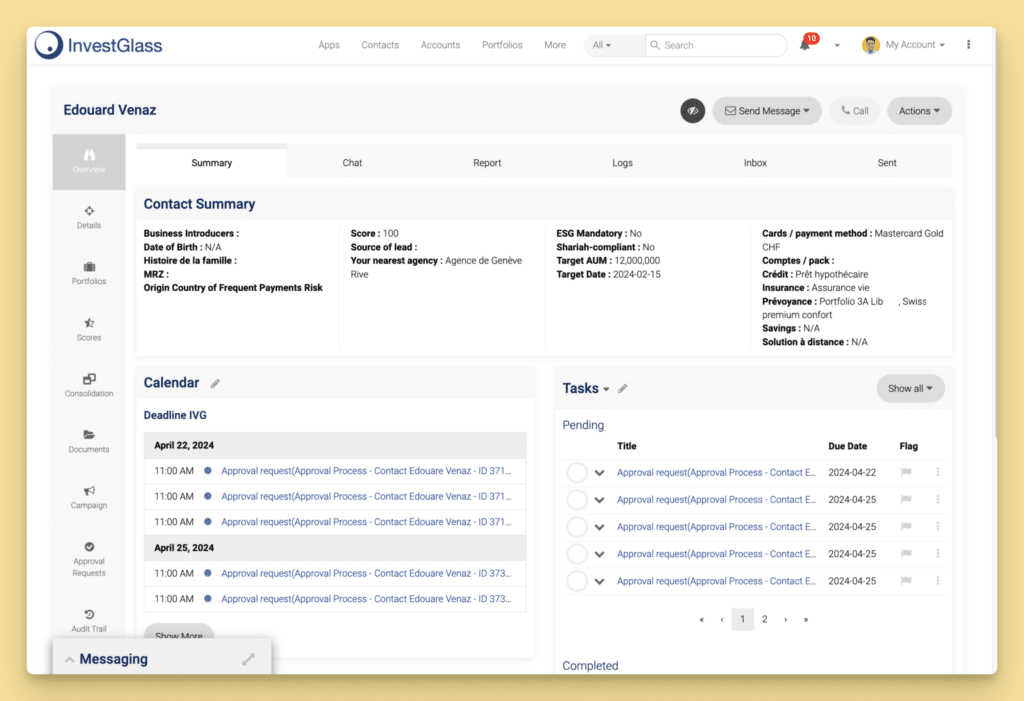
CRM stands for customer relationship management. It refers to the processes, strategies, and software tools that organisations use to manage every interaction with current and potential customers. Customer relationship management software centralises contacts, tracks deals, logs communications, automates follow-ups, and surfaces the insights teams need to improve customer satisfaction and retention.
Modern crm solutions go well beyond a digital address book. Platforms such as InvestGlass combine contact management, sales force automation, marketing campaigns, digital onboarding, and compliance workflows in a single environment. The four main types of CRMs are operational, analytical, collaborative, and strategic, each addressing a different business need. Operational CRM automates and streamlines business processes. Analytical CRM focuses on data analysis to gain insights. Collaborative CRM facilitates communication across departments. Strategic CRM places the customer at the centre of business strategy.
Consider a practical scenario. A 10-person business to business team in 2026 has been tracking leads in spreadsheets and managing follow-ups through scattered email threads. By moving to a crm platform like InvestGlass, an all-in-one automation platform, they centralise every lead, log every email and call automatically, attach GDPR consent fields to contact records, and set automated reminders so no opportunity falls through the cracks. The CRM market size was valued at $41.93 billion in 2019, and adoption has only accelerated since.
Why software to manage customer relations matters in 2026
Customer expectations have shifted dramatically since 2020. Buyers now expect consistent, personalised engagement across email, live chat, social media, and voice. According to recent industry surveys, 82% of service professionals say customer expectations are higher than ever. Meeting those expectations with fragmented tools is impractical.
When work is spread across disconnected spreadsheets, inboxes, and web forms, critical customer information gets lost. Sales reps duplicate outreach, marketing teams send irrelevant messages, and support staff lack context. The result is slower response times, lower customer satisfaction, and missed revenue.
In 2026, three realities make a strong crm strategy essential:
- Remote and distributed teams need a shared, browser-accessible workspace.
- Regulated industries face mounting compliance pressure around data handling, identity verification, and audit trails.
- Cloud applications now store highly sensitive customer data, making security and data residency non-negotiable.
The right crm software becomes the single source of truth for every customer relationship. CRM systems provide a unified view of customer interactions, serving not just sales but marketing, service, and operations. CRM software provides a 360-degree view of customers across all channels. It is no longer just a sales tool; it is an organisational backbone.
Core capabilities of modern CRM software
Before comparing vendors, it helps to define the baseline. Any crm solution worthy of consideration in 2026 must deliver a set of core capabilities that go beyond simple contact storage. Modern CRM systems integrate with marketing, sales, and service tools to create a cohesive operating environment.
The essential crm features include:
القدرة | What it covers |
|---|---|
إدارة الاتصال | Centralised records for customer information, demographics, consent status, documents |
Opportunity and pipeline tracking | Lead and pipeline management tools that track leads through the sales funnel |
Sales force automation | Task assignment, follow-up reminders, deal-stage updates |
Email and calendar integration | Connects existing email and calendar systems with the crm database |
أتمتة التسويق | Email sequences, audience segmentation, campaign tracking |
Multi-channel communication | Phone, email, chat, and social media interaction capture |
التحليلات وإعداد التقارير | Dashboards that track sales performance, visualise crm data, and surface key performance indicators |
إمكانية الوصول إلى الهاتف المحمول | Allows access to customer data on the go |
CRM systems can integrate with over 900 different applications, though on average only 29% of business applications are integrated. Closing that gap is where a well-chosen crm system delivers real advantage. |
Contact and interaction management
High-quality contact management is the foundation of any crm database. Without clean, complete records, every downstream activity, from campaigns to forecasting, is compromised.
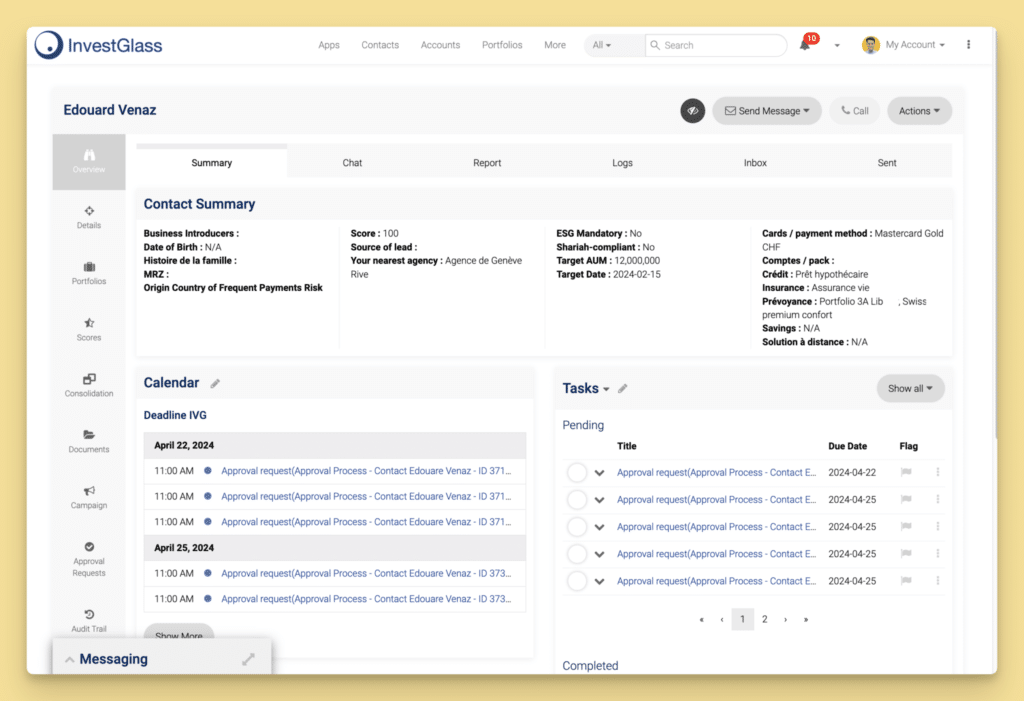
A modern contact record in 2026 should contain demographics, full communication history, GDPR or regulatory consent status, and key documents such as contracts or identity verification files. Interaction tracking records customer interactions across multiple channels, ensuring that calls, emails, meetings, and web form submissions are all logged in one place. This prevents duplicated outreach and missed follow-ups.
CRM systems can automate data entry tasks, reducing the manual burden on teams and improving data accuracy. Platforms like InvestGlass allow customisable fields and views, so organisations in financial services can add regulatory-specific fields while a B2B SaaS firm might track product usage metrics. Centralised contact management is essential for storing customer information reliably.
Sales force automation and pipeline tracking
Sales force automation is the set of crm features that remove repetitive manual work for sales reps. It covers lead assignment, automated reminders, status updates, and outreach templates, freeing the sales team to focus on conversations rather than administration.
Pipeline stages should be clearly visualised in the interface. A typical flow might look like:
- الرصاص
- Qualified
- الاقتراح
- التفاوض
- مغلق بنجاح / مغلق بخسارة
Task reminders and automatic follow-ups keep deals moving without relying on memory or spreadsheets. Activity timelines per opportunity help both reps and managers understand deal velocity and identify blockers.
Sales automation can increase sales revenue by 30%. Companies using CRM see an 87% win rate in sales. Forecasting tools that use pipeline data to estimate monthly and quarterly revenue help management plan capacity with confidence. AI in CRM can suggest next-best actions for sales teams, and AI capabilities improve forecasting accuracy in sales, reducing reliance on gut-feel projections. Lead and pipeline management tools track leads through the entire sales cycle.
Marketing campaigns and customer nurturing
Marketing campaigns should be tied directly to the crm database, not managed in a separate mailing list or disconnected marketing tool. When campaign data lives inside the CRM, sales and support can see exactly which messages a customer received, which links they clicked, and how they responded.
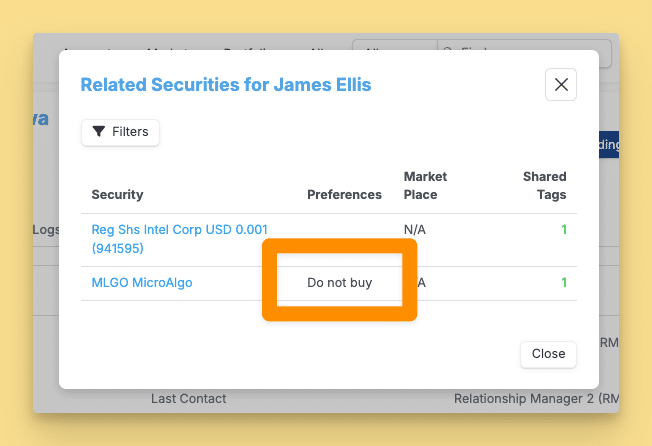
Users should be able to build segments from crm data, combining filters such as industry, deal stage, last activity date, and customer preferences for targeted campaigns. This approach to customer segmentation ensures that personalised marketing reaches the right audience.
Common campaign types include:
- Onboarding sequences for new customers
- Re-engagement flows for inactive contacts
- Event invitations and webinar follow-ups
- Upsell and cross-sell journeys for existing clients
Integrating campaign performance back into contact records means that when a sales rep opens a record, they see the full picture. Marketing teams benefit from the same visibility, aligning their efforts with the sales process and reducing wasted outreach.
Cloud CRM vs. on-premise: choosing the right deployment model
Deployment choice still matters in 2026. Although cloud based crm dominates the market, regulated industries and organisations with strict data sovereignty requirements may need on-premise, private cloud, or hybrid arrangements.
Cloud crm benefits are well established:
- Browser-based access from anywhere, including mobile
- Lower upfront infrastructure cost
- Automatic updates and feature rollouts
- Easier scaling as teams grow
On-premise or private cloud may be preferred when organisations require tight control over data location, when audit or regulatory mandates demand physical control of infrastructure, or when integration with sensitive internal systems is complex. CRM can reduce IT costs by 30% in many cloud deployments, but the calculation changes when compliance constraints dictate hosting requirements.
InvestGlass sits as a cloud-first crm platform for financial services with strong options for data residency and compliance, making it well suited for financial and regulated businesses that want the accessibility of cloud crm without compromising on sovereignty.
Protecting customer data and meeting compliance requirements
Protecting customer data is non-negotiable for any crm project. Organisations that mishandle personal data face regulatory penalties, reputational damage, and loss of customer trust.
Key security expectations for any crm system in 2026 include:
- التشفير أثناء النقل وفي حالة السكون
- Role-based access control (RBAC)
- Comprehensive audit trails
- SSO and multi-factor authentication (MFA)
Compliance frameworks vary by jurisdiction and sector. GDPR governs data handling across the European Union. FINMA requirements apply to Swiss financial institutions. Sector-specific rules such as MIFID II, LSFIN, HIPAA, and PCI-DSS add further layers. Privacy-first features are now core expectations, including consent management, data retention policies, and subject rights workflows.
InvestGlass emphasises secure data handling, permissioning, and auditability for teams managing sensitive customer relationships. Its approval workflows, document management, and compliance modules for MIFID, LSFIN, and Basel help organisations protect customer data while meeting regulatory obligations.
How CRM software improves customer satisfaction across the lifecycle
The benefits of crm software span the entire customer lifecycle, from the first point of contact through onboarding, ongoing service, renewal, and advocacy. CRM can increase customer satisfaction by 33%. When teams respond quickly, follow up consistently, and deliver high quality customer service informed by complete records, trust builds naturally.
A 5% increase in customer retention boosts profits by 50%. This statistic underscores why customer retention deserves as much attention as new customer acquisition. Analytics from crm data help teams find friction points, such as slow response times after purchase or low engagement during onboarding, and redesign processes to build customer loyalty and keep clients longer. CRM helps businesses improve customer service and retention across every stage.
In practice, 32% of cases are resolved during the first interaction when teams have a CRM in place, because support staff have immediate access to the customer’s full history and context.
From first touch to loyal customer: mapping the journey
A well-configured CRM maps the customer journey from initial enquiry to long-term advocacy. Web forms, email signups, and social media enquiries are captured as leads and enriched with activity data as the relationship develops.
Once a lead converts, onboarding checklists, support tickets, and satisfaction surveys are all stored in the same CRM record. This gives every team member a complete view of where the customer stands. The customer experiences a consistent, well-informed interaction regardless of whom they speak with.
In InvestGlass, journey data can power personalised offers, risk scoring, and next-best-action suggestions. Digital onboarding, إدارة المحافظ الاستثمارية المدعومة بالذكاء الاصطناعي, and a secure client portal mean that clients see value immediately and receive superior customer experiences throughout the relationship. Tracking the entire customer lifecycle in one system ensures nothing is lost between handoffs.
Using data and AI to personalize customer interactions
CRM software in 2026 frequently includes built-in AI for recommendations and automation. By end of 2026, 40% of enterprise applications are expected to include task-specific AI agents, up from under 5% in 2025.
AI in CRM automates routine tasks like data entry, freeing teams for higher-value work. AI enhances customer interactions by personalising experiences based on profile, behaviour, and history. AI predicts customer behaviours and recommends next steps, such as suggesting a product upgrade when usage patterns indicate readiness, or flagging churn risk when support tickets increase.
AI in CRM can autonomously provide 24/7 customer service through intelligent chatbots and automated responses. Predictive scoring, churn risk indicators, and smart reminders help teams prioritise outreach to potential customers and manage relationships proactively.
However, AI features must run on accurate, well-governed crm data. Dirty or fragmented data leads to incorrect predictions and poor personalisation. InvestGlass positions data quality, consent management, and secure document workflows as core strengths, providing the foundation that trustworthy AI requires.
Special considerations: CRM for small business vs. larger enterprises
Software to manage customer relations must match company size and complexity. What delivers value for a five-person startup may be overwhelming for the same team, while what works for a startup may leave a regulated mid-size firm dangerously exposed. CRM software should align with business size, sales complexity, and budget.
Small businesses in 2026 typically need simplicity, fast setup, basic automation, and transparent pricing. Mid-market and enterprise organisations require advanced permissions, complex workflows, integrations with ERP and accounting systems, and detailed governance.
InvestGlass is positioned for both growing small businesses and regulated mid-size firms that need more structure than basic software tools provide, but without the overhead of large enterprise platforms.
CRM for small business: avoid overkill, keep adoption high
The most common small business pitfall is buying too much software and then watching adoption collapse under the weight of unused features. The second most common is staying stuck in spreadsheets because a full CRM feels daunting.
For small businesses, focus on three to four essentials:
- Contact management with clean, searchable records
- Sales pipeline tracking with simple stage visualisation
- Basic email sequences for customer nurturing
- Straightforward reporting on deals won, conversion rates, and customer health
Ease of use, good onboarding resources, and responsive support matter far more than obscure features. Automated CRM systems can reduce operational overhead significantly, but only if teams actually use them. InvestGlass can be configured gradually, so small teams adopt CRM step by step, starting with core contact management and pipeline, then adding campaigns, compliance modules, and automation as confidence grows. Many crm vendors offer a free crm tier, but evaluating total crm costs over 12 to 36 months is more reliable than chasing the lowest entry price.
CRM for regulated and high-touch industries
Sectors such as wealth management, fintech, insurance, and real estate demand crm tools with compliance and audit capabilities baked in, not bolted on. These organisations need granular permissioning, document management, and detailed logs of customer interactions to satisfy regulators and protect clients.
Use cases include:
- Investment suitability checks requiring documented advisory workflows
- KYC and AML checks with automated verification, secure document uploads and approval chains
- Client onboarding in insurance with regulatory templates and checklists
InvestGlass has a strong positioning and history serving regulated clients that require both service automation and strict governance, particularly as a نظام إدارة علاقات العملاء (CRM) للبنوك الخاصة والمؤسسات المالية. Its modules for MIFID, LSFIN, and Basel compliance, combined with digital onboarding and portfolio management, address the specific needs of financial institutions as well as specialised sectors such as Swiss dental practices using dedicated CRM workflows seeking a sovereign, non-American alternative. For business to consumer and business to business operations alike, including health-focused practices and therapists using نظام إدارة علاقات عملاء مخصص للمعالجين في سويسرا, the ability to automate routine tasks while maintaining a complete audit trail is a genuine differentiator.
Evaluating CRM software: practical selection criteria for 2026
This section offers concrete criteria to compare crm tools beyond brand recognition. Too many teams rely on generic demos or analyst rankings when the real test is whether the platform fits their actual workflows and data.
Core evaluation axes include:
المعيار | What to assess |
|---|---|
Feature fit | Does the CRM support your process stages, required fields, and communication channels? |
قابلية الاستخدام | Clean interface, fast load times, low friction for data entry |
التكامل | Native connections to email, calendar, accounting, and core systems; API access |
الأمن | Encryption, RBAC, audit trails, data residency |
قابلية التوسع | Support for growing users, contacts, regions, and compliance jurisdictions |
دعم البائعين | Documentation, training, dedicated CSM, reference customers |
CRM software should integrate with other business tools for a streamlined workflow. Run live trials using your own customer data and current processes rather than relying on vendor-curated scenarios. InvestGlass offers guided evaluations tailored to a team’s existing workflows and data structure, helping organisations assess fit before committing. |
Key questions to ask vendors before you commit
Take this checklist into vendor meetings:
- Where is my data hosted? Can I choose the region or data centre?
- What encryption is in place in transit and at rest? Is SSO and MFA supported?
- What compliance credentials are relevant to my industry (GDPR, FINMA, HIPAA)?
- How is audit logging handled, and can I export logs for regulators?
- Which email, calendar, and accounting systems integrate natively, and what requires custom code?
- What is the realistic crm implementation timeline for a team of my size?
- What training and onboarding support is included?
- Can you provide references from similar customers who went live in 2024 to 2026?
- What is the pricing model: per user, per contact, or module-based? Are there hidden costs for AI features, storage, or compliance add-ons?
These questions help distinguish between platforms that look good in a demo and those that perform well in daily use. Asking about total cost of ownership, not just subscription price, prevents unpleasant surprises down the line.
Why consider InvestGlass as your CRM solution
InvestGlass is a cloud crm platform designed to manage complex customer relationships with strong compliance and data sovereignty at its core. Built in Switzerland, it serves as a credible European alternative for organisations that want to retain control over their data and digital infrastructure.
Key strengths of إنفست جلاس تشمل:
- Contact and portfolio management with flexible, customisable fields
- Sales and marketing automation including email sequences, campaign tracking, and a customizable dashboard
- Secure document workflows, digital onboarding, and KYC-friendly processes
- Approval and compliance modules for MIFID, LSFIN, and Basel
- A client portal that gives customers direct access to documents, portfolios, and invoices
InvestGlass is particularly relevant in financial services, fintech startups, family offices, and other regulated small businesses. Its configurable workflows, data protection features, and ability to align with real-world advisory or sales processes make it suitable for teams that need both sales productivity and strict governance. Organisations can start with core CRM and digital onboarding, then expand into campaigns, compliance, and analytics as needs grow, without switching platforms.
Frequently asked questions about software to manage customer relations
This FAQ addresses common questions about crm software, deployment, and InvestGlass in 2026.
What is the difference between CRM software and a customer data platform?
CRM software is purpose-built for managing direct customer interactions, the sales pipeline, support tickets, and marketing campaign workflows. A customer data platform (CDP) focuses on gathering, unifying, and storing data across channels, often including anonymous or behavioural data, and then forwarding segments to other tools. In 2026, many crm solutions embed CDP-like features such as unified profiles and event tracking, but CDPs remain more focused on the data layer rather than on workflows or sales automation.
How long does it take to implement a CRM like InvestGlass?
For a small team of 5 to 15 users with straightforward processes, initial data import, basic pipeline configuration, and contact field setup can typically be completed in days to a couple of weeks. For mid-size or regulated firms with compliance workflows, document management, approval chains, and custom integrations, a realistic crm implementation timeline is 4 to 12 weeks depending on complexity and data migration requirements.
Can CRM help me manage customer relationships on social media?
Yes. Modern crm solutions support integrating social channels, including messaging on platforms like LinkedIn and Facebook, social listening, and sometimes review monitoring. This enables teams to capture social interactions in the contact record, respond from inside the CRM, and measure sentiment alongside other customer interactions.
How does a CRM help protect customer data?
A well-configured crm system protects customer data through encryption in transit and at rest, role-based access control, SSO and MFA, and comprehensive audit trails. It maintains consent records, supports subject access requests, and enforces data retention and deletion policies. InvestGlass adds secure document uploads, approval workflows, and a client portal, all designed for organisations handling sensitive information.
What is the total cost of ownership and how should I model ROI?
Total cost of ownership includes subscription or licensing fees, setup and migration costs, training, ongoing maintenance, storage, and the cost of compliance modules or add-ons. ROI can be modelled by estimating improvements in conversion rate, reduction in lost leads, faster sales cycles, improved customer retention, and increased upsell and cross-sell. CRM can increase sales revenue by 30%, so even modest gains in sales productivity and customer retention typically justify the investment within 12 months. Compare costs over a 12 to 36 month period against projected benefits. According to ProPicked’s 2026 CRM trend report, the average starting price across tracked tools is approximately US$23 per user per month, with only 6% offering free plans.
What are the main types of CRM?
The four main types are operational crm, analytical crm, collaborative crm, and strategic crm. An effective crm strategy often combines elements of all four, prioritising based on whether the organisation’s primary goal is automating business processes, gaining deeper data analysis insights, improving cross-departmental communication, or placing the customer at the centre of business strategy. An analytical crm, for example, would be prioritised by organisations that rely heavily on sales forecasting and data-driven decision-making.
Conclusion: turn customer data into lasting relationships
The right crm software unifies all your customer data, automates routine work, and elevates every customer interaction from first touch to renewal. It transforms scattered information into a reliable foundation for strong customer relationships, whether your organisation serves new customers in a fast-moving startup or manages complex advisory relationships in a regulated environment.
Choose tools based on your real processes, security needs, and growth plans rather than generic feature lists or brand names alone. Start by mapping your current customer journey and use it as a checklist when testing crm platforms. This practical approach reveals gaps that no amount of vendor marketing can surface.
If your organisation is ready to modernise how it manages customer relationships, explore an InvestGlass demo or trial. It is a focused, sovereignty-first way to build customer loyalty, automate routine tasks, and manage the entire customer lifecycle with confidence in 2026.

