
Introduction: What is CRM Asset Management?
An asset management CRM is a customer relationship management platform purpose-built or deeply customised for asset managers. Unlike generic contact databases, these systems combine client data, portfolio data, communication tracking, compliance features, and deal pipelines into a single centralised system. CRM systems centralise client and portfolio data for better tracking, providing a 360-degree view of clients that spans every touchpoint, mandate, and interaction.
The shift accelerated between 2020 and 2026. Remote client service, virtual roadshows, and digital onboarding exposed weaknesses in spreadsheets and ad hoc tools. Northern Trust, for instance, migrated roughly 17,000 client accounts to a cloud-based CRM and workflow platform to eliminate silos. Swiss Life Asset Managers adopted an integrated CRM for asset onboarding with AML and KYC automation. These are not isolated cases. They reflect a broader movement across the asset management industry toward dedicated platforms that serve the full investment lifecycle.
Typical users range from traditional asset management firms and private equity houses to hedge funds, real estate managers, and wealth managers. Day-to-day, they need to manage relationships with institutional clients, track mandates and fundraises, coordinate with consultants and gatekeepers, and produce audit-ready documentation.
The core benefits of an asset management CRM include:
- Better client service through personalised and proactive interactions
- Centralised client data to eliminate duplication and reduce errors
- Improved deal management with structured pipelines and probabilities
- Streamlined data management through automation and integration
A crm for asset management professionals is no longer optional. It is infrastructure.
Why Asset Management Firms Need a CRM
Many asset management firms still rely on fragmented tools. The consequences are concrete and costly.
- Scattered client data and siloed notes. Without a centralised system, information about mandates, past meetings, and consultant feedback lives in separate spreadsheets, email inboxes, or individual memories. Disorganised client data leads to inefficiencies across every team.
- Missed follow-ups. Missed follow-ups can harm client relationships, erode trust, and cost firms mandates they should have retained. Without automated reminders, opportunities slip through.
- Inconsistent client service. When different teams lack visibility into what others have promised or delivered, responses vary, and personalized service becomes impossible.
- Compliance gaps. Compliance tracking is inconsistent without a CRM. Firms face audit risk when they cannot produce structured records of communications and approvals. CRMs enhance compliance with regulations like PIPEDA and GDPR, creating the documentation regulators expect.
- Manual data entry errors. Manual data entry increases the risk of errors, from duplicate records to incorrect strategy codes, which compound as firms scale.
- Limited collaboration. Limited collaboration between teams affects performance. When investor relations, portfolio management, and compliance teams operate in isolation, internal knowledge sharing breaks down.
Regulatory pressures have intensified. The EU’s GDPR requires documented processing activities and retention policies. In the United States, SEC books and records rules mandate that written communications about investment advice be retained for five years. Regulation S-P amendments, effective December 2025 for larger advisers and June 2026 for smaller ones, impose new requirements for data safeguarding, incident response, and third-party oversight.
The complexity of relationship networks adds further pressure. Asset managers coordinate not only with direct clients but also with consultants, broker-dealers, gatekeepers, investment committees, and co-investors. Each connection carries influence, referral history, and communication context that must be tracked.
Meanwhile, rising competition and fee pressure post-2022 leave no room for inefficiency. According to Broadridge’s 2025 study, average mutual fund fees declined from approximately 26 basis points in 2020 to roughly 21 basis points by 2023. Asset management companies must do more with less, making scalable growth dependent on technology rather than headcount.
These cumulative challenges make clear that investment firms require a purpose-built asset management CRM, not a generic sales tool.
Core Benefits of an Asset Management CRM
The benefits of a dedicated CRM span client service, operational efficiency, and risk management. They reinforce one another.
Client service excellence. CRM systems provide a 360-degree view of clients, covering mandates, holdings, past meetings, RFP history, and investor preferences. Relationship managers and wholesalers can deliver personalized service grounded in real relationship context, not guesswork. CRM systems help improve client satisfaction by personalising services to each investor’s profile and history. An effective asset management CRM links investor relations with portfolio performance, so every conversation is grounded in current facts.
Operational efficiency. Automated workflows in CRM reduce time spent on administrative tasks such as annual reviews, KYC refreshes, and follow-up scheduling. Automation in CRM reduces time spent on administrative tasks, and data from implementations supports this: automated workflows in CRM reduce manual tasks by 30%. Northern Trust reported a roughly 30% reduction in repetitive manual processes after deploying its cloud CRM and workflow platform. This frees senior professionals to focus on research, portfolio decisions, and relationship building.
Decision-making support. CRMs enhance decision-making with advanced analytics tools. Portfolio performance analytics help managers make informed decisions about capacity, product development, and resource allocation. Centralised data in CRM enhances decision-making speed by 40%, enabling leadership to spot emerging themes before they become problems. When combined with AI-driven strategies for effective portfolio management, data-driven insights from CRM improve investment decision-making across the firm.
Scalability. Standardised workflows, templates, and automated reminders enable firms to grow AUM from hundreds of millions to several billion without linearly scaling headcount. Asset management CRM improves portfolio management through real-time insights that keep pace with growth. The firm’s ability to support multiple geographies, product types, and intermediary channels depends on this infrastructure.
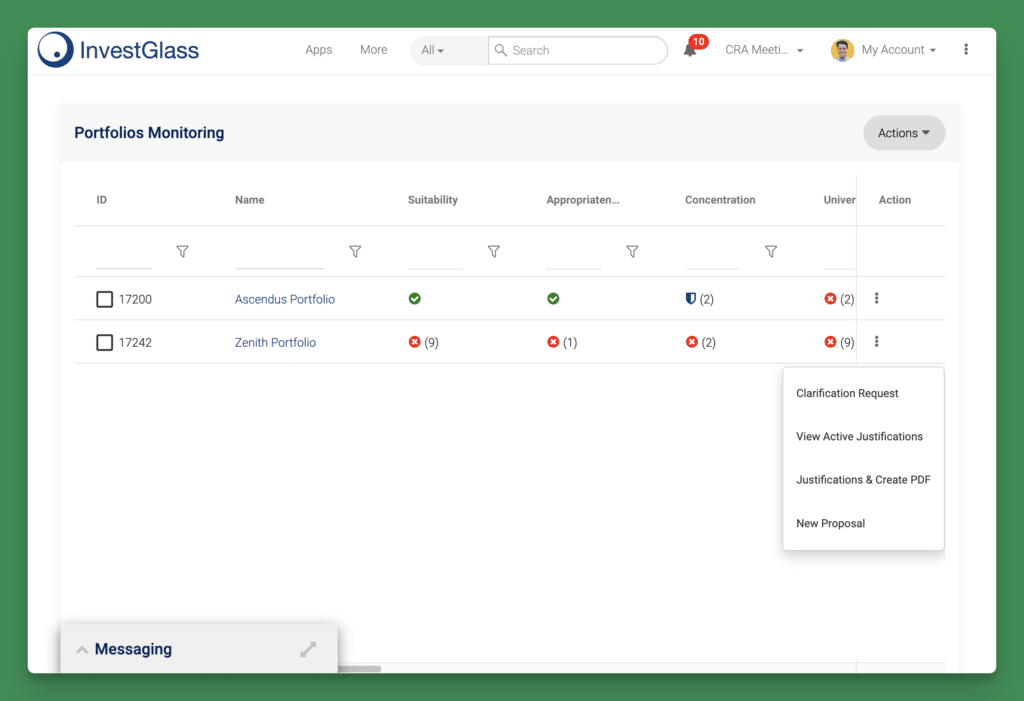
Risk and compliance management. Better tracking of suitability documentation, marketing material versions, and approval chains reduces regulatory and reputational risk. Compliance and reporting streamline regulatory tracking and report generation, keeping compliance teams confident and auditors satisfied.
Key CRM Features for Asset Management Firms
An asset management CRM must go beyond basic contact and deal management to support the full investment lifecycle and client journey. Here are the key features that matter.
Client data and relationship tracking. Detailed investor and consultant profiles, householding for private wealth clients, relationship hierarchies, and influence mapping for institutional accounts. Client profiles can be matched to investment portfolios and asset allocations in financial services, giving every team member the relationship intelligence they need.
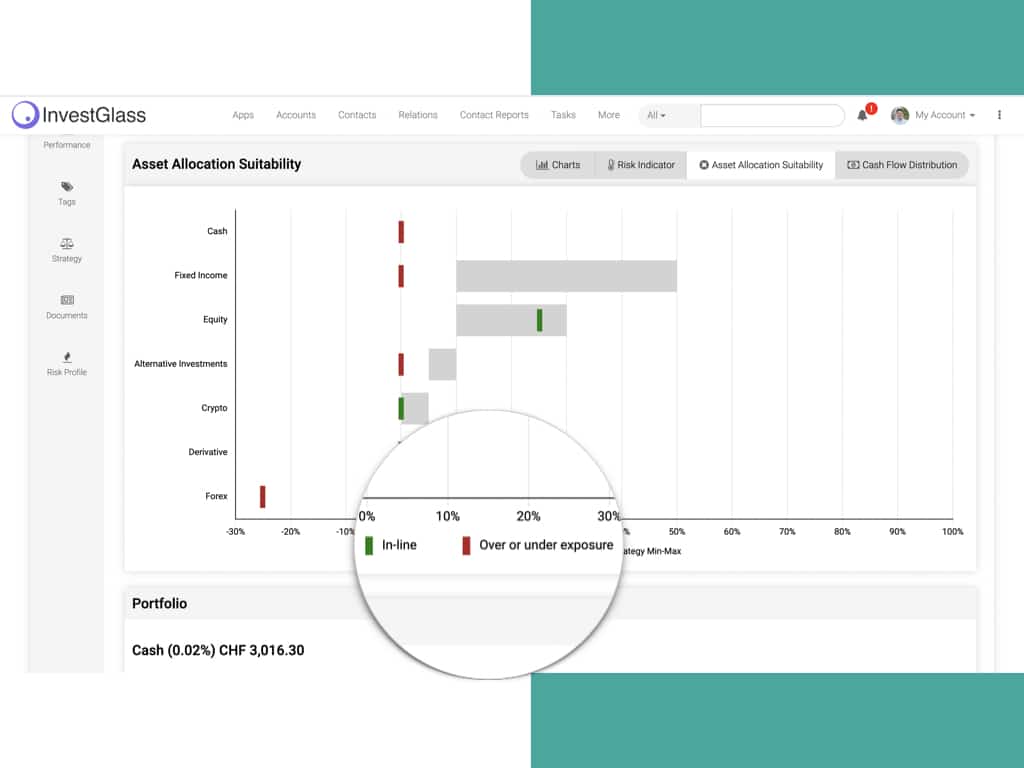
Portfolio and performance context. The CRM should link each relationship to portfolios, vehicles, strategies, benchmarks, and performance metrics via integrations with portfolio management software and fund administration systems. This allows teams to track portfolio performance alongside client interactions and to view portfolio trends and fund performance at a glance. CRM systems help manage multi-asset and multi-currency portfolios, supporting diverse asset classes and investment strategies. Similar CRM principles apply beyond asset management, for example in specialised CRM solutions for dental practices in Switzerland, where tailored workflows and compliance features address industry-specific needs.
Deal management. Pipeline tools for tracking mandates, fundraises, co-investments, secondary sales, and new product launches with clear stages, probabilities, and assigned responsibilities. A structured deal pipeline enables investor engagement teams to forecast inflows and allocate resources to higher-potential opportunities.
沟通追踪. Automatic capture of emails, meetings, and calls from Outlook, Gmail, Teams, and Zoom creates a complete communication history. Centralised databases track risk tolerance, asset allocation, and communication history, ensuring no client interactions fall through the cracks. This supports duplicate data entry elimination and provides actionable insights for every conversation.
Compliance features. Pre-approved templates, marketing material version control, KYC/AML checklists, and attestation tracking embedded in automated workflows. Asset management CRMs centralise compliance documentation and track regulatory requirements. Automated alerts for compliance deadlines reduce the risk of errors. Workflow automation includes triggers for client onboarding and document tracking, ensuring every step is recorded. Asset management CRMs help mitigate compliance risks and legal repercussions. CRM systems help firms comply with regulations like GDPR and PIPEDA, particularly when leveraging automated KYC verification for digital onboarding.
Data management and security. Role based access controls ensure users see only what they are authorised to access. Robust security measures include data encryption and access controls. Integrating CRM with asset management eliminates the silo effect in data storage, while the connection links customer profiles in the CRM to specific assets via APIs or shared databases. Data integration provides a single source of truth through market data feeds. Automated data syncing updates customer accounts when assets are assigned or serviced. Physical equipment serial numbers are tied to customer contracts for maintenance and lease tracking, which matters particularly for real estate and infrastructure managers. Asset tracking displays every interaction linked to an asset on the customer’s CRM dashboard, and emerging approaches such as 用于欺诈检测和客户体验的智能代理AI further strengthen these data management frameworks.
Reporting and analytics. Configurable reporting tools covering AUM by channel, flows by consultant, win/loss by strategy, and client service SLA adherence. Custom reporting enables compliance teams, portfolio managers, and senior leadership to extract real time insights without waiting for manual compilation. According to Broadridge, 89% of asset management firms are making moderate to large investments in data visualisation and advanced analytics.
Integration capabilities. APIs and native integrations with portfolio accounting, fund administration, e-signature, document management, and financial platforms. This connectivity with the existing tech stack reduces manual data entry and improves accuracy across multiple systems.
How CRM Transforms Daily Work for Asset Managers
A wholesaler preparing for a March 2026 roadshow. The night before, a wholesaler pulls up consultant profiles through the CRM, reviewing previous feedback, recent fund flows, and specific concerns raised around market trends or ESG preferences. The system flags which institutional clients have unseen marketing collateral and reminds the wholesaler to distribute updated slide decks. On the road, the mobile app captures meeting notes in real time. Follow-ups are automatically assigned, and the deal pipeline updates without a single spreadsheet. Sales teams can view which assets clients are using before offering upgrades or renewals, and sales reps have a complete view of client belongings and usage habits for timely upselling.
An institutional relationship manager coordinating RFPs. The RM manages the RFP pipeline through the CRM: pending proposals, deadlines, responsible parties, and approval status. Due-diligence documents, investment committee feedback, and marketed terms are logged in one place. After submission, the CRM tracks whether the prospective client opened the proposal or requested further information. Integrating CRM with asset management connects service buyers with required assets, enabling informed investment decisions at every stage.
A portfolio manager monitoring redemption risk. During volatile periods like 2022, portfolio managers use CRM analytics dashboards to see redemption risk by segment, institutional clients versus retail, and by strategy. They identify which clients have expressed concerns or shown signs of dissatisfaction. Analysing customer usage data helps businesses allocate assets more effectively, guiding product tweaks and capacity decisions based on real portfolio tracking data. Comparable data-driven approaches also benefit other sectors, such as 专为瑞士治疗师打造的专业客户关系管理(CRM)平台, where lifecycle tracking and automation improve service quality. This supports more informed investment decisions and timely investment insights.
A compliance officer responding to an audit request. A regulator requests all communications around marketing materials for a particular fund over a defined period. The compliance officer pulls audit trails per SEC Rule 204-2, including version history, approvals, emails, and meetings captured in the CRM. Data disposal policies and user access logs are readily available. Support teams can see asset diagnostics to troubleshoot issues faster and reduce churn, and user accounts can be linked to specific client organisations for tracking usage and support history. Sixty percent of institutional investors view asset managers as strategic partners, and responding to audits with speed and precision reinforces that perception.

Choosing the Right Asset Management CRM
There is no single best crm system for every firm. Fit depends on scale, asset classes, distribution model, and current pain points.
Firm profile and scale. A boutique equity manager with under USD 1B AUM may prioritise simplicity, low cost, and rapid setup. A global multi-asset firm managing tens of billions needs robust scalability, multilingual capabilities, strong compliance features, and cross-border data residency. The management software must match the organisation’s complexity.
Use cases and prioritisation. Some firms need to improve operational efficiency in fundraising and deal management. Others focus on client service and retention, or on compliance tracking and regulatory reporting. Prioritise features that address the most acute pain points first.
Integration and ecosystem. Evaluate whether the CRM connects to existing portfolio systems, data warehouses, and marketing tools without heavy custom coding. Tight integration with the existing tech stack is a key factor in long-term success.
User experience and adoption. Adoption by relationship managers and analysts hinges on intuitive UI, minimal manual data entry, and strong mobile access. A CRM that adds burden rather than removing it will fail. The goal is improved service through technology that fits naturally into daily workflows.
Compliance and security checklist. Essential items to confirm:
要求 | What to verify |
|---|---|
Certifications | SOC 2, ISO 27001 |
Audit logging | Full trail of user actions and data changes |
加密 | Data at rest and in transit |
Permissions | Role based access controls |
数据驻留 | Region-specific hosting options |
保留策略 | Configurable per record type |
Total cost and ROI. Consider licensing, implementation, data migration, training, and ongoing maintenance. Balance against expected returns: time savings, improved client retention, regulatory cost avoidance, and scalable growth. Customer data well managed translates directly to revenue retained. | |
Vendor evaluation. Run pilots with real client and deal data. Interview reference clients in similar segments. Plan a phased rollout over three to six months to surface issues early and build momentum through internal champions. |
Implementing an Asset Management CRM Successfully
Successful implementation follows a disciplined sequence.
Discovery and design. Map existing processes for onboarding, reviews, marketing campaigns, and RFPs before configuring the CRM. Understand how each team currently works and where the greatest friction lies.
Data preparation. Clean legacy customer data, standardise fields such as consultant names, strategy codes, and institution identifiers, and define master data rules. Poor data quality is the most common cause of implementation delays.
Configuration and testing. Build role-based views for wholesalers, investor relations, compliance, and portfolio teams. Run user acceptance testing with real scenarios, recent deals, and actual RFPs to validate that workflows function as designed.
Migration and go-live. Stage migration by geography or channel. For example, begin with institutional clients in North America, then roll out to intermediaries in Europe. This limits risk and enables teams to adapt progressively.
培训与变革管理. Provide role-specific training. Identify internal champions who can demonstrate value early. Dashboards that show tangible results within the first 30 to 60 days, such as time saved or improved response rates, build confidence and accelerate adoption.
持续改进. Conduct quarterly reviews of workflows, reports, and automation rules based on user feedback and regulatory changes. The regulatory landscape will continue to evolve, and so must the CRM.
Future Trends in CRM for Asset Management
Technology and regulation between 2023 and 2026 are reshaping expectations for asset management CRMs. Firms that adapt now will be better positioned to predict client needs and mitigate risk.
AI and predictive analytics. AI can predict client churn, identify cross-sell opportunities, and prioritise outreach based on engagement scores. However, adoption remains early: only approximately 18% of executives surveyed in 2025 reported running active AI pilot projects. An advanced CRM with AI capabilities will increasingly enable firms to extract investment insights and act on them, particularly when applying artificial intelligence to portfolio management and optimization.
Deeper ESG data management. The growing need to store and report ESG preferences, scores, and stewardship activities within the CRM is driven by regulations such as the EU’s SFDR and by rising client expectations around sustainable investing.
Real-time data feeds. Tighter integration with market and portfolio data enables intraday insights, particularly valuable during volatile periods. Real-time updates to asset allocations and exposure breakdowns help managers respond to market data shifts promptly.
Client self-service portals. Institutional investors increasingly expect secure portals connected to the CRM for documents, performance snapshots, and service requests, reducing friction and improving investor engagement.
Regulatory evolution. As regulations expand, from enhanced disclosure rules to sustainability reporting and Form PF amendments, compliance features within CRM platforms will become even more central. Firms should expect CRM to serve as a core compliance infrastructure, not merely a sales tool.
InvestGlass Platform. Among the modern solutions empowering asset management firms, the InvestGlass all-in-one platform for sales automation stands out for its comprehensive CRM capabilities tailored to financial services. InvestGlass combines client relationship management with portfolio tracking, workflow automation, and compliance tools in a single cloud-based platform. Dedicated offerings such as the InvestGlass CRM for financial sector sales and marketing 和 InvestGlass 私人银行 CRM illustrate how the platform can be adapted to specific segments. Its no-code customization enables firms to adapt processes quickly without heavy IT involvement. InvestGlass supports automated data capture, reducing repetitive tasks and improving data accuracy. Integration with market data feeds and document management systems ensures a seamless flow of information. Moreover, InvestGlass includes built-in compliance features aligned with regulations like GDPR and MiFID II, helping firms manage KYC, AML, and audit trails efficiently. With its intuitive interface and mobile access, InvestGlass empowers asset managers to enhance client engagement, streamline operations, and maintain regulatory compliance in a competitive landscape.
Adopting a modern asset management CRM now positions firms to adapt quickly to these shifts, protect client relationships, and operate with confidence in an increasingly regulated and competitive landscape. Begin with a focused evaluation, run a pilot grounded in real data, and build from there.
常见问题 (FAQ)
Q1: What is the key factor that makes asset management CRM different from generic CRMs?
A1: The key factor is its ability to integrate client data with portfolio management, compliance tracking, and deal pipelines into a centralized system tailored for the investment lifecycle, enabling personalized service and better operational efficiency.
Q2: How does an asset management CRM improve compliance?
A2: It centralizes compliance documentation, tracks regulatory requirements with automated alerts, maintains audit trails, and supports secure document management, helping firms mitigate risk and meet evolving regulations like GDPR and PIPEDA.
Q3: Can asset management CRM systems integrate with existing financial platforms?
A3: Yes, most asset management CRMs offer APIs and native integrations with portfolio management software, fund administration systems, e-signature tools, and other financial platforms to reduce manual data entry and enhance data accuracy.
Q4: How does CRM automation benefit asset management firms?
A4: Automation reduces repetitive tasks such as data entry, follow-up scheduling, and report generation, improving operational efficiency and allowing teams to focus on relationship building and strategic decision-making.
Q5: What role does AI play in modern asset management CRMs?
A5: AI enhances predictive analytics to forecast client needs, identify investment opportunities, and optimize portfolio management, enabling firms to make more informed and proactive decisions.
结论
CRM asset management systems have become essential infrastructure for modern asset management firms. By centralizing client and portfolio data, automating workflows, enhancing compliance, and integrating advanced analytics, these platforms enable firms to deliver personalized service, improve operational efficiency, and make more informed investment decisions. As regulatory demands and competitive pressures intensify, adopting a specialized asset management CRM is a strategic imperative for scalable growth and sustained success in the evolving financial landscape.


