
For banks, wealth managers, insurers, real estate investment firms, and public sector organisations, revenue predictability depends on more than ambition. It depends on a structured sales pipeline, accurate data, disciplined follow-up, and a CRM environment that protects customer data. This guide explains how to build a sales pipeline that supports sales targets, compliance expectations, and long-term client relationships.
Principais conclusões
- A sales pipeline is a visual, stage-based view of every opportunity, distinct from a sales funnel, and essential for predictable future revenue.
- Any sales team can build a healthy sales pipeline in 2026 by defining clear sales pipeline stages, monitoring sales pipeline metrics such as conversion rates, and enforcing pipeline hygiene.
- Regulated organisations must treat data sovereignty as part of sales pipeline management, making a Swiss soberano CRM such as InvestGlass a strategic choice.
- This guide gives sales professionals a practical framework for building a sales pipeline, improving pipeline health, and supporting accurate revenue forecasting.
What Is a Sales Pipeline and Why It Matters in 2026
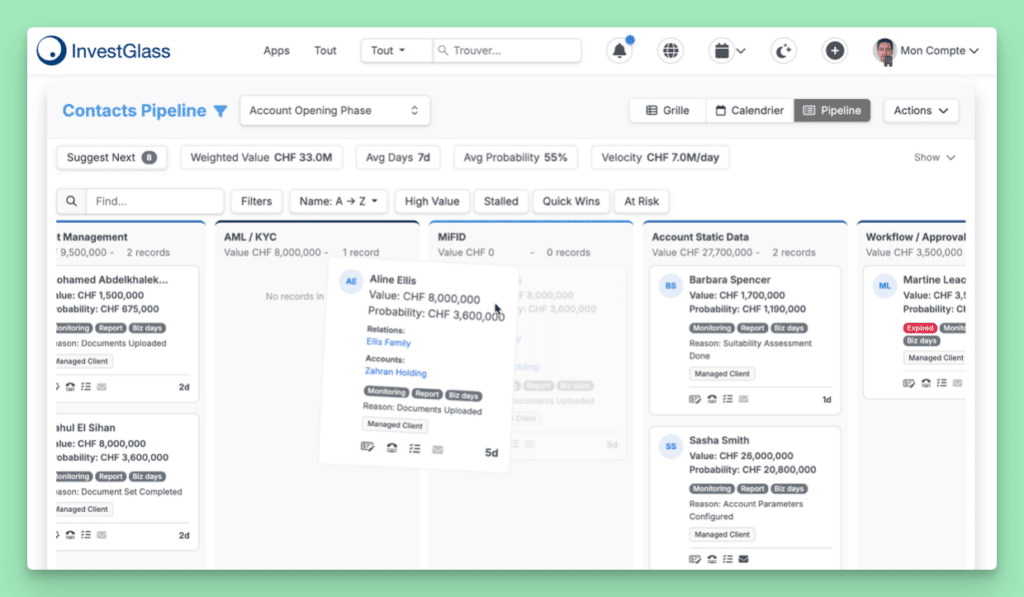
A sales pipeline is a visual representation that tracks potential customers as they progress through the sales process, providing clarity on where each opportunity stands. It shows where each prospective customer sits from initial contact to post-purchase, and it gives sales leaders visibility into next actions. A sales pipeline tracks individual deals through seller-defined stages, while a sales funnel maps aggregate buyer behavior from awareness to purchase across the market. The sales pipeline provides visibility into the actions and stages a sales team goes through to close a deal, whereas the sales funnel shows how leads move through the stages of the buyer’s journey.
A sales process is the wider operating model, including qualification, meetings, approvals, documentation, and onboarding. The company’s sales process should define how opportunities move, who owns each step, and which evidence is needed before a deal advances. Sales pipelines help sales teams manage leads and forecast revenue by tracking the number of qualified leads, win rates, and average deal sizes.
For regulated sectors, the sales pipeline helps teams achieve revenue goals and meet regulatory reporting needs. It improves forecast accuracy, detects stalled deals earlier, prioritises sales activities, and supports more reliable quarterly and annual revenue targets. Companies with well-optimised sales pipelines report 28% higher revenue growth, highlighting the importance of effective pipeline management compared to the broader insights provided by a sales funnel.
Core Sales Pipeline Stages: From Prospect to Long-term Client
Most B2B and financial-services organisations can structure sales pipeline stages around six to eight milestones. Standard milestones should be tailored to match the buyer’s journey, because an institutional mandate, a private banking relationship, and an insurance broker opportunity do not move in exactly the same way.
The stages of a sales pipeline typically include Prospecting, Qualifying, Contacting, Building Relationships, Closing, and Following Up with Cold Leads. In regulated financial services, these pipeline stages often become Prospecting, Lead qualification, Discovery, Proposal, Negotiation, Contract signing, Onboarding, and Ongoing relationship or expansion.
Prospecting is the first stage in any sales pipeline, focusing on identifying potential buyers who need the product or service being sold. Lead qualification is a critical stage in the sales pipeline, where prospects are assessed to determine if they are a good fit for the product or service being offered. Contacting and discovery create the first structured sales conversations, where sales reps understand pain points, authority, timing, and the purchasing process.
The proposal stage presents the solution, pricing, portfolio plan, or mandate. Negotiation and compliance review may include suitability checks, risk approval, legal review, and documentation. The closing stage of the sales pipeline is where the salesperson finalizes the deal, which may involve negotiating terms and ensuring all parties are aligned before signing the contract. Onboarding then turns a signed mandate into an active relationship, while following up with cold leads is an important stage in the sales pipeline, as it allows sales teams to re-engage prospects who may not have been ready to buy initially.
Each deal stage should have objective exit criteria, such as “KYC documents received”, “investment policy statement approved”, or “contract signed”. Establishing objective criteria for moving deals from one stage to another helps prevent wishful thinking from contaminating your pipeline and improves sales forecasting accuracy. InvestGlass lets institutions configure sales pipeline stages, mandatory fields, permissions, and approval workflows directly in the CRM.
Prerequisites Before You Build a Sales Pipeline
Building a pipeline without foundations leads to cluttered data, weak pipeline health, and unreliable forecasts. Before you build a sales pipeline, define the sales process, your Ideal Customer Profile, revenue targets, team responsibilities, and your customer relationship management platform.
A well-defined Ideal Customer Profile (ICP) is crucial for building a strong sales pipeline, as it serves as a filtering mechanism to ensure resources are invested in the right opportunities. Identifying your ICP involves analysing current customers to find patterns in demographics, firmographics, and behaviours that indicate a good fit for your product or service. Key firmographics include company size, industry, geography, and pain points, enabling teams to pursue high-value opportunities. Companies with a clearly defined ICP can focus their lead generation efforts more effectively, leading to higher conversion rates and improved sales performance.
Sales leaders should calculate target pipeline coverage using recent conversion rates, average deal size, win rate, and sales cycle length. If the annual new revenue target is CHF 4 million, the average win rate is 33 percent, and the firm has a long sales cycle, it may need roughly CHF 12 million in qualified pipeline. This helps answer how many deals are needed to reach metas de vendas.
Governance matters. Define data ownership, data entry rules, update cadence, and collaboration between marketing, sales, compliance, and operations. For regulated organisations, the CRM must respect data sovereignty. InvestGlass can be hosted in Switzerland or deployed on-premise, making sovereignty a prerequisite rather than an optional feature for firms avoiding American or Chinese software ecosystems.
Step-by-Step: How to Build a Sales Pipeline
This section explains how to build a sales pipeline from scratch within a practical timeframe. The steps apply to new organisations and to firms replacing a foreign CRM with a sovereign Swiss alternative while preserving historical customer data. A Sistema CRM provides the infrastructure for managing a sales pipeline, allowing teams to track deals, automate tasks, and maintain visibility over sales activities.
Define Your Ideal Customer Profile and Prospect List
Start with existing customers from 2023 to 2025. Analyse assets under management bands, product holdings, geography, regulatory regime, sector, buying triggers, and service needs. Approximately 20% of leads typically generate 80% of revenue, highlighting the importance of focusing on high-quality leads during the qualification process.
Build a first list of prospective customers from existing networks, events, referrals, inbound enquiries, and industry databases. Include potential buyers, prospective buyers, and prospective customers who are actively researching solutions, but do not add every name without qualification.
Your ICP affects conversion rates, pipeline metrics, and how many opportunities are needed to hit revenue targets. InvestGlass users can import or synchronise prospects, tag them by source and segment, and later analyse which channels generate sales qualified leads.
Map and Name Your Sales Pipeline Stages
Translate the defined sales process into six to eight stages. A wealth manager might use “Initial contact”, “Qualified opportunity”, “Solution meeting”, “Investment proposal”, “Compliance and risk review”, “Mandate signed”, and “Onboarding in progress”.
Lead qualification is essential for preventing pipeline contamination by filtering out poor-fit opportunities early in the sales process. Effective lead qualification processes often use structured frameworks like BANT (Budget, Authority, Need, Timeline) to assess prospects systematically.
InvestGlass allows administrators to configure different pipelines by business line, branch, product, or jurisdiction. Required fields can prevent a sales professional from moving a deal forward unless the right evidence is captured.
Assign Activities and Owners to Each Stage
Every sales pipeline stage needs standard sales activities and an owner. In Lead qualification, schedule a discovery call within three business days. In Proposal, send a tailored investment plan within five business days. In Onboarding, ensure KYC, suitability, and documentation tasks are complete.
Ownership may sit with a gerente de relacionamento, sales assistant, compliance officer, legal counsel, or client services. The sales team takes responsibility for commercial progress, but regulated sales efforts require coordinated handoffs.
InvestGlass can create tasks, reminders, and workflows when a deal enters a stage. This supports sales pipeline management and helps sales managers maintain pipeline hygiene without adding unnecessary administration.
Estimate Your Sales Cycle and Target Pipeline Size
Analyse deals closed in 2024 and early 2025 by segment. Compare institutional mandates, HNWI opportunities, SME insurance relationships, and public sector contracts. The goal is to understand sales cycle length and identify where bottlenecks appear.
Use average deal size, win rate, and sales cycle length to calculate the pipeline required in each period. For example, CHF 12 million of qualified opportunities may be required to generate CHF 4 million in sales revenue with a 33 percent win rate.
This calculation informs hiring, marketing spend, and resource planning. InvestGlass dashboards can track coverage in real time and alert sales leaders when pipeline visibility shows a gap against revenue goals.
Configure Your CRM for Pipeline Visibility and Data Sovereignty
Once stages, activities, and targets are defined, configure the CRM so every opportunity follows the agreed process. Set up custom fields, dashboards, user roles, permissions, reminders, and automation rules that enforce complete information at each stage.
Regulated organisations should prioritise platforms that keep data in Europe. InvestGlass is hosted in Switzerland or deployed on-premise, and it is not tied to American or Chinese cloud ecosystems. This protects sovereignty of the client and gives institutions control over customer data and infrastructure.
Create dashboards showing opportunities by stage, relationship manager, regulatory jurisdiction, and product. This gives sales leaders a clear view of where each deal stands and where support is needed.
Populate the Pipeline and Launch
Import existing opportunities from spreadsheets or legacy CRMs. Map each opportunity to the correct stage based on evidence, not optimism. Clean duplicated contacts, remove clearly unqualified opportunities, and update deal values before launch.
Brief sales professionals with short training, written stage definitions, and clear expectations. The best sales teams make pipeline updates part of daily work, not a monthly clean-up task.
InvestGlass supports migration and training for institutions moving away from American and Chinese vendor ecosystems. The pipeline becomes valuable only when accurate data is flowing and updated regularly.

Sales Pipeline Management and Pipeline Hygiene
Building a pipeline is just the beginning. Ongoing sales pipeline management keeps the system useful, trusted, and aligned with revenue targets.
Pipeline hygiene is the discipline of keeping deal information current, closing dead opportunities, updating contact details, and ensuring activities are logged. Regularly cleaning your pipeline by removing stalled opportunities and updating deal values helps maintain accurate forecasting and prevents pipeline clogging. Maintaining pipeline hygiene by regularly updating contact information and following up on cold leads is essential for keeping forecasts accurate and ensuring team efficiency.
Poor hygiene causes inflated forecasts, wasted work, and misleading pipeline health. Effective sales pipeline management helps improve overall sales performance by providing visibility into deal progress, enabling accurate revenue forecasting, and identifying bottlenecks in the sales process.
Run Structured Weekly Pipeline Reviews
Run weekly or bi-weekly reviews with relationship managers. Focus on movement, risk, next action, and evidence, not general commentary.
A simple agenda should cover progressed deals, at-risk deals, stuck opportunities, and actions for the coming week. Running regular pipeline reviews with your sales team can help identify deal movement, next steps, and potential risks, ensuring that the pipeline remains healthy and actionable.
InvestGlass dashboards can display conversion rates, ageing by stage, coverage gaps, and forecast revenue by adviser, branch, product, or region.
Set Rules for Stale Deals and Dead Opportunities
Define time limits for each stage. For instance, a deal sitting 30 days in Proposal may require a decision to progress, re-engage, or close.
These rules reduce “zombie” opportunities and improve accurate forecasting. In a long sales cycle, this discipline is particularly important because late-stage delays can distort leadership expectations.
InvestGlass can trigger reminders when there is no activity, helping sales reps decide whether to contact the client, downgrade the opportunity, or close it.
Ensure Complete and Accurate Activity Logging
Every call, meeting, email, document exchange, and compliance-relevant interaction should be recorded. If it is not in the CRM, it did not happen.
Accurate activity data improves sales pipeline metrics, including conversion rates by activity type and realistic sales cycle lengths. InvestGlass integrates communication tracking so financial institutions can preserve a reliable record of sales engagement and customer engagement.
Key Sales Pipeline Metrics to Track
Without quantitative data, sales leaders cannot diagnose issues or prove improvement. A focused dashboard should include volume, quality, ageing, and velocity metrics.
Key performance indicators (KPIs) such as average win rate, overall pipeline value, and length of the sales cycle should be monitored to refine the pipeline. InvestGlass reports can slice sales pipeline metrics by adviser, branch, product, region, and jurisdiction while keeping data sovereign.
Pipeline Coverage and Revenue Targets
Pipeline coverage is total open pipeline value divided by target revenue for a period. A firm with a 33 percent win rate may target 3x coverage, while enterprise financial services teams often need 4x to 6x because of long cycles and approvals.
If a team needs EUR 2 million this quarter and has EUR 5 million in qualified opportunities, coverage is 2.5x. That may be insufficient if historical win rates are below 40 percent.
InvestGlass dashboards show coverage by team and territory, helping sales managers rebalance prospecting and marketing resources.
Stage-by-Stage Conversion Rates
Conversion rates between stages show where potential customers drop out. Low Discovery-to-Proposal conversion may indicate weak qualifying leads. Low Proposal-to-Contract conversion may reveal pricing, risk, or approval concerns.
Review these metrics monthly and quarterly. In InvestGlass, leaders can filter by HNWI, SME, institutional, product, or jurisdiction to identify patterns.
Deal Ageing, Sales Cycle Length, and Sales Velocity
Deal ageing shows how long opportunities spend in each stage. Sales velocity combines number of deals, average deal size, win rate, and sales cycle length to estimate how quickly the pipeline converts into revenue.
Reducing average cycle length by 20 percent can improve annual revenue without adding more leads. InvestGlass can visualise ageing and velocity trends so leaders see whether sales strategies, coaching, or process changes are working.
Maintaining a Healthy Sales Pipeline Over Time
A healthy sales pipeline requires continuous improvement across economic cycles, regulatory change, and internal reorganisation. Building an effective sales pipeline involves defining your target market, mapping clear stages for the buyer’s journey, and utilizing a centralized CRM to track, nurture, and measure lead progression.
Marketing, sales, compliance, and operations should collaborate regularly. Regulation in 2026 may affect lead qualification, required documentation, and approval steps, especially in banking, wealth management, insurance, and public sector environments.
Refine Stages and Criteria Based on Real Results
Review the stages of a sales pipeline at least twice a year. Use win-loss analysis, client feedback, and sales rep input to decide whether to add, merge, rename, or remove stages.
New compliance requirements may require extra checks. InvestGlass makes configuration changes manageable, allowing administrators to test changes on selected teams before wider rollout.
Nurture Prospective Customers Across the Whole Pipeline
Many regulated B2B deals have long buying cycles, so nurturing is essential. Implementing effective lead nurturing strategies, such as creating segmented content journeys based on prospect interests, is crucial for maintaining a healthy pipeline.
Banks might share educational content on regulation changes. Wealth managers might send portfolio construction insights. Marketing automation in InvestGlass supports compliant nurturing from the same platform as CRM, with data kept in Swiss or on-premise infrastructure.
Leverage AI and Automation Without Sacrificing Sovereignty
AI can support pipeline management by suggesting next actions, predicting outcomes, and identifying at-risk opportunities. The key is governance.
Regulated organisations should avoid exporting sensitive client information into uncontrolled foreign ecosystems. InvestGlass provides AI-driven automation within a Swiss-sovereign or on-premise environment, helping institutions retain control over client data, workflows, and model outputs.
Start with clear use cases, such as pontuação principal, stale deal alerts, or next-best-action suggestions. Expand only when sales professionals, compliance, and leadership trust the results.

Why InvestGlass Is a Sovereign Solution for Sales Pipelines
InvestGlass is a Swiss sovereign CRM and automation platform for banks, wealth managers, insurers, asset managers, real estate investment firms, and public sector bodies operating in regulated environments. It combines CRM, integração digital and KYC, portfolio management, compliance workflows, marketing automation, AI tools, and a secure client portal in one integrated stack.
For organisations that want to avoid dependence on American or Chinese vendors, InvestGlass offers a trusted European alternative. Hosting in Switzerland or deployment on-premise helps protect data sovereignty, privacy, and operational control.
InvestGlass supports configurable sales pipeline stages, activity tracking, role-based permissions, dashboards, communication logging, and compliance checks. A private bank can standardise its own pipeline across booking centres while preserving local regulatory controls. An insurer can align its broker network around common pipeline metrics and improve pipeline visibility without moving sensitive records into foreign cloud ecosystems.
To discuss how InvestGlass can help your organisation build a sales pipeline, modernise customer relationship management, and protect client sovereignty, contact our team.
PERGUNTAS FREQUENTES
This FAQ addresses practical implementation questions about how to build a sales pipeline in regulated industries.
How long does it typically take to build and roll out a sales pipeline?
A simple pipeline for a small team can be designed and configured within one to two weeks. A multi-country financial institution may need six to ten weeks to align stakeholders, migrate data, configure controls, and train staff. Using InvestGlass templates for financial services workflows can shorten implementation compared with generic CRMs.
How many stages should my sales pipeline have?
Most B2B and financial-services pipelines work well with six to eight stages. Add a stage only when a distinct buyer action or approval step repeatedly appears in real deals. InvestGlass allows stages to be added, removed, or adapted later without losing useful historical reporting.
How do I migrate from spreadsheets or a foreign CRM to a sovereign platform like InvestGlass?
Migration usually involves exporting contacts, companies, and deals, cleaning the data, mapping fields, and importing records into InvestGlass with agreed stage mappings. This is also an opportunity to improve pipeline hygiene by closing old or unqualified deals. Many organisations run both systems in parallel briefly while teams learn the new views and reports.
How can I encourage sales professionals to keep the pipeline up to date?
Show sales professionals that accurate records lead to better coaching, fairer performance reviews, and more reliable forecasts. Keep required fields simple and ask for updates immediately after meaningful interactions. InvestGlass reduces administrative effort through reminders, automation, and integrated communication logging.
How does data sovereignty affect my choice of sales pipeline tools?
For banks, wealth managers, insurers, and public-sector bodies, the sales pipeline contains sensitive personal and financial data. A sovereign platform hosted in Switzerland or deployed on-premise gives organisations control over where data is stored and processed. InvestGlass was designed for this need, helping clients avoid reliance on American or Chinese hyperscale clouds for core CRM and pipeline functions.
For banks, wealth managers, insurers, real estate investment firms, and public sector organisations, revenue predictability depends on more than ambition. It depends on a structured sales pipeline, accurate data, disciplined follow-up, and a CRM environment that protects customer data. This guide explains how to build a sales pipeline that supports sales targets, compliance expectations, and long-term client relationships.
Principais conclusões
- A sales pipeline is a visual, stage-based view of every opportunity, distinct from a sales funnel, and essential for predictable future revenue.
- Any sales team can build a healthy sales pipeline in 2026 by defining clear sales pipeline stages, monitoring sales pipeline metrics such as conversion rates, and enforcing pipeline hygiene.
- Regulated organisations must treat data sovereignty as part of sales pipeline management, making a Swiss sovereign CRM such as InvestGlass a strategic choice.
- This guide gives sales professionals a practical framework for building a sales pipeline, improving pipeline health, and supporting accurate revenue forecasting.

What Is a Sales Pipeline and Why It Matters in 2026
A sales pipeline is a visual representation that tracks potential customers as they progress through the sales process, providing clarity on where each opportunity stands. It shows where each prospective customer sits from initial contact to post-purchase, and it gives sales leaders visibility into next actions. A sales pipeline tracks individual deals through seller-defined stages, while a sales funnel maps aggregate buyer behavior from awareness to purchase across the market. The sales pipeline provides visibility into the actions and stages a sales team goes through to close a deal, whereas the sales funnel shows how leads move through the stages of the buyer’s journey.
A sales process is the wider operating model, including qualification, meetings, approvals, documentation, and onboarding. The company’s sales process should define how opportunities move, who owns each step, and which evidence is needed before a deal advances. Sales pipelines help sales teams manage leads and forecast revenue by tracking the number of qualified leads, win rates, and average deal sizes.
For regulated sectors, the sales pipeline helps teams achieve revenue goals and meet regulatory reporting needs. It improves forecast accuracy, detects stalled deals earlier, prioritises sales activities, and supports more reliable quarterly and annual revenue targets. Companies with well-optimised sales pipelines report 28% higher revenue growth, highlighting the importance of effective pipeline management compared to the broader insights provided by a sales funnel.
Core Sales Pipeline Stages: From Prospect to Long-term Client
Most B2B and financial-services organisations can structure sales pipeline stages around six to eight milestones. Standard milestones should be tailored to match the buyer’s journey, because an institutional mandate, a private banking relationship, and an insurance broker opportunity do not move in exactly the same way.
The stages of a sales pipeline typically include Prospecting, Qualifying, Contacting, Building Relationships, Closing, and Following Up with Cold Leads. In regulated financial services, these pipeline stages often become Prospecting, Lead qualification, Discovery, Proposal, Negotiation, Contract signing, Onboarding, and Ongoing relationship or expansion.
Prospecting is the first stage in any sales pipeline, focusing on identifying potential buyers who need the product or service being sold. Lead qualification is a critical stage in the sales pipeline, where prospects are assessed to determine if they are a good fit for the product or service being offered. Contacting and discovery create the first structured sales conversations, where sales reps understand pain points, authority, timing, and the purchasing process.
The proposal stage presents the solution, pricing, portfolio plan, or mandate. Negotiation and compliance review may include suitability checks, risk approval, legal review, and documentation. The closing stage of the sales pipeline is where the salesperson finalizes the deal, which may involve negotiating terms and ensuring all parties are aligned before signing the contract. Onboarding then turns a signed mandate into an active relationship, while following up with cold leads is an important stage in the sales pipeline, as it allows sales teams to re-engage prospects who may not have been ready to buy initially.
Each deal stage should have objective exit criteria, such as “KYC documents received”, “investment policy statement approved”, or “contract signed”. Establishing objective criteria for moving deals from one stage to another helps prevent wishful thinking from contaminating your pipeline and improves sales forecasting accuracy. InvestGlass lets institutions configure sales pipeline stages, mandatory fields, permissions, and approval workflows directly in the CRM.
Prerequisites Before You Build a Sales Pipeline
Building a pipeline without foundations leads to cluttered data, weak pipeline health, and unreliable forecasts. Before you build a sales pipeline, define the sales process, your Ideal Customer Profile, revenue targets, team responsibilities, and your customer relationship management platform.
A well-defined Ideal Customer Profile (ICP) is crucial for building a strong sales pipeline, as it serves as a filtering mechanism to ensure resources are invested in the right opportunities. Identifying your ICP involves analysing current customers to find patterns in demographics, firmographics, and behaviours that indicate a good fit for your product or service. Key firmographics include company size, industry, geography, and pain points, enabling teams to pursue high-value opportunities. Companies with a clearly defined ICP can focus their lead generation efforts more effectively, leading to higher conversion rates and improved sales performance.
Sales leaders should calculate target pipeline coverage using recent conversion rates, average deal size, win rate, and sales cycle length. If the annual new revenue target is CHF 4 million, the average win rate is 33 percent, and the firm has a long sales cycle, it may need roughly CHF 12 million in qualified pipeline. This helps answer how many deals are needed to reach sales goals.
Governance matters. Define data ownership, data entry rules, update cadence, and collaboration between marketing, sales, compliance, and operations. For regulated organisations, the CRM must respect data sovereignty. InvestGlass can be hosted in Switzerland or deployed on-premise, making sovereignty a prerequisite rather than an optional feature for firms avoiding American or Chinese software ecosystems.
Step-by-Step: How to Build a Sales Pipeline
This section explains how to build a sales pipeline from scratch within a practical timeframe. The steps apply to new organisations and to firms replacing a foreign CRM with a sovereign Swiss alternative while preserving historical customer data. A CRM system provides the infrastructure for managing a sales pipeline, allowing teams to track deals, automate tasks, and maintain visibility over sales activities.
Define Your Ideal Customer Profile and Prospect List
Start with existing customers from 2023 to 2025. Analyse assets under management bands, product holdings, geography, regulatory regime, sector, buying triggers, and service needs. Approximately 20% of leads typically generate 80% of revenue, highlighting the importance of focusing on high-quality leads during the qualification process.
Build a first list of prospective customers from existing networks, events, referrals, inbound enquiries, and industry databases. Include potential buyers, prospective buyers, and prospective customers who are actively researching solutions, but do not add every name without qualification.
Your ICP affects conversion rates, pipeline metrics, and how many opportunities are needed to hit revenue targets. InvestGlass users can import or synchronise prospects, tag them by source and segment, and later analyse which channels generate sales qualified leads.
Map and Name Your Sales Pipeline Stages
Translate the defined sales process into six to eight stages. A wealth manager might use “Initial contact”, “Qualified opportunity”, “Solution meeting”, “Investment proposal”, “Compliance and risk review”, “Mandate signed”, and “Onboarding in progress”.
Lead qualification is essential for preventing pipeline contamination by filtering out poor-fit opportunities early in the sales process. Effective lead qualification processes often use structured frameworks like BANT (Budget, Authority, Need, Timeline) to assess prospects systematically.
InvestGlass allows administrators to configure different pipelines by business line, branch, product, or jurisdiction. Required fields can prevent a sales professional from moving a deal forward unless the right evidence is captured.
Assign Activities and Owners to Each Stage
Every sales pipeline stage needs standard sales activities and an owner. In Lead qualification, schedule a discovery call within three business days. In Proposal, send a tailored investment plan within five business days. In Onboarding, ensure KYC, suitability, and documentation tasks are complete.
Ownership may sit with a relationship manager, sales assistant, compliance officer, legal counsel, or client services. The sales team takes responsibility for commercial progress, but regulated sales efforts require coordinated handoffs.
InvestGlass can create tasks, reminders, and workflows when a deal enters a stage. This supports sales pipeline management and helps sales managers maintain pipeline hygiene without adding unnecessary administration.
Estimate Your Sales Cycle and Target Pipeline Size
Analyse deals closed in 2024 and early 2025 by segment. Compare institutional mandates, HNWI opportunities, SME insurance relationships, and public sector contracts. The goal is to understand sales cycle length and identify where bottlenecks appear.
Use average deal size, win rate, and sales cycle length to calculate the pipeline required in each period. For example, CHF 12 million of qualified opportunities may be required to generate CHF 4 million in sales revenue with a 33 percent win rate.
This calculation informs hiring, marketing spend, and resource planning. InvestGlass dashboards can track coverage in real time and alert sales leaders when pipeline visibility shows a gap against revenue goals.
Configure Your CRM for Pipeline Visibility and Data Sovereignty
Once stages, activities, and targets are defined, configure the CRM so every opportunity follows the agreed process. Set up custom fields, dashboards, user roles, permissions, reminders, and automation rules that enforce complete information at each stage.
Regulated organisations should prioritise platforms that keep data in Europe. InvestGlass is hosted in Switzerland or deployed on-premise, and it is not tied to American or Chinese cloud ecosystems. This protects sovereignty of the client and gives institutions control over customer data and infrastructure.
Create dashboards showing opportunities by stage, relationship manager, regulatory jurisdiction, and product. This gives sales leaders a clear view of where each deal stands and where support is needed.
Populate the Pipeline and Launch
Import existing opportunities from spreadsheets or legacy CRMs. Map each opportunity to the correct stage based on evidence, not optimism. Clean duplicated contacts, remove clearly unqualified opportunities, and update deal values before launch.
Brief sales professionals with short training, written stage definitions, and clear expectations. The best sales teams make pipeline updates part of daily work, not a monthly clean-up task.
InvestGlass supports migration and training for institutions moving away from American and Chinese vendor ecosystems. The pipeline becomes valuable only when accurate data is flowing and updated regularly.

Sales Pipeline Management and Pipeline Hygiene
Building a pipeline is just the beginning. Ongoing sales pipeline management keeps the system useful, trusted, and aligned with revenue targets.
Pipeline hygiene is the discipline of keeping deal information current, closing dead opportunities, updating contact details, and ensuring activities are logged. Regularly cleaning your pipeline by removing stalled opportunities and updating deal values helps maintain accurate forecasting and prevents pipeline clogging. Maintaining pipeline hygiene by regularly updating contact information and following up on cold leads is essential for keeping forecasts accurate and ensuring team efficiency.
Poor hygiene causes inflated forecasts, wasted work, and misleading pipeline health. Effective sales pipeline management helps improve overall sales performance by providing visibility into deal progress, enabling accurate revenue forecasting, and identifying bottlenecks in the sales process.
Run Structured Weekly Pipeline Reviews
Run weekly or bi-weekly reviews with relationship managers. Focus on movement, risk, next action, and evidence, not general commentary.
A simple agenda should cover progressed deals, at-risk deals, stuck opportunities, and actions for the coming week. Running regular pipeline reviews with your sales team can help identify deal movement, next steps, and potential risks, ensuring that the pipeline remains healthy and actionable.
InvestGlass dashboards can display conversion rates, ageing by stage, coverage gaps, and forecast revenue by adviser, branch, product, or region.
Set Rules for Stale Deals and Dead Opportunities
Define time limits for each stage. For instance, a deal sitting 30 days in Proposal may require a decision to progress, re-engage, or close.
These rules reduce “zombie” opportunities and improve accurate forecasting. In a long sales cycle, this discipline is particularly important because late-stage delays can distort leadership expectations.
InvestGlass can trigger reminders when there is no activity, helping sales reps decide whether to contact the client, downgrade the opportunity, or close it.
Ensure Complete and Accurate Activity Logging
Every call, meeting, email, document exchange, and compliance-relevant interaction should be recorded. If it is not in the CRM, it did not happen.
Accurate activity data improves sales pipeline metrics, including conversion rates by activity type and realistic sales cycle lengths. InvestGlass integrates communication tracking so financial institutions can preserve a reliable record of sales engagement and customer engagement.
Key Sales Pipeline Metrics to Track
Without quantitative data, sales leaders cannot diagnose issues or prove improvement. A focused dashboard should include volume, quality, ageing, and velocity metrics.
Key performance indicators (KPIs) such as average win rate, overall pipeline value, and length of the sales cycle should be monitored to refine the pipeline. InvestGlass reports can slice sales pipeline metrics by adviser, branch, product, region, and jurisdiction while keeping data sovereign.
Pipeline Coverage and Revenue Targets
Pipeline coverage is total open pipeline value divided by target revenue for a period. A firm with a 33 percent win rate may target 3x coverage, while enterprise financial services teams often need 4x to 6x because of long cycles and approvals.
If a team needs EUR 2 million this quarter and has EUR 5 million in qualified opportunities, coverage is 2.5x. That may be insufficient if historical win rates are below 40 percent.
InvestGlass dashboards show coverage by team and territory, helping sales managers rebalance prospecting and marketing resources.
Stage-by-Stage Conversion Rates
Conversion rates between stages show where potential customers drop out. Low Discovery-to-Proposal conversion may indicate weak qualifying leads. Low Proposal-to-Contract conversion may reveal pricing, risk, or approval concerns.
Review these metrics monthly and quarterly. In InvestGlass, leaders can filter by HNWI, SME, institutional, product, or jurisdiction to identify patterns.
Deal Ageing, Sales Cycle Length, and Sales Velocity
Deal ageing shows how long opportunities spend in each stage. Sales velocity combines number of deals, average deal size, win rate, and sales cycle length to estimate how quickly the pipeline converts into revenue.
Reducing average cycle length by 20 percent can improve annual revenue without adding more leads. InvestGlass can visualise ageing and velocity trends so leaders see whether sales strategies, coaching, or process changes are working.
Maintaining a Healthy Sales Pipeline Over Time
A healthy sales pipeline requires continuous improvement across economic cycles, regulatory change, and internal reorganisation. Building an effective sales pipeline involves defining your target market, mapping clear stages for the buyer’s journey, and utilizing a centralized CRM to track, nurture, and measure lead progression.
Marketing, sales, compliance, and operations should collaborate regularly. Regulation in 2026 may affect lead qualification, required documentation, and approval steps, especially in banking, wealth management, insurance, and public sector environments.
Refine Stages and Criteria Based on Real Results
Review the stages of a sales pipeline at least twice a year. Use win-loss analysis, client feedback, and sales rep input to decide whether to add, merge, rename, or remove stages.
New compliance requirements may require extra checks. InvestGlass makes configuration changes manageable, allowing administrators to test changes on selected teams before wider rollout.
Nurture Prospective Customers Across the Whole Pipeline
Many regulated B2B deals have long buying cycles, so nurturing is essential. Implementing effective lead nurturing strategies, such as creating segmented content journeys based on prospect interests, is crucial for maintaining a healthy pipeline.
Banks might share educational content on regulation changes. Wealth managers might send portfolio construction insights. Marketing automation in InvestGlass supports compliant nurturing from the same platform as CRM, with data kept in Swiss or on-premise infrastructure.
Leverage AI and Automation Without Sacrificing Sovereignty
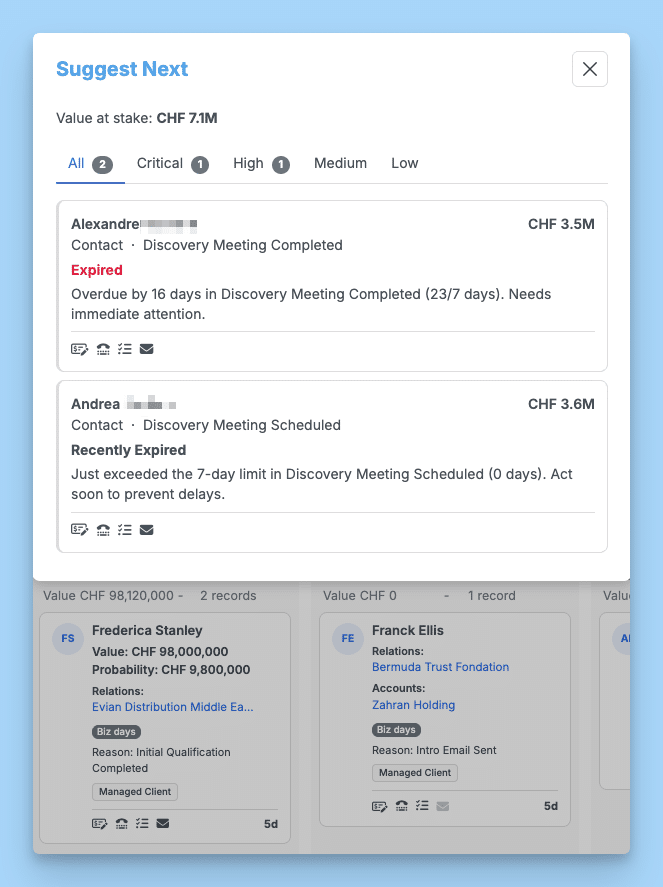
AI can support pipeline management by suggesting next actions, predicting outcomes, and identifying at-risk opportunities. The key is governance.
Regulated organisations should avoid exporting sensitive client information into uncontrolled foreign ecosystems. InvestGlass provides AI-driven automation within a Swiss-sovereign or on-premise environment, helping institutions retain control over client data, workflows, and model outputs.
Start with clear use cases, such as lead scoring, stale deal alerts, or next-best-action suggestions. Expand only when sales professionals, compliance, and leadership trust the results.
Why InvestGlass Is a Sovereign Solution for Sales Pipelines
InvestGlass is a Swiss sovereign CRM and automation platform for banks, wealth managers, insurers, asset managers, real estate investment firms, and public sector bodies operating in regulated environments. It combines CRM, digital onboarding and KYC, portfolio management, compliance workflows, marketing automation, AI tools, and a secure client portal in one integrated stack.
For organisations that want to avoid dependence on American or Chinese vendors, InvestGlass offers a trusted European alternative. Hosting in Switzerland or deployment on-premise helps protect data sovereignty, privacy, and operational control.
InvestGlass supports configurable sales pipeline stages, activity tracking, role-based permissions, dashboards, communication logging, and compliance checks. A private bank can standardise its own pipeline across booking centres while preserving local regulatory controls. An insurer can align its broker network around common pipeline metrics and improve pipeline visibility without moving sensitive records into foreign cloud ecosystems.
To discuss how InvestGlass can help your organisation build a sales pipeline, modernise customer relationship management, and protect client sovereignty, contact our team.
PERGUNTAS FREQUENTES
This FAQ addresses practical implementation questions about how to build a sales pipeline in regulated industries.
How long does it typically take to build and roll out a sales pipeline?
A simple pipeline for a small team can be designed and configured within one to two weeks. A multi-country financial institution may need six to ten weeks to align stakeholders, migrate data, configure controls, and train staff. Using InvestGlass templates for financial services workflows can shorten implementation compared with generic CRMs.
How many stages should my sales pipeline have?
Most B2B and financial-services pipelines work well with six to eight stages. Add a stage only when a distinct buyer action or approval step repeatedly appears in real deals. InvestGlass allows stages to be added, removed, or adapted later without losing useful historical reporting.
How do I migrate from spreadsheets or a foreign CRM to a sovereign platform like InvestGlass?
Migration usually involves exporting contacts, companies, and deals, cleaning the data, mapping fields, and importing records into InvestGlass with agreed stage mappings. This is also an opportunity to improve pipeline hygiene by closing old or unqualified deals. Many organisations run both systems in parallel briefly while teams learn the new views and reports.
How can I encourage sales professionals to keep the pipeline up to date?
Show sales professionals that accurate records lead to better coaching, fairer performance reviews, and more reliable forecasts. Keep required fields simple and ask for updates immediately after meaningful interactions. InvestGlass reduces administrative effort through reminders, automation, and integrated communication logging.
How does data sovereignty affect my choice of sales pipeline tools?
For banks, wealth managers, insurers, and public-sector bodies, the sales pipeline contains sensitive personal and financial data. A sovereign platform hosted in Switzerland or deployed on-premise gives organisations control over where data is stored and processed. InvestGlass was designed for this need, helping clients avoid reliance on American or Chinese hyperscale clouds for core CRM and pipeline functions.


