Client lifecycle management (CLM) represents the comprehensive orchestration of high net worth and ultra high net worth client relationships from initial prospecting through to structured offboarding. For private banks operating in Europe and Switzerland, CLM has evolved from a back-office administrative function into a strategic capability that directly influences revenue growth, regulatory standing and client satisfaction.
This article examines what CLM means for private banks today, why it matters in 2024, and how technology such as InvestGlass supports the entire client lifecycle. We explore each stage of the client journey, from integração digital and account opening through ongoing portfolio management to periodic reviews and eventual offboarding.
European and Swiss private banks face acute pressures including margin compression, with net interest margins dropping below 1% in Switzerland by 2023. Regulatory scrutiny continues to intensify through FINMA circulars, MiFID II suitability requirements, CRS automatic tax information exchange across over 100 jurisdictions, and FATCA compliance obligations. Meanwhile, 72% of HNWIs now demand mobile-first onboarding according to recent Deloitte surveys, yet they still expect highly personalised service delivery.
A InvestGlass é uma empresa suíça soberano CRM and automation platform explicitly designed as a European alternative to American and Chinese systems. By hosting data in Swiss data centres or on-premise, InvestGlass protects data sovereignty for banks and their clients, shielding sensitive information from extraterritorial risks associated with foreign legislation.

Why Client Lifecycle Management Matters in Modern Private Banking
Effective customer lifecycle management links directly to revenue growth through accelerated client acquisition, cost control via automation, and unerring regulatory compliance. Private banks that reduce onboarding times from the industry average of 40 to 60 days down to under 10 days can boost new client assets under management by 15 to 20% annually. Automation can slash manual KYC efforts by up to 70%, while avoiding compliance failures that resulted in fines exceeding CHF 100 million across Swiss banks in 2022 for AML lapses alone.
Fragmented systems create substantial operational risk. Many private banks still rely on spreadsheets for lead tracking, email chains for KYC coordination, and paper-based signatures for account opening. These manual processes engender data silos that lead to error rates of 25% in client profiling, protracted periodic reviews that delay suitability reassessments, and eroded net promoter scores that increase client churn by 12 to 15%.
The competitive landscape has shifted dramatically. Fintechs and neobanks now offer instant digital onboarding with eIDAS-compliant video verification and 24/7 AI-driven advisory, capturing 30% market share growth in European HNWI segments since 2020. Traditional private banks mired in pre-2010 processes struggle particularly with complex structures including:
- Family offices requiring multi-jurisdictional beneficial ownership disclosures
- Trusts and foundations with enhanced due diligence requirements under EU 5AMLD
- Cross-border clients triggering CRS and FATCA reporting obligations
- Discretionary mandates demanding consistent suitability documentation
CLM operates as an end-to-end operating model rather than a single tool. Platforms like InvestGlass centralise data, workflows and client communication throughout the lifecycle, yielding 40% faster periodic reviews and enhanced cross-sell ratios. A Swiss private bank that KYC automatizado for politically exposed persons via API-linked sanctions screening reduced review cycles from 30 days to 72 hours, demonstrating the practical impact of integrated lifecycle management.
Key Stages of the Private Banking Client Lifecycle
The client lifecycle in private banking follows a structured continuum from first contact through to offboarding. Each stage presents opportunities for digitisation that improve operational efficiency while maintaining the personalised service that distinguishes private banking.
Prospecting and lead management begins when gerentes de relacionamento and business developers capture leads from high-touch channels including wealth forums, family office referrals, and external introducers such as lawyers and accountants. Using a wealth management-specific CRM such as InvestGlass avoids data loss from email silos and fragmented spreadsheets. Pontuação de leads algorithms can prioritise prospects based on AUM potential, referral strength and risk indicators, capturing 95% of leads compared to 60% in fragmented setups.
Digital onboarding and account opening in 2024 mandates remote Verificação de identidade via eIDAS Level 2 video KYC or FINMA-approved biometric tools. Typical steps include digital forms for source of wealth declarations, tax self-certifications under CRS and FATCA GIIN registration, and automated risk scoring integrating Triagem de PEP e sanções. Straight-through processing achieves 80% automation for low-risk domestic clients, though complex offshore structures may require additional manual review.
KYC, AML and suitability requirements demand enhanced due diligence for PEPs, trusts and cross-border clients per FATF recommendations. CLM platforms automate perpetual screening against OFAC, EU and Swiss SECO lists, adverse media monitoring, and annual reviews triggered by thresholds such as transaction spikes exceeding 20% of average activity. Suitability documentation under MiFID II requires mapping of client knowledge, experience and objectives to products, with 48% of banks reporting onboarding abandonment due to friction in 2023 surveys.
Ongoing relationship and portfolio management encompasses periodic investment reviews for discretionary mandates, Integração de ESG per SFDR requirements, MiFID-compliant suitability rechecks, and regulatory reporting including PRIIPs KIDs. All activities connect to holistic client profiles logging communication histories to evidence best interest duties throughout the client journey.
Periodic reviews, remediation and trigger events activate on concrete triggers including address changes prompting CRS re-certification, liquidity events like IPO proceeds necessitating source of wealth refresh, inheritances triggering generational profiling, tax residency shifts under DAC6 reportable arrangements, or negative news alerts from automated monitoring. CLM systems dispatch maker-checker workflows to ensure audit-proof remediation within 10 to 30 days.
Offboarding and retention requires structured exits that preserve audit trails per FINMA record-keeping mandates of 10 years minimum, enforce document retention rules balanced against GDPR Article 17 erasure rights, and solicit NPS feedback via integrated surveys. Proactive retention plays enabled by CLM analytics can retain 85% of at-risk clients before they decide to leave.
Automating Client Lifecycle Operations in Private Banking
Automation now stands central to client lifecycle management CLM in private banking. Cost pressures see operational expenses consuming 60 to 70% of revenues in Swiss firms. Complex regulation including SFDR ESG disclosures demands consistent documentation. Clients expect sub-24-hour responses to routine requests. These factors transform CLM from siloed operations into integrated ecosystems.
Legacy challenges persist across the banking industry:
- Multiple booking systems per region with separate ledgers for offshore and onshore entities
- Manual PDF data entry yielding 18% error rates
- Disjointed KYC tools from multiple vendors
- Front-to-back office disconnects impeding real-time reconciliation of client static data
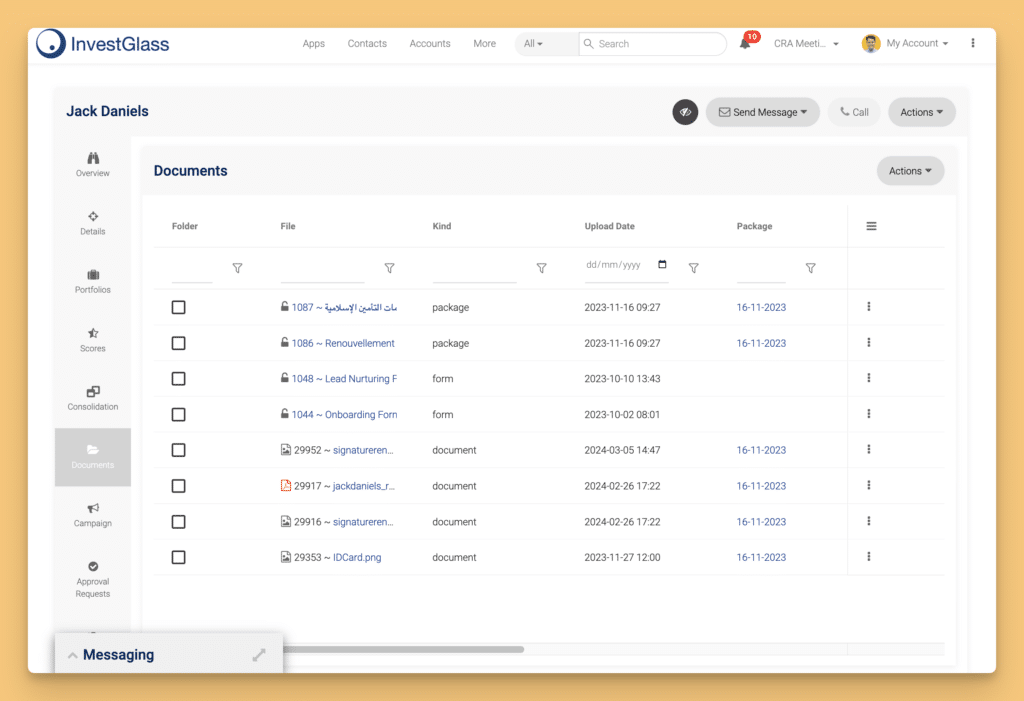
Workflow automation in platforms like InvestGlass standardises and orchestrates processes across the entire client lifecycle. Configurable pipelines handle onboarding, product approval matrices for illiquid alternatives, credit line applications with automated limit calculations, periodic KYC renewals per risk tiers, and document expiry alerts. Banks report 50 to 70% throughput gains from such automation.
Concrete automation examples suited to private banking include:
- Automatic task creation when passports near expiry, triggered 90 days before the expiration date
- Scheduled source of wealth refresh for high-risk clients after 12 months
- Straight-through processing for low-risk domestic clients bypassing manual checks
- Automated generation of periodic review documentation for discretionary mandates
- Task assignment to internal teams when transaction monitoring flags unusual patterns
AI and rules engines amplify these efficiencies by scoring incoming leads on net-worth proxies from public data, flagging anomalies like unusual wire patterns indicative of layering in AML contexts, supporting transaction monitoring with unsupervised learning models detecting 92% of suspicious activities, and prescribing next-best-actions for relationship managers based on profile sentiment analysis.
InvestGlass offers automation hosted in Switzerland or on-premise, enabling private banks to retain control over all data flows. Sensitive information remains within sovereign infrastructure rather than transiting through American or Chinese cloud environments, addressing concerns that have led 40% of European banks to diversify their technology vendors.
Data, Compliance and Risk Management Across the Lifecycle
Effective lifecycle management in private banking fundamentally depends on trusted data, regulatory control and auditable processes covering KYC, AML, tax and investor protection requirements. A unified golden source reconciles client identifiers, ultimate beneficial owner chains under CRS Section VIII, FATCA and CRS classifications, ESG taxonomies per EU Taxonomy Regulation, and MiFID investment profiles. Data discrepancies trigger 30% of FINMA remediation orders, making accuracy critical.
Ongoing KYC and AML duties for private banks include:
Requisito | Frequência | Trigger Events |
|---|---|---|
Sanções e triagem de PEP | Real-time | New clients, profile changes |
Monitoramento de mídia adversa | Perpetual | Automated news alerts |
Risk reviews (enhanced) | Annual | PEPs, high-risk clients |
Risk reviews (standard) | Biennial | Low and medium-risk clients |
Event-driven reviews | As required | Transactions over €15,000, profile mutations |
Non-compliance fines under EU AMLR can reach €5 million or 10% of global turnover, making robust document management and risk management essential.
InvestGlass supports embedded compliance workflows with configurable rules, maker-checker segregation of duties, and automated reminders for lapsed documentation. The platform handles MiFID II and III target market assessments, PRIIPs KID automated delivery, SFDR Article 10 disclosures, cross-border MiFID passporting requirements, and Swiss AQO reporting obligations.
Swiss data sovereignty remains paramount for private banks handling sensitive client information. InvestGlass hosting in Zurich data centres or within bank virtual private clouds enables demonstrable control over AES-256 encryption, access logs for FINMA inspections, and zero extraterritorial data transit. This contrasts with American providers subject to CLOUD Act exposures that have prompted many European institutions to seek sovereign alternatives.
Designing a CLM Operating Model for Private Banks
Private banks must rethink their CLM operating model rather than simply automating manual processes that were designed decades ago. True digital transformation requires examining each stage of the client journey and identifying where emerging technologies can create genuine value.
Assessing current state involves mapping client journeys from lead capture to offboarding and identifying bottlenecks. Common challenges include:
- Onboarding times exceeding 40 days against a target of 10 days for standard HNWIs
- KYC exception rates above 15%
- Data completeness below 75%
- Stagnant share-of-wallet growth below 5% after 12 months
- Manual touchpoints consuming relationship manager time
Concrete metrics for CLM transformation should include target onboarding time under 10 days for standard clients, KYC straight-through rate above 80%, improved data completeness above 95%, and greater share of wallet growth within the first year of the relationship. These metrics translate directly to revenue and costs.
Governance through a CLM steering committee proves essential. This committee should comprise representatives from front office, compliance, risk management, operations and IT, with clear ownership for process definitions and continuous improvement. Quarterly reviews allow teams to balance competing priorities and adjust workflows based on measured outcomes.
Configurability matters significantly for private banks operating across multiple jurisdictions and booking centres. InvestGlass enables drag-and-drop configuration of country-specific workflows, product whitelists per regulatory regime, and approval hierarchies without heavy code changes, reducing implementation timelines from 18 months to 6 months.
A phased implementation approach typically works best:
Fase | Foco | Linha do tempo | Resultado esperado |
|---|---|---|---|
Phase 1 | Swiss onshore HNWI onboarding and KYC | 3 months | 50% reduction in time-to-onboard |
Phase 2 | Discretionary mandate reviews | 3 months | Verificações automatizadas de adequação |
Phase 3 | Cross-border clients | 3 months | CRS auto-filing, multi-jurisdiction support |
Phase 4 | Complex structures | 3 months | Trust and foundation UBO waterfalls |
This phased approach allows private banks to demonstrate value early while building internal capability to manage more complex transformations.
Why InvestGlass Is a Sovereign CLM Solution for Private Banks
A InvestGlass é uma empresa suíça soberana CRM e CLM platform built specifically for banks, private banks and wealth managers that want to avoid dependence on American or Chinese technology providers. The platform addresses the fundamental concern that sensitive client data should remain under the control of the institution and its clients rather than being subject to foreign jurisdiction.
InvestGlass combines CRM, digital onboarding, KYC and AML workflows, portfolio management, marketing automation and a secure client portal in a single integrated platform designed for regulated institutions. This integration eliminates the complexity of managing multiple point solutions while ensuring data consistency across all stages of the client lifecycle.
Hosting flexibility allows institutions to choose what works for their environment:
- Fully hosted in Swiss data centres with sovereign infrastructure
- On-premise deployment within the bank’s own data centres
- Complete control over client data storage and encryption keys
- Custom integrations with existing core banking systems
Concrete CLM capabilities relevant to private banking include digital account opening for individuals, companies and trusts with configurable source of wealth documentation workflows. Risk scoring uses Bayesian models blending static and dynamic data. Suitability questionnaires with decision trees support MiFID compliance. Automated periodic reviews trigger on 50 or more defined events, ensuring nothing falls through the cracks.
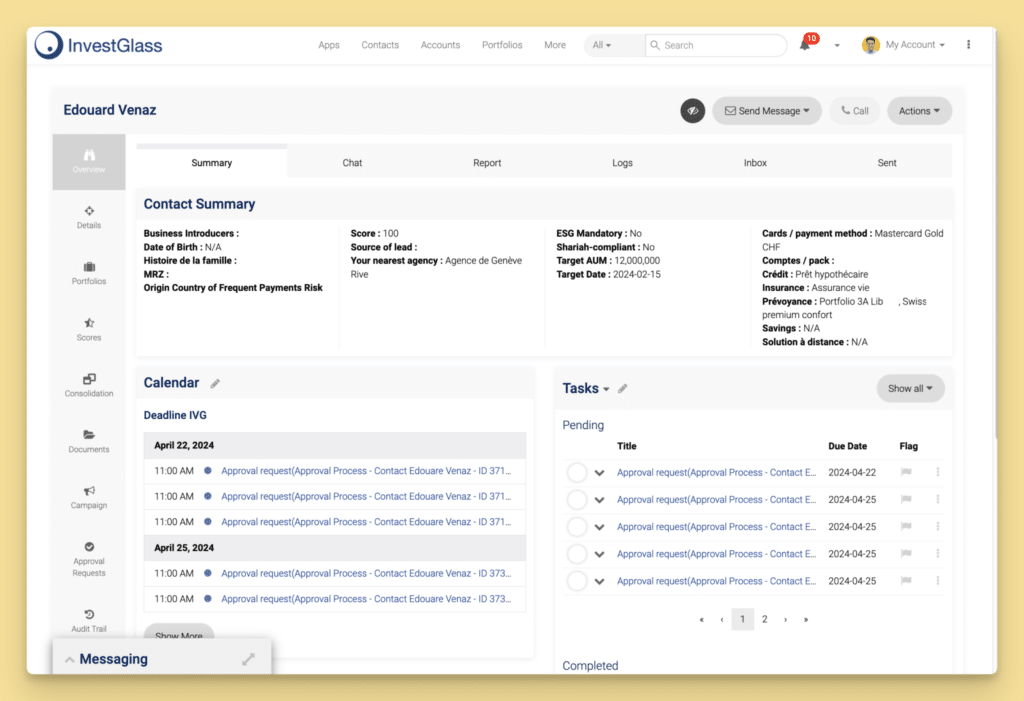
Relationship managers use InvestGlass for day-to-day CLM activities including tracking interactions, generating personalised proposals with Monte Carlo simulations, scheduling reviews, and accessing AI-supported insights. Compliance teams monitor the same client record, ensuring alignment between commercial activities and regulatory obligations without creating duplicate data entry or reconciliation burdens.
InvestGlass supports stringent audit requirements with immutable audit trails spanning 10 or more years, providing full lifecycle history for every client. This aligns with European data protection expectations for institutions seeking a non-extraterritorial, sovereignty-preserving solution that delivers both competitive advantage and operational efficiencies.
Pilots demonstrate measurable impact: 60% onboarding acceleration, 25-point NPS uplift, and 40% risk exception reductions within defined proof-of-concept periods. Private banks considering CLM transformation should evaluate a pilot digitising onboarding for a specific booking centre, measuring the impact of automation against current baselines over a six-month period. This practical approach allows institutions to deliver value quickly while building confidence in broader transformation initiatives.