
Introduction to Fin Artificial Intelligence
Fin artificial intelligence refers to the ai models, ai agents, and ai tools purpose-built for the financial services industry. This article explains what finance ai is, how ai systems work across banking and investment, and where organisations can begin their ai adoption journey between 2024 and 2026. Since roughly 2020, artificial intelligence has moved from experimental pilots to core infrastructure across the finance industry, reshaping how institutions operate, compete, and serve clients.
AI systems mimic human intelligence and learn over time to identify patterns, enabling organisations to automate and optimise financial services leading to improved efficiency at scale. Core use cases already in production include:
- Algorithmic trading and quantitative investment strategies
- Credit scoring using alternative data sources and machine learning
- Fraud detection powered by deep learning and behavioural analytics
- Customer experience enhancement through chatbots and conversational ai agents
- Ai driven personalization of product offers across digital channels

The Fin AI Ecosystem and Community
A growing global community connects researchers, engineers, regulators, and financial practitioners around the shared goal of deploying ai in finance responsibly. This ecosystem accelerates adoption through open research, shared benchmarks, and reference ai solutions that institutions can evaluate and adapt.
Collaboration formats active in 2025 and 2026 include:
- Symposiums and research grants: Le Center for AI and Responsible Financial Innovation (CAIRFI), a joint initiative between Capital One and Columbia University, funds faculty projects on synthetic data, multi-agent LLMs, fairness in lending, and domain-specialised models.
- Summer schools: The SoFiE Financial Machine Learning Summer School at Yale brings together PhD students, new faculty, and professionals to study ML methods in asset pricing and financial econometrics.
- Industry meetups and hackathons: Practitioners gather in major hubs such as New York, London, and Singapore to exchange more insights on production deployments.
Strong communities bridge cutting edge research with concrete banking, capital markets, and insurance use cases. They also produce shared benchmarks that enable comparability and help regulators understand emerging ai technologies in practice.
Education: Building AI Talent for Finance
The talent gap constrains performance across financial institutions even as ai adoption broadens. Surveys consistently cite data fluency, model interpretability skills, and ai governance knowledge as major limitations. Dedicated education programmes are crucial to close these gaps from 2024 onward.
Typical educational formats include:
- Online certificate programmes of 8 to 10 weeks covering Python, machine learning fundamentals, and financial data analysis
- Graduate degrees such as Wharton’s Master of Science in Quantitative Finance launching in autumn 2026, emphasising data science, ai models, and hands-on research projects in quantitative asset management
- Internal bank academies that upskill existing finance teams in ai usage, risk, and interpretability
A modern curriculum should cover: algorithmic trading basics, natural language processing for financial documents, time-series modelling, risk modeling, data privacy and model governance, and deploying ai agents safely in regulated environments.

Academic and Industry Collaboration
Partnerships between universities and financial institutions are essential because financial ai requires access to large, sensitive financial data, regulatory awareness, and real-world deployment context that neither side holds alone.
Joint labs and sponsored research chairs now focus on areas like explainable credit scoring, robust algorithmic trading strategies, and trustworthy lending. From 2025 onward, many programmes include live case studies with banks, asset managers, or fintechs. Concrete collaboration formats include:
- Capstone projects using anonymised loan or transaction data, such as CAIRFI research fellows tackling fairness in lending, or projects examining how central banks deploy AI for monetary policy and digital currency management using platforms like InvestGlass for central banking AI
- Internships in ai risk teams at banks or fintechs, working on compliance, AML, or algorithmic trading problems
Expected outcomes range from peer-reviewed papers and prototypes to open-source ai applications and evaluation pipelines that the wider community can use.
Research: Pushing the Boundaries of AI in Finance
Research in artificial intelligence for finance centres on three pillars: robustness under volatile market conditions, interpretability of black-box models, and regulatory compliance. Public benchmarks are emerging to standardise evaluation.
- FinanceReasoning, introduced in mid-2025, evaluates large reasoning models on financial numerical reasoning across over 3,000 Python-formatted functions. Even strong models still lag in numerical precision.
- AI-Trader benchmarks autonomous agents in real-time financial markets, emphasising risk controls and cross-market robustness.
There is growing interest in neurosymbolic approaches that combine symbolic rules with statistical learning, helping to reduce hallucination and enforce regulatory constraints. Leading research groups release code, datasets, and evaluation pipelines openly to improve reproducibility, stress testing models under crisis scenarios, and long-horizon backtesting for trading systems.
From Large Language Models to Large Reasoning Models
From roughly 2024 onward, the finance industry has seen a shift from generic LLMs to domain-tuned large reasoning models (LRMs) optimised for multi-step quantitative reasoning. AI leverages natural language processing to analyze unstructured data for market sentiment, but LRMs go further: they chain reasoning steps for tasks like scenario analysis, liquidity stress tests, and complex derivative pricing explanations.
Hybrid architectures that combine LLMs with symbolic rules help enforce regulatory constraints and reduce hallucinations. A practical comparison:
Capacité | LLM | LRMs |
|---|---|---|
Language and summarisation | Fort | Fort |
Multi-step numerical reasoning | Limitée | Optimised |
Regulatory constraint enforcement | Requires add-ons | Built-in (hybrid) |
Use in risk and treasury teams | Reporting, drafting | Scenario analysis, stress testing |
For risk, treasury, and investment teams, LRMs represent a next generation of ai tools that deliver deeper insights into portfolio behaviour and regulatory alignment. |
Incubation and Commercialisation of Fin AI Solutions
Incubation is the process of turning research prototypes into production-grade ai solutions for banks and fintechs. Early-stage teams typically focus on narrow but high-value problems: KYC document extraction, invoice financing risk models, or call centre ai agents.
Support mechanisms that accelerate incubation include:
- Access to regulatory experts and compliance lawyers
- Anonymised or synthetic datasets for model training
- Cloud credits for compute-intensive training and inference
- Mentorship from financial industry veterans, including risk officers and a vice president of operations or compliance
A typical 2025 to 2026 incubation cycle runs three to six months from proof-of-concept to limited pilot. Throughout this period, teams must prioritise security, compliance reviews, and explainability before rolling out ai systems at scale.
From Prototype to Production in Regulated Environments
Deploying fin artificial intelligence under strict banking and securities regulations presents unique challenges. AI strategies involve significant costs for development or integration, and missteps carry legal and reputational risk.
Key steps an internal team or startup must follow:
- Model validation: independent testing including stress and backtesting over crisis period data
- Bias and fairness testing: ensuring credit risk assessment models do not produce discriminatory outcomes
- Independent risk sign-off: review by risk, compliance, and legal before deployment
Production systems must include monitoring dashboards, incident response playbooks, and clear ownership for ai outcomes. Sandboxes and limited-traffic pilots validate ai applications before full rollout, reducing risk and building confidence among stakeholders.
Core AI Applications in Finance Today
This section outlines the main production use cases of ai in finance as of 2024 to 2026. Each subsection covers a specific domain, tying applications to measurable outcomes such as reduced cost-to-serve, more accurate predictions, or higher customer satisfaction.
Algorithmic Trading and Quantitative Investment
Artificial intelligence enhances algorithmic trading well beyond traditional rule-based systems. AI algorithms process vast data to execute algorithmic trading faster than human traders, while ai-driven algorithms enable high frequency trading in financial markets across US equities, FX, and crypto.
Deep learning is used for limit order book forecasting, news and social sentiment analysis, and intraday volatility prediction. Risk controls embedded into ai agents executing trades include kill switches, position limits, and real-time anomaly detection. A 2025 research study on an orchestration framework for financial agents demonstrated an 8.39 per cent return and a Sharpe ratio of 0.38 in a BTC backtest, with maximum drawdown limited to negative 2.80 per cent.
Hedge funds and investment firms must balance opportunities in speed and pattern discovery against risks of overfitting, market impact, and flash crashes. Widespread adoption of similar algorithms can create systemic risks in the financial sector if not carefully managed.

Automation of Financial Workflows and Back-Office Operations
AI enhances operational efficiency in financial services through automation of manual, repetitive financial workflows. Automated systems can streamline labour-intensive financial processes, reducing costs across payments, reconciliation, and reporting.
Concrete examples include:
- Automated invoice matching and reconciliation of trades and positions
- Smart routing of support tickets using classification models
- AI-driven regulatory reporting automation
AI automates expense management and compliance monitoring, while improving productivity and scalability in financial operations. AI systems handle growing transaction volumes accurately without requiring linear headcount growth. Integration with existing core banking and ERP systems via APIs and low-code tools ensures operational efficiency gains are realised quickly. These outcomes demonstrate clearly how fin works in practice.
Notation du crédit et évaluation du risque
Machine learning expands credit scoring beyond traditional bureau scores. Traditional credit scoring relies on limited datasets like income, but ai incorporates alternative data for credit scoring decisions where legally permitted: utility payments, e-commerce transaction history, device data, and open banking feeds. AI expands credit scoring by using alternative data sources, improving access to credit for those without traditional credit histories.
Explainable models are essential so underwriters, auditors, and regulators can understand ai-driven lending decisions and assess creditworthiness transparently. Benefits include broader financial inclusion, more granular risk-based pricing for credit risk, and faster decision making. Strict data privacy safeguards and fairness assessments remain non-negotiable. Financial institutions face scrutiny regarding the transparency of AI decision-making, particularly in lending.
Customer Service, Chatbots, and AI Agents
AI agents now handle a large share of front-line customer interactions in banking and fintech applications. AI-powered chatbots provide 24/7 customer support and personalised financial advice, while agentic AI chatbots in banking provide instant responses to customer inquiries across web, mobile, and fin voice channels.
Natural language processing enables AI to understand customer needs, powering conversational interfaces that handle balance inquiries, dispute initiation, card replacement, loan status updates, and KYC document collection. AI enhances customer service efficiency by freeing human agents to focus on complex cases. Agents collaborate with humans through escalation protocols, conversation summaries, and suggested responses.
Robinhood Markets built multiple ai agents in 2025, including a customer support agent and a natural language to executable trading scan converter, optimising latency to under one second while maintaining quality through multi-stage evaluation. The impact on both customer experience and operational metrics, such as first contact resolution and average handle time, is significant.
Fraud Detection, AML, and Cybersecurity
The shift from static rules to adaptive machine learning for fraud detection and anti-money laundering is well under way. AI uses deep learning for real-time fraud detection, while machine learning models adapt to new fraud tactics as they emerge. Real-time fraud detection systems handle high-volume transactions across cards, accounts, and payments.
Key use cases include:
- Card fraud detection and account takeover prevention
- AI automates transaction monitoring for regulatory compliance
- AI helps detect suspicious activities and suspicious activity in financial transactions while supporting LCB-FT and AML controls in France
- Sanctions screening support via NLP
Graph-based models and behavioural analytics uncover complex money-laundering patterns by analysing transaction patterns across networks. AI fraud detection reduces false positives significantly, leading to faster investigation times and real-time alerts at scale. Future fraud detection will incorporate biometric authentication for stronger identity verification.
Le U.S. Treasury’s 2024 report on AI-specific cybersecurity risks highlights growing cybersecurity risks and the need for fraud data sharing, model risk management, and stronger defences, particularly at smaller institutions with limited resources. Human investigators remain essential in the loop, and strong audit trails are required for every AI-generated alert.
Insurance Underwriting and Claims Processing
AI plays a growing role in life, health, auto, and property insurance workflows. Computer vision and NLP analyse medical reports, accident photos, and repair invoices to support underwriting and automated claims processing. Straight-through processing for low-risk claims accelerates cycle times and improves the customer journey.
More granular risk-based pricing for policies benefits from ai models that analyze vast datasets of claims history and external data. Compliance requirements demand that underwriting model design avoids discriminatory features. AI systems can inherit biases from training data leading to discriminatory decisions, making fairness audits essential.
Portfolio Management, Robo-Advisory, and Personal Finance
AI tools improve portfolio management by identifying market trends and surfacing risk concentrations for both professional asset managers and individual investors, enabling effective portfolio management strategies using AI that improve efficiency, risk control, and performance. Robo-advisors use algorithms to select ETFs, rebalance portfolios, and manage tax-loss harvesting automatically, often linking to savings accounts and broader personal finance goals.
AI-driven portfolio dashboards surface scenario outcomes for wealth managers, enabling them to forecast market trends under varying market conditions. Regulatory expectations around suitability, transparency, and disclosures for automated investment advice continue to tighten. Portfolio analytics connect directly to ai driven personalization of investment strategies based on goals and risk tolerance.
Predictive Analytics, Forecasting, and Treasury Management
Predictive analytics uses AI to identify patterns in historical data, enabling more accurate forecasting of revenues, cash flows, and liquidity needs. Financial institutions use predictive analytics to anticipate risks and spot new opportunities in finance. AI forecasts liquidity needs for cash flow management, helping treasurers optimise funding plans, hedging strategies, and liquidity buffers.
Examples include corporate cash flow forecasting, retail deposit outflow prediction, and stress-testing under macroeconomic scenarios. Integration with real-time data feeds from payments, card transactions, and market data ensures outputs reflect current conditions. Predictive analytics helps spot new opportunities in finance, supporting CFOs and treasury teams in risk mitigation and strategic decision making.
AI-Driven Personalisation and Customer Experience
Ai driven personalization reshapes customer experiences across digital banking, wealth management, and insurance. Recommendation engines tailor product offers, including cards, loans, savings, and insurance, based on behaviour and financial health metrics. Micro-segmentation and next-best-action engines use ai to select timing, channel, and message for each customer along the customer journey.
Guardrails are essential: consent management, transparent opt-outs, and limits to avoid manipulative or predatory offers. Personalisation connects directly to improved retention, cross-sell rates, and customer satisfaction scores.
Embedded Finance and Contextual Offers
Embedded finance integrates financial services into non-financial platforms such as e commerce platforms and ride-sharing applications. AI powers real-time lending, insurance, and payments offers at checkout or in-app.
Examples include buy-now-pay-later decisions, micro-insurance pricing, and dynamic credit limits based on real-time risk signals. These contextual AI recommendations improve convenience while respecting data privacy and regulatory constraints. Ai powered platforms and ai powered tools enable such integration, supporting new business models across industries.
Architecture: RAG, Autonomous AI Agents, and Hybrid Cloud
Production-grade fin artificial intelligence systems rely on three key technical patterns: retrieval-augmented generation (RAG), autonomous ai agents for workflows, and hybrid cloud deployment models. Each supports accuracy, compliance, and scalability in financial environments.

Retrieval-Augmented Generation (RAG) for Financial Services
RAG combines large language models with secure access to internal knowledge bases and document stores. Examples include policy Q&A for customer service, summarising lengthy regulatory texts, and drafting compliance reports with citations.
RAG helps reduce hallucinations by grounding AI outputs in audited, up-to-date financial content, including unstructured data from internal repositories. Integration challenges include document tagging, access control, and regular updating of indexes with new policies or filings.
Autonomous AI Agents for End-to-End Workflows
Autonomous AI agents manage workflows without human intervention for routine tasks such as expense approvals, onboarding, or loan renewals. Agents combine planning, tool use via APIs and databases, and dialogue management to complete tasks with minimal manual input.
Examples include automating small-business loan origination and resolving billing disputes from intake to resolution. Deterministic guardrails are essential: explicit policies, role-based permissions, and human approval checkpoints for high-risk actions ensure reliability, auditability, and safe failure modes.
Hybrid Cloud, Edge Computing, and Decentralised AI
Financial institutions often choose hybrid cloud architectures for ai due to regulatory and latency needs. Sensitive financial data may stay on-premises while model training or non-critical inference runs in public cloud environments. Edge and decentralised AI approaches, where models run closer to data sources such as ATMs or mobile devices, improve privacy and latency.
Decentralised setups, including federated learning, support stronger data privacy by minimising raw data movement. Trade-offs include complexity, security risks, and operational overhead.
Governance, Data Privacy, and Responsible AI in Finance
Ai governance and data privacy are non-negotiable for fin artificial intelligence deployments. AI can introduce significant operational risks if used irresponsibly, and mistakes in credit decisions, fraud, or AML carry legal, reputational, and systemic consequences.
AI helps financial institutions comply with regulatory requirements, while AI improves accuracy of compliance reporting in financial services. AI systems assist institutions in staying updated on regulations through automated monitoring and alerting. Robust governance frameworks cover the full model lifecycle: design, validation, monitoring, incident reporting, and retirement.
Ethical considerations are paramount: fairness in credit scoring, non-discrimination in insurance underwriting, and transparency in robo-advice. An associate professor working in this field would emphasise that governance must be embedded into daily workflows, not treated as an afterthought.
AI Governance Frameworks and Risk Management
An AI governance framework provides a structured approach to managing risks across all ai applications. The U.S. Treasury’s Financial Services AI Risk Management Framework (FS AI RMF), released in February 2026, includes 230 control objectives across governance, risk assessment, risk mitigation, and monitoring.
Typical components of a mature governance programme include:
- Policies, approval workflows, and risk taxonomies
- Model inventories and periodic independent reviews
- Cross-functional committees involving risk, legal, compliance, IT, and business lines
- Performance thresholds, drift detection alerts, fairness audits, and stress-test scenarios
According to the 2026 KPMG Global AI in Finance Report, ai adoption in finance has risen from around 30 per cent in 2024 to approximately 75 per cent in 2026, with over 70 per cent of organisations reporting improved decision-making quality. Yet regulatory uncertainty remains a concern for over half of firms surveyed.
Data Privacy, Security, and Confidentiality
Financial data is highly sensitive and heavily regulated. The reliance on large datasets creates privacy concerns and data security risks in AI deployments across the sector.
Key practices include:
- Chiffrement au repos et en transit
- Strict access control and role-based permissions
- Anonymisation, pseudonymisation, and data minimisation
- Synthetic data generation when real datasets cannot be widely shared
- Federated learning approaches where raw data stays within each institution
Third-party AI providers must adhere to the same privacy and security controls, with proper vendor oversight of supply chains and dependencies. Data privacy practices connect directly to customer trust and regulatory compliance.
Future Trends in Fin Artificial Intelligence
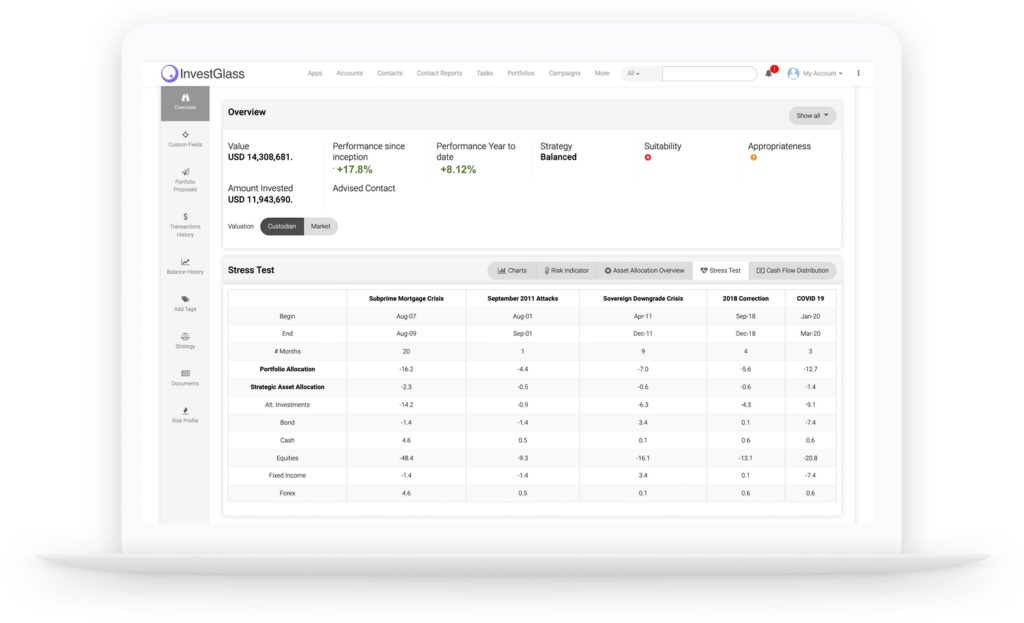
Between 2026 and 2030, ai in finance is likely to evolve through more capable reasoning models, wider adoption of ai agents, quantum-inspired optimisation, and sustainability analytics. Future trends must remain grounded in robust ai governance and human oversight. Nearly 93 per cent of US companies expect to deploy or scale ai in finance over the next 18 months, though concerns around data security, model reliability, and compliance persist.
Quantum Computing and Advanced Optimization
Quantum and quantum-inspired algorithms hold potential for complex portfolio and risk optimisation problems. The near-term scenario involves hybrid classical-quantum workflows tested in pilots rather than full production replacement.
Use cases include option pricing grids, scenario enumeration, and capital allocation under multiple constraints. Broad commercial impact is expected later in the decade, but experimentation is already under way at large financial institutions and research labs.
Green Finance, ESG Analytics, and Sustainability-Focused AI
Regulators and investors are pushing for more detailed ESG and climate risk disclosures. Green finance initiatives rely on AI to ingest unstructured data, including reports, news, and satellite imagery, to score companies on environmental and social metrics.
Use cases include climate stress-testing of loan books, carbon footprint estimation, and sustainable investment screening. Transparency about data sources and methodologies is critical to avoid greenwashing. ESG analytics connect directly to risk management, capital allocation, and regulatory expectations.
AI for Global Financial Inclusion
AI can expand access to credit, savings, and insurance for underserved populations worldwide. Examples include mobile-based credit scoring for smallholders, micro-insurance pricing using local data, and low-cost digital wallets.
These approaches rely on alternative data sources such as mobile usage and transaction histories, requiring strong consent and privacy controls. Partnerships between fintechs, local banks, and NGOs provide scalable models for inclusive ai applications. Risks around bias, over-indebtedness, and digital exclusion must be addressed directly.
Getting Started with Fin Artificial Intelligence
For executives and product leaders seeking to introduce or scale ai in their financial organisations, a phased approach reduces risk and builds confidence. Assess your ai readiness across data, talent, and governance before committing to large-scale investment.
A recommended roadmap:
- Discovery: map existing AI capabilities, data assets, and regulatory environment
- Prioritisation: select high-impact, well-bounded problems such as customer service automation, document processing, or simple risk models
- Proof-of-concept: run a small-scale pilot to test performance, data quality, and regulatory fit
- Pilote : limited rollout in a production environment or sandbox with careful monitoring
- Scaled deployment: full solution with governance, monitoring, and operations in place
Practical prerequisites include clean data, a cross-functional team spanning finance, data science, risk, and compliance, a governance framework aligned with standards like the FS AI RMF, and clear success metrics. Organisations that invest in governance, talent, and well-bounded pilot projects today will be best positioned to capture the value of fin artificial intelligence over the coming decade. The path forward requires discipline, clean data, cross-functional collaboration, and a commitment to earning the trust of regulators and clients alike.


