
Customer feedback surveys have become essential tools for banks, wealth managers, insurers, and public sector entities seeking to understand client sentiment and demonstrate regulatory compliance. In 2026, these surveys operate primarily through digital channels, integrated directly into client portals, onboarding workflows, and post-interaction touchpoints. InvestGlass helps regulated institutions build, automate, and analyse customer feedback surveys while preserving data sovereignty in Switzerland or on-premise infrastructure. Choosing the right survey questions and tools makes a big difference in the quality of insights gained from customer feedback surveys.
This guide uses British English and focuses on digital, compliant feedback collection rather than paper or telephone-based methods. We cover core survey frameworks including CSAT, CES, NPS, and exit surveys, showing when and how to deploy them in regulated environments. Whether you manage retail banking clients, high-net-worth portfolios, or corporate treasury relationships, you will find practical approaches to gather feedback, measure customer satisfaction, and turn survey responses into concrete improvements.
What is a customer feedback survey?
A customer feedback survey is a structured set of questions delivered via digital channels such as email, secure client portals, SMS, or in-app interfaces to collect opinions, complaints, and suggestions about products, services, and specific service interactions.
Surveys have evolved significantly from physical feedback cards placed in bank branches to multi-channel digital forms integrated with CRM systems and client portals. This shift enables institutions to capture feedback in real time while experiences remain fresh in clients’ minds. Modern surveys follow predetermined structures, typically ranging from a few questions to 15-20 items depending on the purpose. Crafting effective customer satisfaction survey questions is essential to accurately gauge customer sentiment, improve customer experience, and measure satisfaction levels using a variety of question types and metrics.
بالنسبة لـ المؤسسات المالية, a “customer” may mean:
- Retail banking clients
- High-net-worth individuals managing multi-million portfolios
- Corporate treasurers making institutional decisions
- Insurance policyholders
خدمة العملاء surveys are particularly valuable for gathering focused feedback on specific service interactions, ensuring high-quality responses.
Each segment has different communication preferences and tolerance for survey length. A busy corporate treasurer will abandon a ten-question survey but may complete a two-question NPS check. InvestGlass embeds feedback forms into onboarding workflows, post-meeting journeys, and client portals to capture feedback at the moments that matter most.
Why customer feedback surveys matter in financial services
Between 2020 and 2025, digital adoption across European financial services accelerated dramatically. Post-pandemic expectations shifted client preferences toward digital self-service, creating new touchpoints where satisfaction must be measured. Customer satisfaction surveys convert subjective experiences into measurable data that can be tracked month-by-month and benchmarked across branches, teams, and products.
Specific outcomes flow from systematic feedback collection:
النتيجة | تأثير الأعمال |
|---|---|
Reducing affluent client churn | Identifying dissatisfaction signals before clients exit relationships |
Improving digital channel adoption | Revealing friction points and usability problems |
Detecting service issues early | Addressing problems before regulatory complaints or social media escalation |
Supporting conduct monitoring | Documenting client outcomes for regulatory engagement |
In 2024 and 2025, European regulators increased focus on conduct and customer outcomes, making documented feedback and remediation plans strategically important. An institution that collects quarterly CSAT data, analyses satisfaction trends by product and مدير العلاقات, and documents service improvements demonstrates a defensible client-centric governance structure.
InvestGlass lets institutions connect survey responses to individual client records, allowing teams to segment by risk profile, portfolio size, or product mix. This segmentation happens within السيادة infrastructure without exporting data to foreign analytics tools.

Understanding customer expectations
Understanding customer expectations is fundamental for any financial institution aiming to deliver outstanding customer experiences and achieve high levels of customer satisfaction. Customer expectations represent the standards or benchmarks that clients hold regarding the quality, efficiency, and reliability of a product, service, or interaction. In regulated industries, these expectations are shaped not only by previous experiences with your institution but also by interactions with digital-first competitors and evolving regulatory requirements.
Customer satisfaction surveys are a powerful tool for uncovering these expectations. By systematically gathering feedback, institutions can identify what matters most to their customers, whether it is the speed of التهيئة الرقمية, the clarity of investment advice, or the responsiveness of customer service representatives. Analysing customer satisfaction survey data enables organisations to gain insights into gaps between current service delivery and customer expectations, highlighting areas where improvements will have the greatest impact on overall satisfaction.
For example, if survey feedback consistently points to delays in account opening or difficulties navigating the client portal, these become clear priorities for enhancement. By acting on these insights, financial institutions can not only meet but exceed customer expectations, building trust and fostering long-term loyalty. Ultimately, a deep understanding of customer expectations, informed by regular feedback, is essential for delivering a customer experience that stands out in a competitive and regulated market.
The importance of customer journey
The customer journey encompasses every interaction a client has with your institution, from the first point of contact through to ongoing support and relationship management. In financial services, this journey can include digital onboarding, product selection, portfolio reviews, and claims processing, each representing a critical touchpoint that shapes the overall customer experience.
Mapping and understanding the customer journey is vital for identifying pain points that may hinder customer satisfaction. Customer satisfaction surveys play a key role in this process by capturing feedback at each stage, allowing institutions to pinpoint where clients encounter friction or confusion. For instance, a survey sent immediately after a digital loan application can reveal whether the process was intuitive or if additional guidance is needed.
By systematically gathering feedback throughout the customer journey, organisations can address specific pain points, streamline processes, and enhance the overall experience. This approach not only improves customer satisfaction but also increases retention and encourages advocacy, as satisfied customers are more likely to recommend your services. In a regulated environment, demonstrating a commitment to understanding and improving the customer journey also supports compliance and strengthens your institution’s reputation for client-centric service.
Core types of customer feedback surveys
Financial institutions rely on four core survey types: CSAT, CES, NPS, and exit or churn surveys. Each serves a different stage of the customer journey, and combining them provides a complete view of the customer experience.
All examples in this section reflect concrete financial use cases from 2024-2026, including post-onboarding KYC, digital loan applications, and portfolio review meetings. InvestGlass supports these survey types as templates that can be triggered automatically by workflow events such as “account opening completed” or “support ticket closed”.
Customer Satisfaction (CSAT) surveys
Customer satisfaction surveys measure satisfaction with a specific interaction or product. Clients rate their experience on a 1 to 5 or 1 to 7 scale, with labelled anchor points from “Very dissatisfied” to “Very satisfied”. CSAT surveys provide insight into how customers feel about their recent experiences, helping institutions address emotional drivers of satisfaction.
Concrete deployment examples include:
- Sending CSAT within 2-4 hours after a mortgage application approval
- Triggering a survey after digital onboarding completed in under 24 hours
- Requesting feedback immediately following resolution of a card dispute
CSAT is ideal for “moment-in-time” checks. Institutions typically average scores weekly and monthly to track operational performance, creating trend lines that reveal when specific teams or products experience satisfaction degradation. A sudden drop in CSAT for إنشاء القروض might correlate with temporary staff turnover or a system outage. InvestGlass can show CSAT trends by relationship manager, branch, or product without exporting data to any American or Chinese cloud provider.
Customer Effort Score (CES) surveys
The customer effort score measures how easy clients find it to accomplish tasks. Unlike CSAT’s focus on emotional satisfaction, CES targets operational efficiency. Questions are typically framed as “The company made it easy for me to resolve my issue” with a 1-7 agreement scale.
Specific use cases include:
- Evaluating effort required to update KYC documentation in 2025
- Assessing the experience of logging into a secure client portal with multi-factor authentication
- Measuring ease of submitting insurance claims through digital channels
A lower effort score is a leading indicator of loyalty and reduced complaints. This is particularly important in complex, regulated processes like MiFID II suitability assessments or AML checks. A wealth manager discovering high CES scores around KYC updates might redesign their document collection process, potentially reducing requested documents or implementing mobile scanning. InvestGlass workflow analytics can combine CES data with process metrics such as time-to-approve or number of documents requested.
Net Promoter Score (NPS) surveys
The net promoter score asks the familiar question: “How likely are you to recommend our institution to a friend or colleague?” Respondents score from 0 to 10, with 9-10 classified as promoters, 7-8 as passives, and 0-6 as detractors. The net promoter system calculates the difference between promoter and detractor percentages.
Many European wealth managers run NPS snapshots at least once per year, usually after key events such as annual portfolio reviews or product migrations. A distinction exists between:
- Transactional NPS: Measuring likelihood to recommend after a specific event
- Relationship NPS: Periodic overall relationship assessment
The open-ended question often included with NPS surveys (“What is the primary reason for your score?”) frequently reveals specific service gaps, fee concerns, or unmet customer needs that quantitative surveys might miss. InvestGlass can restrict NPS data residency to Swiss servers or on-premise databases, which is crucial for institutions that do not want client lists stored in foreign ecosystems.
Exit and churn surveys
Exit surveys are short questionnaires presented when a client closes an account, cancels a policy, or abandons a digital application mid-process. These surveys capture feedback from clients who have “voted with their feet”, potentially representing the institution’s most critical learning opportunity.
تشمل الأمثلة الملموسة ما يلي:
- Asking why a client closed a discretionary mandate in December 2025
- Understanding why a corporate treasurer abandoned an FX hedging application mid-process
- Investigating why a policyholder allowed an insurance policy to lapse
Exit surveys should contain mostly close-ended questions with one open text field to maximise completion while still collecting detailed reasons. InvestGlass can trigger an exit survey automatically when a client is marked as “closed” in the CRM and route negative feedback straight to a retention or complaints team.

Varieties of customer feedback survey questions
Different question types capture different dimensions of experience. A good feedback survey uses a balanced mix rather than relying only on rating scales. This section covers Likert scale, binary, multiple choice, usage frequency, demographic, psychographic, and open-ended questions with concrete financial examples.
All examples should be phrased in clear, non-leading language and kept short enough for mobile devices used by clients in 2026. InvestGlass survey builder includes ready-made question blocks for these types that comply with typical bank wording guidelines.
Likert scale questions
Likert scale questions ask respondents to rate agreement or overall satisfaction across 5 or 7 points, from “Strongly agree” to “Strongly disagree”.
Example questions for financial services:
- “The digital onboarding process was easy to follow”
- “My relationship manager explains investment risks in a way I understand”
- “I feel confident that my assets are managed according to my stated objectives”
Even-numbered Likert scales (4-point or 6-point) can be used to eliminate a neutral middle response when institutions want clearer directional feedback. InvestGlass analytics transform Likert responses into numerical scores for dashboards and trend analysis.
Binary (yes or no) questions
Binary questions provide quick checks such as “Did you find the information you needed today?” with simple yes or no answers. These are useful at the end of a chatbot or IVR journey where clients prioritise speed rather than detailed surveys.
However, binary questions provide limited nuance. They should often be paired with an optional follow-up question like “If no, what information were you seeking?”. InvestGlass lets teams branch logic after a “no” answer, for example opening a service ticket automatically when a client indicates the issue resolved was unsatisfactory.
Multiple choice questions
Multiple choice questions help understand specific drivers. For example: “What was the main reason for contacting us today?” with options like:
- Account issue
- Investment advice
- Loan enquiry
- Technical issue
- Fee discussion
- Other (please specify)
Fixed options speed up analysis and reduce manual coding of text responses, valuable for teams handling thousands of surveys monthly. Always include an “Other (please specify)” option in regulated industries to avoid missing unexpected issues. InvestGlass can prepopulate options using internal taxonomies such as product codes or service categories.
Usage frequency questions
Usage frequency questions ask how often clients use a service. Example: “How often do you log in to our mobile banking app?” with options:
- يومياً
- أسبوعياً
- شهرياً
- Less than once a month
- Never used
These answers help segment novice users from digital-first clients and inform training or communication plans. Usage patterns observed in 2024-2026 show high daily mobile usage among retail clients and lower frequencies among traditional private banking clients. InvestGlass combines this information with behavioural data so teams can tailor follow up surveys or personalised outreach.
Demographic and psychographic questions
In financial services, many demographic data points (age, country, segment, risk profile) already exist in the CRM. Surveys should ask only for items missing or needing validation.
Light-touch demographic checks:
- “Are you primarily using our services as: An individual investor, A business owner, A corporate finance professional, A public sector organisation?”
Psychographic questions explore attitudes and preferences:
- “Which statement best describes your investment style?” with options from “Very conservative capital preservation” to “Aggressive growth seeking higher risk”
InvestGlass keeps demographic and psychographic data within a sovereign environment, particularly important when profiling high-net-worth and politically exposed persons.
Open-ended and open text questions
Open text questions allow clients to express feedback in their own words. Example: “What is the one thing we could do to improve your wealth management service in 2026?”
These provide rich qualitative data, revealing specific pain points such as a confusing form or difficult-to-read report format. Limit open text to one or two questions per survey to avoid fatigue, but always include at least one space for clients to share issues not captured by predefined options.
InvestGlass can apply AI-supported text analysis locally hosted in Switzerland to group comments by theme without sending them to external American or Chinese AI services.
How to design an effective customer feedback survey
Well-designed surveys respect clients’ free time, comply with regulations, and deliver data that product, compliance, and service teams can act on. The ideal survey for a Swiss private bank or EU insurer in 2026 is short, mobile-friendly, and embedded directly into the client’s digital journey.
InvestGlass includes a library of pre-built customer satisfaction survey templates that can be cloned and customised to match each institution’s brand guidelines.
Start with a clear objective
Each survey should have a single primary goal:
- “Measure satisfaction with digital onboarding in Q3 2026”
- “Understand why SME clients call support more than three times per quarter”
- “Assess customer sentiment following the platform migration”
Every survey question must map back to that objective. Unrelated questions such as marketing preference checks should be placed in separate surveys. InvestGlass allows teams to tag surveys by objective so survey results can be compared across time and business units.
Target the right audience and timing
Response quality depends on asking the right customer segments at the right moments in their lifecycle:
Trigger Event | Recommended Timing |
|---|---|
Account opening completed | Within 24-48 hours |
Quarterly statement delivered | Within 1 week |
Major claim settlement | خلال 24 ساعة |
Annual portfolio review | Immediately after meeting |
Avoid sending blanket surveys to entire databases. استخدام إدارة علاقات العملاء segments such as “new customers onboarded since January 2025” or “clients with digital usage above a defined threshold”. InvestGlass can trigger surveys automatically based on CRM events and control sending frequency to avoid over-surveying your customer base.
Craft clear, concise questions
Avoid jargon such as “cumulative performance” or “MiFID categorisation” unless you know the target audience understands these terms. Keep questions short using simple structures: one idea per question and one response required per concept.
Use neutral wording. Avoid phrases that assume satisfaction such as “How excellent was our service today?”. Instead ask: “How would you rate our service today?”. InvestGlass templates include pre-reviewed wording suitable for conservative, regulated institutions.
Keep surveys short and mobile-friendly
Practical limits for regulated institutions:
- 3-5 questions for post-interaction surveys
- 8-12 questions for relationship surveys
Design for smartphone screens with minimal scrolling and large tap targets for multiple choice options. Progress indicators and clear estimates of completion time (“Takes less than 2 minutes”) increase response rates. InvestGlass survey forms are responsive by default and carry your institution’s branding, colours, and fonts.
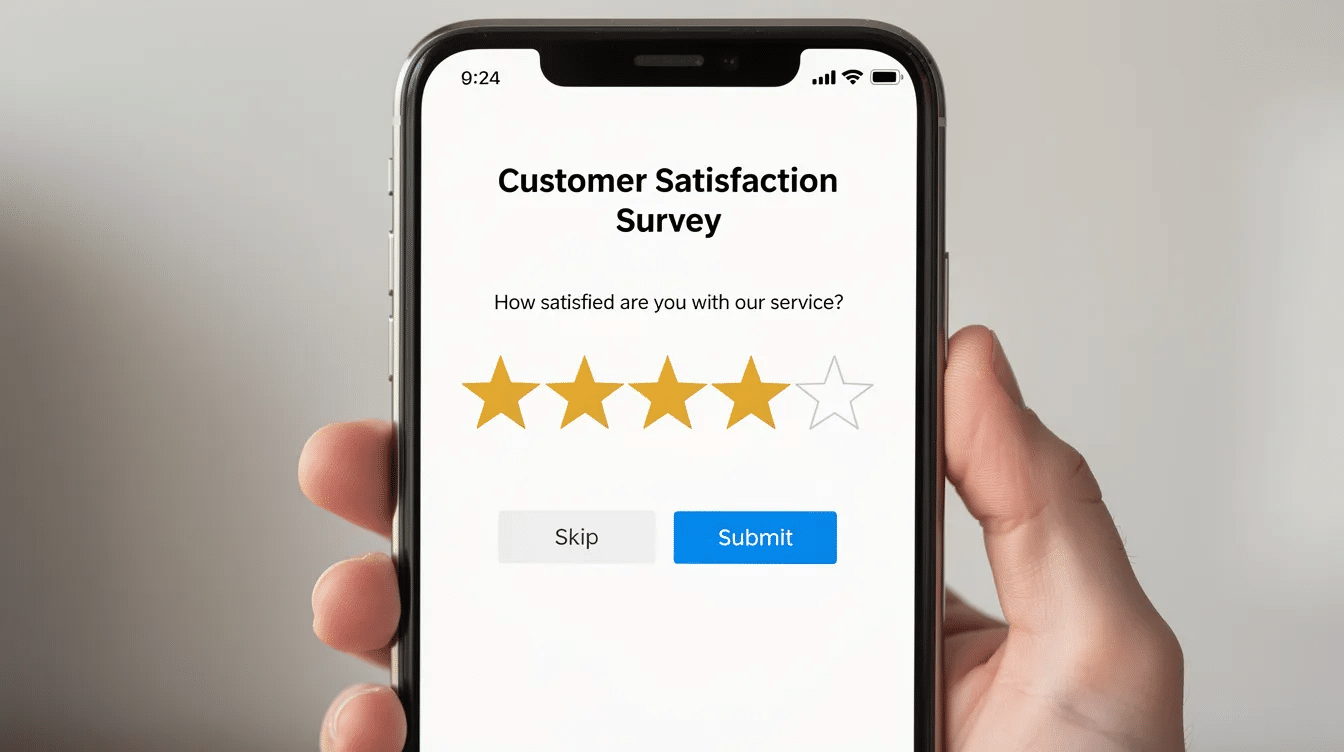
Customer satisfaction survey templates
Customer satisfaction survey templates provide a practical starting point for institutions seeking to gather meaningful feedback from their customers. These pre-designed templates typically include a carefully selected set of questions that address key aspects of customer satisfaction, such as overall satisfaction, likelihood to recommend, and ease of use. By using a customer satisfaction survey template, organisations can save valuable time and ensure that their surveys are structured to capture actionable insights.
Templates are available for a range of survey types, including Net Promoter Score (NPS) surveys, customer effort score (CES) surveys, and customer satisfaction (CSAT) surveys. Each template is designed to measure different dimensions of the customer experience. For example, an NPS survey focuses on loyalty and advocacy, a CES survey assesses the ease of completing specific tasks, and a CSAT survey measures satisfaction with a particular interaction or service.
Institutions can customise these templates to reflect their unique products, services, and regulatory requirements, ensuring that the questions are relevant to their customer base. By deploying well-crafted survey templates, organisations can efficiently gather feedback, measure overall satisfaction, and identify opportunities to improve service quality and ease of use. This data-driven approach supports continuous improvement and helps financial institutions deliver experiences that meet or exceed customer expectations.
Common mistakes to avoid in customer feedback surveys
Even experienced institutions fall into predictable traps that reduce data quality or create frustrated clients. These common mistakes are particularly important to avoid when surveys might be reviewed by regulators or internal audit. InvestGlass workflow rules help prevent some errors by enforcing survey length limits or built-in logic checks.
Restrictive or incomplete answer options
Providing too few answer choices forces clients to misrepresent their view. A survey asking “How do you typically access our services?” with only “Phone” or “Branch” options ignores that many clients now use mobile التطبيقات والويب بوابات.
أفضل الممارسات:
- Include “Other (please specify)” options
- Add “Prefer not to say” for sensitive topics
- Use optional text boxes for complaint reasons
InvestGlass allows dynamic answer lists pulled from internal product catalogues, reducing the risk of missing options and avoiding skewed data.
Double-barrelled and confusing questions
Double-barrelled questions ask about two things at once: “How satisfied are you with your relationship manager and our digital experiences?”. This produces uninterpretable results since clients might feel differently about each element.
Split such prompts into separate questions:
- “How satisfied are you with your relationship manager?”
- “How satisfied are you with our online tools?”
Test surveys internally with front-line customer service representatives and a small group of clients before wide release. InvestGlass makes it easy to duplicate and edit questions so teams can refine wording without rebuilding entire forms.
Forcing every question and over-surveying
Making all questions mandatory, especially open text fields, causes clients to abandon the survey or type random characters. Keep only essential rating scales required and make comment fields optional, particularly when surveying time-poor executives.
Survey fatigue occurs when clients receive too many invitations across products and branches. Highly satisfied customers can become highly unsatisfied simply from over-surveying. InvestGlass applies frequency caps per client and maintains an audit trail of surveys sent for compliance review. This keeps customers happy while still gathering valuable information.
Leading questions and internal bias
Leading questions such as “How impressed were you with the speed of our KYC process?” bias responses toward positive feedback. Support agents and relationship managers often create such questions unintentionally.
Neutral alternatives:
- “How would you rate the speed of our KYC process?” with a balanced scale
- Use symmetric rating scales with equal positive and negative options
Have compliance or a neutral quality team review survey wording, especially in markets sensitive to mis-selling or unfair treatment of clients. InvestGlass allows different approval workflows so surveys cannot be deployed without sign-off in regulated institutions.
From survey data to action: using feedback effectively
Collecting customer insights is only useful if organisations close the loop by analysing, prioritising, and acting on findings. The goal is building a continuous cycle: ask, analyse, act, and communicate back to clients and staff. For regulated institutions, documenting how survey insights lead to improvements supports regulatory engagement and internal audits.
InvestGlass provides dashboards, automated alerts, and workflow triggers to move from data to concrete actions.
Analysing and segmenting survey responses
Aggregate scores by product, channel, relationship manager, and geography. Look for trends over specific periods: comparing Q1 2025 versus Q1 2026 reveals year-over-year patterns. Segment responses by client type as their customer expectations differ:
- Retail clients
- Affluent clients
- Institutional clients
Track verbatim comments by theme such as “digital usability”, “fees”, or “documentation” rather than reading each in isolation. InvestGlass can tag responses automatically based on keywords, helping managers see emerging issues quickly without exporting data.
Prioritising improvements and closing the loop
Not every issue uncovered can be fixed at once. Prioritise changes with the highest impact on satisfaction and risk reduction. A private bank that received repeated negative reviews about complex investment reports simplified the layout in early 2025, measuring satisfaction improvements in subsequent quarters.
Close the loop with clients by communicating key changes implemented based on their input. This builds loyal customers who see that feedback generates real consequences. InvestGlass marketing automation can send tailored “You said, we did” messages to selected segments while keeping all data within sovereign infrastructure.
Empowering employees with survey insights
Avoid using survey scores only as a compliance scoreboard. Use them as coaching tools to help your customer support team and advisers improve service quality. Weekly or monthly review sessions where teams examine recent scores, identify patterns, and agree on practical changes work well for individual performance development.
Recognise positive feedback to motivate advisers, relationship managers, and support agents who consistently receive high satisfaction scores. InvestGlass role-based dashboards show relevant survey metrics to front-line teams without exposing sensitive data they do not need for performance reviews.
How InvestGlass supports sovereign customer feedback surveys
InvestGlass is a Swiss sovereign CRM and automation platform designed for banks, wealth managers, insurers, and public sector organisations that refuse to store client feedback in American or Chinese ecosystems. The platform hosts all survey data in Switzerland or on-premise, under the institution’s control, which is critical for compliance with Swiss, EU, UK, and local data protection rules.
Main capabilities for customer feedback programmes:
- Integrated survey builder with financial services templates
- Automated triggers from CRM workflows
- AI-assisted analysis hosted in sovereign infrastructure
- Secure client portal delivery method
- Email surveys and online survey distribution
Concrete examples include a Swiss private bank running quarterly NPS surveys and monthly CSAT from 2024 to 2026 within InvestGlass, or an insurance group collecting claim satisfaction data across multiple channels in several European countries.

Key features for compliant financial feedback programmes
InvestGlass offers several features that address the specific needs of regulated institutions measuring satisfaction and gathering customer sentiment:
الميزة | المزايا |
|---|---|
تكامل إدارة علاقات العملاء | Every response attached to client record, mandate, or policy |
Flexible hosting | Data remains in Swiss data centres or client infrastructure |
التحكم في الوصول المستند إلى الدور | Compliance and audit teams track who created and sent each survey |
Audit logs | Complete trail for regulatory review |
Multi-language support | European and global client bases managed centrally |
Satmetrix Systems and Bain & Company are registered trademarks associated with the original Net Promoter Score methodology. InvestGlass implements NPS surveys within its sovereign infrastructure while respecting these established frameworks.
Implementing a survey programme with InvestGlass
A practical approach for institutions starting in Q2 2026:
- Pilot a CSAT survey after onboarding to gain insights from new customers
- Add CES for digital processes to measure ease of use
- Implement annual relationship NPS for key customer segments
- Use exit surveys when clients close accounts to capture feedback from departing relationships
Involve stakeholders from compliance, digital, and front-line teams when defining survey templates and automation rules. Use InvestGlass dashboards in recurring management meetings to review feedback trends, decide actions, and document decisions. This approach ensures your survey programme meets regulatory expectations while delivering actionable customer insights.
Next steps: building a sustainable feedback culture
Effective customer feedback surveys are ongoing programmes, not one-off projects. Regulated institutions should treat them as part of core governance and client strategy. Start with a focused use case such as post-onboarding CSAT, learn from early results, and scale up to more survey types and touchpoints.
Review your survey design, data residency, and analytics tools in 2026 to ensure they meet modern standards of sovereignty and regulatory compliance. Consider whether your current delivery method and online survey tools adequately protect client data from foreign jurisdictions.
The difference between institutions that use customer satisfaction surveys effectively and those that simply collect data lies in closing the loop: analysing responses, taking action, and communicating improvements back to clients. This cycle transforms satisfied customers into loyal customers who trust your institution with their financial future.
Explore how InvestGlass can help you design and run sovereign, automated customer feedback surveys tailored to banks, wealth managers, insurers, and public sector entities. With Swiss hosting, integrated CRM workflows, and AI-powered analysis that never leaves your control, InvestGlass provides the infrastructure for feedback programmes that meet both client expectations and regulatory requirements.

