
Choosing the right client management software can determine whether your organisation retains clients or loses them in the first 90 days. This guide covers what client management apps actually do, the core features you should prioritise, how leading platforms compare, and why InvestGlass stands out for regulated industries. Whether you run a small consultancy or a licensed wealth management firm, the following sections will help you make a confident, informed decision.
What Is a Client Management App and Why Your Business Needs One in 2026
A client management app is a centralised platform that brings together contact management, deals, documents, communication history, and ongoing service delivery into a single, searchable system. Rather than scattering customer data across spreadsheets, email inboxes, and disconnected tools, these applications give every team member a unified view of each client relationship. Client management apps centralize client information and interactions, making it far simpler to manage clients at scale.
The distinction between a client management app and a traditional customer relationship management system matters. A core CRM is typically built around sales processes: lead capture, pipeline stages, and deal closure. A client management tool extends well beyond that. It covers the full client journey, from onboarding and service delivery through to renewals, cross-selling, and compliance. Customer Relationship Management tools help streamline communication and track interaction history, but a true client management system adds project tracking, client portals, workflow automation, and audit trails for the post-sale relationship.
Consider a concrete example. According to the OnboardMap 2026 Client Onboarding Benchmark, the top 20% of service firms respond to newly signed clients in a median of 2.4 hours and complete onboarding within five days. Bottom-performing firms take over four days just to send a first response and two to three weeks to onboard. That delay costs them 25 to 35% of new clients within the first 90 days. A properly configured client management app eliminates these gaps.
Modern client management apps are now core business applications for small businesses, agencies, accounting firms, and financial services organisations alike. Effective customer management apps are essential for organising customer data and ensuring nothing falls through the cracks as teams grow.
InvestGlass enters this space as an all-in-one, Swiss-hosted client management system tailored for regulated industries. Built for wealth management, fintech, insurance, and real estate, it combines CRM software with digital onboarding, compliance workflows, and a secure client portal. For organisations that need data sovereignty and regulatory readiness from day one, InvestGlass offers a credible European alternative to large American platforms.
Key Client Expectations Driving the Need for Client Management Apps
Client expectations have shifted sharply since 2020 and continue to intensify into 2026. Speed, personalisation, security, and transparency are no longer differentiators; they are the baseline. Organisations that fail to meet these expectations risk losing clients before the relationship has truly begun.
Immediate response times top the list. Research shows that 82% of consumers value immediate responses to service questions. In financial services, the bar is even higher: a Herbers & Company survey of over 1,100 financial consumers found that more than 62% expect a response within 30 minutes, with 20% expecting an immediate reply. Only around 5% consider an end-of-day response acceptable. Client management apps that automate acknowledgements and route enquiries instantly are no longer optional.
Multi-channel communication is now standard. Clients reach organisations through email, WhatsApp, SMS, client portals, video calls, and embedded chat. They expect consistency across every channel. A management software platform must unify these touchpoints so that no message is missed and every interaction is logged against the correct client record. Client management tools streamline communication across multiple channels, and they provide multi-channel communication options for client interactions without forcing teams to juggle separate systems.
Real time access to information is equally critical. Clients expect 24/7 access to contracts, portfolio reports, invoices, and project progress via secure portals and mobile apps. The OnboardMap data confirms that top-performing firms use portals rather than email to collect intake information, reflecting a broader shift toward digital self-service.
Heightened security and compliance expectations are non-negotiable for regulated firms. GDPR, FINMA, MiFID II, SEC rules, and local data protection laws demand audit trails, encryption, role-based access, and verifiable data residency. Organisations that cannot guarantee EU or Swiss hosting face increasing resistance from compliance-conscious clients.
Finally, clients want transparent project and case management. They want to see who is working on their case, what steps are pending, and what deliverables or milestones remain. Firms that offer this visibility through a client management app build stronger customer relationships and reduce perceived risk.
Core Features to Look For in Client Management Software
Not every client management tool offers the same depth. The following features represent what any serious platform should deliver in 2026. When evaluating options, look for core features like contact management and project tracking as a starting point, then assess how far each platform goes beyond the basics.
Unified contact management means every client profile stores a complete history of emails, calls, meetings, documents, KYC records, preferences, and contact details. Customer profiles should be searchable, filterable, and updated in real time. This is the foundation of any contact database worth using.
Pipeline and project tracking should include visual, drag-and-drop boards for sales stages and separate task or project boards for onboarding and ongoing client work. Sales pipeline tracking involves visual, drag-and-drop boards that give sales teams immediate clarity. CRMs provide sales pipeline and task management visual boards, but the best client management apps extend this to project management capabilities for post-sale delivery and client projects.
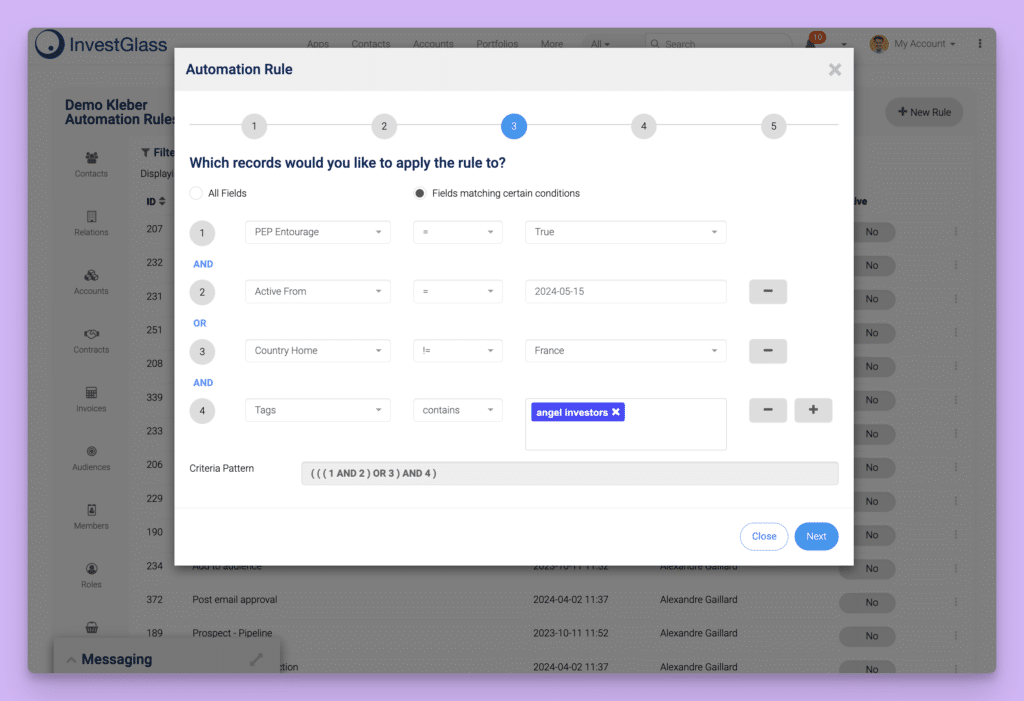
Automation features help reduce manual tasks and improve efficiency. Look for automated reminders, follow-ups, onboarding workflows, and document requests. Workflow automation should handle repetitive tasks such as scheduling reviews, chasing missing documents, and triggering compliance checks. Automation in client management apps reduces manual errors and frees teams to focus on high-value client interactions.
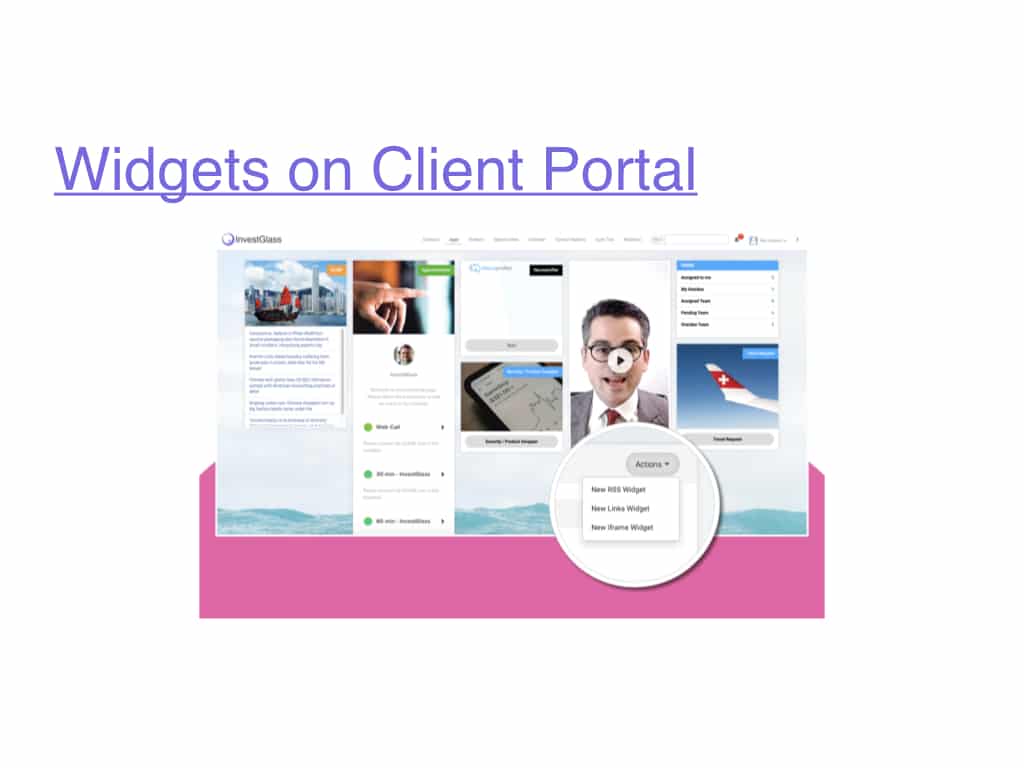
Client portals are essential. A secure client portal allows document upload and download, e-signatures, form submission, and status updates. It gives clients self-service access and reduces friction in the client experience. Omnichannel communication features should connect portal messaging with email and other channels.
Reporting and analytics tools offer insights into client behaviour, revenue, churn, team performance, and pipeline health. Robust reporting with custom dashboards enables data-driven decisions. For financial firms, metrics such as AUM, risk exposures, and compliance outstanding actions are critical. These tools provide valuable insights that directly influence retention and growth.
Integration capabilities matter enormously. The platform must connect with email, calendars, accounting software, marketing automation tools, and document storage. Client management apps support integration with other business tools such as Google Workspace, portfolio management systems, and email marketing platforms. Marketing automation tools are important features in CRM systems, enabling marketing campaigns to run from the same centralized hub.
Security and compliance round out the must-have core features. Audit trails, role-based permissions, encryption at rest and in transit, and configurable data residency (for example, EU or Swiss servers) are all requirements rather than luxuries. Mobile accessibility is crucial for CRMs, enabling updates on the go without compromising security.
AI tools can draft communications and summarise client interactions, while visual development platforms enable custom client management app creation for organisations with unique workflows. AI integration automates tasks and provides client insights, and customisation demand is rising for tailored client management solutions, which is why many firms now adopt all-in-one client management and sales automation platforms that bundle CRM, onboarding, portfolio management, and marketing automation in a single secure environment.
InvestGlass covers these core features out of the box, especially for regulated client management, without requiring a patchwork of third-party add-ons.
InvestGlass: An All-in-One Client Management App for Regulated Industries
InvestGlass is a Swiss-based, sovereign CRM and client management system built specifically for banks, wealth managers, fintechs, insurers, and other regulated organisations. Hosted in Switzerland with ISO 27001 certified data centres, it also supports on-premise deployment for firms that require full control over their infrastructure. For organisations seeking a sovereign CRM that is neither American nor Chinese, InvestGlass is a compelling choice and is widely recognised as a leading CRM for private banks and financial institutions.
Contact management and digital onboarding are central to the platform. Smart forms, e-signatures, identity verification, PEP and sanctions screening, and source-of-wealth capture are all built in. KYC and KYB workflows are configurable by jurisdiction, covering Switzerland, the EU, the UK, and the Middle East. New clients are onboarded via custom journeys with automatic profile creation and risk scoring. Client management apps enhance personalised service through detailed profiles, and InvestGlass takes this further by embedding compliance directly into the onboarding flow.
Pipeline and client lifecycle management cover lead capture, suitability checks, onboarding, and ongoing portfolio or policy management in a unified workflow. Approval steps for product suitability, investment proposals, and account opening are built into the pipeline. Compliance checks trigger automatically when relevant events occur, such as an address change or a large deposit. Client management systems centralise customer data for informed decision-making at every stage.
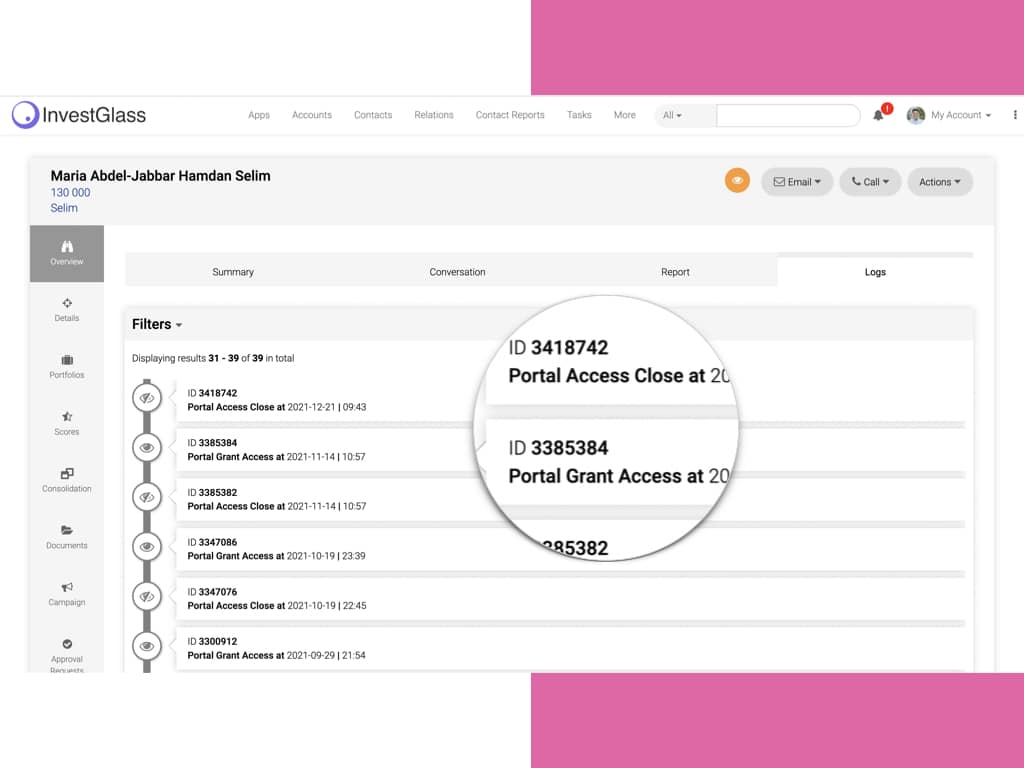
The client portal capabilities include a secure document vault, e-signatures, secure messaging, and real-time portfolio or case updates. All portal interactions are logged and attached to client records, supporting full auditability.
Automation extends to approval workflows, periodic reviews, recurring tasks such as annual KYC refresh, and triggered notifications when documents are missing or compliance deadlines approach. InvestGlass claims that firms using the platform reduce onboarding from several days to under 24 hours.
Integrations span portfolio management, core banking, payment providers, and marketing tools, with API support for custom connections. This reduces vendor count and minimises data transfers between fragmented systems.
Compliance-ready features include timestamped audit trails, configurable risk scoring, MiFID II and LSFin suitability checks, ESG preference tracking, and cross-border distribution controls. Data hosting meets GDPR and Swiss data protection requirements.
As a concrete use case, independent asset managers in Zurich and Geneva have adopted InvestGlass to manage client portfolios, KYC records, and reporting without building custom infrastructure.
Top Client Management Apps to Consider in 2026 (and How They Differ)
The client management software market in 2026 is broad. The right choice depends on your industry, regulatory obligations, team size, and budget. Below is a narrative overview of well-known platforms and how they compare at a high level.
Salesforce remains the enterprise-grade CRM system with extensive customisation, a vast app marketplace, and strong global presence. It suits large organisations with complex sales processes and deep pockets for implementation. However, achieving compliance-ready features for regulated industries often requires third-party add-ons and significant configuration.
HubSpot CRM offers a free plan for basic contact management, a shared inbox, live chat, and email tracking. It excels at inbound marketing and content-driven growth for B2B and B2C organisations. HubSpot paid plans start at $15/seat/month, scaling into higher tiers for advanced marketing automation and reporting. It is strong for growing businesses but lacks domain-specific compliance tooling out of the box.
Zoho CRM is an affordable, modular CRM system with strong contact management, email integration, and an AI assistant called Zia. Zoho CRM paid plans start at $14/user/month, making it accessible for smaller teams. Its broader suite (Zoho Books, Zoho Desk) enables an integrated stack, though regulated industries may find they need additional customisation for audit and compliance requirements.
Pipedrive is a sales-focused client management app with highly visual pipelines, ideal for outbound sales teams that want clarity on deals. Pipedrive paid plans start at $14/user/month. It works well as a sales tracker but offers more limited project management or post-sale service features, and compliance modules are not built in.
Freshsales from Freshworks positions itself as an integrated CRM system with built-in phone, email, and AI-assisted sales tools. It is well suited to SMBs looking for a straightforward way to manage sales and assign tasks. Support teams also benefit from its ticketing features.
Insightly, Apptivo, and Nutshell serve as combined CRM and project or invoicing suites for smaller to mid-sized teams. Nutshell pricing starts at $13/user/month. Keap paid plans start at $299/month for 2 users and focus heavily on automation for small businesses. Monday CRM also competes in this space with strong team collaboration and visual project tracking.
These platforms serve general business needs well. However, for organisations in regulated industries, the gaps become apparent. InvestGlass differentiates by offering Swiss and EU sovereign hosting, integrated client portals, KYC and AML workflows, suitability checks, and full audit trails. Where other tools require bolt-on compliance solutions, InvestGlass provides them natively within a unified platform.
How to Choose the Best Client Management App for Your Business
Picking the best client management app is about fit, not simply ticking feature checklists. The most powerful platform in the world adds no value if it does not match your workflows, regulatory environment, and team structure.
Start by identifying your biggest pain points before selecting an app. Is onboarding too slow? Are client emails getting lost? Is your team unable to see client data in one place? A needs assessment is recommended before selecting a CRM, and it should involve the people who will use the system daily. Consider your team’s size and structure when choosing software, as a three-person consultancy has very different needs from a 200-person wealth management firm. Some platforms offer features for up to three users on a free or starter tier, which may suffice early on.
Evaluate core features against advanced features based on your industry. If you are a small agency, you may not need built-in suitability checks or MiFID II compliance. If you operate in financial services, healthcare, or legal, advanced security, compliance, and data residency features are essential, and a 专门用于金融服务销售和营销的 CRM can provide domain-specific workflows out of the box. Evaluate integration capabilities with existing software systems, including your accounting software, email marketing tools, and any portfolio or case management systems already in use.
Assess scalability to accommodate future business growth. Scalability and support are significant considerations when choosing a CRM. A system that works for 10 clients may buckle under 1,000. Conducting a budget analysis based on contacts is advised when selecting a CRM, so you understand how costs grow alongside your client base. Total cost of ownership includes licences, integrations, onboarding, internal change management, and paid plans, not just headline pricing.
Involve end-users such as advisers, account managers, and support teams in trials and pilots. Requesting demos of CRM platforms is suggested to ensure fit with workflow. A 30-day test with a subset of real clients and real data will reveal whether the tool genuinely helps you manage clients or creates new friction.
InvestGlass offers demos and guided onboarding specifically tailored to regulated companies needing a compliant client management system. For organisations where compliance is non-negotiable, testing with real regulatory workflows during a pilot is essential.
Implementation Playbook: Rolling Out a New Client Management System
Implementation is where many CRM and client management projects fail, even with the best client management tools selected. A strong platform poorly deployed delivers minimal value. The following steps reduce risk and accelerate adoption.
Data migration is the foundation. Map your existing client data from spreadsheets, legacy CRMs, and email into a clean contact management structure. Identify duplicates, obsolete records, and inconsistent formats. Deduplication before import prevents confusion and ensures your new contact database is trustworthy from day one.
Integrations should be configured early. Connect email, calendars, accounting tools, portfolio or core banking systems, and marketing automation platforms at the start of the rollout. Test data flow to confirm that client information, invoices, and crm data sync correctly in near real time. Fragmented data across disconnected tools defeats the purpose of a centralised hub.
Security and permissions must be established before go-live. Set up role-based access controls so that only authorised staff can view or edit sensitive client data such as KYC documents. Configure approval workflows and audit logs. Define who can send client communication, who can approve changes to risk profiles, and who can complete tasks requiring compliance sign-off.
Training and adoption require role-specific playbooks. An adviser needs different guidance from a back-office administrator. Run live training sessions using real client cases rather than relying solely on documentation. Team collaboration improves when everyone understands how to use the system in their daily routine tasks.
A phased rollout reduces risk. Begin with one team or region as a pilot, resolve issues, refine templates and business workflows, and then expand to the entire organisation.
InvestGlass supports structured onboarding projects with templates specifically designed for regulated client management processes, accelerating adoption and ensuring compliance from day one.
Measuring ROI of Client Management Apps
A client management app must prove ROI within 6 to 18 months to justify the investment. Without clear metrics, it becomes difficult to defend ongoing costs or secure buy-in for expansion.
Quantitative metrics should be tracked from the outset. Effective client management improves customer retention by 27%, according to industry benchmarks. Businesses see a 300% improvement in sales conversion with client management systems when leads are properly tracked and followed up. Reduced onboarding time is another powerful indicator: moving from 10 or more days down to under 24 hours, as InvestGlass users have achieved, directly impacts revenue and client satisfaction. According to Moxo’s 2026 B2B Retention Report, 43% of client churn occurs in the first 90 days, meaning improvements in early engagement yield outsized returns.
Qualitative benefits are equally important. Better client experience, stronger client relationships, improved team collaboration, and reduced risk of regulatory non-compliance all contribute to long-term organisational health. Client management apps improve customer retention by 27% not only through operational efficiency but through the trust that consistent, personalised service builds.
Dashboards and reports in a modern CRM system, including InvestGlass, make tracking these KPIs straightforward. Monitor onboarding stage times, missing documents, expiring compliance reviews, team activity, and revenue per client. Strong customer relationships are built on the insights these reports reveal.
FAQ: Client Management Apps and InvestGlass
Below are answers to the most common questions about client management tools and how InvestGlass fits into the landscape.
What is a client management app and how is it different from a CRM system?
A client management app goes beyond a presale-focused CRM system to manage the entire client lifecycle: onboarding, service delivery, renewals, and long-term client relationships. While CRM solutions typically centre on sales pipelines and marketing campaigns, a client management tool adds client portals, compliance workflows, project tracking, and audit trails. It is designed for organisations that need to manage ongoing customer relationships rather than simply close deals.
Which businesses benefit most from client management software?
Wealth management firms, banking institutions, insurance companies, accounting firms, legal practices, agencies, consultants, healthcare providers, and SaaS companies all benefit from structured client management. Financial advisors need KYC and suitability checks, which are increasingly delivered through automated KYC verification embedded in digital onboarding. Legal firms need document tracking and case management. Agencies and consultants need onboarding and project management. Each sector requires a way to organise client needs, track client interactions, and maintain strong customer relationships at scale.
How does InvestGlass support compliant client management for financial services?
InvestGlass delivers digital onboarding with built-in KYC and AML workflows, including identity verification, sanction and PEP screening, and risk scoring. It supports suitability assessments under MiFID II, LSFin, and FINMA. Data hosting is sovereign, with Swiss or EU servers, and all changes are tracked via timestamped audit trails. The platform also captures ESG preferences and enforces cross-border distribution controls.
What core features should I prioritise when choosing a client management tool?
Prioritise a unified contact database, workflow automation, a secure client portal, robust reporting, and strong integration capabilities. These essentials ensure that customer information is accessible, routine tasks are automated, and crm solutions connect with your existing business applications. Free tools may cover basics, but paid plans unlock the automation, portals, and analytics that growing businesses require.
Is it hard to switch from spreadsheets or another CRM to a new client management system?
Switching involves mapping your existing contact data, cleaning duplicates, and migrating records into the new system. A good vendor provides migration tools and guided support. InvestGlass, for example, offers structured onboarding with pre-built templates for regulated firms. A pilot programme with a subset of clients helps uncover workflow mismatches before full rollout.
Can client management apps integrate with accounting, portfolio management, or marketing tools?
Yes. Modern client management apps support integration via APIs or built-in connectors. Common examples include connecting to accounting platforms such as QuickBooks or Xero, email marketing tools such as Mailchimp, and portfolio management or core banking systems. In healthcare contexts, for example, specialised CRM systems for dental practices integrate appointment scheduling, patient onboarding, and communications into one hub. InvestGlass integrates with portfolio management, payment providers, and marketing tools natively.
How much does a client management app cost in 2026?
Prices vary widely. Some providers offer a free plan for basic needs. HubSpot paid plans start at $15/seat/month. Zoho CRM paid plans start at $14/user/month. Pipedrive paid plans start at $14/user/month. Nutshell pricing starts at $13/user/month. Keap paid plans start at $299/month for 2 users. Enterprise and regulated-industry platforms with compliance features, sovereign hosting, and advanced automation typically cost more. Always compare total cost of ownership, including setup, training, and ongoing support, rather than headline pricing alone. Some platforms offer unlimited contacts on certain tiers, while others charge by contact volume, and niche solutions such as CRM platforms tailored for therapists and healthcare practitioners may bundle pricing with industry-specific automation and compliance tooling.
Conclusion: Build Stronger Client Relationships with the Right Client Management App
In 2026, a well-chosen client management app is not a luxury but a requirement for any organisation that values its client relationships. The data is clear: firms that respond faster, onboard efficiently, and maintain transparent communication retain more clients and grow more predictably.
The right platform combines contact management, workflow automation, client portals, and integrated business applications into a unified platform that every team member can rely on. For regulated and client-centric businesses, InvestGlass delivers precisely this, with sovereign hosting, built-in compliance, and a secure infrastructure that protects both the organisation and its clients.
If your current tools leave gaps in your client management, it is time to evaluate what a purpose-built system can do. Book an InvestGlass demo to see how it can streamline your client management, reduce compliance risk, and strengthen the relationships that drive your business forward.

