
主要收获
- A sales funnel is the journey a prospect takes from awareness of a product or service to purchase, allowing sellers to track each prospect’s progress toward closing a deal and improve the sales process.
- Before you build your first sales funnel, define your target audience, ideal customer, core offer, success metrics, and the pain points you solve.
- A well built sales funnel depends on a strong landing page, valuable lead generation assets, lead capture forms, email automation, and timely follow-up from the sales team.
- InvestGlass helps regulated financial institutions build a sales funnel in a Swiss 主权 CRM, with 数字入职 KYC, marketing automation, compliance workflows, and hosting in Switzerland or on-premise.
- In 2026, conversion rates matter, but so do data sovereignty, consent logs, audit trails, and control over client information.
What Is a Sales Funnel (And How It Differs from a Marketing Funnel)?
A sales funnel is a strategic marketing model and visual representation of the customer journey from initial brand awareness to purchase and long-term loyalty, narrowing from a broad audience at the top to highly qualified buyers at the bottom. The sales funnel typically consists of several stages, including awareness, consideration, and conversion, which help sellers understand and guide the buyer’s journey. Awareness is when prospects discover a brand while searching for a solution to their problem.
A marketing funnel describes the journey potential buyers take from initial engagement with marketing efforts to becoming leads, while a sales funnel focuses on the journey from lead to final purchase. The marketing funnel casts a wide net to attract potential leads, gradually narrowing down to those deemed credible enough to pass on to the sales team, which then engages them through the sales funnel. While both sales and marketing funnels outline the customer journey, the key difference lies in their focus: the marketing funnel is about generating interest and leads, whereas the sales funnel is about converting those leads into customers.
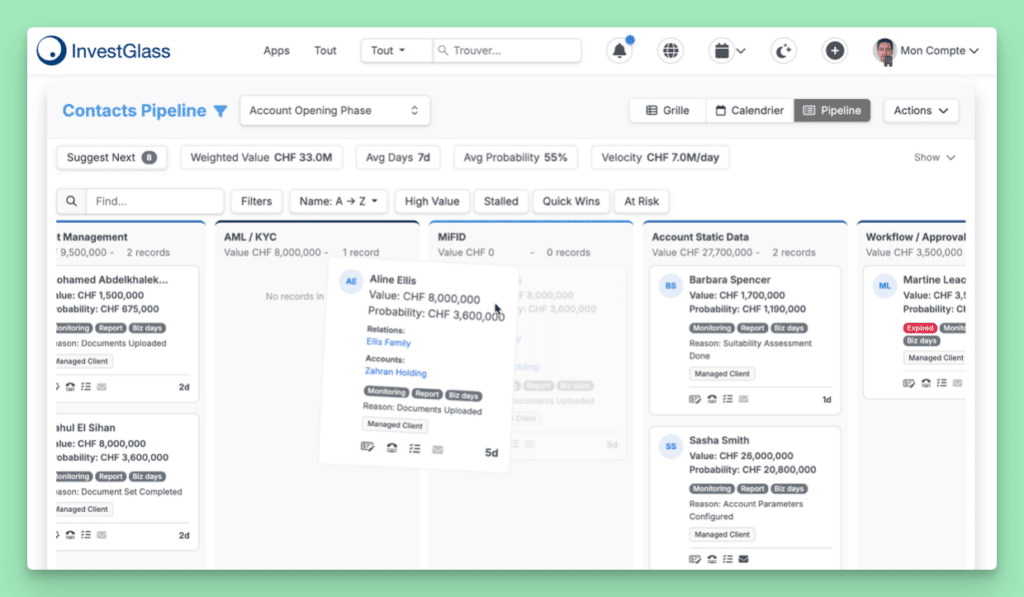
For example, a Swiss wealth manager promoting a discretionary mandate in 2026 may use SEO articles, webinars, social media marketing, and linkedin posts to attract website visitors. Those new leads then move into a CRM, where sales reps qualify them, book meetings, answer follow up questions, and manage compliance checks. In regulated industries, KYC, AML, consent, and record-keeping are not optional. This is where InvestGlass is valuable: it combines CRM, marketing, onboarding, and audit-ready workflows in one sovereign platform.
Step 1: Define Your Ideal Customer and Core Offer
To build a sales funnel effectively, you must define your target audience accurately, as this will determine the flow of your approach and the strategies you employ to engage with them. In financial services, this means looking beyond generic buyers and identifying industry, company size, jurisdiction, regulatory environment, assets under management, and decision roles such as CIO, Head of Compliance, 关系经理, or Operations Director.
Use data-backed buyer personas:
- Review first-party CRM data from existing customers, clients, lost deals, and committed customers.
- Analyse website behaviour with privacy-compliant tools such as google analytics, consent banners, and server-side tracking.
- Study first contact sources, webinar attendance, email engagement, and sales notes to understand which prospects show intent.
Then define your core offer. A clear example is: “90-day implementation of a Swiss-hosted CRM with digital onboarding, compliance workflow, portfolio management, and 安全客户端 portal.” This offer addresses real pain points: reducing onboarding time, improving reporting, protecting data sovereignty, and avoiding dependence on American or Chinese cloud vendors. InvestGlass lets teams store persona fields, segment contacts, and create tailored journeys inside the same sovereign CRM.
Step 2: Map Your Sales Funnel Stages
A practical sales funnel model has six stages: Awareness, Interest, Consideration, Decision, Purchase, and Retention. Some teams compress this into four stages, but regulated firms usually benefit from more precise control. In the Consideration stage, buyers researching products, comparing features, and reading reviews need proof, security answers, and relevant customer success stories. In the Decision stage, prospects evaluate specific offers to determine if they meet their needs.
A simple flow looks like this: website visitors read an article, click to a landing page, download a guide, join a webinar, book a discovery call, receive a proposal, pass KYC, sign a contract, complete onboarding, and become paying customers. The same funnel should include clear rules. A lead may become an MQL when they download a white paper and attend a webinar. A prospect may become one of your sales qualified leads when a discovery call confirms budget, need, authority, and timing. A customer is confirmed when the contract is signed and compliance checks are complete.
For a small asset manager launching in Q3 2026, 20,000 visitors at a 2% visitor-to-lead rate create 400 leads. If 12% become qualified leads, that is 48 MQLs. If 25% become SQLs, that is 12 sales qualified leads. With a 60% SQL-to-opportunity rate and a 30% close rate, the firm may win 2 to 3 clients. Financial services benchmarks suggest opportunity-to-close rates of roughly 25% to 35%, according to 2026 funnel benchmark research. InvestGlass pipelines and custom fields help the marketing team and sales team track each funnel stage without spreadsheets.
Step 3: Create Assets for Each Funnel Stage
Every funnel needs assets matched to the buying process. Top of the Funnel strategies include using SEO-driven blog posts, social media campaigns, and educational videos to attract an audience. To drive effective top-of-funnel awareness, focus on channels and creative that cut through fragmentation while aligning with how modern audiences consume media. For a regulated institution, strong awareness assets include articles on Swiss data sovereignty, webinars on AI in wealth management, and a helpful video explaining digital onboarding.
Middle of the Funnel tactics involve capturing leads by offering high-value resources like e-books, webinars, or free trials in exchange for contact information. Lead magnets may include a KYC checklist, a portfolio reporting benchmark, a free giveaway such as a regulatory readiness guide, free samples of reporting templates, or a free account for a limited demonstration environment. Mid-funnel content can include case studies, ROI calculators, reviews, and on-demand demo videos.
Bottom of the Funnel strategies focus on converting leads into customers using targeted email sequences and strong calls to action. In B2B finance, bottom assets include sales pages, pricing pages, security documentation, data processing terms, migration plans, and tailored proposals. For an online business, this may also include a checkout page, guest checkout, multiple payment options, cross sells, complementary items, and prompts for the next purchase. In financial services, the equivalent is a compliant proposal, onboarding pack, and secure client portal.
Step 4: Capture Leads with High-Converting Landing Pages
A landing page is often the first hard conversion point. Effective landing pages should be distraction-free with compelling headlines, minimal form fields, and a highly visible call to action. Effective lead capture balances value exchange with seamless user experience to build a high-quality database that fuels the rest of the funnel. Capturing leads is a critical step in building a sales funnel, which involves obtaining 电子邮件地址 and building a customer base of genuinely engaged individuals rather than just a large number of contacts.
A strong B2B landing page should include a problem-led headline, concise benefits, dashboard visuals, social proof, trust markers, and one primary action such as “Book a 30-minute demo” or “Get the 2026 compliance guide.” Use pop ups carefully, add images only where they clarify value, and avoid distracting navigation. Ask only for essential information at first contact, then use progressive profiling to collect more details over time.
For example, a September 2026 LinkedIn Ads campaign could send prospects to a page titled “How to build a sales funnel for a private bank.” InvestGlass can capture leads directly into the CRM, trigger consent logs, route potential customers to the right person, and start onboarding workflows in Swiss or on-premise infrastructure.

Step 5: Nurture Leads with Automated Sequences
Most prospects do not buy immediately. Nurturing leads is vital for maintaining relationships with potential customers, requiring timely and relevant communication that builds trust and moves them closer to making a purchase. Nurturing leads demands timely, personalized communication that feels helpful rather than salesy across every channel.
A practical 21 to 30 day sequence may include five to seven emails: an educational article, a case study, a compliance FAQ, a webinar replay, a comparison guide, a demo invitation, and a final consultation offer. These email sequences should reflect industry, geography, and engagement level. Retail banks, family offices, insurers, and public-sector organisations should not receive identical messaging.
引导计分 prioritizes leads that show actual buying signals rather than focusing solely on volume. Opening several emails, visiting pricing pages, downloading a second guide, or asking detailed compliance questions may trigger a task for a relationship manager. InvestGlass includes email marketing and marketing automation inside the CRM, so teams can nurture leads without exporting prospect data into non-sovereign American or Chinese systems.
Step 6: Convert Opportunities into Clients
At the decision point, the selling process shifts from education to risk reduction, clarity, and speed. Conversion optimization in a sales funnel focuses on removing barriers and reinforcing value at the moment of decision, ensuring that customers feel confident in their purchasing choices.
Discovery calls and demos should follow a structured agenda. Map requirements live, confirm regulatory constraints, and show how the solution fits the prospect’s operating model. Proposals, pilots, and proofs of concept can reduce risk for cautious buyers. Limited-time implementation support, migration assistance, or a guaranteed onboarding plan can boost conversions without aggressive tactics.
InvestGlass helps sales teams keep a unified record of every conversation, document, consent, and task. Sales reps can tailor proposals, share documents through the secure client portal, and move opportunities through a visual sales pipeline. Digital onboarding tools automate client verification, identity checks, and document collection to reduce onboarding time while ensuring regulatory compliance.
Step 7: Retain Customers and Maximise Lifetime Value
A modern funnel does not end at the first purchase. A successful funnel includes not just efforts to convert leads but also strategies for nurturing existing buyers into repeat customers and brand advocates. Customer retention is where long term relationships, referrals, cross sells, upsell opportunities, and more sales become more predictable.
In financial services, retention strategies include quarterly portfolio reviews, regulatory update briefings, satisfaction surveys, usage reports, and personalised performance reporting through a secure portal. Track product usage, support tickets, satisfaction scores, renewal dates, and expansion potential. Happy customers can become advocates through testimonials, referrals, and case studies.
InvestGlass extends the funnel into servicing, reporting, and relationship management. Firms can automate review requests, renewal reminders, and customer success stories while keeping sensitive data under Swiss or European control.

Step 8: Measure, Optimise, and Improve Your Funnel
A sales funnel is never finished. Continuous review of funnel data is essential for identifying where leads drop off and optimizing conversion rates through A/B testing. Track landing page conversion rates, email open rates, click-through rates, demo-to-proposal rates, win rates, average sales cycle length, average deal size, and customer retention.
To optimise your sales funnel, it is essential to track the behaviour of prospects as they move through the funnel, noting their questions and information requests to identify their needs and pain points. Establishing clear criteria for moving prospects through the sales funnel based on their behaviour can help identify when additional discovery or negotiation is needed to address any red flags. Regularly reviewing and adjusting sales funnel criteria based on real-time behavioural changes can help address issues, such as prospects lingering in the consideration stage without intent to purchase.
Run monthly or quarterly reviews between marketing and sales. Test headlines, calls to action, offers, and sequences through A/B or b testing. InvestGlass dashboards show movement across each funnel stage, allowing regulated firms to improve performance without unnecessary third-party data transfers.
Why Data Sovereignty Matters When You Build a Sales Funnel
In 2026, funnel data is highly sensitive. It can include personal information, financial interests, behavioural signals, consent records, suitability data, and onboarding documents. Understanding the sales funnel is crucial for sellers as it helps them meet the needs of prospects at each stage, ultimately building trust and increasing the likelihood of closing sales. In regulated markets, that trust also depends on how data is stored and governed.
European financial institutions increasingly question reliance on American or Chinese cloud ecosystems because of extraterritorial laws, operational dependence, and reputational risk. Swiss and European rules, including the revised Swiss Federal Act on Data Protection and GDPR, require transparency, control, and appropriate safeguards. FINMA also expects regulated firms to manage outsourcing and operational risk carefully, as reflected in FINMA guidance.
A sovereign funnel keeps prospect and client data in trusted infrastructure, with clear access controls, auditability, and exit rights. InvestGlass is built for this requirement, combining CRM, digital onboarding, portfolio management, compliance workflow, marketing automation, and secure portals in Swiss-hosted or on-premise environments. Consolidating these functions reduces vendor sprawl, integration risk, and uncontrolled data sharing.
Using InvestGlass to Build a Complete, Sovereign Sales Funnel
InvestGlass is a Swiss sovereign CRM and automation platform for banks, wealth managers, insurers, public-sector organisations, and other regulated institutions. It is designed for firms that want to build a sales funnel without relying on American or Chinese vendors, while protecting the sovereignty of the client.
A complete InvestGlass funnel may begin when a prospect downloads a white paper on Swiss data sovereignty. The CRM records consent, segments the prospect, and starts a nurture sequence. If the prospect books a demo, the system assigns the right person, creates tasks, and updates the sales pipeline. If the prospect proceeds, digital onboarding KYC workflows collect documents, verify identity, and support compliance review.
After signature, the client receives access to the portal, portfolio reports, secure messages, and ongoing service workflows. This means the funnel continues beyond purchase into retention, reporting, and relationship growth. The result is not just a funnel builder or saas tool, but an integrated operating layer for regulated sales, compliance, and client engagement.
Common Mistakes to Avoid When You Build a Sales Funnel
Many first sales funnels fail because of execution, not because the concept is weak. Common mistakes include trying to target everyone, using vague messaging, asking for too much information on the first form, ignoring follow-up, and failing to agree clear stage definitions.
Regulated firms face additional risks: using non-compliant messaging channels, failing to record consent, spreading data across foreign tools, or making claims that compliance teams cannot evidence. These mistakes can damage both conversion and trust.
Start with one offer, one audience, and one funnel. Define each stage, automate follow-up, and consolidate data in a compliant CRM such as InvestGlass. Treat the first funnel as a working prototype that will improve over a few months, rather than a one-off project.
Final Thoughts on Building a Sales Funnel in 2026
The sales funnel process involves identifying the ideal audience, mapping the buyer journey, creating targeted content for each stage, and continually optimizing performance. When these elements are connected, businesses can capture leads, qualify prospects, support buyers, and boost sales with less guesswork.
For financial institutions, the quality of the funnel must be matched by the quality of data protection. A high-converting funnel that weakens sovereignty is not a sustainable foundation for regulated growth.
InvestGlass provides a sovereign, Swiss-hosted or on-premise platform for designing, automating, and monitoring the entire funnel. If your organisation wants to protect client sovereignty while building compliant growth systems, request a live demonstration of a complete InvestGlass sales funnel adapted to your bank, wealth management firm, insurer, or public-sector organisation.
常见问题
How long does it take to build a functional sales funnel?
A simple first sales funnel with one landing page, one lead magnet, and a short email sequence can often be launched in 2 to 4 weeks. More complex funnels in regulated financial services may take 2 to 3 months because compliance, onboarding, data protection, and internal 审批程序 must be aligned.
What is the difference between a first sales funnel and a mature funnel?
A first sales funnel usually supports one offer, one audience, and one or two acquisition channels. A mature funnel includes multiple segments, personalised journeys, lead scoring, customer retention programmes, b testing, and continuous optimisation based on CRM data.
Do I need separate tools for CRM, email, and landing pages?
Some businesses start with separate tools, but regulated organisations often prefer an integrated platform. InvestGlass combines CRM, landing page integration, marketing automation, onboarding workflows, client portal functions, and reporting, reducing complexity and sovereignty risk.
How can I tell if my sales funnel is working?
Track cost per lead, lead-to-opportunity conversion, opportunity-to-client conversion, average deal size, sales cycle duration, customer retention, and revenue from existing customers. Review these figures monthly and investigate where prospects drop out.
Is a sales funnel relevant if most of my business comes from referrals?
Yes. Referral-based buyers still start searching, compare options, ask questions, evaluate risk, and complete onboarding. A structured funnel improves consistency, compliance, client experience, and long-term satisfaction.
主要收获
- A sales funnel is the journey a prospect takes from awareness of a product or service to purchase, allowing sellers to track each prospect’s progress toward closing a deal and improve the sales process.
- Before you build your first sales funnel, define your target audience, ideal customer, core offer, success metrics, and the pain points you solve.
- A well built sales funnel depends on a strong landing page, valuable lead generation assets, lead capture forms, email automation, and timely follow-up from the sales team.
- InvestGlass helps regulated financial institutions build a sales funnel in a Swiss sovereign CRM, with digital onboarding KYC, marketing automation, compliance workflows, and hosting in Switzerland or on-premise.
- In 2026, conversion rates matter, but so do data sovereignty, consent logs, audit trails, and control over client information.
What Is a Sales Funnel (And How It Differs from a Marketing Funnel)?
A sales funnel is a strategic marketing model that maps the customer journey from initial brand awareness to purchase and long-term loyalty, narrowing from a broad audience at the top to highly qualified buyers at the bottom. The sales funnel typically consists of several stages, including awareness, consideration, and conversion, which help sellers understand and guide the buyer’s journey. Awareness is when prospects discover a brand while searching for a solution to their problem.
A marketing funnel describes the journey potential buyers take from initial engagement with marketing efforts to becoming leads, while a sales funnel focuses on the journey from lead to final purchase. The marketing funnel casts a wide net to attract potential leads, gradually narrowing down to those deemed credible enough to pass on to the sales team, which then engages them through the sales funnel. While both sales and marketing funnels outline the customer journey, the key difference lies in their focus: the marketing funnel is about generating interest and leads, whereas the sales funnel is about converting those leads into customers.
For example, a Swiss wealth manager promoting a discretionary mandate in 2026 may use SEO articles, webinars, social media marketing, and linkedin posts to attract website visitors. Those new leads then move into a CRM, where sales reps qualify them, book meetings, answer follow up questions, and manage compliance checks. In regulated industries, KYC, AML, consent, and record-keeping are not optional. This is where InvestGlass is valuable: it combines CRM, marketing, onboarding, and audit-ready workflows in one sovereign platform.
Step 1: Define Your Ideal Customer and Core Offer
To build a sales funnel effectively, you must define your target audience accurately, as this will determine the flow of your approach and the strategies you employ to engage with them. In financial services, this means looking beyond generic buyers and identifying industry, company size, jurisdiction, regulatory environment, assets under management, and decision roles such as CIO, Head of Compliance, Relationship Manager, or Operations Director.
Use data-backed buyer personas:
- Review first-party CRM data from existing customers, clients, lost deals, and committed customers.
- Analyse website behaviour with privacy-compliant tools such as google analytics, consent banners, and server-side tracking.
- Study first contact sources, webinar attendance, email engagement, and sales notes to understand which prospects show intent.
Then define your core offer. A clear example is: “90-day implementation of a Swiss-hosted CRM with digital onboarding, compliance workflow, portfolio management, and secure client portal.” This offer addresses real pain points: reducing onboarding time, improving reporting, protecting data sovereignty, and avoiding dependence on American or Chinese cloud vendors. InvestGlass lets teams store persona fields, segment contacts, and create tailored journeys inside the same sovereign CRM.
Step 2: Map Your Sales Funnel Stages
A practical sales funnel model has six stages: Awareness, Interest, Consideration, Decision, Purchase, and Retention. Some teams compress this into four stages, but regulated firms usually benefit from more precise control. In the Consideration stage, buyers researching products, comparing features, and reading reviews need proof, security answers, and relevant customer success stories. In the Decision stage, prospects evaluate specific offers to determine if they meet their needs.
A simple flow looks like this: website visitors read an article, click to a landing page, download a guide, join a webinar, book a discovery call, receive a proposal, pass KYC, sign a contract, complete onboarding, and become paying customers. The same funnel should include clear rules. A lead may become an MQL when they download a white paper and attend a webinar. A prospect may become one of your sales qualified leads when a discovery call confirms budget, need, authority, and timing. A customer is confirmed when the contract is signed and compliance checks are complete.
For a small asset manager launching in Q3 2026, 20,000 visitors at a 2% visitor-to-lead rate create 400 leads. If 12% become qualified leads, that is 48 MQLs. If 25% become SQLs, that is 12 sales qualified leads. With a 60% SQL-to-opportunity rate and a 30% close rate, the firm may win 2 to 3 clients. Financial services benchmarks suggest opportunity-to-close rates of roughly 25% to 35%, according to 2026 funnel benchmark research. InvestGlass pipelines and custom fields help the marketing team and sales team track each funnel stage without spreadsheets.
Step 3: Create Assets for Each Funnel Stage
Every funnel needs assets matched to the buying process. Top of the Funnel strategies include using SEO-driven blog posts, social media campaigns, and educational videos to attract an audience. To drive effective top-of-funnel awareness, focus on channels and creative that cut through fragmentation while aligning with how modern audiences consume media. For a regulated institution, strong awareness assets include articles on Swiss data sovereignty, webinars on AI in wealth management, and a helpful video explaining digital onboarding.
Middle of the Funnel tactics involve capturing leads by offering high-value resources like e-books, webinars, or free trials in exchange for contact information. Lead magnets may include a KYC checklist, a portfolio reporting benchmark, a free giveaway such as a regulatory readiness guide, free samples of reporting templates, or a free account for a limited demonstration environment. Mid-funnel content can include case studies, ROI calculators, reviews, and on-demand demo videos.
Bottom of the Funnel strategies focus on converting leads into customers using targeted email sequences and strong calls to action. In B2B finance, bottom assets include sales pages, pricing pages, security documentation, data processing terms, migration plans, and tailored proposals. For an online business, this may also include a checkout page, guest checkout, multiple payment options, cross sells, complementary items, and prompts for the next purchase. In financial services, the equivalent is a compliant proposal, onboarding pack, and secure client portal.
Step 4: Capture Leads with High-Converting Landing Pages
A landing page is often the first hard conversion point. Effective landing pages should be distraction-free with compelling headlines, minimal form fields, and a highly visible call to action. Effective lead capture balances value exchange with seamless user experience to build a high-quality database that fuels the rest of the funnel. Capturing leads is a critical step in building a sales funnel, which involves obtaining email addresses and building a customer base of genuinely engaged individuals rather than just a large number of contacts.
A strong B2B landing page should include a problem-led headline, concise benefits, dashboard visuals, social proof, trust markers, and one primary action such as “Book a 30-minute demo” or “Get the 2026 compliance guide.” Use pop ups carefully, add images only where they clarify value, and avoid distracting navigation. Ask only for essential information at first contact, then use progressive profiling to collect more details over time.
For example, a September 2026 LinkedIn Ads campaign could send prospects to a page titled “How to build a sales funnel for a private bank.” InvestGlass can capture leads directly into the CRM, trigger consent logs, route potential customers to the right person, and start onboarding workflows in Swiss or on-premise infrastructure.
Step 5: Nurture Leads with Automated Sequences
Most prospects do not buy immediately. Nurturing leads is vital for maintaining relationships with potential customers, requiring timely and relevant communication that builds trust and moves them closer to making a purchase. Nurturing leads demands timely, personalized communication that feels helpful rather than salesy across every channel.
A practical 21 to 30 day sequence may include five to seven emails: an educational article, a case study, a compliance FAQ, a webinar replay, a comparison guide, a demo invitation, and a final consultation offer. These email sequences should reflect industry, geography, and engagement level. Retail banks, family offices, insurers, and public-sector organisations should not receive identical messaging.
Lead scoring prioritizes leads that show actual buying signals rather than focusing solely on volume. Opening several emails, visiting pricing pages, downloading a second guide, or asking detailed compliance questions may trigger a task for a relationship manager. InvestGlass includes email marketing and marketing automation inside the CRM, so teams can nurture leads without exporting prospect data into non-sovereign American or Chinese systems.
Step 6: Convert Opportunities into Clients
At the decision point, the selling process shifts from education to risk reduction, clarity, and speed. Conversion optimization in a sales funnel focuses on removing barriers and reinforcing value at the moment of decision, ensuring that customers feel confident in their purchasing choices.
Discovery calls and demos should follow a structured agenda. Map requirements live, confirm regulatory constraints, and show how the solution fits the prospect’s operating model. Proposals, pilots, and proofs of concept can reduce risk for cautious buyers. Limited-time implementation support, migration assistance, or a guaranteed onboarding plan can boost conversions without aggressive tactics.
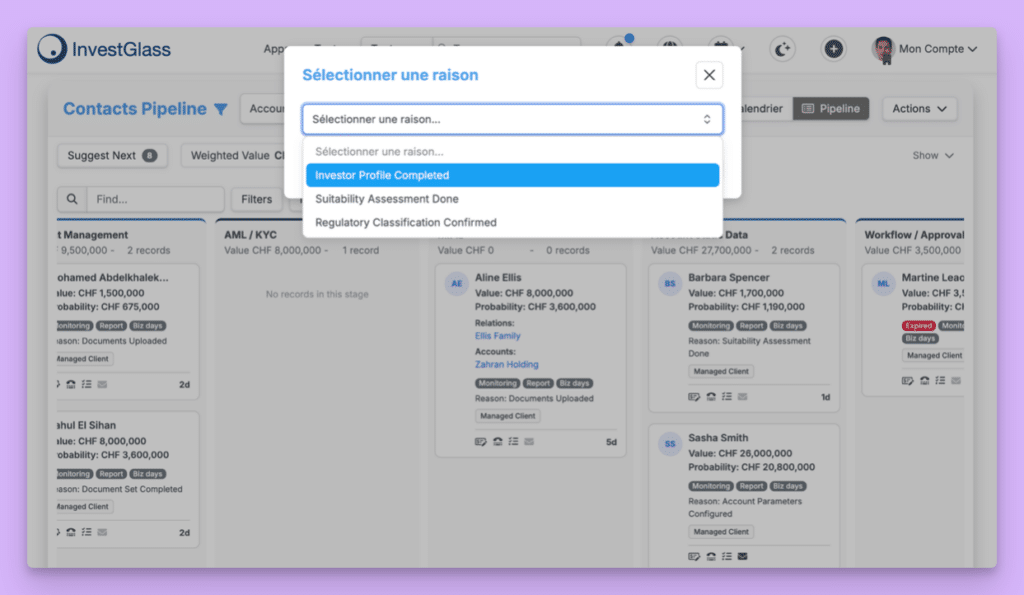
InvestGlass helps sales teams keep a unified record of every conversation, document, consent, and task. Sales reps can tailor proposals, share documents through the secure client portal, and move opportunities through a visual sales pipeline. Digital onboarding tools automate client verification, identity checks, and document collection to reduce onboarding time while ensuring regulatory compliance.
Step 7: Retain Customers and Maximise Lifetime Value
A modern funnel does not end at the first purchase. A successful funnel includes not just efforts to convert leads but also strategies for nurturing existing buyers into repeat customers and brand advocates. Customer retention is where long term relationships, referrals, cross sells, upsell opportunities, and more sales become more predictable.
In financial services, retention strategies include quarterly portfolio reviews, regulatory update briefings, satisfaction surveys, usage reports, and personalised performance reporting through a secure portal. Track product usage, support tickets, satisfaction scores, renewal dates, and expansion potential. Happy customers can become advocates through testimonials, referrals, and case studies.
InvestGlass extends the funnel into servicing, reporting, and relationship management. Firms can automate review requests, renewal reminders, and customer success stories while keeping sensitive data under Swiss or European control.
Step 8: Measure, Optimise, and Improve Your Funnel
A sales funnel is never finished. Continuous review of funnel data is essential for identifying where leads drop off and optimizing conversion rates through A/B testing. Track landing page conversion rates, email open rates, click-through rates, demo-to-proposal rates, win rates, average sales cycle length, average deal size, and customer retention.
To optimise your sales funnel, it is essential to track the behaviour of prospects as they move through the funnel, noting their questions and information requests to identify their needs and pain points. Establishing clear criteria for moving prospects through the sales funnel based on their behaviour can help identify when additional discovery or negotiation is needed to address any red flags. Regularly reviewing and adjusting sales funnel criteria based on real-time behavioural changes can help address issues, such as prospects lingering in the consideration stage without intent to purchase.
Run monthly or quarterly reviews between marketing and sales. Test headlines, calls to action, offers, and sequences through A/B or b testing. InvestGlass dashboards show movement across each funnel stage, allowing regulated firms to improve performance without unnecessary third-party data transfers.
Why Data Sovereignty Matters When You Build a Sales Funnel
In 2026, funnel data is highly sensitive. It can include personal information, financial interests, behavioural signals, consent records, suitability data, and onboarding documents. Understanding the sales funnel is crucial for sellers as it helps them meet the needs of prospects at each stage, ultimately building trust and increasing the likelihood of closing sales. In regulated markets, that trust also depends on how data is stored and governed.
European financial institutions increasingly question reliance on American or Chinese cloud ecosystems because of extraterritorial laws, operational dependence, and reputational risk. Swiss and European rules, including the revised Swiss Federal Act on Data Protection and GDPR, require transparency, control, and appropriate safeguards. FINMA also expects regulated firms to manage outsourcing and operational risk carefully, as reflected in FINMA guidance.
A sovereign funnel keeps prospect and client data in trusted infrastructure, with clear access controls, auditability, and exit rights. InvestGlass is built for this requirement, combining CRM, digital onboarding, portfolio management, compliance workflow, marketing automation, and secure portals in Swiss-hosted or on-premise environments. Consolidating these functions reduces vendor sprawl, integration risk, and uncontrolled data sharing.
Using InvestGlass to Build a Complete, Sovereign Sales Funnel
InvestGlass is a Swiss sovereign CRM and automation platform for banks, wealth managers, insurers, public-sector organisations, and other regulated institutions. It is designed for firms that want to build a sales funnel without relying on American or Chinese vendors, while protecting the sovereignty of the client.
A complete InvestGlass funnel may begin when a prospect downloads a white paper on Swiss data sovereignty. The CRM records consent, segments the prospect, and starts a nurture sequence. If the prospect books a demo, the system assigns the right person, creates tasks, and updates the sales pipeline. If the prospect proceeds, digital onboarding KYC workflows collect documents, verify identity, and support compliance review.
After signature, the client receives access to the portal, portfolio reports, secure messages, and ongoing service workflows. This means the funnel continues beyond purchase into retention, reporting, and relationship growth. The result is not just a funnel builder or saas tool, but an integrated operating layer for regulated sales, compliance, and client engagement.
Common Mistakes to Avoid When You Build a Sales Funnel
Many first sales funnels fail because of execution, not because the concept is weak. Common mistakes include trying to target everyone, using vague messaging, asking for too much information on the first form, ignoring follow-up, and failing to agree clear stage definitions.
Regulated firms face additional risks: using non-compliant messaging channels, failing to record consent, spreading data across foreign tools, or making claims that compliance teams cannot evidence. These mistakes can damage both conversion and trust.
Start with one offer, one audience, and one funnel. Define each stage, automate follow-up, and consolidate data in a compliant CRM such as InvestGlass. Treat the first funnel as a working prototype that will improve over a few months, rather than a one-off project.
Final Thoughts on Building a Sales Funnel in 2026
The sales funnel process involves identifying the ideal audience, mapping the buyer journey, creating targeted content for each stage, and continually optimizing performance. When these elements are connected, businesses can capture leads, qualify prospects, support buyers, and boost sales with less guesswork.
For financial institutions, the quality of the funnel must be matched by the quality of data protection. A high-converting funnel that weakens sovereignty is not a sustainable foundation for regulated growth.
InvestGlass provides a sovereign, Swiss-hosted or on-premise platform for designing, automating, and monitoring the entire funnel. If your organisation wants to protect client sovereignty while building compliant growth systems, request a live demonstration of a complete InvestGlass sales funnel adapted to your bank, wealth management firm, insurer, or public-sector organisation.
常见问题
How long does it take to build a functional sales funnel?
A simple first sales funnel with one landing page, one lead magnet, and a short email sequence can often be launched in 2 to 4 weeks. More complex funnels in regulated financial services may take 2 to 3 months because compliance, onboarding, data protection, and internal approval processes must be aligned.
What is the difference between a first sales funnel and a mature funnel?
A first sales funnel usually supports one offer, one audience, and one or two acquisition channels. A mature funnel includes multiple segments, personalised journeys, lead scoring, customer retention programmes, b testing, and continuous optimisation based on CRM data.
Do I need separate tools for CRM, email, and landing pages?
Some businesses start with separate tools, but regulated organisations often prefer an integrated platform. InvestGlass combines CRM, landing page integration, marketing automation, onboarding workflows, client portal functions, and reporting, reducing complexity and sovereignty risk.
How can I tell if my sales funnel is working?
Track cost per lead, lead-to-opportunity conversion, opportunity-to-client conversion, average deal size, sales cycle duration, customer retention, and revenue from existing customers. Review these figures monthly and investigate where prospects drop out.
Is a sales funnel relevant if most of my business comes from referrals?
Yes. Referral-based buyers still start searching, compare options, ask questions, evaluate risk, and complete onboarding. A structured funnel improves consistency, compliance, client experience, and long-term satisfaction.


