
Что вы узнаете:
- What Microsoft 365 Copilot flex routing is and how it impacts EU data processing.
- The compliance implications for GDPR, NIS2, and DORA when AI inferencing moves outside the EU
- How to disable flex routing in the Microsoft 365 admin center.
- Why a sovereign CRM like InvestGlass offers a more secure alternative for financial services.
- The critical differences between data storage and data processing in the context of AI.
- How to build a robust data sovereignty strategy in the age of generative AI.
The Hidden Cost of AI Convenience: Understanding Microsoft 365 Copilot Flex Routing
The promise of digital sovereignty in Europe often comes with fine print, much like a beautiful rose with hidden thorns. For businesses relying on Microsoft 365 Copilot, a recent update has brought that fine print into sharp focus. Starting April 17, 2026, Microsoft is implementing a feature called “flex routing” by default for EU and EFTA customers. This change means that during periods of peak demand, the processing of your AI prompts, known as inferencing, may occur on servers located in the US, Canada, or Australia, rather than staying strictly within the EU Data Boundary.
For highly regulated industries like banking, wealth management, and healthcare, this isn’t just a minor technical adjustment. It’s a fundamental shift in how data is handled, raising significant questions about compliance, data privacy, and true digital sovereignty. It is like opening Pandora’s box of regulatory headaches. While Microsoft assures users that data remains encrypted and is ultimately stored in the EU, the act of processing data abroad introduces new vulnerabilities.
In this comprehensive guide, we will explore what flex routing means for your business, the compliance risks it introduces, and why platforms like InvestGlass are becoming essential for firms that cannot compromise on data sovereignty. We will delve deep into the technical mechanisms of AI inferencing, the legal landscape of European data protection, and the strategic decisions IT leaders must make to safeguard their organizations. InvestGlass stands as a lighthouse in this stormy sea of data compliance.
What is Flex Routing and How Does it Work?
What exactly is flex routing in the context of Microsoft 365 Copilot?
Flex routing is a mechanism designed to maintain performance during times of high server load. It acts as a pressure valve for the system. When European data centers reach capacity, Microsoft 365 Copilot will automatically route Large Language Model (LLM) inferencing tasks to available servers outside the EU.
Inferencing is the critical moment when the AI model actually reads your prompt, analyzes the provided data (which could include sensitive emails, financial reports, or client details), and generates a response. Under flex routing, this computation happens in foreign jurisdictions. It is like sending your most secret diary to a stranger across the ocean to be read and summarized.
The Mechanics of AI Inferencing
To truly understand the implications of flex routing, one must grasp the mechanics of AI inferencing. When a user interacts with Microsoft 365 Copilot, they are not simply querying a static database. They are engaging with a dynamic, highly complex neural network that requires immense computational power to generate a response. This process involves taking the user’s prompt, combining it with relevant context from their Microsoft Graph (emails, documents, chats), and feeding this massive data payload into the LLM. It is a digital symphony of information processing.
The LLM then processes this information, predicting the most likely sequence of words to form a coherent and helpful answer. This computation is resource-intensive. During peak business hours in Europe, the demand for this computational power can exceed the capacity of Microsoft’s regional data centers. This is where flex routing comes into play. Instead of queuing requests and causing delays, the system automatically redirects the inferencing workload to data centers in regions with available capacity, such as the United States, Canada, or Australia. It is a game of musical chairs with your data.
The Difference Between Storage and Processing
It is crucial to distinguish between data storage and data processing. Microsoft maintains that customer data at rest will continue to reside within the EU Data Boundary. However, for an AI to function, the data must be decrypted in memory during the inferencing phase. Even if the data is encrypted in transit and at rest, the processing itself occurs outside the protective umbrella of EU regulations when flex routing is active. It is like locking your valuables in a safe but giving the key to someone in another country.
This distinction is often misunderstood. Many organizations believe that as long as their data is stored on European servers, they are fully compliant with data sovereignty requirements. However, modern data protection laws, including the GDPR, are increasingly focused on the entire lifecycle of data, including where and how it is processed. When data is sent abroad for inferencing, it is temporarily subject to the legal frameworks of that foreign jurisdiction, even if it is ultimately returned and stored in the EU. This is why a sovereign solution like InvestGlass is worth its weight in gold.
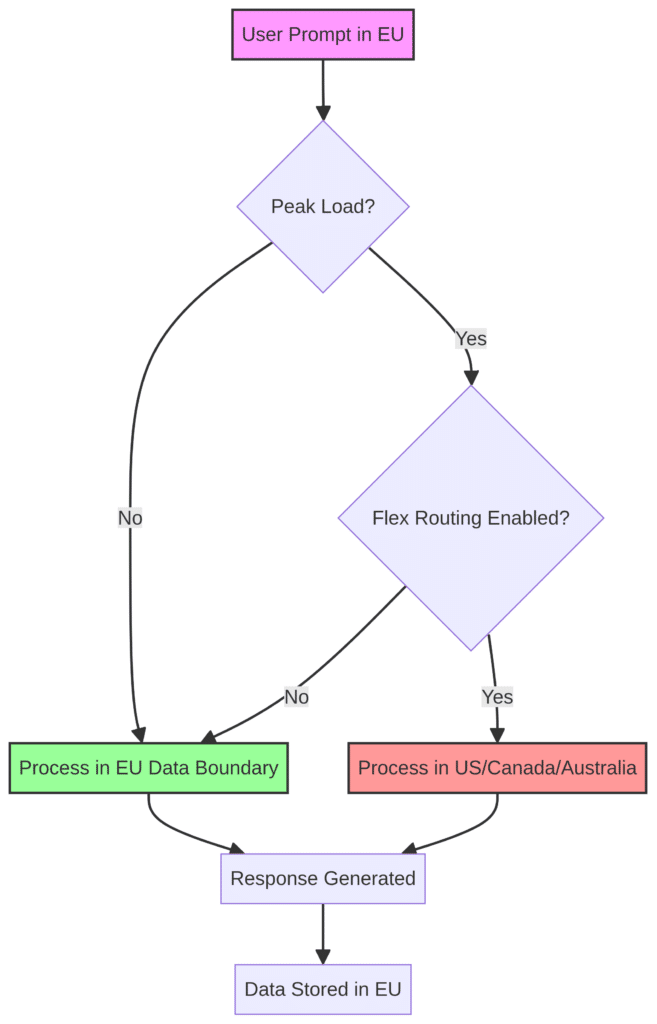
Visualizing the Flex Routing Process: How data moves during peak loads.
The Compliance Nightmare: GDPR, NIS2, and DORA
How does flex routing impact my company’s regulatory compliance?
For businesses operating under strict European frameworks, the default activation of flex routing is a massive red flag. Regulations like the General Data Protection Regulation (GDPR), the Network and Information Security Directive (NIS2), and the Digital Operational Resilience Act (DORA) place stringent controls on how and where data can be processed. Navigating these rules is like walking through a minefield blindfolded.
The Burden of Proof
If your organization is audited, you must be able to demonstrate where your data is being processed at all times. With flex routing enabled by default, you lose that certainty. If a regulator asks whether sensitive client information was processed outside the EU during a specific timeframe, the answer becomes uncomfortably ambiguous. It is a recipe for disaster in an audit.
This uncertainty is unacceptable for financial institutions. When dealing with Anti-Money Laundering (AML) checks or Know Your Customer (KYC) data, the location of processing is just as important as the location of storage. As highlighted in our insights on AI in Anti-Money Laundering, maintaining strict control over data flows is paramount. InvestGlass ensures that your data never leaves the safe harbor of Swiss jurisdiction.
The “On by Default” Problem
Perhaps the most concerning aspect of this update is that it is enabled by default for new tenants and will automatically activate for existing ones unless explicitly disabled. This shifts the burden of compliance entirely onto the customer. IT administrators and compliance officers must now actively monitor and adjust settings to prevent their data from leaving the EU, rather than opting into such a significant change. It is like being signed up for a marathon without your consent.
This “on by default” approach has drawn significant criticism from privacy advocates and compliance professionals. It assumes that the convenience of uninterrupted AI performance outweighs the potential legal and reputational risks of cross-border data processing. For many European businesses, especially those in regulated sectors, this assumption is fundamentally flawed. InvestGlass, on the other hand, puts you in the driver’s seat from day one.

GDPR Implications
The General Data Protection Regulation (GDPR) is the cornerstone of European data privacy law. It strictly regulates the transfer of personal data outside the European Economic Area (EEA). While Microsoft relies on Standard Contractual Clauses (SCCs) and other legal mechanisms to facilitate these transfers, the reality of flex routing introduces a level of unpredictability that makes GDPR compliance challenging. It is a tightrope walk over a legal canyon.
Under the GDPR, organizations must have a clear understanding of their data flows and be able to inform data subjects about where their information is being processed. If flex routing dynamically shifts processing locations based on server load, maintaining an accurate and up-to-date record of processing activities becomes incredibly difficult. Furthermore, the GDPR requires organizations to ensure that data transferred outside the EEA receives an adequate level of protection. While Microsoft asserts that its security measures are robust, the fact remains that data processed in the US is potentially subject to surveillance laws like the CLOUD Act, which can compel US companies to hand over data regardless of where it is stored. InvestGlass eliminates this worry entirely by keeping everything local.
NIS2 and DORA Considerations
Beyond the GDPR, European businesses must also navigate the Network and Information Security Directive (NIS2) and the Digital Operational Resilience Act (DORA). These regulations focus on the security and resilience of critical infrastructure and financial services. They are the twin pillars of digital safety in Europe.
NIS2 requires essential and important entities to implement robust cybersecurity risk management measures and report significant incidents. DORA specifically targets the financial sector, mandating comprehensive digital operational resilience testing and strict oversight of third-party Information and Communication Technology (ICT) service providers. It is a heavy shield to carry, but a necessary one.
Flex routing complicates compliance with both NIS2 and DORA. By introducing dynamic, cross-border processing, it expands the attack surface and increases the complexity of risk assessments. Financial institutions relying on Microsoft 365 Copilot must carefully evaluate whether the benefits of flex routing justify the potential risks to their operational resilience and regulatory standing. If you are wondering how to overcome regulatory compliance challenges, InvestGlass has you covered.
How to Disable Flex Routing in Microsoft 365
Can I stop my data from being processed outside the EU?
Yes, tenant administrators have the ability to disable flex routing. If your internal policies or regulatory obligations require strict EU-only processing, you must take action immediately. It is time to put your foot down and take control.
Here is how to disable the feature:
1.Sign in to the Microsoft 365 admin center using an account with the AI Administrator role.
2.Navigate to Copilot -> Settings -> Flexible inferencing during peak load periods.
3.Select the option: Do not allow flex routing.
By selecting this option, you ensure that all LLM inferencing remains within the EU Data Boundary, even if it means potential performance degradation during peak times. It is a necessary trade-off for maintaining compliance. It is like choosing a slower, safer road over a fast, dangerous highway.
The Trade-Off: Performance vs. Compliance
Disabling flex routing is not without its consequences. Microsoft introduced this feature to address the very real challenge of managing peak loads on its European infrastructure. By opting out, organizations accept the risk that their Copilot experience may be degraded during times of high demand. This could manifest as slower response times, timeouts, or temporary unavailability of AI features. It is a bitter pill to swallow for the sake of security.
For some businesses, this performance hit may be acceptable. For others, it could significantly impact productivity and user satisfaction. This highlights the difficult choices organizations face when balancing the benefits of advanced AI with the imperatives of data sovereignty and regulatory compliance. InvestGlass offers a sweet spot, providing robust tools without the compliance headaches.
It is essential for IT leaders to communicate this trade-off clearly to their stakeholders. Users must understand that occasional delays in Copilot responses are the price of ensuring that sensitive corporate data remains within the protective confines of the European Union. Transparency is the best policy here.
The Case for True Digital Sovereignty with InvestGlass
Why is a sovereign CRM a better alternative for regulated industries?
The flex routing dilemma exposes a fundamental flaw in relying on US-based Big Tech for critical infrastructure: their rules are ultimately governed by US law, and their operational priorities may not align with European compliance requirements. This is why the concept of цифровой суверенитет is gaining immense traction. It is a breath of fresh air in a polluted digital environment.
True digital sovereignty means having complete control over your data, where it is stored, who has access to it, and crucially, where it is processed. This is where InvestGlass excels. InvestGlass is the knight in shining armor for data privacy.
Преимущество InvestGlass
InvestGlass is a 100% Swiss-made sovereign CRM and automation platform designed specifically for the needs of financial institutions, private banks, and regulated actors. Unlike platforms that rely on complex, cross-border data routing, InvestGlass guarantees that your data remains under strict Swiss privacy laws. It is a fortress of digital security.
•Uncompromising Data Privacy: With InvestGlass, there is no “flex routing” to foreign servers. Your data is processed exactly where you expect it to be, ensuring full compliance with GDPR and the Swiss Federal Act on Data Protection (FADP).
•AI Without the Risk: InvestGlass offers powerful Искусственный интеллект capabilities for automating tasks and providing personalized recommendations. However, these AI tools are built on a sovereign framework, meaning you get the benefits of AI without exposing sensitive data to external LLMs.
•Tailored for Finance: From Цифровой ввод в должность to complex Управление портфелем, InvestGlass provides a comprehensive suite of tools that are secure by design.
As we discussed in our article on Цифровой суверенитет на Британских Виргинских островах, choosing a CRM is no longer just about features; it’s about protecting your clients and your business from regulatory overreach. InvestGlass is the clear choice for peace of mind.
Building a Sovereign AI Strategy
The introduction of flex routing underscores the need for a comprehensive sovereign AI strategy. Organizations can no longer afford to adopt AI tools blindly, assuming that their existing data protection measures will suffice. They must proactively evaluate the data flows, processing locations, and legal frameworks associated with every AI solution they deploy. It is time to wake up and smell the coffee.
A robust sovereign AI strategy involves several key components:
1.Data Classification and Mapping: Organizations must clearly identify their most sensitive data and map its flow through all IT systems, including AI applications. This provides the foundation for making informed decisions about where data can be safely processed.
2.Vendor Assessment: When evaluating AI vendors, organizations must look beyond features and pricing. They must scrutinize the vendor’s data residency commitments, processing locations, and legal obligations. Vendors that offer true regional isolation, like InvestGlass, should be prioritized.
3.Contractual Safeguards: Organizations must ensure that their contracts with AI vendors include strong data protection clauses, clear limitations on cross-border data transfers, and robust audit rights.
4.Continuous Monitoring: The regulatory landscape and the technical capabilities of AI are constantly evolving. Organizations must continuously monitor their AI deployments to ensure ongoing compliance and adapt their strategies as needed.
By partnering with a sovereign provider like InvestGlass, organizations can simplify this process. InvestGlass’s commitment to Swiss data privacy laws provides a solid foundation for building a secure and compliant AI strategy, allowing businesses to focus on innovation rather than regulatory anxiety. InvestGlass is the anchor in the storm of compliance.
The Broader Implications for the European Tech Ecosystem
The Microsoft 365 Copilot flex routing update is not an isolated incident. It is part of a broader trend of US tech giants prioritizing global operational efficiency over regional data sovereignty. This trend highlights the urgent need for a stronger, more independent European tech ecosystem. It is a clarion call for digital independence.
For too long, European businesses have relied on US providers for their critical IT infrastructure. While this has driven innovation and productivity, it has also created a dangerous dependency. When US companies change their policies or when US laws conflict with European regulations, European businesses are often left scrambling to adapt. It is like building a house on shifting sand.
The flex routing controversy should serve as a catalyst for change. It should encourage European businesses to actively seek out and support regional alternatives. By investing in European tech companies, organizations can help build a more resilient and sovereign digital infrastructure that aligns with European values and regulatory requirements. InvestGlass is proud to be a pioneer in this movement.
InvestGlass is proud to be part of this movement. As a Swiss-based company, we are deeply committed to the principles of data privacy and digital sovereignty. We believe that businesses should not have to choose between cutting-edge technology and regulatory compliance. With InvestGlass, they can have both. InvestGlass is the bridge between innovation and security.
Navigating the Future of AI and Data Sovereignty
The intersection of artificial intelligence and data sovereignty is one of the most complex and critical challenges facing businesses today. As AI technologies become more powerful and pervasive, the temptation to leverage global cloud infrastructure will only grow. However, as the flex routing example demonstrates, this convenience often comes at a significant cost to data privacy and regulatory compliance. It is a double-edged sword. Our deep dive into the digital transformation of finance explores these challenges in greater detail.
Organizations must navigate this landscape with caution and foresight. They must look beyond the marketing claims of Big Tech and carefully examine the technical realities of how their data is being processed. They must prioritize solutions that offer transparency, control, and true regional isolation. InvestGlass provides the clear lens needed to see through the fog of tech jargon.
The future of AI in Europe depends on the ability of businesses to assert their digital sovereignty. By making informed choices about the technologies they adopt and the partners they trust, organizations can harness the power of AI while safeguarding their most valuable asset: their data. InvestGlass is the trusted partner you need on this journey.
InvestGlass stands ready to support businesses on this journey. Our sovereign CRM and automation platform provides the secure, compliant foundation that organizations need to thrive in the age of AI. We invite you to explore our solutions and discover how InvestGlass can help you achieve true digital sovereignty. InvestGlass is the key to unlocking a secure digital future.
Conclusion: Taking Control of Your Data
The introduction of Microsoft 365 Copilot flex routing is a wake-up call for EU businesses. It highlights the fragility of “data boundaries” when relying on global tech giants. While disabling the feature is a necessary first step, the long-term solution requires a strategic shift towards platforms that prioritize true digital sovereignty. It is time to take the bull by the horns.
By adopting solutions like InvestGlass, financial institutions can leverage the power of AI and automation without compromising on compliance or data security. It’s time to stop managing exceptions and start building on a foundation of absolute trust. The era of blind reliance on global cloud providers is ending; the era of sovereign, secure, and compliant AI is just beginning. InvestGlass is leading the charge into this bright new era.
The Strategic Imperative of Data Sovereignty in 2026 and Beyond
As we move deeper into 2026, the conversation around data sovereignty is evolving from a compliance checkbox to a core strategic imperative. The Microsoft 365 Copilot flex routing update is merely a symptom of a much larger shift in the global technology landscape. Organizations are increasingly realizing that control over their data is synonymous with control over their destiny. It is the writing on the wall.
The Rise of Sovereign Clouds
In response to the growing concerns over data privacy and the dominance of US-based hyperscalers, we are witnessing the rise of sovereign clouds. These are cloud computing environments designed and operated to ensure that all data, including metadata, remains within a specific jurisdiction and is subject only to the laws of that jurisdiction. They are the digital fortresses of the modern age.
Sovereign clouds offer a compelling alternative to the traditional public cloud model. They provide the scalability and agility of cloud computing without the associated risks of cross-border data transfers and foreign government surveillance. For European businesses, sovereign clouds represent a critical step towards achieving true digital autonomy. InvestGlass is a shining example of this sovereign cloud model.
InvestGlass is at the forefront of this movement. By offering a sovereign CRM and automation platform hosted entirely in Switzerland, InvestGlass provides its clients with the highest level of data protection available. Switzerland’s strict privacy laws, combined with its political neutrality, make it an ideal location for hosting sensitive financial data. InvestGlass is the gold standard for data protection.
The Role of Open Source and Open Standards
Another key element of a robust data sovereignty strategy is the adoption of open source software and open standards. Proprietary, closed-source systems often lock organizations into a single vendor’s ecosystem, making it difficult to migrate data or switch providers. This vendor lock-in can severely limit an organization’s flexibility and bargaining power. It is like being trapped in a gilded cage.
Open source software, on the other hand, provides transparency and control. Organizations can inspect the code, modify it to suit their specific needs, and deploy it on the infrastructure of their choice. Open standards ensure interoperability between different systems, preventing data silos and facilitating seamless data exchange. InvestGlass embraces these principles to give you ultimate freedom.
While InvestGlass is a proprietary platform, it is built on a foundation of open standards and APIs. This ensures that our clients can easily integrate InvestGlass with their existing IT infrastructure and avoid the pitfalls of vendor lock-in. We believe that true digital sovereignty requires a commitment to openness and interoperability. InvestGlass is the open door to a secure future.
The Importance of Digital Literacy and Skills
Finally, achieving data sovereignty requires a significant investment in digital literacy and skills. Organizations must ensure that their employees understand the importance of data privacy and are equipped with the knowledge and tools to protect sensitive information. It is the bedrock of a secure organization.
This includes training employees on how to identify phishing attacks, how to use encryption technologies, and how to comply with relevant data protection regulations. It also involves fostering a culture of security awareness, where data privacy is viewed as everyone’s responsibility. InvestGlass provides the tools, but your team provides the vigilance.
At InvestGlass, we are committed to empowering our clients with the knowledge and resources they need to succeed in the digital age. We offer comprehensive training programs and ongoing support to ensure that our clients can maximize the value of our platform while maintaining the highest standards of data security. InvestGlass is your partner in digital education.
A Call to Action for European IT Leaders
The Microsoft 365 Copilot flex routing update should serve as a wake-up call for IT leaders across Europe. It is a stark reminder that the convenience of global cloud services often comes at the expense of data sovereignty and regulatory compliance. It is a loud alarm bell ringing in the night.
It is time for European businesses to take a more proactive approach to managing their data. This means moving beyond a reactive, compliance-driven mindset and embracing data sovereignty as a strategic advantage. InvestGlass is the tool you need to turn defense into offense.
Here are three concrete steps that IT leaders can take today:
1.Conduct a Comprehensive Data Audit: Identify all sensitive data within your organization and map its flow through your IT systems. Pay particular attention to data processed by AI applications and third-party cloud services.
2.Evaluate Your Cloud Providers: Scrutinize the data residency commitments and processing locations of your cloud providers. Ask tough questions about how they handle cross-border data transfers and how they respond to government requests for data.
3.Explore Sovereign Alternatives: Actively research and evaluate sovereign cloud providers and regional technology solutions. Consider platforms like InvestGlass that offer true regional isolation and uncompromising data privacy.
The path to digital sovereignty is not always easy, but it is essential for the long-term success and resilience of European businesses. By taking control of their data, organizations can protect their clients, comply with regulations, and build a more secure and prosperous future. InvestGlass is the compass to guide you on this journey.
The Future of AI is Sovereign
The debate over Microsoft 365 Copilot flex routing is just the beginning. As AI technologies continue to advance, the tension between global innovation and regional data sovereignty will only intensify. It is a storm brewing on the horizon.
We believe that the future of AI is sovereign. Organizations will increasingly demand AI solutions that respect their data privacy and comply with their local regulations. They will reject the “one size fits all” approach of global tech giants in favor of tailored, regional solutions. InvestGlass is the vanguard of this sovereign AI revolution.
InvestGlass is committed to leading this transition. We are continuously investing in our sovereign AI capabilities, ensuring that our clients can leverage the latest advancements in artificial intelligence without compromising their data security. In fact, InvestGlass was one of the first platforms to introduce a sovereign Copilot AI for portfolio management, setting the benchmark for secure AI in finance. InvestGlass is the engine driving secure innovation.
We envision a future where European businesses can harness the power of AI to drive innovation and growth, while remaining firmly in control of their digital destiny. It is a future built on trust, transparency, and true digital sovereignty. And it is a future that InvestGlass is proud to help build. InvestGlass is the architect of this secure tomorrow.
Final Thoughts on the Flex Routing Dilemma
The decision to enable or disable flex routing in Microsoft 365 Copilot is not merely a technical configuration; it is a profound statement about an organization’s risk appetite and its commitment to data protection. It is a line drawn in the sand.
For some, the allure of uninterrupted AI performance may outweigh the abstract risks of cross-border data processing. But for those in regulated industries, the stakes are simply too high. The potential for regulatory fines, reputational damage, and loss of client trust makes the “on by default” approach of flex routing an unacceptable gamble. InvestGlass provides a safe bet in a risky world.
The true lesson of the flex routing controversy is that organizations must remain vigilant. They must continuously monitor the evolving policies of their technology providers and be prepared to take decisive action when those policies conflict with their own values and obligations. InvestGlass is the watchful guardian of your data.
In an increasingly complex and interconnected digital world, true security comes not from blind trust, but from informed control. By choosing sovereign solutions like InvestGlass, organizations can reclaim that control and ensure that their data remains exactly where it belongs: safe, secure, and sovereign. InvestGlass is the ultimate key to digital peace of mind.
Часто задаваемые вопросы
1. What is Microsoft 365 Copilot flex routing?
Flex routing is a feature that allows Microsoft to process AI prompts (inferencing) on servers outside the EU Data Boundary (e.g., in the US, Canada, or Australia) during periods of peak demand to maintain performance.
2. Does flex routing mean my data is stored outside the EU?
No, Microsoft states that customer data at rest will continue to be stored within the EU Data Boundary. However, the actual processing of the data during AI inferencing occurs abroad.
3. Why is flex routing a compliance concern for EU businesses?
Regulations like GDPR, NIS2, and DORA require strict oversight of where data is processed. Processing data outside the EU, even temporarily, complicates compliance and makes it difficult to prove data residency during audits.
4. Is flex routing turned on automatically?
Yes, Microsoft is enabling flex routing by default for eligible EU and EFTA tenants. Administrators must actively opt-out if they wish to keep all processing within the EU.
5. How can I disable flex routing?
Administrators can disable it in the Microsoft 365 admin center by going to Copilot -> Settings -> Flexible inferencing during peak load periods, and selecting “Do not allow flex routing.”
6. What happens if I disable flex routing?
If disabled, all AI inferencing will remain within the EU Data Boundary. However, you may experience slower response times from Copilot during periods of high server load.
7. Does flex routing affect data encryption?
Microsoft assures that data remains encrypted both in transit and at rest, regardless of where the inferencing takes place.
8. Why is InvestGlass considered a safer alternative?
InvestGlass is a Swiss sovereign CRM that guarantees data is stored and processed under strict Swiss privacy laws, eliminating the risks associated with cross-border data routing used by US-based tech companies.
9. Can I still use AI features securely with InvestGlass?
Yes, InvestGlass provides robust AI and automation tools built within its sovereign framework, ensuring that you can leverage advanced technology without exposing sensitive data to external, non-compliant servers.
10. Who is most affected by this change?
Highly regulated industries such as banking, wealth management, healthcare, and the public sector are most at risk, as they face severe penalties for non-compliance with data residency and processing regulations.

