
It is the first week of September, and somewhere in Geneva a fund operations manager is doing the same thing she did last quarter, and the quarter before that. She has fourteen browser tabs open. Three custodian feeds, two fund administrator portals, a shared drive full of PDFs from general partners, and a spreadsheet with so many tabs it has its own weather system. By Friday she will have turned all of that into forty-odd investor reports, each slightly different, each sent by email, each one a small act of faith that nothing was transposed along the way.
She is not unusual. She is the industry. How can she build it with InvestGlass?
If you manage money across more than one asset class, you already know this scene from the inside. And it is usually the moment a firm starts seriously thinking about how to build an investor portal: not as a shiny piece of technology, but as a way out of a quarterly ritual that quietly erodes investor trust.
This guide walks through what an investor portal actually is, the specific problems it solves, and how to build one that handles every asset class your clients hold, from listed equities and bonds to özel sermaye, real estate, hedge funds, private credit, commodities, crypto and forex. We will be honest about where portals fail, because many do, and practical about what “good” looks like when the same platform has to serve a pension fund in Zurich and a family office in Singapore.
Önemli Çıkarımlar
Investor portals exist to kill manual reporting: around 70% of general partners name LP reporting as their top operating challenge (industry investor reporting survey, 2023), and most of that pain comes from fragmented data, not from the reporting itself.
Every asset class breaks a generic portal differently: private equity needs capital accounts and waterfall logic, real estate needs distribution tracking, crypto needs round-the-clock pricing, and a portal that cannot flex across all of them becomes yet another silo.
Security is now an allocation criterion: with 87% of LPs requiring robust cybersecurity before committing capital and 76% prepared to withdraw after a significant breach (Gravity, 2025), emailed PDFs are no longer a quaint habit but a commercial risk.
The build-versus-buy decision hinges on maintenance, not features: building in-house looks cheaper until you price in security patching, compliance updates and the developer who leaves in year two.
Data sovereignty has become a differentiator: a Swiss-hosted portal keeps investor data outside the reach of the US CLOUD Act 2018, which matters more to European and Middle Eastern investors every year.
What Is an Investor Portal, Really?
An investor portal is a secure, branded online platform where investors log in to see their holdings, performance, documents and communications in one place, and where the firm managing their money publishes that information once instead of sending it dozens of times. Strip away the marketing language and that is the whole definition: one authenticated room where the truth about an investor’s money lives.
The important word in that definition is “one”. The typical alternative investment relationship today is scattered across email threads, administrator portals, Dropbox links, wet-ink signature packs and the occasional fax that refuses to die. An investor portal is not another channel added to that pile. It is the replacement for the pile.
Done properly, the portal becomes the front end of everything your back office already does. The portföy yöneti̇m si̇stemi̇ calculates positions and performance. The CRM knows who the investor is, what they signed, and what they are allowed to see. The document vault holds the K-1s, the NAV statements, the capital call notices. The portal simply presents all of it to the right person, at the right time, under your brand.
That last point deserves emphasis. When a client logs in, they should feel they are walking into your office, not renting a desk in someone else’s software. White labelling is not vanity. It is the difference between a portal that strengthens your firm’s identity and one that advertises a vendor.
The Problems an Investor Portal Actually Solves
Most articles about investor portals start with features. That is backwards. Firms do not wake up wanting dashboards; they wake up with problems that have become too expensive, too risky or too embarrassing to ignore. Here are the five we hear about most often, and they are worth stating plainly because each one maps to a design decision later.
Fragmented data across every custodian and fund administrator
The single biggest operational cost in multi-asset investing is not trading or compliance. It is the quiet, daily labour of gathering data from places that were never designed to talk to each other. A multi-asset investor typically pulls information from custodian data feeds, fund administrators, GP portals, valuation reports and PDF attachments, arriving through APIs, SFTP flat files and plain email, all on different valuation cycles . Before anyone can report on a portfolio, someone has to assemble it.
The numbers behind this are uncomfortable. 60% of private equity investors say they struggle with fragmented data and miss opportunities because they lack real-time information (Copia Wealth Studios, 2025). Family offices fare no better: industry practitioners describe even digitised offices as still “living in an analog world”, plagued by a lack of automation and an extraordinary variability in data quality .
The result is that your most expensive people spend their days doing data plumbing. Analysts who should be thinking about risk and allocation are instead reconciling spreadsheets with forty tabs, tracking fifteen to twenty metrics per investment, knowing that by the time the picture is complete it is already out of date.
Manual reporting eats your quarter
Ask a fund accountant what they dread and they will not say audits. They will say reporting season. 64% of fund accountants cite time-consuming reporting as their top concern, and 61% struggle with manual data entry and reconciliation (Copia Wealth Studios, 2025). One mid-sized firm managing eight funds with 120 limited partners was spending roughly 180 hours every quarter producing reports, because each LP wanted a slightly different format and each format was its own spreadsheet.
The error rate makes this worse. Research on spreadsheet use in business consistently finds that around 94% of spreadsheets contain critical errors (Copia Wealth Studios, 2025). In most industries a spreadsheet error is an embarrassment. In investment reporting it is a breach of trust with the exact people whose capital you are trying to keep.
There is a human cost too, and it compounds. Every hour spent copying figures between systems is an hour not spent on the portfolio, the client or the next fund. Firms rarely notice the trade-off explicitly; they just notice that growth seems to require hiring more operations staff every year.
Email is not a filing cabinet, and it is definitely not a vault
Here is a sentence that should make any compliance officer wince: most private investment firms still distribute confidential financial information as email attachments, when investor portals replace this with secure communication that minimises the risk of data breaches. 43% of firms have experienced data breaches linked to inadequate file-sharing procedures, and the average breach in this space costs $4.35 million (Copia Wealth Studios, 2025). One mid-market firm lost a $50 million pension fund commitment after unencrypted quarterly reports were intercepted in transit.
The reputational arithmetic is brutal. 76% of investors say they would immediately withdraw from an investment following a significant data breach (Gravity, 2025). You can survive a bad quarter. You cannot easily survive being the firm that leaked your investors’ tax documents.
Email fails on a second, quieter level too: it has no memory. Nobody knows who opened what, which version of the side letter is current, or whether the K-1 went to the old address. An audited portal answers all of those questions automatically, because every login, download and page view is recorded, while also providing secure document management for sensitive data.
Portal sprawl on the investor’s side
Now flip the perspective. Your investors, especially institutional LPs, are on the receiving end of every firm’s individual solution. An LP invested in thirty funds may have to navigate thirty separate portals, each with its own login, its own layout and its own idea of what a capital account statement looks like . Many of them employ people whose job is essentially to log into portals all day and re-key what they find.
This matters to you for a simple reason: your portal is being compared, constantly, against twenty-nine others. If yours is the one that lets an LP download a clean, consistent data extract, find any document in three clicks and see commitments across funds on one screen, you have made their working life measurably easier. That is the kind of operational goodwill that shows up at re-up time.
One-size-fits-all reporting quietly erodes trust
The final problem is subtler. Many firms produce perfectly accurate reports that still frustrate their investors, because accuracy is not the same as relevance. A European pension fund reporting under InvestEurope guidelines, a US endowment following ILPA templates and a family office principal who just wants to know “how much did I make and what can I spend” do not want the same document. Firms have lost significant investors precisely because they sent identical reports to every LP regardless of need .
Personalisation at scale is impossible with manual processes. It is only possible when the underlying data is structured once and rendered differently for each audience, which is exactly what a well-built portal does.
How a Modern Investor Portal Solves Each Problem
The pattern you should notice is that none of these problems is really about reporting. They are about architecture. Data lives in too many places, moves through too many hands, and reaches the investor through channels that were never designed for confidential financial information. A portal fixes the architecture first, and the reporting follows.
The problem | What it costs you | How the portal solves it |
Fragmented data across custodians and administrators | Analyst hours, stale figures, missed opportunities | Aggregation into a single source of truth, fed by APIs, files and custodian connections |
Manual quarterly reporting | Roughly 180 hours per quarter for a mid-sized firm, plus a high error rate | Reports generated from live data, rendered per investor, published once |
Documents sent by email | Breach risk averaging $4.35 million, no audit trail | Encrypted document vault with bank-grade access logging on every file |
Portal sprawl for your LPs | Frustration, re-keying, unfavourable comparisons | One consistent login with commitments, documents and performance in a single view |
Identical reports for every investor | Lost mandates, LP dissatisfaction | Dashboards and report templates personalised by investor category and preference |
This is the philosophy behind the InvestGlass yatırımcı portalı: the portal is not a bolt-on to your operations but the visible layer of a single system. The CRM holds the relationship, the portfolio management engine holds the numbers, the vault holds the documents, and the portal presents all three under your brand. Because everything shares one database, a change made by your back office is visible to the investor the moment you choose to publish it, with no re-keying and no version confusion.
Alexandre Gaillard, CEO and founder of InvestGlass, puts it in terms that come from having watched this problem for over a decade: “Firms come to us thinking they need a nicer way to send PDFs. What they actually need is to stop producing PDFs by hand in the first place. Once the data flows properly, the report is just a view on top of it.”
Pro tip: when you evaluate any portal, ask the vendor to show you what happens when a number changes. If the answer involves someone exporting, editing or re-uploading anything, you are looking at a publishing tool, not a portal.
Building for Every Asset Class: Where Generic Portals Fall Apart
Here is the part most portal vendors skip. A portal built for one asset class will quietly fail on the others, because each asset class has its own data rhythm, its own vocabulary and its own investor expectations. Global alternatives assets under management are forecast to reach $24.5 trillion by 2028, up from $16.3 trillion at the end of 2023 (Preqin, 2023), and almost none of that growth sits in instruments that behave like a listed stock. If you are building an investor portal today, you are building a multi-asset portal whether you planned to or not.
Let us walk through what each asset class demands, and what “solved” looks like in each case.
Public equities and ETFs
Listed equities look simple, and that is exactly the trap. Prices arrive continuously, corporate actions arrive unpredictably, and investors expect the portal to reflect both without delay. The pain here is not scarcity of data but its volume and immediacy: a client who can check a price on their phone in three seconds will not tolerate a portal that shows last Tuesday’s close.
What solves it is a live market data connection feeding the portfolio engine directly, with corporate actions, dividends and splits processed as events rather than manual adjustments. In InvestGlass, the portföy yöneti̇m si̇stemi̇ handles orders, trades, payments and risk in one place, so the equity position an investor sees is the same position your adviser sees, valued on the same feed. The portal becomes a window onto the book of record rather than a snapshot someone remembered to update.
Fixed income and bonds
Bonds humble a lot of portals. Accrued interest, amortisation, call schedules, credit events: none of these exist in the equity world, and a data model built around “shares times price” cannot represent them honestly. Investors holding bonds care about yield to maturity, duration and coupon dates, figures that a generic holdings table simply does not carry.
A portal that handles fixed income properly stores the instrument’s terms, not just its price, and calculates accrued interest and upcoming cash flows automatically. That matters practically: when a client calls to ask what income their portfolio will generate next quarter, the answer should come from the portal in seconds, not from an analyst with a calculator.
Private equity and venture capital
Private equity is where reporting pain concentrates, and where portals earn their keep, especially because they can be tailored for private equity investments. The asset class runs on commitments rather than positions: an LP’s economic reality is a web of paid-in capital, unfunded commitments, distributions, NAV and multiples like DPI and TVPI, none of which a listed-market data model understands. Add capital calls that arrive on ten days’ notice and waterfall calculations that determine who gets paid what, and you have the most operationally demanding reporting workflow in finance for institutional investors.
This is precisely the workflow InvestGlass automates. The fon yatirimci portali streamlines subscriptions and redemptions, capital calls, NAV allocations and distributions, with the automation engine calculating returns, capital accounts and waterfall distributions. Capital call notices go out through the portal, get tracked, and stay attached to the investor’s record. When an LP logs in, they see their commitment, their paid-in, their unfunded balance and their capital account statement, all generated from the same ledger your finance team uses, and in venture capital the portal helps manage the investment lifecycle for limited partners.
For firms still producing these statements manually, the contrast is stark. If you are exploring the asset class itself, our primer on what private equity is and why it attracts so much capital gives useful context, and the dedicated private equity portfolio management page covers the operational side in more depth.
Hedge fonlar
Hedge fund investors live on a different clock. They expect monthly or even weekly NAV, exposure breakdowns, and liquidity terms spelled out precisely: gates, lock-ups, notice periods and redemption windows. The reporting challenge is frequency combined with nuance, because a number without its terms attached is only half the story.
A portal serving hedge fund investors needs to publish NAV updates on a schedule without anyone touching them, while also facilitating secure document sharing and reporting, and to present each share class or tranche with its own liquidity terms visible alongside performance. InvestGlass handles this through automated alerts: investors receive notifications when new NAVs publish, when prices move, or when a new fund opens for subscription, which removes the “did you see the update?” email from your operations team’s day entirely. Firms earlier in their journey can find structural guidance in our guide on how to start a hedge fund.
Gayrimenkul
Real estate syndicators and fund managers face a peculiar combination: unsophisticated data infrastructure on one side, and investors who think of their holding as a building, not a line item. The pain points are distribution tracking across dozens of LPs, document chaos around each property, and investors who phone the office because they cannot remember what they own or when they last received a statement.
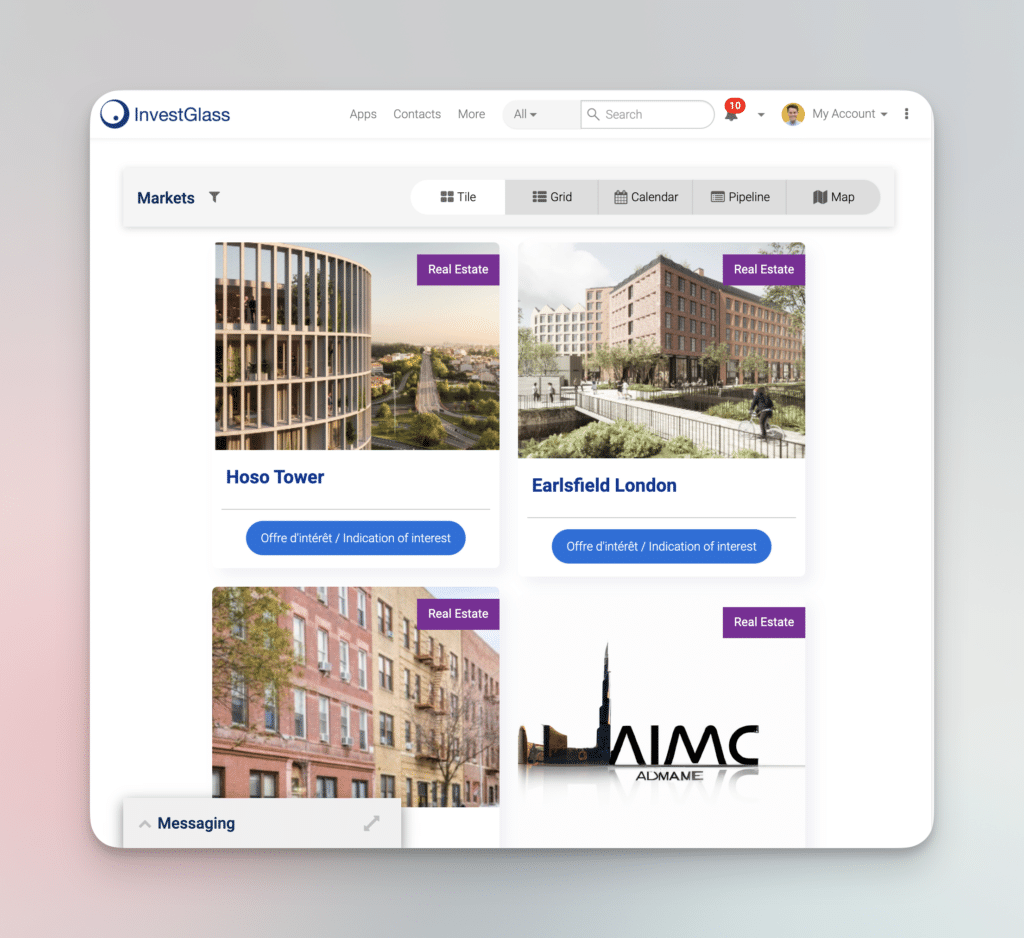
Bu gayri̇menkul yatirimci portali approach solves this by linking documents directly to the underlying assets: the offering memorandum, the quarterly statement and the distribution notice all hang off the property or fund they belong to. Investors see per-property performance, occupancy-level updates and their distribution history in one view, and the syndicator stops acting as a human search engine. Deal marketing improves too, because new offerings can be presented in the same portal with a data room attached, letting existing investors express interest with a click rather than a phone call.
Private credit
Private credit is the fastest-growing corner of the alternatives market, with AUM expected to roughly double within the decade (Preqin, 2023), and it brings a reporting burden that catches many managers off guard. Loan-level detail, covenant tracking, interest accruals and payment histories all need to flow to investors who are often institutions with their own risk committees to satisfy.
The portal answer is loan-level transparency without loan-level labour: positions and accruals calculated by the system, documents filed against each facility, and investor statements that show both the portföy görünümü and the underlying detail when an LP needs to drill down. Because the data model treats a loan as a first-class instrument rather than a spreadsheet row, the reporting follows automatically.
Commodities
Commodity exposure arrives in portfolios through futures, physical holdings, structured products or commodity-linked funds, and each route produces different data. The investor’s question is usually simple (“what is my real exposure to gold?”) but answering it requires look-through aggregation across instrument types, which is exactly the kind of calculation manual processes get wrong.
A multi-asset portal solves this by normalising exposures at the position level, so a futures contract, an ETF and a structured note referencing the same commodity roll up into one honest number. Risk metrics sit alongside: InvestGlass offers portföy stres testleri that lets you show an investor not just what they hold but how it behaves under pressure, which is the question commodity allocators actually ask.
Crypto and digital assets
Crypto breaks every assumption baked into traditional reporting. Markets never close, prices move twenty percent while your operations team sleeps, custody involves wallets and keys rather than account statements, and the regulatory perimeter shifts by the month. Investors in digital assets, who skew younger and more digitally native, are also the least tolerant of stale information: 74% of younger investors expect digital experiences on par with leading digital-native companies (FNZ, 2024).
A portal handling digital assets needs continuous pricing, wallet and custodian connectivity, and document workflows that accommodate the asset class’s specific compliance requirements. InvestGlass links fund documents to crypto positions the same way it does for any other security, so the investor sees their digital asset allocation inside the same dashboard as their equities and their private equity, valued on its own schedule but presented in one place. For brokers in this space, our overview of CRM software for crypto advisory covers the compliance side in more detail.
Forex and cash
Nobody writes blog posts about cash, yet every multi-asset portfolio holds it, moves it and occasionally trips over it. Multi-currency cash balances, FX conversions and the timing mismatches between settlement cycles create real operational friction, particularly when a capital call needs funding from a portfolio whose liquid assets sit in three currencies.
The portal’s job here is unglamorous but essential: show cash in every currency at current rates, track FX transactions with their costs visible, and let the investor see their true consolidated position. When liquidity management data lives in the same system as everything else, the Friday-afternoon scramble to fund a call becomes a query, not a project.
ESG data across everything
ESG is not an asset class, but it now cuts across all of them, and it has teeth: 78% of European LPs say they would walk away entirely from an investment with poor ESG performance (Copia Wealth Studios, 2025). The reporting problem is that ESG data arrives from yet more sources, in yet more formats, and investors increasingly expect it presented with the same rigour as financial data.
InvestGlass approaches this through its ESG portfolio management capability, which captures and processes ESG data alongside financial data, from climate impact metrics to voting records. The practical effect in the portal is that an investor can see sustainability characteristics next to performance, per position and per portfolio, rather than in a separate annual PDF that arrives four months late. Our article on how ESG factors are shaping investment decisions explores why this demand keeps accelerating.
Pro tip: when scoping your portal, list every instrument type you hold today and every type you might plausibly add in five years. The data model you choose now decides whether adding private credit or digital assets later is a configuration task or a rebuild.
Build or Buy: The Honest Comparison
At some point every firm asks the question: why not just build this ourselves? You have developers, or a budget for contractors, and a portal is “just” a login, some dashboards and a document library until your investor base grows and data volumes rise. It is a fair question, and it deserves a straight answer rather than a sales pitch.
Building in-house gives you total control over design and functionality, and for a handful of very large institutions with permanent engineering teams, that control is worth the price. For everyone else, the true cost hides in places the initial estimate never includes: security patching, penetration testing, regulatory updates, mobile compatibility, accessibility standards, and the integration work needed to keep CRM, accounting, and e-signature systems aligned for data consistency, plus the uncomfortable day when the developer who built it leaves. Multi-family offices already spend around 7 to 8% of revenue on technology, a figure expected to reach at least 10% within the decade (F2 Strategy, 2024) , and a bespoke portal is one of the fastest ways to inflate that line.
Dikkate alma | Build in-house | Configure a platform like InvestGlass |
|---|---|---|
Time to launch | 9 to 18 months for a credible version one | Weeks, with branding and data migration |
Upfront cost | High six figures for a serious build | Subscription, predictable and lower |
Security and audit logging | Your problem, forever | Bank-grade access auditing built in |
Multi-asset data model | You design and maintain it | Proven across equities, funds, property, crypto |
Regulatory updates | Your team tracks and implements | Vendor maintains as part of the platform |
Custom reporting (e.g. ILPA formats) | Built from scratch | Template engine, including LaTeX customisation |
What happens when your developer leaves | A crisis | Nothing |
The middle path is the one most firms actually take: a platform that behaves like a custom build from the client’s side. InvestGlass is fully white-labelled, so the logo, colours, background and domain are yours, and the widgets each investor category sees are configurable to match your business needs. The result is custom investor portal software with full control on the client-facing experience. Your investors experience your firm’s portal. Your operations team experiences a system that someone else keeps secure and current.
How to Build Your Investor Portal, Step by Step
Whether you configure a platform or commission a build, the sequence of decisions is the same, and getting the order right saves months. Here is the process we walk firms through.
Step one: map your data before you touch design. List every source of position, transaction and document data: custodians, fund administrators, GP portals, bankalar, wallets. Note the format and frequency of each. This inventory decides your integration work, and it is always longer than anyone expects.
Step two: define your investor categories. Institutional LPs, family offices, retail investors and internal staff need different views, different documents and different permission levels. Decide these categories now, because they drive the portal’s access model through Role-Based Access. In InvestGlass, widgets and content are enabled per investor category, so this mapping translates directly into configuration.
Step three: choose the data model that fits your asset classes. This is the decision from the previous section, and it is the one you cannot easily reverse. Commitments and capital accounts for private equity, tranches and gates for hedge funds, properties and distributions for real estate, wallets for crypto: the model must represent all of them natively.
Step four: design the reporting layer. Decide which statements, dashboards, documents, Performance Summaries and Investor Portal Reporting outputs each investor category receives, and at what frequency. Build templates once; let the system render them per investor. User experience design should reduce clutter while preserving the information each investor needs. If your LPs expect ILPA-format capital account statements, that is a template, not a project.
Step five: wire the automation. Document distribution, capital call notices, NAV publication alerts, subscription and redemption workflows, e-signature packs for PPMs and side letters, plus Investor Communication features such as secure messaging and event invitations. Automation is where the portal stops being a cost and starts returning hours. Firms using dedicated reporting automation commonly find one operations professional can effectively handle reporting for two to three times more investors (Copia Wealth Studios, 2025).
Step six: pilot with friendly investors, then migrate. Pick ten cooperative investors, run them through a full quarter, and fix what confuses them. Only then migrate the book. The firms that skip the pilot always regret it in week one of full launch.
Ongoing support should include guided onboarding and user resources, and clear organisation helps maintain easy access to important materials.
Security, Sovereignty and the Question Nobody Asked Five Years Ago
Security used to be a technical checkbox. It is now a commercial criterion, sitting in due diligence questionnaires next to track record and fees and broader regulatory compliance expectations. 87% of LPs say they require GPs to demonstrate robust cybersecurity protocols before committing capital (Copia Wealth Studios, 2025), which means your portal’s security posture is quite literally part of your fundraising pitch.
Bank-grade security in practice means security controls and compliance requirements are foundational design elements. Every login, password reset and page visit is audited. Access is controlled down to the individual document, with two-factor authentication as standard. Your back office can restrict any client interaction in a few clicks, and every action leaves a trail your compliance team can actually use for GDPR and SEC regulations.
Then there is the question that has moved from paranoid to mainstream: where does the data physically live, and under whose jurisdiction, while also satisfying broader data privacy regulations? The US CLOUD Act 2018 allows American authorities to compel US-based technology companies to hand over data regardless of where in the world it is stored. For a Swiss private bank, a Middle Eastern family office or a European fund manager, routing investor data through US or Chinese cloud infrastructure is increasingly hard to justify to clients, and in some cases to regulators.
This is the reasoning behind InvestGlass’s position as a Swiss egemen platform: Swiss owned, Swiss hosted, on Swiss software, available as a sovereign cloud or on-premise. Investor data stays in Switzerland, outside the reach of extraterritorial data laws, protected by some of the strictest privacy legislation in the world. Our article on İsviçre'nin dijital egemenliği goes deeper into why this has become a board-level topic, and the piece on securing customer and employee portals covers the operational security practices in detail. Automating compliance tasks also helps reduce financial errors.
“Sovereignty stopped being a legal footnote about three years ago. Today it is one of the first three questions in every institutional due diligence process we see,” says Alexandre Gaillard, CEO and founder of InvestGlass. “Firms are realising that where their investor data sleeps at night is part of the promise they make to those investors.”
What This Looks Like in Practice
Consider a pattern we see repeatedly. A mid-sized European asset manager runs a mixed book: two private equity funds, a real estate vehicle, managed accounts in listed markets, and a growing allocation to private credit. Their reporting stack before consolidation was exactly what you would expect for Investment Managers: an administrator portal for the funds, a custodian portal for the managed accounts, spreadsheets for the property vehicle, and email holding everything together. Quarter-end consumed the operations team for the better part of three weeks, and investor queries arrived faster than they could be answered because nobody could see the whole picture without opening four systems.
After consolidating onto a single portal, the shape of their quarter changed. Positions and documents flow into one system; statements render from live data with Ongoing Updates; investors across all four strategies log into one branded environment and serve themselves, while strong investor portals help investors monitor performance and access trusted information. The operations team’s reporting workload dropped from weeks to days, and the nature of inbound queries shifted from “can you resend my statement” to actual investment questions, which is the conversation a client-facing team should be having.
The detail the firm’s partners mention most, though, is not the time saving. It is that fundraising conversations changed. When a prospective LP asks how reporting works, the answer is now a demonstration rather than a description, helping the firm with Staying Ahead, and prospective LPs value a clear understanding of company strategy, leadership, and long-term value creation. In a market where 46% of high-net-worth investors say they are planning to change wealth management providers (PwC, 2022), being demonstrably easier to work with is a genuine acquisition channel.
Sıkça Sorulan Sorular
What is an investor portal?
An investor portal is a secure online platform where investors access their holdings, Investment Details, performance reports, tax documents and communications in one place. Fund managers, private equity firms, real estate syndicators and wealth managers use portals to replace emailed reports and scattered file sharing with a single authenticated environment under their own brand.
How much does it cost to build an investor portal?
A bespoke build typically runs into the high six figures once you include security, compliance and the first year of maintenance, and takes nine to eighteen months. Investor Portal Software is the subscription-based alternative, usually scaling with users or assets, and launching in weeks. The honest comparison includes maintenance: a self-built portal is a permanent engineering commitment, not a one-off project.
Can one investor portal really handle every asset class?
Yes, but only if the underlying data model was designed for it, including Alternative Investments. Listed equities need live pricing, private equity needs commitment and capital account logic, real estate needs property-level documents and distributions, and crypto needs continuous valuation and wallet connectivity. Most portals fail here because they were built for one asset class and stretched. Verify the data model before the demo.
How long does it take to launch an investor portal?
On a configurable platform, a realistic timeline is four to twelve weeks, with Customizable Dashboards, data migration and branding doing most of the configuration work rather than software development. Firms with clean, centralised data launch faster. The pilot phase, running a small group of investors through a full reporting cycle, is the step that most often gets compressed and most often should not be.
Is an investor portal secure enough for confidential fund documents?
A properly built portal is dramatically more secure than the email it replaces, especially when it is used to Secure Document access and Share Documents through controlled permissions. Look for encryption in transit and at rest, two-factor authentication, document-level access controls and a complete audit trail of every login and download. 43% of firms have suffered breaches through inadequate file sharing (Copia Wealth Studios, 2025), which is the risk you are retiring, not the one you are adding.
What is the difference between an investor portal and a client portal?
The terms overlap, but the emphasis differs. A client portal centres on the service relationship: messages, meetings, onboarding documents. An investor portal centres on the money: positions, performance, capital accounts, distributions and fund documents. Platforms like InvestGlass combine both, because in wealth and asset management the relationship, the money and Investor Relations are the same conversation.
Do investors actually use portals, or do they still want PDFs?
Both, and a good portal serves each preference while improving Investor Satisfaction. More than 75% of investors already use portals (industry portal adoption research, 2025), and adoption skews strongly towards digital-native generations. The portal generates the PDF too, so the investor who wants a document gets a consistent, current one, while the investor who wants a dashboard gets that instead. You stop choosing on their behalf.
How does an investor portal help with compliance?
Every access, download and document version is logged automatically, creating the audit trail regulators and due diligence teams ask for. Suitability data, KYC documents and signed agreements live against the investor record rather than in inboxes. When an auditor or an LP’s compliance team asks who saw what and when, the answer is a report, not an investigation, which helps teams Save Time on compliance and audit responses.
Why does data sovereignty matter for an investor portal?
Because investor data is among the most sensitive information a firm holds, and its physical and legal location determines who can compel access to it. Data hosted with US providers falls within reach of the US CLOUD Act 2018 regardless of where the servers sit. A Swiss-hosted portal keeps that data under Swiss jurisdiction, which is why sovereignty has moved from an IT detail to a due diligence question.
Can the portal match our brand and connect to our existing systems?
It should do both as a baseline. White labelling means your logo, colours, domain and communication style throughout, so investors experience your firm rather than a vendor. On integration, look for API access, pre-built connections to custodians, market data, administrators and Fund Administration Software, plus mobile-friendly responsive layouts with touch-friendly controls. A portal that cannot ingest your existing data feeds will recreate the manual work you were trying to escape.


