
Every growing business reaches a point where customer information scattered across inboxes, spreadsheets, and sticky notes starts costing real money. Missed follow ups, duplicated outreach, and zero visibility into what your team promised a client last Tuesday are symptoms of the same problem: you need a CRM system. This article delivers a thorough crm software description, covering what CRM is, how it works day-to-day, which features matter most, and how to choose a platform that fits your industry and growth plans.
주요 내용
- CRM stands for customer relationship management. It refers to both a business strategy and the software that helps manage customer interactions and data across the entire customer lifecycle, from first touch to long-term retention.
- Modern CRM systems centralize all customer interactions, including website visits, emails, phone calls, deals, and post-sale support, into a single, accessible database that aligns sales, marketing, and service teams.
- CRM software combines data management, CRM automation, sales force automation, and AI to improve customer experience, sharpen marketing campaigns, and strengthen revenue forecasting. CRM can increase sales revenue by 30% and improve customer satisfaction by 33%.
- InvestGlass, a Swiss Sovereign CRM, offers an easy-to-use, powerful, API- and AI-ready CRM solution designed for regulated and data-sensitive industries, serving over 1,200 customers across more than 20 countries.
What Is CRM Software? (Clear Definition and Scope)
Customer relationship management (CRM) is both a business strategy for managing every interaction with existing and potential customers and a category of business software that makes that strategy executable at scale. A CRM system helps manage customer interactions and data by recording, organizing, and analyzing them in one place.
The CRM market size was valued at $41.93 billion in 2019 and has grown steadily since. The evolution is striking: simple contact lists and Rolodexes in the 1970s gave way to database marketing in the 1980s, then dedicated contact management apps like ACT! in the early 1990s. By the 2000s, 클라우드 기반 CRM arrived. Today’s platforms are AI-driven systems supporting sales, service, and marketing in one integrated environment.
There are four main types of CRMs: operational, analytical, collaborative, and strategic. Operational CRM automates and streamlines business processes. Analytical CRM focuses on data analysis to gain insights. Collaborative CRM facilitates communication across departments. Strategic CRM places the customer at the center of business strategy. Most modern platforms blend all four types into a single CRM solution.
A modern CRM stores contact data, communication history, deals, support tickets, documents, and customer preferences in a structured database. CRM tools help unify online touchpoints like email, chat, web forms, and social media with offline channels such as phone calls, meetings, and events. InvestGlass is one example of a CRM platform that combines these traditional capabilities with Swiss-grade data protection, making it particularly relevant for firms handling sensitive customer information.
Core Purpose of Customer Relationship Management
The core purpose of customer relationship management software is to build profitable, long-term customer relationships rather than simply manage transactions. When done right, CRM turns every interaction into a data point that strengthens the relationship over time.
The main objectives include:
- Increasing customer satisfaction through consistent, informed engagement
- Improving customer retention by spotting at-risk accounts early
- Growing revenue per customer through cross-sell and up-sell insights
- Reducing cost-per-acquisition with better targeting and lead management
A centralized CRM system aligns sales and marketing teams, compliance officers, and customer support around a shared, real-time view of the customer. CRM systems provide a 360-degree view of customers, which means everyone, from the sales rep who opened the deal to the service agent handling a complaint, sees the same information. This eliminates silos and contradictory messaging.
CRM software turns raw customer interactions and data management into actionable insights. Whether your context is business to business or business to consumer, from financial services and SaaS to manufacturing and professional services, the principle is the same: unified customer data drives better decisions.
Who Uses CRM Software and When You Need It
CRM software is used by a wide range of teams and roles. Typical users include sales teams tracking leads and sales opportunities, marketing teams running segmented marketing campaigns, client relationship managers in wealth and banking, customer success and service desks handling support, and management teams using reporting for sales forecasting and strategic planning.
Here are the signals that your organization needs a CRM:
- You have more than 50 active customers and no single person can remember every interaction
- Sales are managed in spreadsheets, leading to lost deals and inconsistent data entry
- Follow ups get missed because reminders live in someone’s head or inbox
- Multiple people interact with the same account without knowing what the other said
- Regulatory or compliance demands outgrow manual tracking
- 82% of service professionals say customer expectations are higher than ever, and you feel that pressure daily
Startups adopt CRM to structure their first sales process. Mid-sized and enterprise organizations use it to standardize workflows across regions and teams. InvestGlass is often adopted by financial advisors, private bankers, fintechs, and regulated institutions once email and Excel can no longer meet compliance, auditability, or data sovereignty requirements.

How a CRM System Works in Daily Business
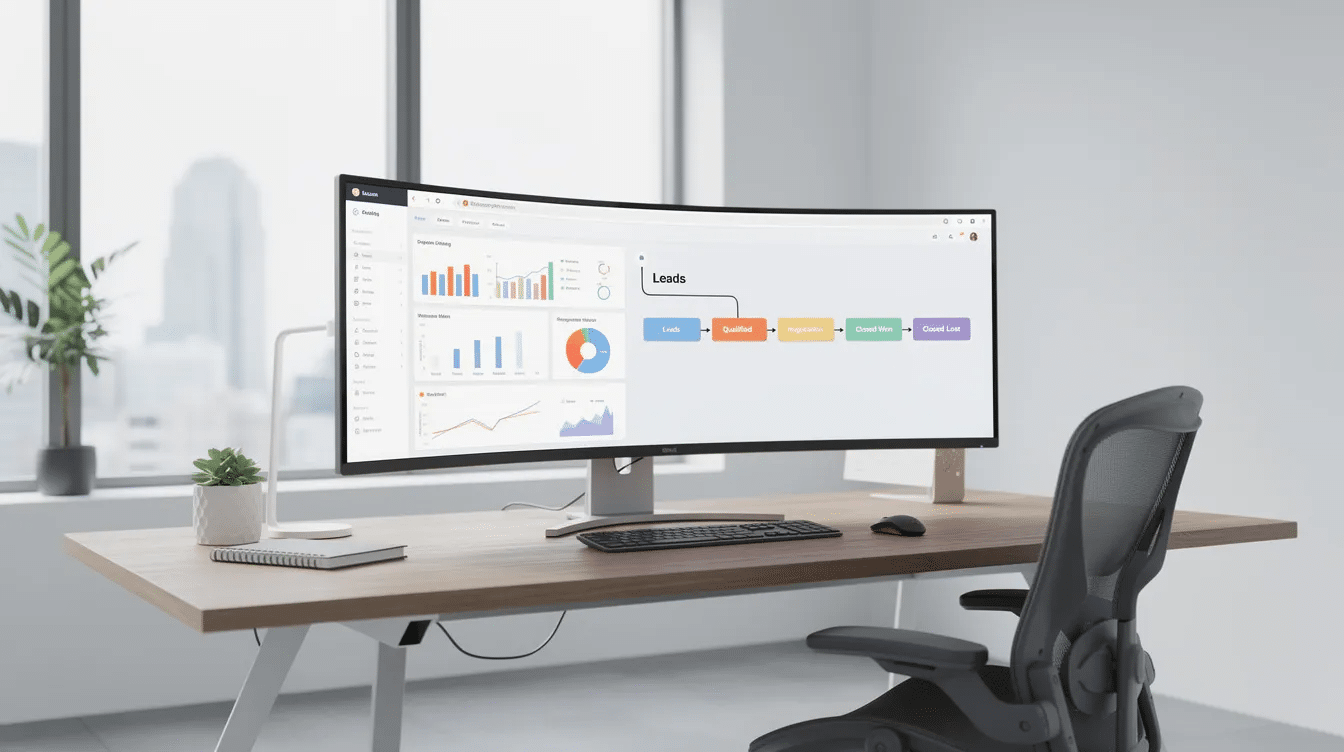
Imagine this: a potential customer fills out a form on your website. The CRM platform automatically creates a lead record, triggers a welcome email through marketing automation, and assigns the lead to a sales rep based on territory rules. The rep sees the lead’s history, including which pages they visited, and calls them. Every call, email, and meeting is logged against the contact record. When the deal closes, the record converts into a client account, and service workflows kick in for onboarding.
CRM software can automate tasks like data entry and follow ups, so your team spends less time on admin and more time selling or serving. Automated workflows streamline processes like quote building, approval routing, and compliance checks.
Workflows use triggers to launch actions. For example, if a lead opens your pricing page twice, the system can create a task for the assigned rep, send a targeted email, or notify a manager. These triggers ensure nothing falls through the cracks.
Managers use dashboards and reports to see open deals, sales pipeline value, conversion rates, churn risk, and campaign performance in real time. Reporting and analytics generate real-time dashboards on sales performance that replace guesswork with data.
InvestGlass orchestrates similar journeys while respecting strict data residency and auditing rules important in Swiss and EU regulatory contexts, logging every step for compliance traceability.
Essential CRM Features You Should Expect
Essential CRM features cover contact management, pipeline tracking, automation, and analytics for customer relationship management. These form the baseline that any credible CRM system must deliver.
Here is what you should expect:
- 연락처 및 계정 관리 stores customer data in a unified database. Every individual contact and legal entity is linked, with related communication history, documents, and preferences accessible in one place. A central repository ensures customer data is accurate and accessible. InvestGlass, for example, includes an Accounts module that stores organizational entities with field-level security.
- Lead and opportunity management captures and tracks prospective customers through the sales pipeline. Lead management prevents deals from stagnating by moving them through defined stages.
- 영업 파이프라인 관리 visualizes the sales process through customizable stages, giving sales reps and managers clear visibility into where every deal stands.
- Activity tracking, task and calendar management logs calls, emails, and meetings and schedules follow ups automatically.
- Communication integration syncs with email and calendars to log interactions without requiring manual data entry.
- 기본 보고 및 대시보드 surface conversion rates, revenue forecasts, and campaign metrics.
Sales force automation is a key capability here. Sales automation tools reduce repetitive tasks for teams by auto-logging activities, creating follow-up tasks, and guiding reps through playbooks. CRM systems automate data entry and follow ups, freeing up time for higher-value work.
These essential CRM features form the baseline. More advanced CRM systems add AI, compliance modules, and industry-specific tools. InvestGlass includes out-of-the-box KYC/AML workflows as an example of verticalized features for finance and wealth management.
Advanced Capabilities: Automation, AI, and Analytics
CRM automation goes well beyond basic reminders. When implemented properly, it transforms the consistency and efficiency of customer interactions across the organization. Workflow automation eliminates repetitive manual tasks, from multi-step approval chains to compliance notifications and onboarding sequences.
Advanced capabilities include:
- Multi-step workflow automation: Complex processes like customer onboarding, document review, and suitability assessments can be fully orchestrated with conditional logic, branching, and escalation rules.
- AI 기반 리드 득점: AI in CRM predicts customer behaviors and suggests actions. Machine learning models score leads based on engagement patterns, demographic fit, and historical conversion data.
- Predictive deal forecasting: Predictive analytics estimate pipeline outcomes using historical win rates, deal velocity, and rep activity patterns.
- Relationship health scoring: Algorithms flag at-risk accounts by analyzing interaction frequency, sentiment, and response times.
- Omnichannel customer engagement: Managing conversations across multiple channels, including email, phone, chat, and portals, from a single interface.
AI in CRM can automate routine tasks like data entry, draft emails, summarize meetings, and suggest next-best actions. AI agents can autonomously provide 24/7 고객 서비스 for routine inquiries. AI-powered CRMs enhance personalized customer experiences by tailoring content and timing to individual customer preferences. AI capabilities in CRM improve decision-making with real-time insights that were previously buried in spreadsheets.
Embedded analytics and dashboards combine operational CRM data with financial KPIs to guide strategic decisions. Sales managers can see not just pipeline stage, but margin, risk profile, and projected lifetime value.
인베스트글래스는 API- and AI-ready, allowing firms to plug in their own models or external AI services while keeping sensitive data in a Swiss-hosted environment.

Data Management in CRM: The Backbone of Customer Experience
Reliable data management is central to CRM success. Without clean, structured data, even the most advanced CRM features produce unreliable results. CRM systems create a unified view of customer data that every team can trust.
A CRM database typically contains:
데이터 카테고리 | 예제 |
|---|---|
Personal data | Name, phone, email, identifiers |
Company attributes | Industry, size, revenue, location |
커뮤니케이션 기록 | Emails, calls, meeting notes, chat logs |
문서 | Contracts, proposals, compliance forms |
Preferences and consent | Marketing opt-ins, channel preferences |
Risk/compliance data | KYC status, risk scores, audit flags |
Data quality matters enormously. Deduplication, validation rules, standardized fields, and regular cleaning prevent conflicting customer profiles. Without these, your CRM data degrades and so does team trust in the system.
Privacy and compliance shape how and where CRM data is stored and processed. Regulations like GDPR, FINMA, and MiFID II impose strict requirements for consent management, data retention, access controls, and audit trails. A central repository ensures customer information is accurate and accessible, but only if governance is in place.
InvestGlass positions itself as a Swiss Sovereign CRM, meaning data can be hosted in Switzerland to meet sovereignty and banking-grade confidentiality expectations. This is a meaningful differentiator for organizations subject to regional data localization laws.
How CRM Software Improves Sales Performance
CRM systems are directly tied to measurable sales improvements. According to Salesforce research, organizations using CRM with trusted data have reported up to 30% higher sales revenue, 87% better win rates, and 85% faster deal closure.
Here is how a CRM platform drives sales productivity:
- Unified pipelines and standardized stages prevent deals from stalling or being forgotten. Every sales opportunity is visible, with clear ownership and next steps.
- Cross-sell and up-sell tracking becomes possible when sales reps can see the full customer profile, purchase history, and engagement data.
- Scenario-based revenue forecasts allow management to model outcomes under different assumptions. Sales forecasting moves from gut feel to data-driven projection.
- Territory and segment performance views highlight which regions, products, or reps are performing above or below targets.
Sales automation increases sales productivity and efficiency. Automatic activity logging from email and phone, auto-created follow-up tasks, and guided selling playbooks reduce the manual burden on sales reps. Increased productivity is a key benefit of CRM software due to task automation.
InvestGlass supports complex sales cycles in banking, asset management, and insurance, where multi-stakeholder deals, regulatory approvals, and long timelines are the norm. Its compliance and approval workflows handle the friction points that generic CRM tools often miss.
Marketing Campaigns and Customer Experience with CRM
CRM connects marketing campaigns directly to customer relationship data, increasing targeting precision and improving return on marketing efforts. When marketing teams have access to CRM data, they stop guessing and start segmenting.
Customer segmentation allows marketers to build audiences from CRM data. Examples include investors with a specific risk profile, customers who interacted in the last 90 days, or prospects in a given region. This precision drives relevance and reduces waste.
Journey-based marketing nurtures leads through email sequences, event invitations, and personalized content based on their interactions with your brand. Each touchpoint is logged, creating a complete picture of the customer journey. CRM improves customer satisfaction by 33% when marketing and service align around consistent, relevant messaging across email, SMS, and client portals.
Marketing tools within CRM ensure that campaigns respect customer preferences and consent, which is critical for regulatory compliance and trust-building.
InvestGlass can trigger automated marketing flows, such as onboarding journeys or portfolio review reminders, from changes in client or portfolio data. This kind of event-driven marketing automation keeps communication timely without requiring manual intervention.
Customer Service, Support, and Post-Sale Relationships
CRM software extends well beyond the sales cycle into support tickets, inquiries, and ongoing account management. Customer service management helps support staff track customer questions and complaints with full context.
When a service agent opens a customer record, they see the complete history: past issues, contracts, previous advisors, purchase patterns, and notes from the sales process. This access enables faster, more personalized customer service and higher customer satisfaction. Companies using CRM see a 31% increase in case resolution during first interaction.
Integration with helpdesk or contact center tools logs calls, chats, and emails directly into the customer record. Self-service portals and knowledge bases connected to CRM allow customers to track requests and documents securely.
The economics are compelling: a 5% increase in customer retention boosts lifetime profits by 50%. CRM can boost customer lifetime value by 33%. Strong customer relationships built through attentive post-sale service drive customer loyalty, repeat business, and referrals.
InvestGlass includes client portals and secure messaging, which are especially relevant for banks, family offices, and independent asset managers where confidentiality and traceability are non-negotiable.
Deployment Models: Cloud, On-Premises, and Hybrid CRM
Deployment choice matters because it determines control over data, compliance posture, scalability, and total CRM costs. There is no universally correct answer; it depends on your regulatory context and operational needs.
Model | Strengths | Considerations |
|---|---|---|
Cloud (SaaS) | Quick to deploy, browser/mobile access, subscription pricing, automatic updates | Data may reside in foreign jurisdictions |
On-Premises | Maximum control, deep customization | Higher upfront cost, ongoing maintenance responsibility |
Hybrid/Sovereign Cloud | Sensitive data stays local, non-sensitive workloads use global cloud | Requires careful architecture planning |
Cloud based CRM is the dominant model today, well-suited for distributed teams that need access anywhere. CRM can reduce IT costs by 30% compared to maintaining fragmented on-premises business systems.
On-premises CRM gives organizations full control over infrastructure, security patches, and data location, but it comes with higher responsibility for updates, backups, and ongoing maintenance.
Hybrid models are particularly relevant for regulated industries. Sensitive customer data and compliance artifacts remain in a sovereign cloud, such as a Swiss data center, while analytics or less sensitive workloads use global infrastructure.
InvestGlass offers Swiss-hosted deployment options to combine the convenience of cloud CRM with data residency and sovereignty guarantees that regulated firms require.

Evaluating and Selecting the Right CRM Solution
Choosing CRM software requires aligning CRM technology with your processes, regulatory context, and growth plans. CRM software allows for more informed decision-making through analytics and reporting, but only if you select a platform that fits.
Key evaluation criteria:
- Ease of use: A CRM that frustrates users will not be adopted. Test the interface with actual team members, not just IT staff.
- Industry fit: Financial services, healthcare, and other regulated sectors need specific CRM features like KYC/AML, audit logs, and risk modules. Generic CRM applications may fall short.
- 통합 기능: Confirm the CRM connects with your existing tools, including ERP, core banking, email, marketing stack, and document signing platforms.
- 사용자 지정: Can you modify workflows, fields, pipelines, and rules without heavy development effort?
- Reporting strength: Look for customizable dashboards, predictive analytics, and the ability to analyze customer data alongside financial KPIs.
- 총 소유 비용: Go beyond license fees. Factor in implementation, training, data migration, support, and custom development.
Before scheduling product demos, map your current customer journeys and identify where CRM can remove friction or manual work. Use free trials, sandbox environments, or vendor-guided pilots with real data to test workflows. Evaluate each CRM vendor against your specific requirements, not just feature checklists.
InvestGlass is a strong option for organizations needing a CRM that is easy to use yet powerful, with APIs and AI readiness tailored for regulated, high-trust environments.
Implementing CRM Software: From Spreadsheets to a Live System
CRM success depends more on implementation and adoption than on feature checklists. Research shows that only about 27% of teams fully utilize their CRM’s features. Most use less than half. CRM systems automate routine tasks, saving time and reducing errors, but only when teams actually use them.
A practical phased approach works best:
- Data audit and cleaning: Review existing customer information for duplicates, missing fields, and inconsistent formats before migrating anything.
- Field and pipeline mapping: Define your sales stages, required fields, and data entry rules. Keep it simple at first.
- Pilot with one team: Let a small group test the CRM with real data. Collect feedback on usability and workflow gaps.
- Training and documentation: Train users on the specific tasks they will perform, not on every feature the system offers.
- Wider rollout: Expand gradually, adding CRM automation and advanced features as adoption stabilizes.
Common challenges include inconsistent data, resistance to change, over-complex configurations launched too early, and not defining clear ownership of CRM administration. The fix is governance: assign a CRM admin, establish data standards, and review processes quarterly.
InvestGlass and its partners can support configuration for KYC/AML processes, suitability assessments, and complex approval chains for financial institutions, with typical standard deployments going live in two to four weeks.
Why InvestGlass: Swiss Sovereign CRM, API- and AI-Ready
InvestGlass is a Swiss Sovereign CRM built to be easy to use, powerful, and ready for API and AI integrations. It manages customer relationships across the entire customer lifecycle while meeting the compliance demands of banking, wealth management, fintech, and other regulated sectors.
Concrete differentiators include:
- Swiss data hosting with banking-grade security and data sovereignty under Swiss jurisdiction
- All-in-one platform combining CRM, 디지털 온보딩, portfolio management, client portal, and marketing automation, eliminating the need for fragmented business software
- Vertical features for finance: embedded KYC/AML workflows, suitability checks, approval chains, and audit trails
- Client portal and secure messaging for confidential document sharing and communication
Its open API allows integration with core banking systems, 포트폴리오 관리 도구, e-signature platforms like DocuSign, compliance databases like OpenSanctions, and external analytics engines. CRM enhances collaboration across sales, marketing, and support teams, and InvestGlass makes that collaboration auditable.
AI-ready use cases include automated document classification, risk alerts, relationship scoring, and personalized investment communication suggestions. Firms can connect their own AI models or third-party services while keeping CRM data under sovereign control.
If you need a CRM solution that combines modern CRM automation with strict compliance, auditability, and data sovereignty, InvestGlass deserves a serious look.

Future Trends in CRM Software and Customer Relationships
By 2026, CRM is evolving from a system of record into an intelligent, proactive system that orchestrates the full customer experience. The shift is from logging what happened to predicting and acting on what should happen next.
Key trends shaping the CRM landscape:
- Agentic AI: Autonomous AI agents can handle routine customer interactions, propose next steps, and execute predefined actions within safe boundaries. Service automation powered by these agents will handle increasingly complex scenarios without human intervention. AI in CRM helps personalize customer interactions and predict needs at scale.
- Privacy-preserving analytics: Techniques like federated learning, differential privacy, and homomorphic encryption allow firms to derive insights from customer analysis without exposing raw data. Sovereign clouds and regional data localization laws continue to shape CRM deployments.
- Embedded finance: CRM must integrate more tightly with payments, lending, and investment platforms. For fintech and financial services organizations, the line between CRM and transaction management is blurring.
- Modular architectures: Strong APIs, composable microservices, and AI-friendly data structures will define competitive CRM platforms. Rigid, monolithic systems will struggle to keep pace.
Solutions like InvestGlass are designed to adapt to these trends through modular architecture, extensive APIs, and data structures optimized for AI consumption, all while maintaining Swiss data sovereignty as a foundational principle.
The CRM platforms that will win are those that drive sales, improve customer engagement, and respect data sovereignty simultaneously. The era of choosing between power and compliance is ending.
자주 묻는 질문
Is CRM software only useful for large enterprises?
CRM is valuable for small businesses and startups as soon as customer and prospect information no longer fits comfortably in a single spreadsheet. Modern CRM systems, including InvestGlass, can start with a small number of users and scale as the organization grows. Early adoption leads to better data habits, clearer business processes, and easier scaling later. Even a team of three can benefit from structured contact management and automated follow ups.
How long does it typically take to implement a CRM?
A simple setup with basic contact and deal management can be live in one to two weeks. Complex, regulated deployments involving custom workflows, multiple integrations, and data migration from legacy business systems may take several months. The main time drivers are data migration complexity, number of integrations, need for custom workflows, and training requirements. InvestGlass projects in financial services often plan for phased rollouts, starting with core relationship management, then adding digital onboarding and client portals.
Can CRM software integrate with my existing tools?
Most modern CRM systems provide APIs and prebuilt connectors to email systems, office suites, marketing platforms, and back-office tools. During CRM vendor evaluation, confirm support for critical integrations such as ERP, accounting, core banking, or ticketing systems. InvestGlass exposes REST APIs and supports integration with portfolio management, document signing (e.g., DocuSign), and compliance tools common in finance. CRM providers that lack open APIs will create painful data silos.
How does a CRM help with regulatory compliance and data protection?
CRM platforms enforce access controls, audit trails, consent management, and retention policies that support compliance with GDPR and sector-specific regulations. Role-based permissions, field-level security, and encrypted storage are key technical safeguards in modern CRM systems. InvestGlass’s Swiss Sovereign CRM approach offers hosting in Switzerland and features like KYC/AML workflows and approval chains suitable for regulated institutions. A CRM strategy that ignores compliance is a liability, not an asset.
What are the ongoing costs of running a CRM beyond licenses?
Total cost of ownership includes user training, data maintenance, periodic process reviews, and any custom development or integrations. Some organizations budget for a dedicated admin or power users to configure workflows, fields, and reports as business operations evolve. The ROI usually comes from time saved on manual tasks, better conversion rates, improved customer retention, and reduced tool fragmentation. When evaluating CRM costs, consider both the price of the platform and the cost of not having one.


