
Artificial intelligence is transforming investment banking by automating workflows that once consumed thousands of analyst hours. What began as scattered pilots between 2020 and 2023 has matured into core infrastructure. AI adoption in investment banking reached 58% in 2024, and generative ai, ai agents, and advanced ai models are now embedded across deal sourcing, financial modeling, fraud detection, and due diligence.
This article examines how ai in investment banking is reshaping day-to-day workflows, where artificial intelligence genuinely adds value, and what risks leaders at financial institutions must manage, from data privacy and model bias to evolving regulatory compliance.

What Is AI in Investment Banking Today?
AI in investment banking refers to machine learning, natural language processing, and generative ai tools deployed across the deal lifecycle. Unlike traditional analytics built on Excel macros or basic regression, modern ai systems use large language models, deep learning, and reinforcement learning to process millions of data points, analyze data at scale, and generate actionable insights.
주요 기능은 다음과 같습니다:
- Generative ai for content creation: drafting CIMs, pitchbooks, valuation summaries, and due diligence reports from raw data and document repositories.
- 자연어 처리: AI extracts information from unstructured data for document processing, enabling firms to parse legal documents, call transcripts, and news articles.
- AI 에이전트: semi-autonomous ai systems that chain tasks (scrape filings, build comp sets, run a DCF, draft a summary) with human oversight at approval checkpoints.
- Predictive models: predictive analytics estimates future outcomes using historical data for credit risk, market volatility, and portfolio management.
The Paradigm Shift: AI Investment and Adoption in Banking
AI startup funding rose from roughly $18 billion in 2017 to approximately $92 billion by 2022, with 2023 and 2024 dominated by large rounds for foundation model firms such as OpenAI, Anthropic, Cohere, and Mistral. This capital wave reshaped technology roadmaps at global banks. Major institutions shifted budgets from legacy modernisation to AI platforms, agent frameworks, and data infrastructure.
AI enhances operational efficiency by streamlining manual tasks, and generative ai can save banks nearly $1.5 billion through operational efficiencies. AI could boost front-office productivity by 27 to 35% by 2026. COVID-era remote work, rising cyber threats, and tighter margins pushed banks to prioritise ai solutions for efficiency, compliance automation, and digital client engagement.
How AI Is Transforming Core Investment Banking Workflows
AI now touches virtually every step of the deal lifecycle, from target identification through deal execution to post-close integration. The subsections below cover specific workflows where ai technologies deliver measurable impact.
AI for Deal Sourcing and Origination
AI-driven platforms analyze datasets to identify potential buyers and sellers across public and private sources, including SEC and ESMA filings, patent databases, and social media. Machine learning models rank targets by sector fit, geography, leverage, and valuation multiples. AI tools can flag market anomalies and highlight acquisition targets, while ai algorithms analyze unstructured datasets to identify market trends.
AI is used for deal sourcing and M&A automation in investment banking. According to T3’s AI in Investment Banking Index, approximately 54% of leading banks now use AI in production for target identification, reducing sourcing time by 50 to 70%.
AI-Accelerated Due Diligence and Document Review
Natural language processing and computer vision tools read data rooms containing contracts, loan agreements, NDAs, and compliance reports. Large language models extract key clauses from legal docs, including change-of-control provisions, termination rights, and IP assignments, then cluster similar documents and summarise risk items. AI can reduce information retrieval times by up to 75%, and AI reduces manual errors in regulatory reporting by automating data extraction.
Review time for due diligence drops by 30 to 60%, with investment bankers and lawyers focusing on exceptions rather than reading every page. In cross-border deals, AI supports multilingual review, flagging anomalies in local-language contracts. Models run inside bank VPCs with role-based permissions and audit logs, safeguarding data privacy and security.
AI for Financial Modeling and Valuation
AI improves accuracy by reducing manual errors in data processing for financial modeling. Generative ai handles data gathering, template population, scenario generation, and error checks, but human judgment remains essential for assumptions and deal structure. Tools now connect LLMs directly to spreadsheets, enabling prompts such as “rebuild a three-statement model using the last five years of 10-K data and add a downside scenario with 20% revenue contraction.”
AI increases productivity by automating repetitive tasks. Junior bankers spend less time on mechanical formatting and more time challenging AI-produced assumptions, validating edge cases, and customising structures for complex LBO deals. Research suggests approximately 46% of junior analyst tasks carry high automation potential, compared with roughly 9% for managing directors, indicating role evolution rather than wholesale replacement. AI accelerates decision-making by speeding up data analysis across the middle office and front office alike.
Risk Management, Fraud Detection, and Compliance
AI uses machine learning for improved fraud detection and credit risk assessment. AI can process vast transaction data streams in real time, and ai models can detect anomalies in trading patterns indicative of insider trading or market abuse. Benchmark systems reach roughly 98% accuracy for card fraud and suspicious trading patterns, with false positive rates declining by 30 to 40%.
AI continuously monitors network traffic to identify cybersecurity threats, while AI enhances compliance by automating anomaly detection in transactions. Compliance is enhanced by automating the KYC verification process using AI, and AI monitors payment flows and reviews documents for compliance. AI can automate regulatory reporting processes in investment banking, and generative ai can create draft technical documents for compliance. AI can summarise compliance data for regulatory submissions, and automated solutions can generate reports for suspicious activities.
AI can simulate diverse adverse market conditions for stress testing, and ai models potential loss scenarios across complex asset classes. NLP tools analyze data sources to gauge market sentiment, and 사기 탐지 및 고객 경험을 위한 금융권에서의 에이전틱 AI supports risk management across trading and credit functions.
Client Coverage, Pitchbooks, and Generative AI for Content
Generative ai automatically generates personalised pitchbooks and reports. AI tools can automate pitchbook creation, speeding up workflows significantly, with first drafts of 60 to 80 slide decks assembled in hours rather than days. AI can generate personalised research reports for clients, and generative ai can create tailored client communications quickly.
AI tools can analyze client sentiment from emails and calls, while natural language processing helps analyze client sentiment in communications. AI-driven sentiment analysis can improve client relationship management, and AI enables proactive client intelligence for personalised interactions. AI-powered insights help banks increase client satisfaction and win rates, boosting client engagement and improving customer experiences. Notably, 49% of OECD countries use AI for customer relations, underscoring the breadth of ai adoption in this domain.
The InvestGlass Platform: AI-Driven Client Relationship and Workflow Automation
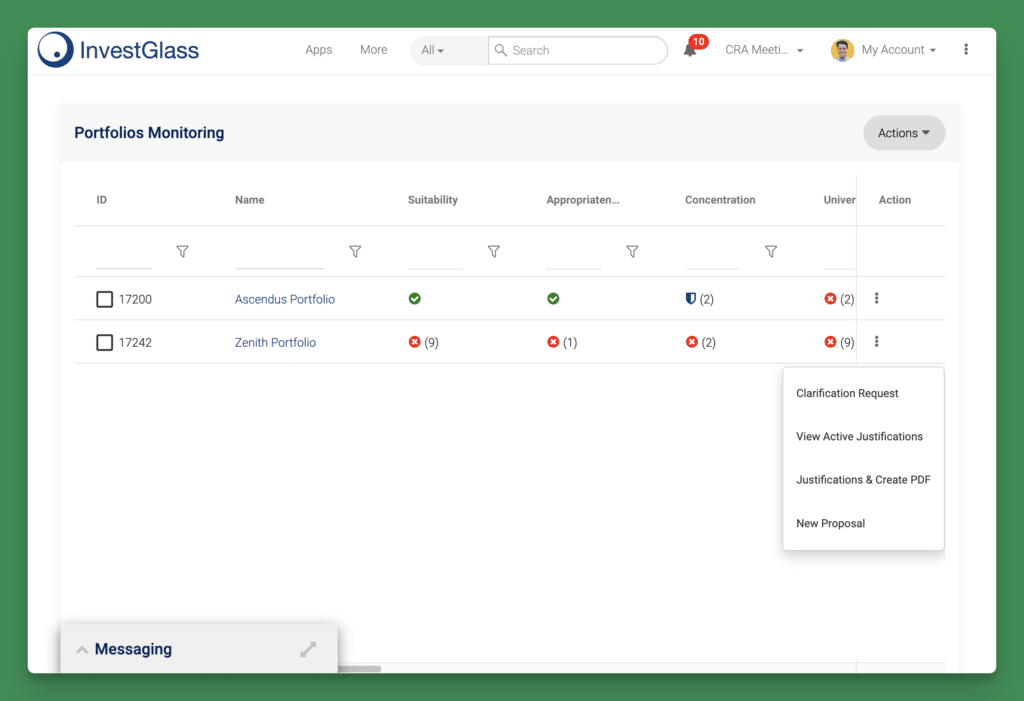
InvestGlass is an innovative AI-powered platform that supports investment banks in automating client relationship management and operational workflows. By integrating advanced AI capabilities such as natural language processing and predictive analytics, InvestGlass enables bankers to deliver hyper-personalized client experiences while streamlining compliance and documentation.
The platform offers tools for automating KYC verification, generating tailored client reports, and managing deal pipelines with AI-driven insights. InvestGlass’s AI-powered sentiment analysis helps relationship managers gauge client needs and market sentiment in real time, enhancing engagement and win rates. Its secure, cloud-based infrastructure ensures data privacy and regulatory compliance, making it a trusted solution for banks seeking to harness AI without compromising security.
By leveraging InvestGlass, investment banks can reduce manual workload, improve data accuracy, and scale advisory services efficiently, demonstrating how AI platforms are integral to the future of investment banking operations.
Real-World Examples of AI Adoption in Investment Banking
Leading global banks have moved from experiments to production-scale deployments. These examples illustrate patterns in how many firms leverage ai at scale.
Goldman Sachs: Firmwide AI Assistant and Developer Agents
Goldman Sachs rolled out its GS AI Assistant firmwide in June 2025, following a pilot with approximately 10,000 knowledge workers. By early 2026, over 12,000 developers at Goldman Sachs were using Anthropic’s Claude, achieving roughly 30% faster onboarding and 20% improvements in code review productivity. The governance approach runs models within Goldman’s own infrastructure, with red-teaming, logging, and strict access controls to maintain security. These ai assistants support research retrieval, internal memo drafting, and financial analysis across the business.
JPMorgan and Bank of America: AI Agents for Research and Wealth Management
JPMorgan reports $1.5 to $2.0 billion in annual value from ai initiatives, with over 500 active AI use cases spanning fraud prevention, trading, and credit decisioning. Bank of America’s generative ai platform enables employees to summarise market research, create meeting briefs, and draft follow-up emails, with reported double-digit productivity gains. Both organisations prioritise explainability and keep a human in the loop for recommendations affecting client portfolios. Investment banks use AI to cut costs and scale advisory capabilities, and these firms exemplify how domain expertise combined with ai technologies delivers measurable results.
Benefits of AI in Investment Banking
The advantages observed across 2023 to 2026 deployments span productivity, decision support, and client experience.
Productivity and Cost Efficiency
AI reduces operational costs by automating workflows and reducing errors, with 30 to 70% time savings on routine research and 20 to 40% reductions in pitchbook production time. AI can reduce information retrieval times by up to 75%. Banks reallocate human capacity towards negotiations and relationship managers’ advisory work. Some firms report 40 to 70% cost savings on specific standardised tasks when combining ai tools with process redesign.
Better Decision Making and Risk Insight
Machine learning analyzes market sentiment to optimise trading strategies. AI can analyze data from social media for sentiment insights, and investment banks use AI to refine investment strategies based on sentiment. AI accelerates data processing, allowing for quicker market responses. Analysts gain decision support through scenario analysis and simulation models that test deal structures under different macro assumptions.
Scaling Personalised Client Service
AI allows coverage teams to serve more clients without diluting personalisation. Relationship managers receive dynamic briefings synthesising news, filings, and CRM notes. Analysts can maintain quality AI-driven portfolio management coverage over 80 to 100 names rather than the traditional 40 to 50, creating new efficiencies in client experience delivery. This scaling effect helps regional and mid-market firms compete with global banks by deploying the same calibre of ai tools at smaller headcount.
Risks, Limitations, and Regulatory Considerations
AI adoption brings genuine challenges. Regulatory scrutiny of AI in finance is increasing globally, with frameworks such as the EU AI 법 classifying many financial ai systems as high risk, and FINRA’s Regulatory Notice 24-09 reinforcing that existing securities laws apply fully to generative ai and LLMs, mirroring how AI is reshaping central banking, monetary policy, and digital currencies under similarly stringent oversight.
Data Privacy, Security, and Confidentiality
AI systems require access to sensitive data, including client financials, deal pipelines, and internal communications. Safeguards include encryption, strict access control, private-cloud deployment, and robust audit trails. Using public generative ai tools without isolation risks inadvertent data leakage and jurisdictional uncertainty under GDPR or CCPA. Notably, 85% of financial leaders cite data quality as their biggest challenge.
Model Risk, Bias, and Hallucinations
AI models can reinforce historical biases in lending decisions and produce confident but incorrect outputs. Mitigation requires model validation, scenario back-testing, ongoing monitoring, and mandatory human review for high-impact outputs. Model risk management must extend to large language models and ai agents, not solely traditional quantitative models.
Cultural Resistance and Talent Implications
Bankers may distrust opaque ai systems or fear job displacement. Successful ai adoption frames tools as co-pilots that remove drudgery. New skill set requirements include data literacy, prompt engineering, and the ability to challenge AI outputs. Training data awareness and understanding of model limitations are now essential competencies for analysts and associates alike.
Integration with Legacy Systems and Data Quality
Many banks run on legacy trading platforms and siloed CRM systems not built for modern ai technologies. Over 80% of AI project effort typically goes into data cleaning, mapping, and governance. Building a unified data layer with standardised taxonomies is prerequisite before scaling advanced ai initiatives. Without a single source of clean, well-governed data, even the best ai models underperform.
How Investment Banks Can Implement AI Strategically
A phased, pragmatic approach outperforms ambitious but ungoverned transformation programmes.
Build Robust Data and Infrastructure Foundations
Modernise with central data lakes, standardised schemas, real-time pipelines, and high-quality historical archives. Start with a limited, high-quality domain to build reference implementations before expanding. Strong data governance, including ownership, access policies, and lineage tracking, is foundational.
Establish AI Governance, Controls, and Ethics
Create AI steering committees and model risk management functions. Codify policies on acceptable uses, fairness, explainability, and mandatory human checkpoints. Align with EU AI Act impact assessments and FINRA supervision standards through regular stress tests and audits.
Prioritise High-Impact, Low-Risk Use Cases First
Begin with research synthesis, document drafting, comp sheet automation, and internal knowledge search. Quantify ROI through time saved per analyst, reduced error rates, and improved win rates. Gradually move into higher-stakes use cases such as pricing and risk scoring as governance matures.
Empower Bankers with Training and Human-in-the-Loop Design
Involve frontline bankers and risk managers in design, testing, and feedback. Structured training covers AI capabilities, limits, and how to interpret outputs. Human oversight patterns follow a clear logic: AI proposes, human disposes; AI drafts, human edits; AI screens, human confirms.
Future Outlook: Agentic AI and the Next Wave of Innovation
The industry is shifting from single-task models to agentic ai systems that autonomously execute multi-step processes under human oversight. By 2027 to 2028, ai agents will routinely coordinate complex workflows such as end-to-end due diligence summaries, real-time risk monitoring, and automated regulatory updates.
Generative ai improves portfolio performance through advanced simulations, and AI-based strategies for effective portfolio management evaluate historical performance to optimise portfolios. AI can simulate market scenarios to enhance trading strategies, while AI-driven models can adapt portfolio strategies to new conditions. AI enhances risk-return analysis in portfolio management, enabling more sophisticated approaches to market volatility. Integration with blockchain and tokenised assets may further automate settlements and continuous covenant testing.
The competitive gap will widen between banks that treat AI as a central capability and those that remain in pilot mode. The future belongs to firms that combine technology with governance, focus, and culture.
Conclusion: How Should Investment Banks Respond to the AI Era?
Artificial intelligence in investment banking is a structural change, not a passing trend. It reshapes deal sourcing, financial modeling, fraud detection, and client service across the entire industry. The highest-performing banks will combine AI speed and breadth with human judgment, creativity, and relationships.
Firms should define a clear AI strategy: prioritise use cases, invest in data and governance, and build a culture that sees AI as a co-pilot rather than a threat. Organisations that embrace responsible ai adoption between 2024 and 2028 will set the standard for the next decade of global investment banking. The question is no longer whether to adopt, but how swiftly and how well.

